Detection Boundaries for Panel Slope Homogeneity Tests Under Small-Group Heterogeneity
Pith reviewed 2026-05-18 04:14 UTC · model grok-4.3
The pith
Slope-homogeneity tests in panels miss heterogeneity confined to small groups when deviations shrink with sample size.
A machine-rendered reading of the paper's core claim, the machinery that carries it, and where it could break.
Core claim
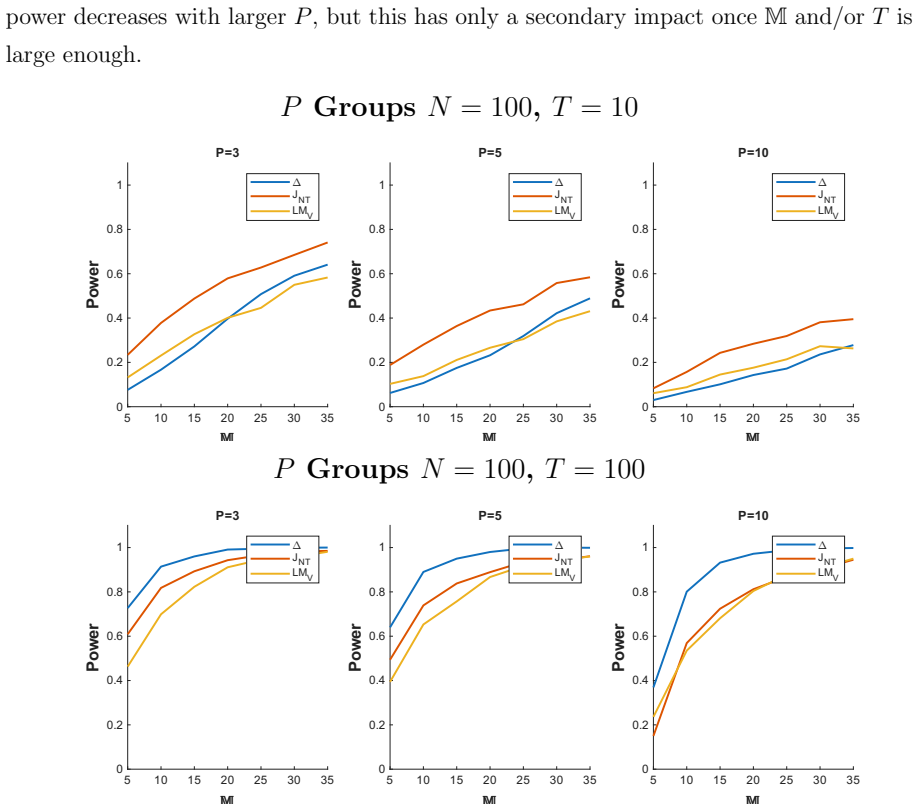
Under doubly local alternatives in which only small groups of units depart from the common slope and the magnitude of the deviations shrinks with sample size, detectability is characterized as a function of panel dimensions, the size of the departing groups, and the rate at which deviations shrink. The results indicate precisely when the tests have power against such alternatives and when they will miss the heterogeneity.
What carries the argument
Doubly local alternatives with small departing groups and shrinking deviation magnitudes; this setup determines the power function and the resulting detection boundaries.
If this is right
- The tests have power only when group size and shrinking rate satisfy explicit conditions relative to N and T.
- Non-rejection cannot be read as evidence of homogeneity if deviations are local and limited to small groups.
- Monte Carlo simulations confirm that the theoretical boundaries predict finite-sample rejection rates accurately.
- Researchers can assess in advance whether their panel is large enough to detect heterogeneity of a given strength.
Where Pith is reading between the lines
- Applied researchers facing possible small-group heterogeneity may need supplementary diagnostics that target subsets rather than the full panel.
- The local-alternative approach could be adapted to study power in related panel procedures such as tests for cross-sectional dependence.
- If prior information on likely group sizes exists, the boundaries might guide sample-size planning or modified critical values.
Load-bearing premise
The power analysis assumes heterogeneity follows a doubly local pattern with small departing groups whose deviations shrink with sample size.
What would settle it
Simulate panel data with a fixed small number of units having slope deviations that shrink at the exact boundary rate for given N and T, then check whether the test's rejection frequency stays near the nominal size or rises according to the derived boundary.
Figures

read the original abstract
Empirical researchers often use slope-homogeneity tests to assess whether slopes can be treated as common across units. A key difficulty is that heterogeneity may be concentrated in a small number of units, so that a failure to reject homogeneity may reflect limited power rather than true homogeneity. We quantify this issue by analyzing the power of standard slope-homogeneity tests under doubly local alternatives - alternatives in which only small groups of units depart from the common slope and the magnitude of the deviations shrinks with sample size. We characterize detectability as a function of panel dimensions, the size of the departing groups, and the rate at which deviations shrink. The results tell the researcher clearly when homogeneity tests are informative and when they will miss small-group heterogeneity. A Monte Carlo study confirms the theory.
Editorial analysis
A structured set of objections, weighed in public.
Referee Report
Summary. The paper claims to characterize the detection boundaries for standard slope-homogeneity tests in panel data under doubly local alternatives, where only small groups of units depart from a common slope and the magnitude of deviations shrinks with sample size. Detectability is expressed as a function of panel dimensions N and T, the size of departing groups, and the shrinkage rate. Monte Carlo simulations are used to confirm the asymptotic results.
Significance. If the derivations hold, the work is significant for providing explicit guidance to empirical researchers on when homogeneity tests have power against small-group heterogeneity versus when non-rejection may simply reflect limited power. The functional dependence on panel dimensions and local-alternative parameters, together with the Monte Carlo confirmation, strengthens the practical value of the asymptotic characterization.
major comments (1)
- [§3] §3 (Asymptotic Analysis): The detection boundaries are derived exclusively under the doubly local alternative with small-group departures and shrinking deviations (as a function of N, T, group size, and shrinkage rate). This setup is load-bearing for the claim that the results 'tell the researcher clearly when homogeneity tests are informative,' yet the manuscript does not examine whether the same rates remain sharp or valid under fixed (non-shrinking) deviations; a concrete extension or counter-example would clarify the scope.
minor comments (2)
- [§4] The Monte Carlo section would benefit from additional tables reporting power at the exact boundary rates derived in the theory, to make the confirmation more direct.
- [§2] Notation for the local-alternative parameter (e.g., the shrinkage rate δ) could be introduced earlier and used consistently across theorems and simulations.
Simulated Author's Rebuttal
We thank the referee for the careful reading and constructive comment on the scope of the asymptotic analysis. We respond to the major comment below.
read point-by-point responses
-
Referee: [§3] §3 (Asymptotic Analysis): The detection boundaries are derived exclusively under the doubly local alternative with small-group departures and shrinking deviations (as a function of N, T, group size, and shrinkage rate). This setup is load-bearing for the claim that the results 'tell the researcher clearly when homogeneity tests are informative,' yet the manuscript does not examine whether the same rates remain sharp or valid under fixed (non-shrinking) deviations; a concrete extension or counter-example would clarify the scope.
Authors: We thank the referee for highlighting this point. The paper deliberately restricts attention to doubly local alternatives because this is the regime in which detection is nontrivial and the boundaries depend explicitly on the panel dimensions, group size, and shrinkage rate. Under fixed (non-shrinking) deviations, standard slope-homogeneity tests are consistent for any fixed positive group size and nonzero deviation, so the detection boundary collapses to the trivial statement that any fixed departure is eventually detectable. The local framework is therefore essential for obtaining the sharp, informative rates that constitute the paper's main contribution and that directly address the practical question of when non-rejection may reflect limited power. We are happy to add a brief clarifying paragraph in Section 3 (or the conclusion) noting this distinction and confirming that the results are not claimed to apply outside the local setting. revision: partial
Circularity Check
No circularity: asymptotic derivation of detection boundaries under local alternatives is self-contained
full rationale
The paper performs a theoretical asymptotic analysis of test power under doubly local alternatives where deviations shrink with sample size and affect only small groups. Detectability boundaries are characterized directly from panel dimensions (N,T), group size, and shrinkage rate via standard local-alternative expansions; no parameter is fitted to data and then relabeled as a prediction, no self-citation supplies a load-bearing uniqueness result, and the Monte Carlo serves only as numerical confirmation rather than input to the derivation. The central claim therefore remains independent of its own outputs.
Axiom & Free-Parameter Ledger
axioms (1)
- domain assumption Standard regularity conditions for panel data models and asymptotic analysis under local alternatives
Lean theorems connected to this paper
-
IndisputableMonolith/Foundation/AbsoluteFloorClosure.leanreality_from_one_distinction unclear?
unclearRelation between the paper passage and the cited Recognition theorem.
Theorem 1... Δ, J, LM under H_{1,n} with M/N → m_0 and √(M T)/(γ N^{1/4}) → c
What do these tags mean?
- matches
- The paper's claim is directly supported by a theorem in the formal canon.
- supports
- The theorem supports part of the paper's argument, but the paper may add assumptions or extra steps.
- extends
- The paper goes beyond the formal theorem; the theorem is a base layer rather than the whole result.
- uses
- The paper appears to rely on the theorem as machinery.
- contradicts
- The paper's claim conflicts with a theorem or certificate in the canon.
- unclear
- Pith found a possible connection, but the passage is too broad, indirect, or ambiguous to say the theorem truly supports the claim.
Reference graph
Works this paper leans on
-
[1]
Ando, T. and J. Bai (2015). A simple new test for slope homogeneity in panel data models with interactive effects.Economics Letters 136, 112–117
work page 2015
-
[2]
Arellano, M. and O. Bover (1995). Another look at the instrumental variable estimation of error-components models.Journal of econometrics 68(1), 29–51
work page 1995
-
[3]
Bester, C. A. and C. B. Hansen (2016). Grouped effects estimators in fixed effects models. Journal of Econometrics 190(1), 197–208
work page 2016
-
[4]
Blomquist, J. and J. Westerlund (2013). Testing slope homogeneity in large panels with serial correlation.Economics Letters 121(3), 374–378
work page 2013
-
[5]
Bonhomme, S. and E. Manresa (2015). Grouped patterns of heterogeneity in panel data. Econometrica 83(3), 1147–1184
work page 2015
-
[6]
Breitung, J., C. Roling, and N. Salish (2016). Lagrange multiplier type tests for slope homogeneity in panel data models.The Econometrics Journal 19(2), 166–202
work page 2016
-
[7]
Breusch, T. S. and A. R. Pagan (1979). A simple test for heteroscedasticity and random coefficient variation.Econometrica: Journal of the econometric society, 1287–1294
work page 1979
-
[8]
Dzemski, A. and R. Okui (2024). Confidence set for group membership.Quantitative Economics 15(2), 245–277
work page 2024
-
[9]
Hsiao, C. (2003).Analysis of panel data. Cambridge university press
work page 2003
-
[10]
Juhl, T. and O. Lugovskyy (2014). A test for slope heterogeneity in fixed effects models. Econometric Reviews 33(8), 906–935
work page 2014
-
[11]
Lu, X. and L. Su (2017). Determining the number of groups in latent panel structures with an application to income and democracy.Quantitative Economics 8(3), 729–760
work page 2017
-
[12]
Pesaran, M. H. and T. Yamagata (2008). Testing slope homogeneity in large panels. Journal of econometrics 142(1), 50–93
work page 2008
-
[13]
Su, L. and Q. Chen (2013). Testing homogeneity in panel data models with interactive fixed effects.Econometric Theory 29(6), 1079–1135
work page 2013
-
[14]
Su, L., Z. Shi, and P. C. Phillips (2016). Identifying latent structures in panel data. Econometrica 84(6), 2215–2264. 21
work page 2016
-
[15]
Swamy, P. A. (1970). Efficient inference in a random coefficient regression model.Econo- metrica: Journal of the Econometric Society, 311–323. 22
work page 1970
discussion (0)
Sign in with ORCID, Apple, or X to comment. Anyone can read and Pith papers without signing in.