Global Chlorophyll-textit{a} Retrieval algorithm from Sentinel 2 Using Residual Deep Learning and Novel Machine Learning Water Classification
Pith reviewed 2026-05-18 03:52 UTC · model grok-4.3
The pith
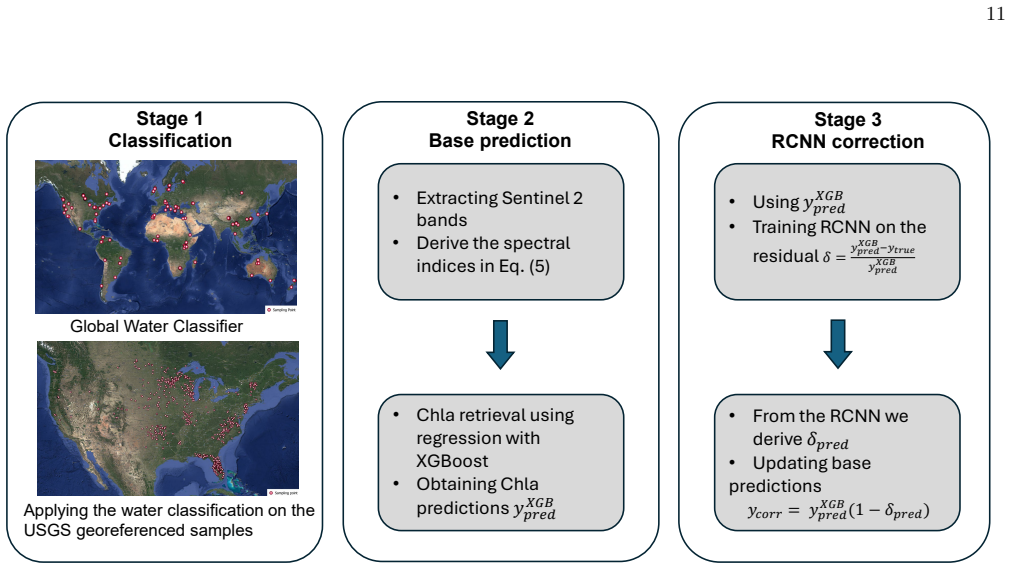
A pipeline of water classification, XGBoost regression, and residual CNN correction retrieves chlorophyll-a from Sentinel-2 data at R² 0.79 across 867 global water bodies.
A machine-rendered reading of the paper's core claim, the machinery that carries it, and where it could break.
Core claim
The central claim is that a supervised Global Water Classifier trained on nearly 100 globally distributed inland water bodies, when used to select positive scenes for an XGBoost regressor trained on 13626 USGS AquaMatch matchups and followed by a residual CNN trained on normalized prediction errors, produces accurate chlorophyll-a retrievals with R² = 0.79, MAE = 13.52 mg/m³, and slope = 0.91 when evaluated on 867 water bodies covering chlorophyll concentrations up to 1000 mg/m³.
What carries the argument
The Global Water Classifier (GWC), a supervised machine learning model that labels water pixels across chlorophyll levels while excluding non-water spectra, which filters input for the subsequent XGBoost regression and residual CNN correction stages.
If this is right
- Positive scenes labeled by the GWC yield higher retrieval accuracy than scenes labeled negative, confirming the classifier reduces interference.
- The residual CNN stage removes structured errors left by the initial XGBoost model and raises overall performance.
- The full pipeline maintains its metrics on 867 diverse water bodies without any additional tuning or local calibration.
- Chlorophyll estimates remain usable up to 1000 mg/m³, covering both oligotrophic and highly eutrophic inland waters.
Where Pith is reading between the lines
- The same classifier-plus-correction structure could be retrained on other satellite sensors or for additional water-quality variables such as turbidity.
- If the GWC generalizes as claimed, the method could support near-real-time global monitoring dashboards for inland water quality.
- Testing on water bodies with optical properties deliberately outside the current training set would quantify the limits of transferability.
Load-bearing premise
The Global Water Classifier trained on the chosen 100 water bodies will correctly identify water in every global inland water body and the USGS matchup points will represent the full range of optical conditions found in the 867 test bodies.
What would settle it
A substantial drop in R² or rise in MAE when the same pipeline is run on a fresh collection of water bodies whose optical conditions fall outside the training distribution, such as extreme sediment loads or chlorophyll values beyond 1000 mg/m³.
Figures




read the original abstract
We present the Global Water Classifier (GWC), a supervised, geospatially extensive Machine Learning (ML) classifier trained on Sen2Cor corrected Sentinel-2 surface reflectance data. Using nearly 100 globally distributed inland water bodies, GWC distinguishes water across Chlorophyll-a (Chla) levels from non-water spectra (clouds, sun glint, snow, ice, aquatic vegetation, land and sediments) and shows geographically stable performance. Building on this foundation model, we perform Chla retrieval based on a matchup Sentinel-2 reflectance data with the United States Geological Survey (USGS) AquaMatch in-situ dataset, covering diverse geographical and hydrological conditions. We train an XGBoost regressor on 13626 matchup points. The positive labeled scenes by the GWC consistently outperform the negatives and produce more accurate Chla retrieval values, which confirms the classifiers advantage in reducing various interferences. Next, residual analysis of the regression predictions revealed structured errors, motivating a residual CNN (RCNN) correction stage. We add a CNN residual stage trained on normalized residuals, which yield substantial improvement. Our algorithm was tested on 867 water bodies with over 2,000 predictions and Chla values up to 1000~mg$/m^{3}$, achieving $R^2$ = 0.79, MAE = 13.52~mg$/m^{3}$, and slope = 0.91, demonstrating robust, scalable, and globally transferable performance without additional tuning.
Editorial analysis
A structured set of objections, weighed in public.
Referee Report
Summary. The manuscript introduces the Global Water Classifier (GWC), a supervised ML classifier trained on Sen2Cor-corrected Sentinel-2 surface reflectance from nearly 100 globally distributed inland water bodies to separate water spectra from interferences including clouds, sun glint, snow, ice, aquatic vegetation, land, and sediments. It then trains an XGBoost regressor on 13,626 matchup points between Sentinel-2 reflectance and USGS AquaMatch in-situ Chla data, applies GWC filtering to retain positive scenes, and adds a residual CNN (RCNN) stage trained on normalized prediction errors. The pipeline is evaluated on 867 water bodies yielding over 2,000 predictions with Chla up to 1000 mg/m³, reporting R² = 0.79, MAE = 13.52 mg/m³, and slope = 0.91, with claims of geographically stable and globally transferable performance without additional tuning.
Significance. If the generalization claims hold under independent validation, the work offers a practical advance for high-resolution global monitoring of inland eutrophic waters using Sentinel-2, addressing interference issues through explicit classification before regression and residual correction. The scale of the AquaMatch matchup dataset and the residual-learning stage represent concrete strengths that could improve upon traditional band-ratio or semi-analytical methods for complex optical conditions.
major comments (3)
- [Abstract] Abstract and Methods: The headline metrics (R² = 0.79, MAE = 13.52 mg/m³, slope = 0.91) on 867 water bodies are obtained after GWC filtering (trained on ~100 bodies) followed by XGBoost + RCNN, yet no water-body-stratified hold-out, regional cross-validation, or explicit confirmation that the 867 bodies are disjoint from the GWC training set is provided. This directly undermines the central claim of geographically stable, out-of-distribution global transfer without tuning.
- [Methods] Methods/Results: No comparison (histograms, Kolmogorov-Smirnov tests, or spectral statistics) is shown between the 13,626 AquaMatch training matchups and the optical/Chla conditions in the 867 test bodies. Without this, the reported improvement from GWC filtering and RCNN correction cannot be shown to reflect genuine generalization rather than in-distribution performance.
- [Abstract] Abstract: The absence of error bars, cross-validation folds, or scene-selection criteria for the 867-body test set leaves open the possibility that post-hoc filtering or non-representative sampling contributes to the quoted performance numbers, which are load-bearing for the 'robust, scalable' assertion.
minor comments (2)
- [Abstract] Abstract: The LaTeX fragment 'mg$/m^{3}$' should be rendered as proper math mode (mg m^{-3}) for readability.
- Throughout: Consider adding a table or figure comparing GWC accuracy metrics across the ~100 training bodies versus the 867 test bodies to make the generalization claim more transparent.
Simulated Author's Rebuttal
We thank the referee for their insightful and constructive comments, which help strengthen the validation of our global claims. We address each major comment point by point below and have revised the manuscript accordingly to improve transparency on data splits, distributional comparisons, and uncertainty measures.
read point-by-point responses
-
Referee: [Abstract] Abstract and Methods: The headline metrics (R² = 0.79, MAE = 13.52 mg/m³, slope = 0.91) on 867 water bodies are obtained after GWC filtering (trained on ~100 bodies) followed by XGBoost + RCNN, yet no water-body-stratified hold-out, regional cross-validation, or explicit confirmation that the 867 bodies are disjoint from the GWC training set is provided. This directly undermines the central claim of geographically stable, out-of-distribution global transfer without tuning.
Authors: We agree that explicit documentation of the data splits is necessary to support the out-of-distribution claims. The 867 test water bodies were selected from independent regions with no overlap to the ~100 bodies used for GWC training. We will revise the Methods section to explicitly state this disjointness, document the water-body-stratified partitioning, and include results from a regional cross-validation experiment to further substantiate geographic stability. revision: yes
-
Referee: [Methods] Methods/Results: No comparison (histograms, Kolmogorov-Smirnov tests, or spectral statistics) is shown between the 13,626 AquaMatch training matchups and the optical/Chla conditions in the 867 test bodies. Without this, the reported improvement from GWC filtering and RCNN correction cannot be shown to reflect genuine generalization rather than in-distribution performance.
Authors: We acknowledge this gap in the current manuscript. In the revised version, we will add histograms of Sentinel-2 reflectance bands and Chla distributions, along with Kolmogorov-Smirnov test statistics, comparing the 13,626 training matchups against the 867 test bodies. This addition will allow readers to assess the degree of distributional shift and confirm that performance gains reflect generalization. revision: yes
-
Referee: [Abstract] Abstract: The absence of error bars, cross-validation folds, or scene-selection criteria for the 867-body test set leaves open the possibility that post-hoc filtering or non-representative sampling contributes to the quoted performance numbers, which are load-bearing for the 'robust, scalable' assertion.
Authors: The 867-body test set includes all scenes that passed GWC positive classification and had available in-situ matchups, with no additional post-hoc filtering applied. We will clarify this selection process in the revised Abstract and Methods. Bootstrap-derived error bars will be added to the headline metrics, and we will report k-fold cross-validation results for the XGBoost and RCNN stages to quantify variability. Full end-to-end pipeline CV is computationally intensive but can be summarized in supplementary material. revision: partial
Circularity Check
No significant circularity detected in the ML pipeline
full rationale
The paper outlines a conventional supervised ML workflow consisting of training the GWC classifier on labeled data from nearly 100 water bodies, training an XGBoost regressor on 13,626 independent AquaMatch matchup points, and fitting a residual CNN on structured errors from the regressor. Final metrics are computed on a distinct test collection of 867 water bodies. No step reduces by construction to its own inputs, no fitted parameter is relabeled as a prediction, and no self-citation or uniqueness theorem is invoked to justify core modeling choices. The reported R², MAE, and slope therefore reflect out-of-sample evaluation rather than tautological reuse of training signals.
Axiom & Free-Parameter Ledger
free parameters (2)
- XGBoost hyperparameters
- RCNN architecture and training schedule
axioms (1)
- domain assumption Sen2Cor atmospheric correction produces surface reflectance values that are comparable across global sites.
Lean theorems connected to this paper
-
IndisputableMonolith/Cost/FunctionalEquation.leanwashburn_uniqueness_aczel unclear?
unclearRelation between the paper passage and the cited Recognition theorem.
We train an XGBoost regressor on 13626 matchup points... residual CNN (RCNN) correction stage... R² = 0.79, MAE = 13.52 mg/m³
-
IndisputableMonolith/Foundation/ArithmeticFromLogic.leanLogicNat.induction unclear?
unclearRelation between the paper passage and the cited Recognition theorem.
Global Water Classifier (GWC)... Random Forest... dynamic training approach... Cohen’s kappa > 0.95
What do these tags mean?
- matches
- The paper's claim is directly supported by a theorem in the formal canon.
- supports
- The theorem supports part of the paper's argument, but the paper may add assumptions or extra steps.
- extends
- The paper goes beyond the formal theorem; the theorem is a base layer rather than the whole result.
- uses
- The paper appears to rely on the theorem as machinery.
- contradicts
- The paper's claim conflicts with a theorem or certificate in the canon.
- unclear
- Pith found a possible connection, but the passage is too broad, indirect, or ambiguous to say the theorem truly supports the claim.
Reference graph
Works this paper leans on
-
[1]
Climate change and harmful al- gal blooms: Insights and perspective.Harmful Algae, 91:101731, 2020
Christopher J Gobler. Climate change and harmful al- gal blooms: Insights and perspective.Harmful Algae, 91:101731, 2020
work page 2020
-
[2]
Hans W Paerl, Nathan S Hall, and Elizabeth S Ca- landrino. Controlling harmful cyanobacterial blooms in a world experiencing anthropogenic and climatic- induced change.Science of The Total Environment, 409(10):1739–1745, 2016
work page 2016
-
[3]
Aaron Kaplan and Moshe Harel. Phytoplankton blooms in waterbodies: An emerging approach to greenhouse gas mitigation?Preprints.org, 2025. Preprint. Posted 25 July 2025
work page 2025
-
[4]
IOCCG.Remote sensing of inherent optical proper- ties: Fundamentals, tests of algorithms, and applications
-
[5]
5, International Ocean-Colour Coordi- nating Group (IOCCG), Dartmouth, Canada
Report No. 5, International Ocean-Colour Coordi- nating Group (IOCCG), Dartmouth, Canada
-
[6]
Sushant Mishra, Deepak R Mishra, and William M Schluchter. A novel algorithm for predicting phyco- cyanin concentrations in cyanobacteria: A case study using meris images of lake erie.Remote Sensing of Envi- ronment, 128:192–201, 2013
work page 2013
-
[7]
Retrieving water chlorophyll-a concentration in inland waters: A review
Anna Llodra-Llabres, Manuel Garcia-Sevillano, Maria E Ortiz-Cruz, and Bo-Cai Gao. Retrieving water chlorophyll-a concentration in inland waters: A review. Remote Sensing of Environment, 295:113565, 2023
work page 2023
-
[8]
Nima Pahlevan, Beth Smith, Bryan Franz, Jason Schnei- der, and Michael Ondrusek. Seamless retrievals of chlorophyll-a from sentinel-2 (msi) and sentinel-3 (olci) in inland and coastal waters: A machine learning approach. Remote Sensing of Environment, 231:111207, 2019
work page 2019
-
[9]
Wesley J Moses, Anatoly A Gitelson, Robin G Perkins, Brian A Bergamaschi, and Jeff Gross. Evaluation of chlorophyll-a remote sensing algorithms for optically complex coastal environments.Remote Sensing of En- vironment, 122:239–250, 2012
work page 2012
-
[10]
Shuang He, Yi Pan, Yu Qin, Yu Zhu, and Yan Zhong. Deep fusion networks for chlorophyll-a retrieval integrat- ing physical and data-driven principles.Remote Sensing of Environment, 280:113168, 2022. 16
work page 2022
-
[11]
Mark W Matthews. Eutrophication and cyanobacterial blooms in south african inland waters: 10 years of meris observations.Remote Sensing of Environment, 155:161– 177, 2014
work page 2014
-
[12]
Operational bloom monitor- ing system algaemap for latin american inland waters
Fernanda L Lobo, Thiago Bernardes, Evlyn M L M Novo, and Cl´ audia C F Barbosa. Operational bloom monitor- ing system algaemap for latin american inland waters. Remote Sensing Applications: Society and Environment, 23:100585, 2021
work page 2021
-
[13]
Alex A Gilerson, Jian Zhou, Sein Hlaing, Ioannis Ioan- nou, John F Schalles, Colleen B Mouw, and Samir Ahmed. Retrieval of chlorophyll-a in turbid productive waters using a novel algorithm based on the red and nir bands.Remote Sensing of Environment, 114(11):2403– 2412, 2010
work page 2010
-
[14]
Yifan Zhang, Jie Li, and Yan Zhong. A bayesian ap- proach for remote sensing of chlorophyll-a concentra- tion in inland waters.Remote Sensing of Environment, 272:112891, 2022
work page 2022
-
[15]
Rohan Joshi, Rahul Sharma, and Menghua Wang. Cross- sensor deep learning framework for chlorophyll-a map- ping in inland waters.Remote Sensing of Environment, 305:113887, 2024
work page 2024
-
[16]
Xiang Li, Lin Zhang, and Yan Gao. Machine learning- based retrieval of chlorophyll-a and total suspended mat- ter from satellite data.ISPRS Journal of Photogramme- try and Remote Sensing, 210:208–220, 2025
work page 2025
-
[17]
Yan Zhong, Yifan Gong, Lingli Yu, Xueying Hu, and Ming Ding. Interpretable deep learning for earth obser- vation: From black-box to gray-box.ISPRS Journal of Photogrammetry and Remote Sensing, 191:74–91, 2022
work page 2022
-
[18]
Timothy T Wynne, Richard P Stumpf, Michelle C Tom- linson, V Ransibrahmanakul, and Tracy A Villareal. Detecting karenia brevis blooms and algal resuspension events in the western gulf of mexico with satellite ocean color imagery.Harmful Algae, 9(5):480–488, 2010
work page 2010
-
[19]
Raphael M Kudela, Elisa Berdalet, Stewart Bernard, Michele A Burford, Lionel Fernand, Shuang Lu, Suzanne Roy, et al.Harmful algal blooms: A scientific summary for policy makers. IOC/UNESCO, Paris, 2015
work page 2015
-
[20]
Yosef Z Yacobi, Tamar Zohary, Nurit Kress, and Ami Nishri. Phytoplankton pigment dynamics in lake kinneret determined using hplc and remote sensing.Journal of Plankton Research, 33(8):1233–1243, 2011
work page 2011
-
[21]
Amit Dev, Alon Rimmer, and Yosef Z Yacobi. Cyanobac- terial pigment concentrations in inland waters: Novel semi-analytical algorithms for multi- and hyperspectral data.Remote Sensing of Environment, 269:112791, 2022
work page 2022
-
[22]
Amit Dev, Yosef Z Yacobi, and Alon Rimmer. Measure- ment of in-vivo spectral reflectance of bottom types: Im- plications for remote sensing of shallow waters.Remote Sensing, 14(18):4583, 2022
work page 2022
-
[23]
T´ ulio E da Silva, Andr´ e C Oliveira, and Gabriel Nasci- mento. Chlorophyll-a estimation in 149 tropical semi-arid reservoirs using sentinel-2 and machine learning.Remote Sensing, 16(11):1870, 2024
work page 2024
-
[24]
M. R. Brousil, M. F. Meyer, K. Willi, B. G. Steele, J. De La Torre, and M. R. Ross. Aquamatch chloro- phyll a data from water quality portal: ˜1970–2024 ver 1, 2024
work page 1970
-
[25]
Lehmann, Daniela Gurlin, Nima Pahlevan, Krista Alikas, Claudia Giardino, et al
Moritz K. Lehmann, Daniela Gurlin, Nima Pahlevan, Krista Alikas, Claudia Giardino, et al. GLORIA: A global dataset of remote sensing reflectance and water quality from inland and coastal waters, 2022
work page 2022
-
[26]
Chuanmin Hu. A novel ocean color index to detect float- ing algae in the global oceans.Remote Sensing of Envi- ronment, 113(10):2118–2129, 2009
work page 2009
-
[27]
S. K. McFeeters. The use of the normalized difference wa- ter index (ndwi) in the delineation of open water features. International Journal of Remote Sensing, 17(7):1425– 1432, 1996
work page 1996
-
[28]
J. Chen, X. Zhu, J. E. Vogelmann, F. Gao, and S. Jin. A simple and effective method for filling gaps in landsat etm+ slc-off images.Remote Sensing of Environment, 91(1):90–97, 2005
work page 2005
-
[29]
Jacob Cohen. A coefficient of agreement for nomi- nal scales.Educational and Psychological Measurement, 20(1):37–46, 1960
work page 1960
-
[30]
Kaiming He, Xiangyu Zhang, Shaoqing Ren, and Jian Sun. Deep residual learning for image recognition.IEEE Conference on Computer Vision and Pattern Recognition (CVPR), pages 770–778, 2016. Foundational paper for the ResNet architecture, relevant for RCNN Stage 3
work page 2016
-
[31]
M.A. Warren, S.G.H. Simis, V. Martinez-Vicente, K. Poser, M. Bresciani, K. Alikas, E. Spyrakos, C. Gi- ardino, and A. Ansper. Assessment of atmospheric cor- rection algorithms for the sentinel-2a multispectral im- ager over coastal and inland waters.Remote Sensing of Environment, 225:267–289, 2019
work page 2019
-
[32]
Wenxin Li, Yuancheng Huang, Qian Shen, Yue Yao, Wenting Xu, Jiarui Shi, Yuting Zhou, Jinzhi Li, Yut- ing Zhang, and Hangyu Gao. Assessment of seven at- mospheric correction processors for the sentinel-2 multi- spectral imager over lakes in qinghai province.Remote Sensing, 15(22), 2023
work page 2023
-
[33]
Quang-Tu Bui, C´ edric Jamet, Vincent Vantrepotte, Xavier M´ eriaux, Arnaud Cauvin, and Mohamed Abdelil- lah Mograne. Evaluation of sentinel-2/msi atmospheric correction algorithms over two contrasted french coastal waters.Remote Sensing, 14(5), 2022
work page 2022
-
[34]
Oliveira, Kien Trung Tran, Daniel Jorge, Xavier M´ eriaux, and Rodolfo Paranhos
Manh Duy Tran, Vincent Vantrepotte, Hubert Loisel, Eduardo N. Oliveira, Kien Trung Tran, Daniel Jorge, Xavier M´ eriaux, and Rodolfo Paranhos. Band ratios com- bination for estimating chlorophyll-a from sentinel-2 and sentinel-3 in coastal waters.Remote Sensing, 15(6):1653, 2023
work page 2023
-
[35]
Bongseok Jeong, Sunmin Lee, Joonghyeok Heo, Jeongho Lee, and Moung-Jin Lee. Deep learning-based retrieval of chlorophyll-a in lakes using sentinel-1 and sentinel-2 satellite imagery.Water, 17(11), 2025
work page 2025
-
[36]
Yuting He, Penghai Wu, Xiaoshuang Ma, Jie Wang, and Yanlan Wu. Physical-based spatial-spectral deep fusion network for chlorophyll-a estimation using modis and sentinel-2 msi data.Remote Sensing, 14(22):5828, 2022
work page 2022
discussion (0)
Sign in with ORCID, Apple, or X to comment. Anyone can read and Pith papers without signing in.