Heuristic Quality Coefficients for Interferometric Phase Linking
Pith reviewed 2026-05-18 02:57 UTC · model grok-4.3
The pith
Three heuristic quality coefficients assess the reliability of phase linking estimates for distributed scatterers in multitemporal InSAR.
A machine-rendered reading of the paper's core claim, the machinery that carries it, and where it could break.
Core claim
We propose three heuristic quality coefficients within a unified mathematical framework that covers common PL methods: (1) a method-specific goodness-of-fit coefficient that normalizes the achieved PL objective between a method-consistent upper bound and an empirically modeled noise floor level; (2) a closure phase coefficient computed from the sample coherence matrix in advance; and (3) an ambiguity coefficient that compares the obtained PL estimate with the best alternative in its orthogonal complement in the solution space. All coefficients are normalized to the interval [0,1], where 1 indicates maximum reliability and 0 matches the behavior expected under pure noise.
What carries the argument
Three normalized heuristic quality coefficients (goodness-of-fit, closure phase, and ambiguity) inside a single mathematical framework that evaluates phase linking results from the sample coherence matrix without requiring Fisher-information matrices.
Load-bearing premise
The empirically modeled noise floor level used to normalize the goodness-of-fit coefficient accurately represents the behavior expected under pure noise.
What would settle it
Running the same simulations under exponential and seasonal decorrelation models, computing the normalized absolute phase error independently, and observing whether the goodness-of-fit coefficient loses its consistent tracking relationship with that error.
Figures


read the original abstract
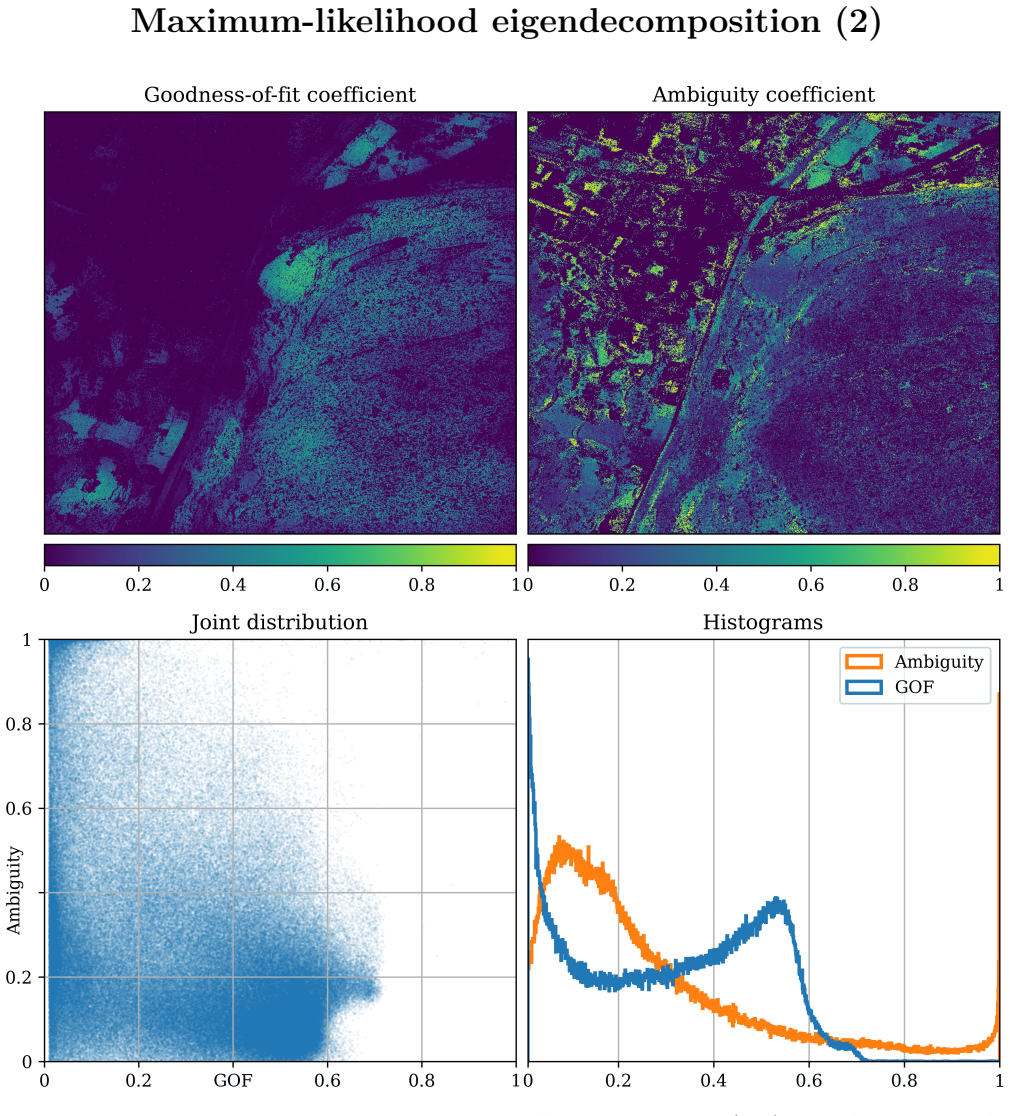
In multitemporal InSAR, phase linking (PL) refers to the estimation of a single-reference interferometric phase history for distributed scatterers (DS) from the information contained in the sample coherence matrix. Because the phase information in this matrix is typically inconsistent, DS processing needs practical reliability indicators to decide whether a pixel's PL estimate is sufficiently supported by the data for subsequent deformation analysis. For maximum-likelihood estimation, uncertainty can be quantified via Fisher-information-based covariance estimates, but no analogous, generally applicable uncertainty quantification is available for the broad range of non-ML methods. We propose three heuristic quality coefficients within a unified mathematical framework that covers common PL methods: (1) a method-specific goodness-of-fit coefficient that normalizes the achieved PL objective between a method-consistent upper bound and an empirically modeled noise floor level; (2) a closure phase coefficient computed from the sample coherence matrix in advance; and (3) an ambiguity coefficient that compares the obtained PL estimate with the best alternative in its orthogonal complement in the solution space. All coefficients are normalized to the interval $[0,1]$, where 1 indicates maximum reliability and 0 matches the behavior expected under pure noise. Simulations under exponential and seasonal decorrelation models show that the goodness-of-fit coefficient tracks the normalized absolute phase error most consistently, whereas the closure phase coefficient provides an a priori indicator for pre-screening. Experiments on a TerraSAR-X stack over Visp, Switzerland, reveal plausible spatial patterns across urban and vegetated areas and show that the ambiguity coefficient provides complementary information, especially in regions with temporally varying scattering mechanisms.
Editorial analysis
A structured set of objections, weighed in public.
Referee Report
Summary. The manuscript proposes three heuristic quality coefficients for evaluating the reliability of interferometric phase linking (PL) estimates in multitemporal InSAR for distributed scatterers. Within a unified framework applicable to common PL methods, it introduces (1) a method-specific goodness-of-fit coefficient that normalizes the achieved PL objective between a method-consistent upper bound and an empirically modeled noise floor, (2) a closure phase coefficient derived from the sample coherence matrix, and (3) an ambiguity coefficient comparing the PL estimate to alternatives in its orthogonal complement. All are scaled to [0,1] with 1 indicating high reliability and 0 corresponding to pure noise behavior. Simulations under exponential and seasonal decorrelation models indicate that the goodness-of-fit coefficient most consistently tracks the normalized absolute phase error, while the closure phase coefficient serves as an a priori pre-screening tool. Real-data experiments on a TerraSAR-X stack over Visp, Switzerland, demonstrate plausible spatial patterns in urban and vegetated areas, with the ambiguity coefficient providing complementary information in regions with varying scattering mechanisms.
Significance. If validated, the coefficients address a practical gap by supplying reliability indicators for non-ML PL methods lacking Fisher-information covariance estimates, potentially aiding DS selection in deformation analysis. The unified framework covering multiple PL methods and the simulation results showing consistent tracking of phase error by the goodness-of-fit coefficient are positive contributions. The real-data spatial patterns add empirical support, though the heuristic and empirically normalized nature limits immediate theoretical guarantees.
major comments (2)
- [Abstract and Section 3] Abstract and Section 3 (goodness-of-fit definition): The central claim that the goodness-of-fit coefficient 'tracks the normalized absolute phase error most consistently' depends on the [0,1] scaling produced by subtracting an empirically modeled noise floor from the achieved PL objective. The manuscript models this floor empirically but provides no derivation, closed-form expectation under pure noise, or verification against coherence-matrix statistics for the specific PL estimators; without this, the reported consistency may be sensitive to the chosen floor rather than a general property of the data.
- [Simulation results] Simulation results (exponential and seasonal decorrelation models): The reported superiority of the goodness-of-fit coefficient over the other two in tracking normalized absolute phase error is load-bearing for the practical utility claim, yet the results are presented without sensitivity tests to perturbations in the empirical noise floor parameter; this leaves open whether the tracking holds under alternative floor choices consistent with the same coherence statistics.
minor comments (2)
- [Abstract] The abstract refers to a 'method-consistent upper bound' without specifying its exact functional form for each PL method; adding a brief equation or reference in the main text would improve clarity for readers.
- Notation for the three coefficients could be introduced with consistent symbols early in the manuscript to aid cross-referencing between the unified framework and the individual definitions.
Simulated Author's Rebuttal
We thank the referee for the constructive and detailed review of our manuscript. We address each major comment below and indicate the planned revisions.
read point-by-point responses
-
Referee: [Abstract and Section 3] Abstract and Section 3 (goodness-of-fit definition): The central claim that the goodness-of-fit coefficient 'tracks the normalized absolute phase error most consistently' depends on the [0,1] scaling produced by subtracting an empirically modeled noise floor from the achieved PL objective. The manuscript models this floor empirically but provides no derivation, closed-form expectation under pure noise, or verification against coherence-matrix statistics for the specific PL estimators; without this, the reported consistency may be sensitive to the chosen floor rather than a general property of the data.
Authors: We acknowledge that the noise floor is obtained empirically via Monte Carlo simulation under noise-only conditions rather than from a closed-form expectation. Because the proposed coefficients are heuristic and the PL estimators are nonlinear, a general closed-form derivation for arbitrary estimators is not available. We will revise Section 3 to expand the description of the empirical estimation procedure, report the specific simulation settings used to obtain the floor, and include additional verification steps that compare the modeled floor against the observed distribution of the PL objective and the statistical properties of the sample coherence matrix. revision: partial
-
Referee: [Simulation results] Simulation results (exponential and seasonal decorrelation models): The reported superiority of the goodness-of-fit coefficient over the other two in tracking normalized absolute phase error is load-bearing for the practical utility claim, yet the results are presented without sensitivity tests to perturbations in the empirical noise floor parameter; this leaves open whether the tracking holds under alternative floor choices consistent with the same coherence statistics.
Authors: We agree that explicit sensitivity tests would strengthen the simulation results. In the revised manuscript we will add a dedicated sensitivity analysis (new figure or table) that perturbs the noise-floor value within a range consistent with the coherence statistics of the simulated data and demonstrates that the relative performance of the goodness-of-fit coefficient in tracking normalized absolute phase error remains stable. revision: yes
Circularity Check
No significant circularity; coefficients defined from coherence matrix and objectives with separate simulation validation
full rationale
The paper defines the three heuristic quality coefficients directly from the sample coherence matrix, PL objective values, and solution-space comparisons, with the goodness-of-fit normalization using a method-consistent upper bound and an empirically modeled noise floor. The claim that the goodness-of-fit coefficient tracks normalized absolute phase error is supported by separate simulations under exponential and seasonal decorrelation models rather than by algebraic construction or by fitting the coefficient to the phase-error values themselves. No self-citation load-bearing steps, uniqueness theorems imported from prior author work, or ansatz smuggling appear in the described framework. The derivation remains self-contained as a proposal of heuristics whose performance is assessed externally to their definition.
Axiom & Free-Parameter Ledger
free parameters (1)
- empirically modeled noise floor level
axioms (1)
- domain assumption Phase information in the sample coherence matrix is typically inconsistent for distributed scatterers.
Lean theorems connected to this paper
-
IndisputableMonolith/Cost/FunctionalEquation.leanwashburn_uniqueness_aczel unclear?
unclearRelation between the paper passage and the cited Recognition theorem.
We introduce three quality criteria... a method-specific goodness-of-fit coefficient that normalizes the achieved PL objective between a method-consistent upper bound and an empirically modeled noise floor level
-
IndisputableMonolith/Foundation/AlexanderDuality.leanalexander_duality_circle_linking unclear?
unclearRelation between the paper passage and the cited Recognition theorem.
closure phase coefficient... Φ_Δ := (N choose 3)^(-1) ∑ cos(ϕ_Δ_ijk)
What do these tags mean?
- matches
- The paper's claim is directly supported by a theorem in the formal canon.
- supports
- The theorem supports part of the paper's argument, but the paper may add assumptions or extra steps.
- extends
- The paper goes beyond the formal theorem; the theorem is a base layer rather than the whole result.
- uses
- The paper appears to rely on the theorem as machinery.
- contradicts
- The paper's claim conflicts with a theorem or certificate in the canon.
- unclear
- Pith found a possible connection, but the passage is too broad, indirect, or ambiguous to say the theorem truly supports the claim.
Reference graph
Works this paper leans on
-
[1]
Permanent scatterers in SAR interferometry
A. Ferretti, C. Prati, and F. Rocca. “Permanent scatterers in SAR interferometry”. In:IEEE Transactions on Geoscience and Remote Sensing39.1 (2001), pp. 8–20.issn: 0196-2892. doi: 10.1109/36.898661
-
[2]
Andrew Hooper et al. “A new method for measuring deformation on volcanoes and other natural terrains using InSAR persistent scatterers”. In:Geophysical Research Letters31.23 (Dec. 2004).issn: 1944-8007. doi: 10.1029/2004gl021737
-
[3]
Interferometric point target analysis for deformation mapping
C. Werner et al. “Interferometric point target analysis for deformation mapping”. In:2003 IEEE International Geoscience and Remote Sensing Symposium. Vol. 7. IGARSS-03. IEEE, 2003, pp. 4362–4364.doi: 10.1109/ igarss.2003.1295516
-
[4]
Persistent Scatterer Interferometry: A review
Michele Crosetto et al. “Persistent Scatterer Interferometry: A review”. In:ISPRS Journal of Photogrammetry and Remote Sensing115 (May 2016), pp. 78–89.issn: 0924-2716. doi: 10.1016/j.isprsjprs.2015.10.011
-
[5]
Differential tomography: a new framework for SAR interferometry
F. Lombardini. “Differential tomography: a new framework for SAR interferometry”. In:IEEE Transactions on Geoscience and Remote Sensing43.1 (Jan. 2005), pp. 37–44.issn: 0196-2892.doi: 10.1109/tgrs.2004.838371
-
[6]
Four-Dimensional SAR Imaging for Height Estimation and Monitoring of Single and Double Scatterers
G. Fornaro, D. Reale, and F. Serafino. “Four-Dimensional SAR Imaging for Height Estimation and Monitoring of Single and Double Scatterers”. In:IEEE Transactions on Geoscience and Remote Sensing47.1 (Jan. 2009), pp. 224–237.issn: 1558-0644. doi: 10.1109/tgrs.2008.2000837
-
[7]
Single-Look SAR Tomography as an Add-On to PSI for Improved Deformation Analysis in Urban Areas
Muhammad Adnan Siddique et al. “Single-Look SAR Tomography as an Add-On to PSI for Improved Deformation Analysis in Urban Areas”. In:IEEE Transactions on Geoscience and Remote Sensing54.10 (Oct. 2016), pp. 6119–6137.issn: 1558-0644. doi: 10.1109/tgrs.2016.2581261
-
[8]
InSAR Deformation Analysis with Distributed Scatterers: A Review Complemented by New Advances
Markus Even and Karsten Schulz. “InSAR Deformation Analysis with Distributed Scatterers: A Review Complemented by New Advances”. In:Remote Sensing 10.5 (May 2018), p. 744. issn: 2072-4292. doi: 10.3390/rs10050744
-
[9]
P. Berardino et al. “A New Algorithm for Surface Deformation Monitoring Based on Small Baseline Differential SAR Interferograms”. In:IEEE Transactions on Geoscience and Remote Sensing40.11 (Nov. 2002), pp. 2375–
work page 2002
-
[10]
issn: 0196-2892. doi: 10.1109/tgrs.2002.803792
-
[11]
On the Exploitation of Target Statistics for SAR Interferometry Applications
Andrea Monti Guarnieri and Stefano Tebaldini. “On the Exploitation of Target Statistics for SAR Interferometry Applications”. In:IEEE Transactions on Geoscience and Remote Sensing46.11 (Nov. 2008), pp. 3436–3443. issn: 0196-2892. doi: 10.1109/tgrs.2008.2001756. 34
-
[12]
A New Algorithm for Processing Interferometric Data-Stacks: SqueeSAR
Alessandro Ferretti et al. “A New Algorithm for Processing Interferometric Data-Stacks: SqueeSAR”. In: IEEE Transactions on Geoscience and Remote Sensing49.9 (Sept. 2011), pp. 3460–3470.issn: 1558-0644. doi: 10.1109/tgrs.2011.2124465
-
[13]
Mathematical Framework for Phase-Triangulation Algorithms in Distributed-Scatterer Interferometry
Ning Cao, Hyongki Lee, and Hahn Chul Jung. “Mathematical Framework for Phase-Triangulation Algorithms in Distributed-Scatterer Interferometry”. In:IEEE Geoscience and Remote Sensing Letters12.9 (Sept. 2015), pp. 1838–1842.issn: 1558-0571. doi: 10.1109/lgrs.2015.2430752
-
[14]
Efficient Phase Estimation for Interferogram Stacks
Homa Ansari, Francesco De Zan, and Richard Bamler. “Efficient Phase Estimation for Interferogram Stacks”. In: IEEE Transactions on Geoscience and Remote Sensing56.7 (July 2018), pp. 4109–4125.issn: 1558-0644. doi: 10.1109/tgrs.2018.2826045
-
[15]
Gianfranco Fornaro et al. “CAESAR: An Approach Based on Covariance Matrix Decomposition to Improve Multibaseline–Multitemporal Interferometric SAR Processing”. In:IEEE Transactions on Geoscience and Remote Sensing53.4 (Apr. 2015), pp. 2050–2065.issn: 1558-0644. doi: 10.1109/tgrs.2014.2352853
-
[16]
Sequential Estimator: Toward Efficient InSAR Time Series Analysis
Homa Ansari, Francesco De Zan, and Richard Bamler. “Sequential Estimator: Toward Efficient InSAR Time Series Analysis”. In:IEEE Transactions on Geoscience and Remote Sensing55.10 (Oct. 2017), pp. 5637–5652. issn: 1558-0644. doi: 10.1109/tgrs.2017.2711037
-
[17]
Non-linear phase linking using joined distributed and persistent scatterers
Sara Mirzaee, Falk Amelung, and Heresh Fattahi. “Non-linear phase linking using joined distributed and persistent scatterers”. In:Computers & Geosciences171 (Feb. 2023), p. 105291.issn: 0098-3004. doi: 10. 1016/j.cageo.2022.105291
-
[18]
Phase Estimation for Distributed Scatterers in InSAR Stacks Using Integer Least Squares Estimation
Sami Samiei-Esfahany et al. “Phase Estimation for Distributed Scatterers in InSAR Stacks Using Integer Least Squares Estimation”. In:IEEE Transactions on Geoscience and Remote Sensing54.10 (Oct. 2016), pp. 5671–5687.issn: 1558-0644. doi: 10.1109/tgrs.2016.2566604
-
[19]
Covariance Fitting Interferometric Phase Linking: Modular Framework and Optimization Algorithms
Phan Viet Hoa Vu et al. “Covariance Fitting Interferometric Phase Linking: Modular Framework and Optimization Algorithms”. In:IEEE Transactions on Geoscience and Remote Sensing63 (2025), pp. 1–18. issn: 1558-0644. doi: 10.1109/tgrs.2025.3550978
-
[20]
Jie Dong et al. “A Unified Approach of Multitemporal SAR Data Filtering Through Adaptive Estimation of Complex Covariance Matrix”. In:IEEE Transactions on Geoscience and Remote Sensing56.9 (Sept. 2018), pp. 5320–5333.issn: 1558-0644. doi: 10.1109/tgrs.2018.2813758
-
[21]
Accurate Estimation of Correlation in InSAR Observations
H.A. Zebker and K. Chen. “Accurate Estimation of Correlation in InSAR Observations”. In:IEEE Geoscience and Remote Sensing Letters2.2 (Apr. 2005), pp. 124–127.issn: 1545-598X. doi: 10.1109/lgrs.2004.842375
-
[22]
Coherenceestimationinsyntheticapertureradardatabasedonspeckle noise modeling
CarlosLópez-MartínezandEricPottier.“Coherenceestimationinsyntheticapertureradardatabasedonspeckle noise modeling”. In:Applied Optics46.4 (Feb. 2007), p. 544.issn: 1539-4522. doi: 10.1364/ao.46.000544
-
[23]
Robust Estimators for Multipass SAR Interferometry
Yuanyuan Wang and Xiao Xiang Zhu. “Robust Estimators for Multipass SAR Interferometry”. In:IEEE Transactions on Geoscience and Remote Sensing54.2 (Feb. 2016), pp. 968–980.issn: 1558-0644. doi: 10.1109/ tgrs.2015.2471303
-
[24]
Phan Viet Hoa Vu et al. “Robust Phase Linking in InSAR”. In:IEEE Transactions on Geoscience and Remote Sensing 61 (2023), pp. 1–11.issn: 1558-0644. doi: 10.1109/tgrs.2023.3289338
-
[25]
Phase Inconsistencies and Multiple Scattering in SAR Interferometry
Francesco De Zan, Mariantonietta Zonno, and Paco Lopez-Dekker. “Phase Inconsistencies and Multiple Scattering in SAR Interferometry”. In:IEEE Transactions on Geoscience and Remote Sensing53.12 (Dec. 2015), pp. 6608–6616.issn: 1558-0644. doi: 10.1109/tgrs.2015.2444431
-
[26]
On Closure Phase and Systematic Bias in Multilooked SAR Interferometry
Yujie Zheng et al. “On Closure Phase and Systematic Bias in Multilooked SAR Interferometry”. In:IEEE Transactions on Geoscience and Remote Sensing(2022). doi: 10.1109/tgrs.2022.3167648
-
[27]
Vegetation and soil moisture inversion from SAR closure phases: First experiments and results
Francesco De Zan and Giorgio Gomba. “Vegetation and soil moisture inversion from SAR closure phases: First experiments and results”. In:Remote Sensing of Environment217 (Nov. 2018), pp. 562–572.issn: 0034-4257. doi: 10.1016/j.rse.2018.08.034
-
[28]
LaMIE: Large-Dimensional Multipass InSAR Phase Estimation for Distributed Scatterers
Yusong Bai et al. “LaMIE: Large-Dimensional Multipass InSAR Phase Estimation for Distributed Scatterers”. In: IEEE Transactions on Geoscience and Remote Sensing61 (2023), pp. 1–15.issn: 1558-0644. doi: 10.1109/ tgrs.2023.3330971
-
[29]
Compressed SAR Interferometry in the Big Data Era
Dinh Ho Tong Minh and Yen-Nhi Ngo. “Compressed SAR Interferometry in the Big Data Era”. In:Remote Sensing 14.2 (Jan. 2022), p. 390.issn: 2072-4292. doi: 10.3390/rs14020390
-
[30]
G.H. Golub and C.F. Van Loan.Matrix Computations. 4th ed. Baltimore: The Johns Hopkins University Press,
-
[31]
isbn: 9781421407944. 35
-
[32]
L.N. Trefethen and D. Bau.Numerical Linear Algebra. Philadelphia: Society for Industrial and Applied Mathematics, 1997. isbn: 9780898719574
work page 1997
-
[33]
Statistics: textbooks and monographs 185
Leandro Pardo.Statistical inference based on divergence measures. Statistics: textbooks and monographs 185. Boca Raton: Chapman & Hall/CRC, 2006. 492 pp.isbn: 9781584886006
work page 2006
-
[34]
Phase Unwrapping in InSAR: A Review
Hanwen Yu et al. “Phase Unwrapping in InSAR: A Review”. In:IEEE Geoscience and Remote Sensing Magazine 7.1 (Mar. 2019), pp. 40–58.issn: 2373-7468. doi: 10.1109/mgrs.2018.2873644
-
[35]
Angular synchronization by eigenvectors and semidefinite programming
A. Singer. “Angular synchronization by eigenvectors and semidefinite programming”. In:Applied and Compu- tational Harmonic Analysis30.1 (Jan. 2011), pp. 20–36.issn: 1063-5203. doi: 10.1016/j.acha.2010.02.001
-
[36]
Nonconvex Phase Synchronization
Nicolas Boumal. “Nonconvex Phase Synchronization”. In:SIAM Journal on Optimization26.4 (Jan. 2016), pp. 2355–2377.issn: 1095-7189. doi: 10.1137/16m105808x
-
[37]
Statistical Modeling of Polarimetric SAR Data: A Survey and Challenges
Xinping Deng et al. “Statistical Modeling of Polarimetric SAR Data: A Survey and Challenges”. In:Remote Sensing 9.4 (Apr. 2017), p. 348.issn: 2072-4292. doi: 10.3390/rs9040348
-
[38]
DEM-Based SAR Pixel-Area Estimation for Enhanced Geocoding Refinement and Radiometric Normalization
Othmar Frey et al. “DEM-Based SAR Pixel-Area Estimation for Enhanced Geocoding Refinement and Radiometric Normalization”. In:IEEE Geoscience and Remote Sensing Letters10.1 (Jan. 2013), pp. 48–52. issn: 1558-0571. doi: 10.1109/lgrs.2012.2192093
-
[39]
Automated terrain corrected SAR geocoding
U. Wegmuller. “Automated terrain corrected SAR geocoding”. In:IEEE 1999 International Geoscience and Remote Sensing Symposium. IGARSS’99 (Cat. No.99CH36293). Vol. 3. IGARSS-99. IEEE, 1999, pp. 1712–1714. doi: 10.1109/igarss.1999.772070
-
[40]
Shuyi Yao and Timo Balz. “Phase-Based Similarly Decorrelated Pixel Selection and Phase-Linking in InSAR Using Circular Statistics”. In:IEEE Transactions on Geoscience and Remote Sensing62 (2024), pp. 1–12. issn: 1558-0644. doi: 10.1109/tgrs.2024.3422171
-
[41]
W. H. Press et al.Numerical Recipes. The Art of Scientific Computing. 3rd ed. Cambridge University Press,
-
[42]
Cheap, Valid Regularizers for Improved Interferometric Phase Linking
S. Zwieback. “Cheap, Valid Regularizers for Improved Interferometric Phase Linking”. In:IEEE Geoscience and Remote Sensing Letters19 (2022), pp. 1–4.issn: 1558-0571. doi: 10.1109/lgrs.2022.3197423
-
[43]
R.A. Horn and C.R. Johnson.Matrix Analysis. 2nd ed. New York: Cambridge University Press, 2013.isbn: 9780521548236
work page 2013
-
[44]
N.L. Johnson, S. Kotz, and N. Balakrishnan.Continuous Univariate Distributions, Volume 2. 2nd ed. Wiley Series in Probability and Statistics. New York: Wiley, 1995.isbn: 9780471584940
work page 1995
-
[45]
Jorge Nocedal and Stephen J. Wright.Numerical optimization. 2nd ed. Springer Series in Operations Research and Financial Engineering. New York, NY: Springer, 2006.isbn: 9780387400655
work page 2006
-
[46]
Youcef Saad.Iterative Methods for Sparse Linear Systems. 2nd ed. Philadelphia, PA: Society for Industrial and Applied Mathematics, 2007.isbn: 9780898715347
work page 2007
-
[47]
On the shortest spanning subtree of a graph and the traveling salesman problem
Joseph B. Kruskal. “On the shortest spanning subtree of a graph and the traveling salesman problem”. In: Proceedings of the American Mathematical Society7.1 (Feb. 1956), pp. 48–50.issn: 1088-6826. doi: 10.1090/s0002-9939-1956-0078686-7
-
[48]
Shortest Connection Networks And Some Generalizations
R. C. Prim. “Shortest Connection Networks And Some Generalizations”. In:Bell System Technical Journal 36.6 (Nov. 1957), pp. 1389–1401.issn: 0005-8580. doi: 10.1002/j.1538-7305.1957.tb01515.x. 36
discussion (0)
Sign in with ORCID, Apple, or X to comment. Anyone can read and Pith papers without signing in.