Disentangling peripheral hearing loss from central and cognitive effects on speech intelligibility in older adults
Pith reviewed 2026-05-18 03:46 UTC · model grok-4.3
The pith
Older adults with hearing loss often understand speech as well as or better than young listeners given the same simulated peripheral loss, pointing to separate central contributions.
A machine-rendered reading of the paper's core claim, the machinery that carries it, and where it could break.
Core claim
When young normal-hearing listeners are tested with the Wakayama University Hearing Impairment Simulator set to match a target older adult's audiogram, the older adult's speech-in-noise scores are comparable to or higher than those of the simulated young listeners. GESI predictions derived from young-listener data under-predict many older adults' subjective scores, but the residual differences do not correlate with hearing level, indicating that GESI has absorbed peripheral effects and left central or cognitive factors visible for comparison.
What carries the argument
The Wakayama University Hearing Impairment Simulator (WHIS) applied to young normal-hearing listeners, paired with the Gammachirp Envelope Similarity Index (GESI) as the objective intelligibility predictor, to separate peripheral loss from other influences.
If this is right
- The framework supplies a concrete method for comparing central and cognitive contributions across individual older adults and young listeners with or without hearing loss.
- Residual differences between measured and GESI-predicted scores can be treated as candidate indices of central or cognitive influence once peripheral hearing loss is controlled.
- Absence of correlation between residual scores and average hearing level supports treating the residuals as independent of the degree of peripheral loss.
- The approach enables systematic testing of whether speech-perception ability in older adults declines with age after peripheral effects are removed.
Where Pith is reading between the lines
- If the same simulator and predictor are applied to larger groups, the size and sign of residuals could be used to classify older adults into subgroups that differ mainly in central versus peripheral contributions.
- The finding that many older adults exceed GESI predictions calibrated on young listeners invites direct tests of whether cognitive compensation or different listening strategies are responsible.
- Extending the method to hearing-aid settings would allow prediction of how much benefit remains after peripheral loss is compensated, leaving central factors as the next target for improvement.
Load-bearing premise
The hearing-loss simulator reproduces only peripheral effects and does not introduce its own central or cognitive differences that would make simulated young listeners behave differently from real older adults.
What would settle it
A direct test in which the same older adult's audiogram is simulated in young listeners and the older adult's measured intelligibility scores fall reliably below the simulated scores would falsify the claim that central contributions are visible once peripheral loss is matched.
Figures


read the original abstract
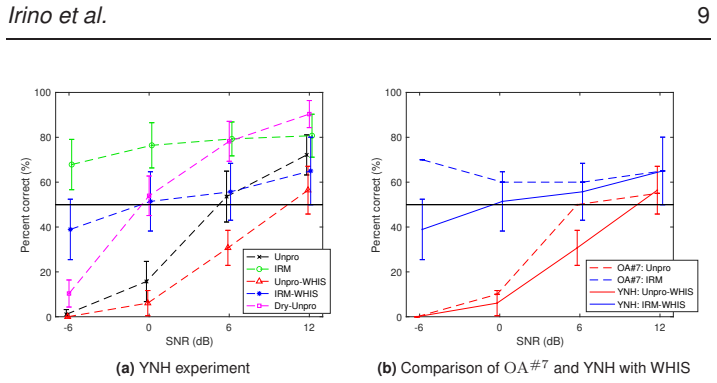
Age-related hearing loss (HL) reduces speech intelligibility (SI) in older adults (OAs). However, deficits in central and cognitive processing also substantially impact SI. Understanding these contributions is essential for explaining individual differences and developing effective assistive hearing strategies. This study presents a framework that distinguishes peripheral HL from central and cognitive influences on SI. This framework uses the Wakayama University Hearing Impairment Simulator (WHIS), and the Gammachirp Envelope Similarity Index (GESI), an objective measure of intelligibility. First, speech-in-noise tests were conducted with young, normal-hearing listeners (YNHs) using WHIS to simulate the audiogram of a target OA. The target OA achieved SI scores comparable to or higher than those of YNHs with simulated HL, suggesting contributions beyond peripheral hearing function. Then, GESI was used to predict SI scores for YNHs and OAs across different hearing levels. The prediction accuracy was comparable for both groups. Interestingly, many OAs' subjective SI scores were higher than those predicted using parameters derived from YNHs' experiments. This finding is inconsistent with previous research indicating that speech perception ability declines with age. This issue will be discussed. There was no significant correlation between the average hearing levels and the residual differences between the subjective and predicted SI scores. This suggests that GESI effectively absorbed the effects of peripheral HL. Thus, the proposed framework may facilitate systematic examination and comparison of central and cognitive factors beyond peripheral HL among individual YNHs and OAs with and without HL.
Editorial analysis
A structured set of objections, weighed in public.
Referee Report
Summary. The manuscript presents a framework to separate peripheral hearing loss from central and cognitive contributions to speech intelligibility (SI) in older adults (OAs). It uses the Wakayama University Hearing Impairment Simulator (WHIS) to present a target OA's audiogram to young normal-hearing listeners (YNHs), compares their SI scores to the real OA's performance, and applies the Gammachirp Envelope Similarity Index (GESI) fitted on YNH data to predict SI for both groups. The key findings are that the target OA matches or exceeds the simulated YNH scores, GESI prediction accuracy is comparable across groups, many OAs exceed GESI predictions, and residuals show no correlation with average hearing thresholds, which the authors interpret as evidence that GESI has absorbed peripheral effects.
Significance. If the central inference holds, the work supplies a practical experimental and modeling route for quantifying supra-peripheral contributions to SI deficits, which is relevant for individualized amplification and for testing hypotheses about cognitive reserve in aging. The combination of simulation and an objective index is a strength, but the absence of direct validation for the simulator limits the strength of the claim that central factors have been isolated.
major comments (1)
- [Abstract] Abstract and Methods: The claim that the target OA's SI scores indicate contributions 'beyond peripheral hearing function' and that 'GESI effectively absorbed the effects of peripheral HL' rests on the untested assumption that WHIS reproduces exactly the peripheral distortions experienced by real OAs while introducing no additional central or cognitive confounds. No section reports validation of WHIS against listeners with verified peripheral-only loss (e.g., young listeners with cochlear damage or objective peripheral metrics such as otoacoustic emissions or auditory brainstem responses). This is load-bearing for the OA-versus-simulated-YNH comparison.
minor comments (2)
- [Abstract] Abstract: The sentence 'This issue will be discussed' regarding the inconsistency with prior findings on age-related decline in speech perception is vague; the discussion section should explicitly address this point with reference to the residual analysis.
- [Abstract] Abstract: The statement that 'there was no significant correlation between the average hearing levels and the residual differences' should include the exact correlation coefficient, p-value, and sample size to allow readers to assess the strength of the null result.
Simulated Author's Rebuttal
We thank the referee for their thoughtful and constructive comments. We address the major concern about the validation of the WHIS simulator and the strength of the claims regarding peripheral versus supra-peripheral contributions below.
read point-by-point responses
-
Referee: The claim that the target OA's SI scores indicate contributions 'beyond peripheral hearing function' and that 'GESI effectively absorbed the effects of peripheral HL' rests on the untested assumption that WHIS reproduces exactly the peripheral distortions experienced by real OAs while introducing no additional central or cognitive confounds. No section reports validation of WHIS against listeners with verified peripheral-only loss (e.g., young listeners with cochlear damage or objective peripheral metrics such as otoacoustic emissions or auditory brainstem responses). This is load-bearing for the OA-versus-simulated-YNH comparison.
Authors: We acknowledge that the manuscript does not include a dedicated empirical validation of WHIS using objective peripheral metrics such as otoacoustic emissions or auditory brainstem responses in listeners with confirmed peripheral-only loss. WHIS is an established simulator designed to model peripheral hearing impairment through audiogram-based frequency-specific attenuation and related peripheral processing effects, with its development and prior applications documented in the literature. We agree that the current presentation would be strengthened by greater transparency on this point. In the revised manuscript we will expand the Methods section to provide additional detail on the WHIS implementation and cite the original validation studies supporting its use for peripheral simulation. We will also add a brief discussion of the simulator's assumptions and limitations, noting that any residual central or cognitive confounds introduced by simulation would, if present, tend to reduce rather than inflate the observed differences. Finally, we will revise the abstract and relevant claims to use more cautious phrasing, indicating that the OA-versus-simulated-YNH comparison provides evidence consistent with supra-peripheral contributions rather than definitive isolation of central factors. These changes directly address the load-bearing nature of the assumption while preserving the overall framework and findings. revision: yes
Circularity Check
No significant circularity detected; derivation relies on independent experimental comparisons and statistical residuals
full rationale
The paper's core chain proceeds from (1) conducting SI tests on YNHs via WHIS configured to target OA audiograms, (2) fitting GESI parameters exclusively to the YNH dataset, (3) applying those fixed parameters to generate predictions for OA listeners, and (4) computing residuals whose lack of correlation with hearing level is offered as evidence that peripheral effects were absorbed. None of these steps reduces to a self-definition, a fitted input renamed as a prediction, or a load-bearing self-citation whose validity is presupposed by the present work. The central inference (OA advantage implies central/cognitive contributions) is falsifiable against the external benchmark of the WHIS-simulated YNH scores and is not forced by construction from the inputs.
Axiom & Free-Parameter Ledger
free parameters (1)
- GESI parameters derived from YNH experiments
axioms (1)
- domain assumption WHIS simulation reproduces only peripheral hearing loss without central or cognitive side effects
Lean theorems connected to this paper
-
IndisputableMonolith/Cost/FunctionalEquation.leanwashburn_uniqueness_aczel unclear?
unclearRelation between the paper passage and the cited Recognition theorem.
WHIS first analyzes input sounds using the gammachirp filterbank (GCFB) to produce an auditory spectrogram... The total HL was set to match the hearing levels of the target OA listener. The degree of active hearing loss (HLact) can be controlled by a parameter α
-
IndisputableMonolith/Foundation/ArithmeticFromLogic.leanreality_from_one_distinction unclear?
unclearRelation between the paper passage and the cited Recognition theorem.
GESI is a simple, bottom-up model based on GCFB and a modulation filter bank... The metric is derived solely from bottom-up features and does not incorporate a model of higher-level processes.
What do these tags mean?
- matches
- The paper's claim is directly supported by a theorem in the formal canon.
- supports
- The theorem supports part of the paper's argument, but the paper may add assumptions or extra steps.
- extends
- The paper goes beyond the formal theorem; the theorem is a base layer rather than the whole result.
- uses
- The paper appears to rely on the theorem as machinery.
- contradicts
- The paper's claim conflicts with a theorem or certificate in the canon.
- unclear
- Pith found a possible connection, but the passage is too broad, indirect, or ambiguous to say the theorem truly supports the claim.
Reference graph
Works this paper leans on
-
[1]
Amano S, Sakamoto S, Kondo T and Suzuki Y (2009) Development o f familiarity-controlled word lists 2003 (FW03) to assess spoken-word intelligibility in Japanese. Speech Commun. 51(1): 76–82. DOI:10.1016/j.specom.2008.07.002. Barker J, Akeroyd M, Bailey W, Cox TJ, Culling JF, Firth J, Gra etzer S and Naylor G (2024) The 2nd clarity prediction challenge: A ...
-
[2]
Enhancing healthcare with eog: A novel approach to sleep stage classification,
DOI:10.1109/ICASSP48485.2024.10446441. Barker J, Akeroyd M, Cox TJ, Culling JF, Firth J, Graetzer S, G riffiths H, Harris L, Naylor G, Podwinska Z et al. (2022) The 1st clarity prediction chall enge: A machine learning challenge for hearing aid intelligibility prediction. In: Proc. Interspeech
-
[3]
DOI: 10.21437/Interspeech.2022-10821. Bugannim Y , Roziner I and Kishon-Rabin L (2025) Speech recognition in noise across the life span with cognition and hearing sensitivity as mediators of age e ffects. Scientific Reports 15(1): 20575. DOI:10.1038/s41598-025-05882-5. Dalton DS, Cruickshanks KJ, Klein BE, Klein R, Wiley TL and No ndahl DM (2003) The impac...
-
[4]
DOI:10.3389/fnagi.2014. 00347. F¨ ullgrabe C and ¨Ozt¨ urk OC (2022) Immediate effects of (simulated) age-rel ated hearing loss on cognitive processing and performance for the backward-dig it-span task. Frontiers in Aging Neuroscience 14: 912746. DOI:10.3389/fnagi.2022.912746 . Gordon-Salant S, Frisina RD, Fay RR and Popper AN (2009) The aging auditory sy...
-
[5]
Holt LL, Peelle JE, Coffin AB, Popper AN and Fay RR (2022) Speech perception, volume
Springer Science & Business Media. Holt LL, Peelle JE, Coffin AB, Popper AN and Fay RR (2022) Speech perception, volume
work page 2022
-
[6]
Irino T (2023) Hearing impairment simulator based on auditory excitation pattern playback: WHIS
Springer. Irino T (2023) Hearing impairment simulator based on auditory excitation pattern playback: WHIS. IEEE Access 11: 78419–78430. DOI:10.1109/ACCESS.2023.329867
- [7]
- [9]
-
[10]
pp. 3929–3933. DOI:10.21437/Interspeech.2022-211 . Jensen J and Taal CH (2016) An Algorithm for Predicting the In telligibility of Speech Masked by Modulated Noise Maskers. IEEE/ACM Trans. ASLP 24(11): 2009–2022. DOI:10.1109/ TASLP .2016.2585878. Jeub M, Schafer M and V ary P (2009) A binaural room impulse res ponse database for the evaluation of dereverb...
-
[11]
Kates JM (2023) Extending the hearing-aid speech perceptio n index (HASPI): Keywords, sentences, and context. J. Acoust. Soc. Am. 153(3): 1662–1673. DOI:10.1121/10.0017546. Kocabay AP , Aslan F, Y¨ uce D and Turkyilmaz D (2022) Speech in noise: implications of age, hearing loss, and cognition. Folia Phoniatrica et Logopaedica 74(5): 345–351. DOI: 10.1159/...
-
[12]
pp. 181–185. DOI:10.21437/Interspeech. 2021-174. Yamamoto A, Irino T, Miyazaki F and Tamaru H (2023) GESI: Gamm achirp Envelope Similarity Index for Predicting Intelligibility of Simulated Hearing Loss Sounds. arXiv preprint arXiv:2310.15399 DOI:10.48550/arXiv.2310.15399. Yamamoto A, Miyazaki F and Irino T (2025) Predicting speech i ntelligibility in olde...
-
[13]
DOI:10.1016/j.specom.2020.06.001. Yamamoto K, Irino T, Ohashi N, Araki S, Kinoshita K and Nakata ni T (2018) Multi-resolution Gammachirp Envelope Distortion Index for Intelligibility Prediction of Noisy Speech. In: Proc. Interspeech
-
[14]
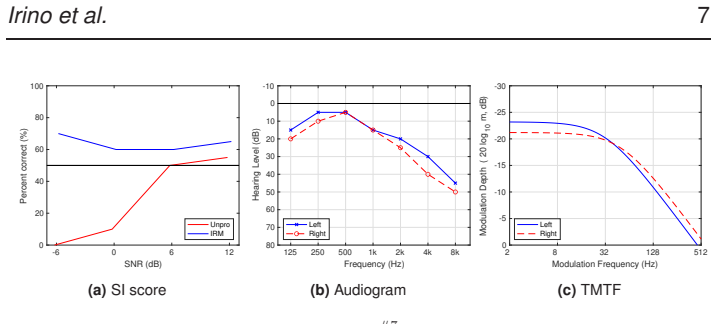
Hyderabad, India, pp. 1863–1867. DOI:10.21437/Inte rspeech. 2018-1291. Appendix: Audiogram and TMTF of YNH and OA The audiograms and TMTFs of the 14 YNH listeners in the curren t study are shown in Figs. 7c and 7d. The audiograms and TMTFs of the 15 OA participants are shown in Figs. 7c and 7d. The OA participants were between 62 and 81 years old and thei...
-
[15]
The input sounds to GESI are reference ( r) and test ( t) signals
Figure 8 shows the block diagram of GESI. The input sounds to GESI are reference ( r) and test ( t) signals. First, the cross-correlation between them is computed to pe rform the time alignment of the speech segment. Then, both signals are anal yzed with the gammachirp auditory filterbank (GCFB) ( Irino and Patterson 2006 ; Irino 2023), which contains the ...
work page 2006
-
[16]
Audiograms and TMTFs of 14 YNHs participated in this study an d 15 OAs participated in the previous OA study ( Y amamoto et al. 2025). Note that small random values were added to the hearing levels to distinguish the individu al lines. 0.5 ms frame shift, something like an “auditory” spectrogra m (hereafter referred to as EPgram). The reference speech is ...
work page 2025
-
[17]
5, a moderate level, were used to analyze the test signal. This is because the α value cannot be estimated without extensive psychoacoustic experiments (for details, see Appendix A of Y amamoto et al. 2025). Next, the time offset between the EPgrams of the reference an d test speech is compensated for each channel of the GCFB. The cross-correlation is com...
work page 2025
-
[18]
This comes from the upper limit of the horizontal axis h in the SSI. The weighting function w(Ef ) i represents the efficiency of extracting information from the GCFB outputs above the absolute thresh old (A T). As age-related HL gradually progresses, individuals may co mpensate by extracting speech information from the remaining audibl e regions, potentia...
work page 2011
discussion (0)
Sign in with ORCID, Apple, or X to comment. Anyone can read and Pith papers without signing in.