MoTIF: A Mode-Structured Tensor Framework for Multi-Parametric Approximation, Super-Resolution and Forecasting of Unsteady Systems
Pith reviewed 2026-05-18 03:03 UTC · model grok-4.3
The pith
MoTIF separates flow data into parameter, spatial, and temporal modes to reconstruct unseen configurations and forecast evolution with errors below 2%.
A machine-rendered reading of the paper's core claim, the machinery that carries it, and where it could break.
Core claim
The central discovery is that a mode-structured tensor approach based on HOSVD enables decoupled learning of operators on each mode, preserving the tensor structure while achieving accurate multi-parametric approximation, super-resolution, and temporal forecasting in unsteady laminar flows, with relative root mean square errors below 2% compared to high-fidelity simulations.
What carries the argument
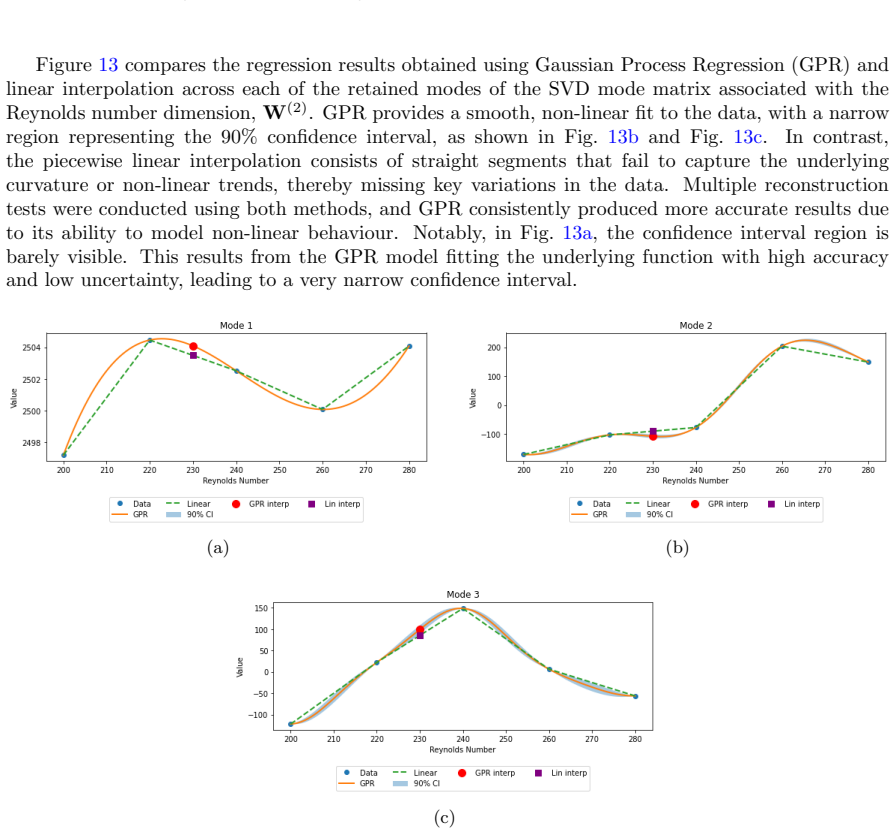
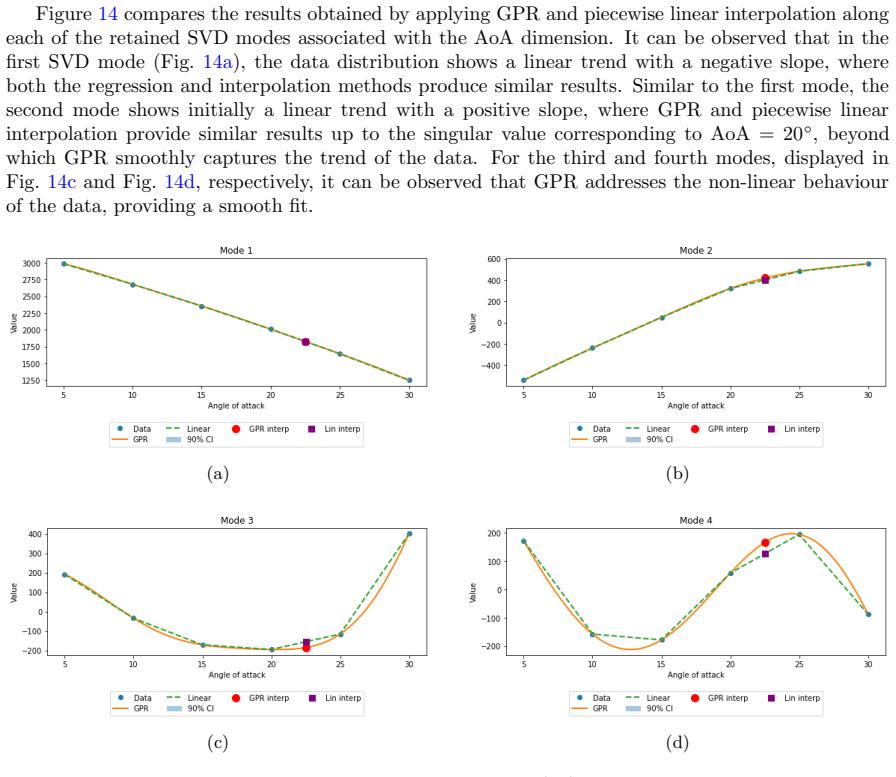
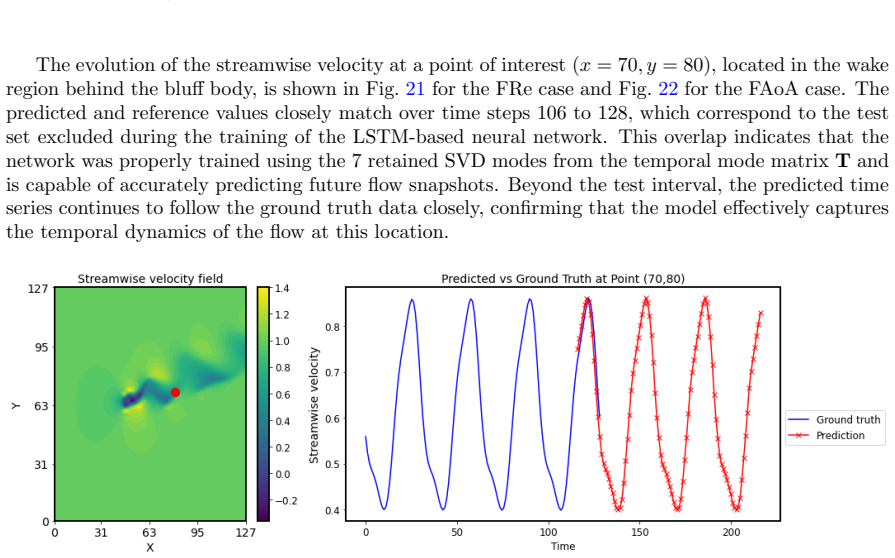
High-Order Singular Value Decomposition (HOSVD) to obtain a structured multilinear representation separating physical parameters, spatial coordinates, and temporal evolution into distinct modal components, followed by dedicated operators like Gaussian Process Regression and recurrent neural networks on each mode.
If this is right
- Accurate reconstruction of flow fields for parameter values not in the original database.
- Enhancement of spatial resolution in the approximated solutions.
- Forecasting of future time steps in the system evolution.
- Provision of a scalable reduced-order modeling alternative for parametric dynamical systems.
Where Pith is reading between the lines
- Similar mode separation could apply to other unsteady systems in engineering, such as structural vibrations or heat transfer problems.
- Integrating additional physical constraints into the modal operators might further reduce errors in complex regimes.
- The success with low errors suggests the method could reduce computational costs significantly for parametric studies in fluid dynamics.
Load-bearing premise
The unsteady flow data admits a sufficiently low-rank multilinear structure that permits independent approximation operators on the separated parameter, spatial, and temporal modes without destroying essential coupling.
What would settle it
Running the MoTIF framework on a new set of unsteady flow simulations with Reynolds numbers and angles of attack outside the training set and measuring if the relative root mean square error exceeds 2% for reconstructions or predictions.
Figures






read the original abstract
We introduce MoTIF, a mode-structured tensor framework for multi-parametric approximation, super-resolution, and temporal forecasting of high-dimensional unsteady systems. The methodology leverages High-Order Singular Value Decomposition (HOSVD) to obtain a structured multilinear representation of multi-dimensional datasets, separating physical parameters, spatial coordinates, and temporal evolution into distinct modal components. This decomposition enables the application of dedicated approximation operators to each mode. Gaussian Process Regression is employed to interpolate and extrapolate parametric and spatial modal matrices, enabling database completion and resolution enhancement, while recurrent neural networks are applied to the temporal mode to forecast system evolution. This decoupled operator-learning strategy preserves the intrinsic tensor structure while providing a flexible non-intrusive reduced-order modelling framework. The proposed methodology is validated on a database of unsteady laminar flow simulations with varying Reynolds numbers and angles of attack. Accurate reconstruction of unseen flow configurations and temporal prediction are achieved, with relative root mean square errors consistently below 2\% compared to high-fidelity simulations. The framework provides a scalable and mathematically structured alternative to conventional surrogate modelling approaches for high-dimensional parametric dynamical systems.
Editorial analysis
A structured set of objections, weighed in public.
Referee Report
Summary. The paper introduces MoTIF, a mode-structured tensor framework for multi-parametric approximation, super-resolution, and temporal forecasting of high-dimensional unsteady systems. It employs High-Order Singular Value Decomposition (HOSVD) to obtain a structured multilinear representation separating physical parameters, spatial coordinates, and temporal evolution into distinct modal components. Dedicated operators are then applied independently: Gaussian Process Regression (GPR) for interpolating and extrapolating parametric and spatial modal matrices, and recurrent neural networks (RNNs) for forecasting the temporal mode. The framework is validated on a database of unsteady laminar flow simulations with varying Reynolds numbers and angles of attack, claiming accurate reconstruction of unseen configurations and temporal predictions with relative root mean square errors consistently below 2% compared to high-fidelity simulations.
Significance. If the low-rank multilinear separability assumption holds and the reported accuracy is robustly supported, the work provides a mathematically structured, non-intrusive reduced-order modeling approach for multi-parametric dynamical systems in fluid dynamics. By preserving the intrinsic tensor structure while allowing flexible per-mode operator learning, it offers a scalable alternative to black-box surrogates, with built-in capabilities for database completion and resolution enhancement. This could be particularly useful for parametric studies of unsteady flows where full-order simulations are expensive.
major comments (2)
- Abstract: The headline claim of relative RMS errors consistently below 2% for reconstruction of unseen Re/AoA configurations and temporal forecasts is presented without any mention of dataset size, the procedure used to select HOSVD truncation ranks, baseline comparisons against other reduced-order or surrogate methods, or statistical error bars. This absence leaves the empirical support for the central accuracy claim provisional and load-bearing for the validation narrative.
- Abstract (methodology description): The decoupled operator strategy (GPR on parametric/spatial modes, RNN on temporal mode) rests on the assumption that the unsteady flow data admits a sufficiently low-rank multilinear structure permitting independent approximation without destroying essential nonlinear couplings. In the laminar regime, variations in Reynolds number and angle of attack can produce non-separable effects (e.g., vortex shedding frequency depending simultaneously on both parameters); if this occurs, the independent operators will misrepresent extrapolation cases even when in-sample reconstruction succeeds. No rank-truncation diagnostics, core-tensor analysis, or extrapolation-specific error breakdowns are referenced to confirm the assumption holds at the stated accuracy level.
minor comments (1)
- Abstract: The acronym 'MoTIF' is introduced without an explicit expansion or definition of its components in the provided text.
Simulated Author's Rebuttal
We thank the referee for the constructive and detailed comments. We address each major point below, clarifying aspects of the manuscript and indicating revisions where the abstract or supporting analysis can be strengthened without altering the core claims.
read point-by-point responses
-
Referee: Abstract: The headline claim of relative RMS errors consistently below 2% for reconstruction of unseen Re/AoA configurations and temporal forecasts is presented without any mention of dataset size, the procedure used to select HOSVD truncation ranks, baseline comparisons against other reduced-order or surrogate methods, or statistical error bars. This absence leaves the empirical support for the central accuracy claim provisional and load-bearing for the validation narrative.
Authors: We agree that the abstract, as a concise summary, omits several supporting details that appear in the main text. The dataset size, HOSVD rank selection via energy threshold on the singular values, baseline comparisons to POD-based surrogates, and cross-validation error bars are all reported in Sections 3 and 4. To improve clarity for readers who focus on the abstract, we have revised it to include a brief statement on dataset scale and the rank-selection criterion while preserving length constraints. revision: yes
-
Referee: Abstract (methodology description): The decoupled operator strategy (GPR on parametric/spatial modes, RNN on temporal mode) rests on the assumption that the unsteady flow data admits a sufficiently low-rank multilinear structure permitting independent approximation without destroying essential nonlinear couplings. In the laminar regime, variations in Reynolds number and angle of attack can produce non-separable effects (e.g., vortex shedding frequency depending simultaneously on both parameters); if this occurs, the independent operators will misrepresent extrapolation cases even when in-sample reconstruction succeeds. No rank-truncation diagnostics, core-tensor analysis, or extrapolation-specific error breakdowns are referenced to confirm the assumption holds at the stated accuracy level.
Authors: We acknowledge the referee's concern about potential non-separability. The manuscript already contains core-tensor analysis and singular-value spectra (Section 2.3 and Figure 3) showing that the leading modes capture the dominant energy, including coupled parametric effects on shedding frequency. The parametric GPR operators are trained on the joint variation of Re and AoA, allowing the model to learn non-separable influences within the low-rank subspace. We have added explicit extrapolation error breakdowns for unseen (Re, AoA) pairs in the revised results section to further substantiate the claim. We also note the limitation for strongly nonlinear regimes in the updated discussion. revision: partial
Circularity Check
No circularity: derivation chain remains self-contained
full rationale
The paper decomposes multi-parametric unsteady flow data via HOSVD into distinct modal components for parameters, space, and time, then applies independent GPR operators to parametric/spatial modes and RNN to the temporal mode for interpolation, extrapolation, and forecasting. Validation explicitly targets unseen Reynolds-number and angle-of-attack configurations with reported RMSE <2% against held-out high-fidelity simulations. No equation or step reduces the claimed predictions to quantities fitted on the identical data used for validation; the low-rank multilinear assumption is an empirical modeling choice whose validity is tested externally rather than enforced by construction. The central claims therefore retain independent content beyond the input dataset.
Axiom & Free-Parameter Ledger
free parameters (3)
- HOSVD truncation ranks
- GPR kernel hyperparameters
- RNN training hyperparameters
axioms (1)
- domain assumption Unsteady flow data can be represented as a low-rank tensor whose modes for parameters, space, and time are separable enough for independent operators.
Reference graph
Works this paper leans on
-
[1]
The impact of oceanic heat transport on the atmospheric circulation,
M.-A. Knietzsch, V. Lucarini, and F. Lunkeit, “The impact of oceanic heat transport on the atmospheric circulation,”arXiv preprint arXiv:1410.0565, 2014
-
[2]
Numerical simulation of turbulent sediment transport, from bed load to saltation
O. Duran, B. Andreotti, and P. Claudin, “Numerical simulation of turbulent sediment transport, from bed load to saltation,”arXiv preprint arXiv:1111.6898, 2011
work page internal anchor Pith review Pith/arXiv arXiv 2011
-
[3]
Urban fluid mechanics: Air circulation and contaminant dispersion in cities,
E. R. Pardyjak, M. J. Brown, and J. C. Hunt, “Urban fluid mechanics: Air circulation and contaminant dispersion in cities,”Environmental Fluid Mechanics, vol. 2, no. 1, pp. 95–116, 2002
work page 2002
-
[4]
Effect of water–air heat transfer on the spread of thermal pollution in rivers,
A. Rajwa-Kuligiewicz, K. Kulasza, and A. Kiczko, “Effect of water–air heat transfer on the spread of thermal pollution in rivers,”Acta Geophysica, vol. 67, no. 2, pp. 597–619, 2019
work page 2019
-
[5]
W. contributors,Application of cfd in thermal power plants,https://en.wikipedia.org/wiki/ Application_of_CFD_in_thermal_power_plants, Accessed: 2025-05-22, 2021
work page 2025
-
[6]
The future of computational fluid dynamics (CFD) simulation in the chemical process industries,
D. F. Fletcher, “The future of computational fluid dynamics (CFD) simulation in the chemical process industries,”Chemical Engineering Research and Design, vol. 187, pp. 299–305, 2022, issn: 0263-8762.doi:https://doi.org/10.1016/j.cherd.2022.09.021[Online]. Available: https://www.sciencedirect.com/science/article/pii/S0263876222005202
-
[7]
A. Mazumdar, J. Burkotov´ a, T. Kr´ atk´ y, T. Chugh, and K. Miettinen, “Handling simulation failures of a computationally expensive multiobjective optimization problem in pump design,” Engineering Applications of Artificial Intelligence, vol. 136, p. 108 897, 2024,issn: 0952-1976. doi:https : / / doi . org / 10 . 1016 / j . engappai . 2024 . 108897[Onlin...
work page 2024
-
[8]
Z. Dar, J. Baiges, and R. Codina,Reduced Order Modeling. Unspecified Publisher, 2024
work page 2024
-
[9]
On the experimental, numerical and data-driven methods to study urban flows,
P. Torres, S. Le Clainche, and R. Vinuesa, “On the experimental, numerical and data-driven methods to study urban flows,”Energies, vol. 14, no. 5, 2021,issn: 1996-1073.doi:10.3390/ en14051310[Online]. Available:https://www.mdpi.com/1996-1073/14/5/1310
work page 2021
-
[10]
Parametric dynamic mode decomposition for reduced order modeling,
Q. A. Huhn, M. E. Tano, J. C. Ragusa, and Y. Choi, “Parametric dynamic mode decomposition for reduced order modeling,”Journal of Computational Physics, vol. 475, p. 111 852, 2023,issn: 0021-9991.doi:https://doi.org/10.1016/j.jcp.2022.111852[Online]. Available:https: //www.sciencedirect.com/science/article/pii/S0021999122009159
-
[11]
Z. Zhong, X. Hua, Z. Zhai, and M. Ma, “A novel tensor-based modal decomposition method for reduced order modeling and optimal sparse sensor placement,”Aerospace Science and Tech- nology, vol. 155, p. 109 530, 2024,issn: 1270-9638.doi:https://doi.org/10.1016/j.ast. 2024.109530[Online]. Available:https://www.sciencedirect.com/science/article/pii/ S127096382...
-
[12]
TURBULENCE AND THE DYNAMICS OF COHERENT STRUCTURES PART I: COHERENT STRUCTURES,
L. Sirovich, “TURBULENCE AND THE DYNAMICS OF COHERENT STRUCTURES PART I: COHERENT STRUCTURES,”Quarterly of Applied Mathematics, vol. 45, no. 3, pp. 561–571, 1987,issn: 0033569X, 15524485. Accessed: Oct. 4, 2024. [Online]. Available:http://www.jstor. org/stable/43637457
-
[13]
Turbulence and the Dynamics of Coherent Structures. II. Symmetries and Trans- formations,
L. Sirovich, “Turbulence and the Dynamics of Coherent Structures. II. Symmetries and Trans- formations,”Quarterly of Applied Mathematics, vol. 45, pp. 573–582, 1987. [Online]. Available: https://api.semanticscholar.org/CorpusID:11429443
work page 1987
-
[14]
J. L. Lumley,The structure of inhomogeneous turbulent flows, 1967
work page 1967
-
[15]
Model order reduction in aerodynamics: Review and appli- cations,
G. Mendon¸ ca, F. Afonso, and F. Lau, “Model order reduction in aerodynamics: Review and appli- cations,”Proceedings of the Institution of Mechanical Engineers, Part G: Journal of Aerospace Engineering, vol. 233, no. 15, pp. 5816–5836, 2019.doi:10.1177/0954410019853472eprint: https://doi.org/10.1177/0954410019853472. [Online]. Available:https://doi.org/10...
-
[16]
X. Hu et al., “A transient reduced order model for battery thermal management based on singular value decomposition,” in2014 IEEE Energy Conversion Congress and Exposition (ECCE), 2014, pp. 3971–3976.doi:10.1109/ECCE.2014.6953941
-
[18]
The extension of factor analysis to three-dimensional matrices,
L. R. Tucker, “The extension of factor analysis to three-dimensional matrices,” inContributions to mathematical psychology.H. Gulliksen and N. Frederiksen, Eds., New York: Holt, Rinehart and Winston, 1964, pp. 110–127
work page 1964
-
[19]
Quaternion higher-order singular value decomposition and its applications in color image processing,
J. Miao, K. I. Kou, D. Cheng, and W. Liu, “Quaternion higher-order singular value decomposition and its applications in color image processing,”Information Fusion, vol. 92, pp. 139–153, 2023, issn: 1566-2535.doi:https://doi.org/10.1016/j.inffus.2022.11.026[Online]. Available: https://www.sciencedirect.com/science/article/pii/S1566253522002366
-
[20]
Nonintrusive model order reduction for cross- diffusion systems,
B. Karas¨ ozen, G. M¨ ulayim, and M. Uzunca, “Nonintrusive model order reduction for cross- diffusion systems,”Communications in Nonlinear Science and Numerical Simulation, vol. 115, p. 106 734, 2022,issn: 1007-5704.doi:https://doi.org/10.1016/j.cnsns.2022.106734[On- line]. Available:https://www.sciencedirect.com/science/article/pii/S1007570422002738
-
[21]
M. K. Moayyedi and M. N. beygi, “A high fidelity cost efficient tensorial method based on combined pod-hosvd reduced order model of flow field,”European Journal of Computational Mechanics, vol. 27, no. 4, pp. 342–366, 2018.doi:10.1080/17797179.2018.1550963eprint: https://doi.org/10.1080/17797179.2018.1550963. [Online]. Available:https://doi.org/ 10.1080/1...
-
[22]
Application of hosvd to aerodynamics. the problem of shock waves,
L. S. Lorente, D. Alonso, J. M. Vega de Prada, and A. Vel´ azquez, “Application of hosvd to aerodynamics. the problem of shock waves,” in9th International Conference on Computational and Mathematical Methods in Science and Engineering, CMMSE 2009, Asturias, Espa˜ na, Jun. 2009,isbn: 978-84-612-9727-6
work page 2009
-
[23]
P. D´ ıaz-Morales, A. Corrochano, M. L´ opez-Mart´ ın, and S. L. Clainche, “Deep learning com- bined with singular value decomposition to reconstruct databases in fluid dynamics[formula pre- sented],”Expert Systems with Applications, vol. 238, Mar. 2024.doi:10.1016/j.eswa.2023. 121924
-
[24]
Data repairing and resolution enhancement using data-driven modal decomposition and deep learning,
A. Hetherington, D. Serfaty, A. Corrochano, J. Soria, and S. Le Clainche, “Data repairing and resolution enhancement using data-driven modal decomposition and deep learning,”Experi- mental Thermal and Fluid Science, vol. 157, p. 111 241, 2024,issn: 0894-1777.doi:https : / / doi . org / 10 . 1016 / j . expthermflusci . 2024 . 111241[Online]. Available:http...
work page 2024
-
[25]
G. Aversano, M. Ferrarotti, and A. Parente, “Digital twin of a combustion furnace operating in flameless conditions: Reduced-order model development from cfd simulations,”Proceedings of the Combustion Institute, vol. 38, pp. 5373–5381, 2021.doi:10.1016/j.proci.2020.08.032 [Online]. Available:https://doi.org/10.1016/j.proci.2020.08.032
-
[26]
Adaptive digital twins of combustion systems using sparse sensing strategies,
A. Procacci, R. Amaduzzi, A. Coussement, and A. Parente, “Adaptive digital twins of combustion systems using sparse sensing strategies,”Proceedings of the Combustion Institute, 2022.doi: 10.1016/j.proci.2022.03.158[Online]. Available:https://doi.org/10.1016/j.proci. 2022.03.158
-
[27]
R. Abad´ ıa-Heredia, M. L´ opez-Mart´ ın, B. Carro, J. Arribas, J. P´ erez, and S. Le Clainche, “A predictive hybrid reduced order model based on proper orthogonal decomposition combined with deep learning architectures,”Expert Systems with Applications, vol. 187, p. 115 910, 2022, issn: 0957-4174.doi:https://doi.org/10.1016/j.eswa.2021.115910[Online]. Av...
-
[28]
Pod-lstm model for predicting pressure time series on structures,
X. Du, C. Hu, and H. Dong, “Pod-lstm model for predicting pressure time series on structures,” Journal of Wind Engineering and Industrial Aerodynamics, vol. 245, p. 105 651, 2024,issn: 0167-6105.doi:https : / / doi . org / 10 . 1016 / j . jweia . 2024 . 105651[Online]. Available: https://www.sciencedirect.com/science/article/pii/S016761052400014X
work page 2024
-
[29]
Generation of aerodynamics databases using high- order singular value decomposition,
L. S. Lorente, J. M. Vega, and A. Velazquez, “Generation of aerodynamics databases using high- order singular value decomposition,”Journal of Aircraft, vol. 45, no. 5, pp. 1779–1788, 2008. doi:10 . 2514 / 1 . 35258eprint:https : / / doi . org / 10 . 2514 / 1 . 35258. [Online]. Available: https://doi.org/10.2514/1.35258
-
[30]
G. Barrag´ an, A. Hetherington, R. Abad´ ıa-Heredia, J. Garicano-Mena, and S. L. Clainche,Hosvd- sr: A physics-based deep learning framework for super-resolution in fluid dynamics, 2025. arXiv: 2504.17994 [physics.flu-dyn]. [Online]. Available:https://arxiv.org/abs/2504.17994
-
[31]
A. Sengupta, R. Abad´ ıa-Heredia, A. Hetherington, J. M. P´ erez, and S. L. Clainche,Hybrid machine learning models based on physical patterns to accelerate cfd simulations: A short guide on autoregressive models, 2025. arXiv:2504 . 06774 [physics.flu-dyn]. [Online]. Available: https://arxiv.org/abs/2504.06774
-
[32]
J. Sola and J. Sevilla, “Importance of input data normalization for the application of neural net- works to complex industrial problems,”IEEE Transactions on Nuclear Science, vol. 44, pp. 1464– 1468, 3 PART 3 1997,issn: 00189499.doi:10.1109/23.589532
-
[33]
P. J. M. Ali, “Investigating the impact of min-max data normalization on the regression perfor- mance of k-nearest neighbor with different similarity measurements,”ARO-THE SCIENTIFIC JOURNAL OF KOYA UNIVERSITY, vol. 10, pp. 85–91, 1 Jun. 2022,issn: 2410-9355.doi: 10.14500/aro.10955
-
[34]
Normalization techniques in training dnns: Methodology, analysis and application,
L. Huang, J. Qin, Y. Zhou, F. Zhu, L. Liu, and L. Shao, “Normalization techniques in training dnns: Methodology, analysis and application,” Sep. 2020. [Online]. Available:http://arxiv. org/abs/2009.12836
-
[35]
Implications of factor analysis of three-way matrices for measurement of change,
L. R. Tucker, “Implications of factor analysis of three-way matrices for measurement of change,” inProblems in measuring change.C. W. Harris, Ed., Madison WI: University of Wisconsin Press, 1963, pp. 122–137
work page 1963
-
[36]
Some mathematical notes on three-mode factor analysis,
L. R. Tucker, “Some mathematical notes on three-mode factor analysis,”Psychometrika, vol. 31, pp. 279–311, 1966. [Online]. Available:https : / / api . semanticscholar . org / CorpusID : 44301099
work page 1966
-
[37]
On the best rank-1 and rank-(r1 ,r2 ,. . .,rn) approximation of higher-order tensors,
L. De Lathauwer, B. De Moor, and J. Vandewalle, “On the best rank-1 and rank-(r1 ,r2 ,. . .,rn) approximation of higher-order tensors,”SIAM Journal on Matrix Analysis and Applica- tions, vol. 21, no. 4, pp. 1324–1342, 2000.doi:10.1137/S0895479898346995eprint:https: //doi.org/10.1137/S0895479898346995. [Online]. Available:https://doi.org/10.1137/ S0895479898346995
-
[38]
SIAM Journal on Matrix Analysis and Applications , author =
L. De Lathauwer, B. De Moor, and J. Vandewalle, “A multilinear singular value decomposition,” SIAM Journal on Matrix Analysis and Applications, vol. 21, no. 4, pp. 1253–1278, 2000.doi:10. 1137/S0895479896305696eprint:https://doi.org/10.1137/S0895479896305696. [Online]. Available:https://doi.org/10.1137/S0895479896305696 34
-
[39]
Compression of aerodynamic databases using high-order singular value decomposition,
L. S. Lorente, J. M. Vega, and A. Velazquez, “Compression of aerodynamic databases using high-order singular value decomposition,”Aerospace Science and Technology, vol. 14, no. 3, pp. 168–177, 2010,issn: 1270-9638.doi:10 . 1016 / j . ast . 2009 . 12 . 003[Online]. Available: https://www.sciencedirect.com/science/article/pii/S1270963809000935
work page 2010
-
[40]
Modelflows-app: Data-driven post-processing and reduced order mod- elling tools,
A. Hetherington et al., “Modelflows-app: Data-driven post-processing and reduced order mod- elling tools,”Computer Physics Communications, vol. 301, p. 109 217, 2024,issn: 0010-4655. doi:https : / / doi . org / 10 . 1016 / j . cpc . 2024 . 109217[Online]. Available:https : / / www . sciencedirect.com/science/article/pii/S0010465524001401
work page 2024
-
[41]
K. Taira et al., “Modal analysis of fluid flows: An overview,”AIAA Journal, vol. 55, no. 12, pp. 4013–4041, 2017.doi:10.2514/1.J056060
- [42]
-
[43]
A. N. Kolmogorov,“On the analytic methods of probability theory. Uspekhi matematicheskikh nauk, 1938
work page 1938
-
[44]
I. A. Ibragimov and Y. A. Rozanov,Gaussian random processes. Springer Science & Business Media, 1978
work page 1978
-
[45]
C. E. Rasmussen and C. K. I. Williams,Gaussian Processes for Machine Learning. The MIT Press, 2006
work page 2006
-
[46]
S. Hochreiter and J. Schmidhuber, “Long short-term memory,”Neural Computation, vol. 9, no. 8, pp. 1735–1780, Nov. 1997,issn: 0899-7667.doi:10.1162/neco.1997.9.8.1735eprint: https://direct.mit.edu/neco/article-pdf/9/8/1735/813796/neco.1997.9.8.1735.pdf. [Online]. Available:https://doi.org/10.1162/neco.1997.9.8.1735
-
[47]
A survey on long short-term memory networks for time series prediction,
B. Lindemann, T. M¨ uller, H. Vietz, N. Jazdi, and M. Weyrich, “A survey on long short-term memory networks for time series prediction,”Procedia CIRP, vol. 99, pp. 650–655, 2021, 14th CIRP Conference on Intelligent Computation in Manufacturing Engineering, 15-17 July 2020, issn: 2212-8271.doi:https://doi.org/10.1016/j.procir.2021.03.088[Online]. Available...
-
[48]
An lstm-enhanced surrogate model to simulate the dynamics of particle-laden fluid systems,
A. Hajisharifi, R. Halder, M. Girfoglio, A. Beccari, D. Bonanni, and G. Rozza, “An lstm-enhanced surrogate model to simulate the dynamics of particle-laden fluid systems,”Computers & Fluids, vol. 280, p. 106 361, 2024,issn: 0045-7930.doi:https://doi.org/10.1016/j.compfluid. 2024.106361[Online]. Available:https://www.sciencedirect.com/science/article/pii/ ...
-
[49]
Chollet et al.,Keras,https://github.com/fchollet/keras, 2015
F. Chollet et al.,Keras,https://github.com/fchollet/keras, 2015
work page 2015
-
[50]
S. Hochreiter and J. Schmidhuber, “Long short-term memory,”Neural computation, vol. 9, no. 8, pp. 1735–1780, 1997
work page 1997
-
[51]
D. P. Kingma and J. Ba,Adam: A method for stochastic optimization, 2017. arXiv:1412.6980 [cs.LG]. [Online]. Available:https://arxiv.org/abs/1412.6980
work page internal anchor Pith review Pith/arXiv arXiv 2017
-
[52]
Turbulent flow around a square cylinder at reynolds number 22,000: A dns study,
F. Trias, A. Gorobets, and A. Oliva, “Turbulent flow around a square cylinder at reynolds number 22,000: A dns study,”Computers & Fluids, vol. 123, pp. 87–98, 2015,issn: 0045-7930. doi:https : / / doi . org / 10 . 1016 / j . compfluid . 2015 . 09 . 013[Online]. Available:https : //www.sciencedirect.com/science/article/pii/S0045793015003254
work page 2015
-
[53]
Wake interactions in multibody con- figurations with different shape,
V. Beltr´ an, C. M´ endez, S. Le Clainche, and J. M. Vega, “Wake interactions in multibody con- figurations with different shape,”Aerospace Science and Technology, vol. 95, p. 105 428, 2019, issn: 1270-9638.doi:https://doi.org/10.1016/j.ast.2019.105428[Online]. Available: https://www.sciencedirect.com/science/article/pii/S1270963819311307
-
[54]
Study of various mesh strategies for flow over a square cylinder using OpenFOAM®,
A. S. Kumar, A. Singh, N. Gaur, and K. B. T., “Study of various mesh strategies for flow over a square cylinder using OpenFOAM®,”AIP Conference Proceedings, vol. 2277, no. 1, p. 230 001, Nov. 2020,issn: 0094-243X.doi:10.1063/5.0025201eprint:https://pubs.aip.org/aip/ acp/article- pdf/doi/10.1063/5.0025201/13272208/230001\_1\_online.pdf. [Online]. Available...
work page doi:10.1063/5.0025201eprint:https://pubs.aip.org/aip/ 2020
-
[55]
OpenFOAM: Open source CFD in research and industry,
H. Jasak, “OpenFOAM: Open source CFD in research and industry,”International Journal of Naval Architecture and Ocean Engineering, vol. 1, no. 2, pp. 89–94, 2009,issn: 2092-6782. doi:https : / / doi . org / 10 . 2478 / IJNAOE - 2013 - 0011[Online]. Available:https : / / www . sciencedirect.com/science/article/pii/S2092678216303879 36
work page 2009
discussion (0)
Sign in with ORCID, Apple, or X to comment. Anyone can read and Pith papers without signing in.