Observing Orbital Decay in the Ultracompact Hot Subdwarf Binary System ZTFJ213056.71+442046.5
Pith reviewed 2026-05-21 19:23 UTC · model grok-4.3
The pith
Astronomers measure the orbital decay of an ultracompact binary and derive its chirp mass assuming pure gravitational-wave emission.
A machine-rendered reading of the paper's core claim, the machinery that carries it, and where it could break.
Core claim
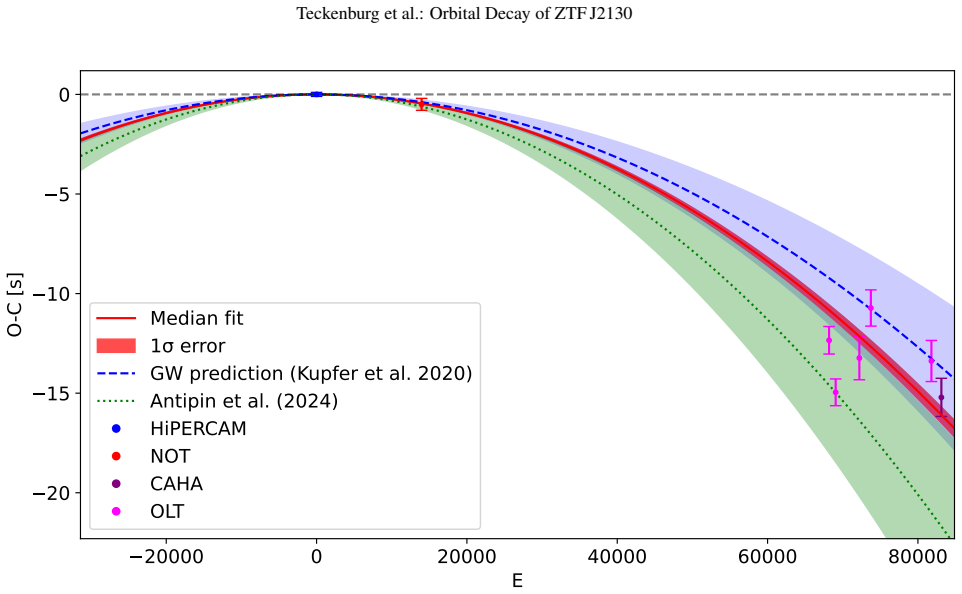
The authors measure an orbital period derivative of (−1.97 ± 0.05) × 10^{-12} s s^{-1} for ZTFJ2130. Interpreting this decay as the result of gravitational-wave emission alone yields a chirp mass of (0.408 ± 0.006) M_⊙. The observed decay is fully consistent with predictions from spectral and photometric modeling, and LISA data-analysis simulations indicate that the mission will measure the same chirp mass with an uncertainty of 5 percent.
What carries the argument
O-C timing analysis of high-cadence light curves, which accumulates the phase shift caused by the changing orbital period and converts it into a direct measurement of the period derivative.
If this is right
- The derived orbital decay matches the rate expected from spectral and light-curve models, confirming that gravitational waves dominate the angular-momentum loss.
- LISA is expected to recover the chirp mass to 5 percent precision, providing an independent check on the electromagnetic measurement.
- Modern qCMOS detectors on 1-meter-class telescopes can deliver the timing precision needed to detect orbital decay in other ultracompact binaries.
- Future LISA data could reveal deviations from pure gravitational-wave evolution if accretion or other processes contribute at a detectable level.
Where Pith is reading between the lines
- If the no-mass-transfer assumption holds, this system offers a clean test bed for low-frequency gravitational-wave predictions in the electromagnetic domain.
- Repeated observations of similar systems could build a sample of chirp masses that helps calibrate the overall population of LISA sources.
- Higher-precision timing could eventually place limits on small additional contributions such as magnetic braking once the gravitational-wave term is subtracted.
Load-bearing premise
The measured period derivative is produced solely by gravitational-wave emission with no measurable contribution from mass transfer, magnetic braking, or other astrophysical processes.
What would settle it
A new set of timing observations that yields a period derivative differing by more than a few percent from the value predicted by the current chirp mass, or a LISA detection whose amplitude is inconsistent with the electromagnetic chirp-mass value.
Figures

read the original abstract
Ultracompact Galactic binary systems (UCBs) emit low-frequency gravitational waves (GWs). The emission of GWs is causing these systems to lose angular momentum, which is detectable by observing an orbital period decay. ZTFJ213056.71+442046.5 (ZTFJ2130) is an UCB with a period of 39.3401(1) minutes consisting of a Roche lobe-filling hot subdwarf and a white dwarf companion. We attempt to measure the orbital decay rate $\dot{P}$ caused by GW emission of ZTFJ2130 and predict the expected GW signal for LISA. High-speed photometry was conducted using the FLI Kepler KL4040FI CMOS camera, mounted to the 1.2-meter Oskar L\"uhning telescope at the Hamburg Observatory as well as the Hamamatsu ORCA-Quest 2 qCMOS camera at the 1.23-meter telescope at CAHA in Spain. ZTFJ2130 was observed on six nights between August 2024 and September 2025. The obtained lightcurves combined with previous high-cadence observations were used to conduct an O-C timing analysis. Additionally, we employed the LISA data analysis tool ldasoft to model the expected GW data. We measure a period change of $(-1.97\pm0.05)\times10^{-12}\,\mathrm{ss^{-1}}$. Assuming only GW emission, this result was used to calculate a chirp mass of $(0.408\pm0.006)\,\mathrm{M_{\odot}}$. From ldasoft we predict that LISA will be able to measure the chirp mass with an uncertainty of 5%. We measure $\dot{P}$ with an uncertainty of only 2% and show that modern (q)CMOS detectors are well suited to provide precise timing measurements, enabling the measurement of the orbital decay of UCBs with high precision with modest size telescopes. The derived orbital decay is fully consistent with predictions from spectral and lightcurve modeling. We show that future observations with LISA can potentially provide a deviation from only gravitational wave effects, e.g. due to accretion, if the effect is sufficiently large.
Editorial analysis
A structured set of objections, weighed in public.
Referee Report
Summary. The paper reports high-cadence photometry of the ultracompact binary ZTF J213056.71+442046.5 (P=39.3401 min) using CMOS detectors on 1.2-m and 1.23-m telescopes. An O-C analysis of new and archival light curves yields an orbital period derivative of (-1.97 ± 0.05) × 10^{-12} s s^{-1}. Assuming gravitational-wave emission is the only angular-momentum-loss channel, this is converted via the quadrupole formula to a chirp mass of (0.408 ± 0.006) M_⊙. ldasoft is then used to forecast that LISA can recover the chirp mass to ~5% precision. The work also emphasizes the utility of modern (q)CMOS detectors for precise timing of ultracompact binaries.
Significance. If the central assumption holds, the result supplies a direct, high-precision (2.5% uncertainty) measurement of orbital decay in a Roche-lobe-filling hot-subdwarf + white-dwarf system that is consistent with independent spectral and light-curve modeling. It demonstrates that modest-aperture telescopes equipped with modern detectors can now reach the timing precision needed to detect gravitational-wave-driven decay, and it provides a concrete LISA forecast that could eventually test for additional angular-momentum-loss channels.
major comments (1)
- Abstract and O-C timing analysis section: The chirp-mass value (0.408 ± 0.006) M_⊙ is obtained directly from the measured dot{P} by inserting it into the pure-quadrupole formula. No quantitative upper bound is supplied on possible contributions from conservative mass transfer (whose sign and magnitude depend on q and dot{M}) or magnetic braking, even though the 2.5% precision on dot{P} means that a contribution at only a few percent of the observed value would shift the inferred chirp mass outside the quoted uncertainty. The consistency with spectral/light-curve modeling is cited as supporting evidence, but an explicit limit derived from the light-curve fit or evolutionary tracks is required to justify the assumption at the stated precision.
minor comments (2)
- Abstract: the notation 'ss^{-1}' should be written as 's s^{-1}' or 's^{-1}' for clarity.
- Observation log (presumably Table 1 or §2): list the exact mid-exposure times, exposure durations, and filter for each night so that the O-C data points can be reproduced.
Simulated Author's Rebuttal
We thank the referee for their careful reading of the manuscript and for the positive recommendation of minor revision. We address the single major comment below and will update the manuscript accordingly to strengthen the justification for our assumptions.
read point-by-point responses
-
Referee: Abstract and O-C timing analysis section: The chirp-mass value (0.408 ± 0.006) M_⊙ is obtained directly from the measured dot{P} by inserting it into the pure-quadrupole formula. No quantitative upper bound is supplied on possible contributions from conservative mass transfer (whose sign and magnitude depend on q and dot{M}) or magnetic braking, even though the 2.5% precision on dot{P} means that a contribution at only a few percent of the observed value would shift the inferred chirp mass outside the quoted uncertainty. The consistency with spectral/light-curve modeling is cited as supporting evidence, but an explicit limit derived from the light-curve fit or evolutionary tracks is required to justify the assumption at the stated precision.
Authors: We agree that an explicit quantitative upper bound on possible non-GW contributions would better support the pure-quadrupole assumption at the 2.5% precision level of our measurement. Although the manuscript already states that the observed decay is fully consistent with predictions from spectral and light-curve modeling, we acknowledge that this consistency should be made quantitative. In the revised manuscript we will add a short paragraph (or subsection) in the O-C timing analysis or discussion section that derives an upper limit on the mass-transfer contribution using the mass ratio q and the upper bound on |M-dot| already obtained from the light-curve and spectral fits. We will show that conservative mass transfer can affect dot{P} by at most ~1% (well below our uncertainty), while magnetic braking is expected to be negligible at this orbital period according to standard evolutionary tracks. These additions will not alter the reported dot{P} or chirp-mass values but will explicitly justify the assumption. revision: yes
Circularity Check
No circularity: measured dot{P} converted to chirp mass via standard quadrupole formula; LISA forecast uses external tool
full rationale
The paper's core derivation begins with an independent O-C timing analysis of multi-night photometric light curves to extract the observed orbital period derivative dot{P} = (-1.97 ± 0.05) × 10^{-12} s s^{-1}. This measured value is then inserted into the standard gravitational-wave quadrupole formula under the explicit assumption of pure GW-driven decay to obtain the chirp mass (0.408 ± 0.006) M_⊙. The conversion is a one-way algebraic application of a known relation and does not redefine dot{P}, refit any timing parameters, or feed the derived mass back into the photometry. The LISA detectability forecast is generated separately with the external ldasoft package and likewise introduces no closed loop. No load-bearing self-citations, uniqueness theorems, or ansatzes from prior author work are invoked to justify the mapping; the chain is therefore self-contained against external benchmarks and receives the default non-circularity finding.
Axiom & Free-Parameter Ledger
axioms (1)
- domain assumption Orbital angular-momentum loss is due solely to gravitational-wave emission via the quadrupole formula
Lean theorems connected to this paper
-
IndisputableMonolith/Foundation/RealityFromDistinction.leanreality_from_one_distinction unclear?
unclearRelation between the paper passage and the cited Recognition theorem.
Assuming only GW emission, this result was used to calculate a chirp mass of (0.408±0.006) M_⊙ ... Mc = c³/G (5/96 π^{-8/3} f^{-11/3} dot{f})^{3/5}
-
IndisputableMonolith/Patterns/Gravity/ZeroParameterGravity.leanzero_parameter_gravity_certificate unclear?
unclearRelation between the paper passage and the cited Recognition theorem.
The derived orbital decay is fully consistent with predictions from spectral and lightcurve modeling
What do these tags mean?
- matches
- The paper's claim is directly supported by a theorem in the formal canon.
- supports
- The theorem supports part of the paper's argument, but the paper may add assumptions or extra steps.
- extends
- The paper goes beyond the formal theorem; the theorem is a base layer rather than the whole result.
- uses
- The paper appears to rely on the theorem as machinery.
- contradicts
- The paper's claim conflicts with a theorem or certificate in the canon.
- unclear
- Pith found a possible connection, but the passage is too broad, indirect, or ambiguous to say the theorem truly supports the claim.
Reference graph
Works this paper leans on
-
[1]
2023, Living Reviews in Relativity, 26, 2
Amaro-Seoane, P., Andrews, J., Arca Sedda, M., et al. 2023, Living Reviews in Relativity, 26, 2
work page 2023
-
[2]
2024, Astronomy Letters, 50, 619
Antipin, S., Berdnikov, L., Postnov, K., et al. 2024, Astronomy Letters, 50, 619
work page 2024
-
[3]
Barlow, B. N., Corcoran, K. A., Parker, I. M., et al. 2022, ApJ, 928, 20
work page 2022
-
[4]
Bauer, E. B. & Kupfer, T. 2021, ApJ, 922, 245
work page 2021
-
[5]
Bauer, E. B., Schwab, J., & Bildsten, L. 2017, ApJ, 845, 97
work page 2017
-
[6]
Bildsten, L., Shen, K. J., Weinberg, N. N., & Nelemans, G. 2007, ApJL, 662, L95
work page 2007
-
[7]
Brooks, J., Bildsten, L., Marchant, P., & Paxton, B. 2015, ApJ, 807, 74
work page 2015
-
[8]
Copperwheat, C. M., Marsh, T. R., Dhillon, V . S., et al. 2010, MNRAS, 402, 1824
work page 2010
-
[9]
Cornish, N. & Robson, T. 2017, in Journal of Physics Conference Series, V ol. 840, Journal of Physics Conference Series (IOP), 012024
work page 2017
-
[10]
Craig, M., Crawford, S., Seifert, M., et al. 2023, astropy/ccdproc: 2.4.1
work page 2023
-
[11]
2022, Monthly Notices of the Royal Astronomical Society, 519, 148
Deshmukh, K., Kupfer, T., Hakala, P., et al. 2022, Monthly Notices of the Royal Astronomical Society, 519, 148
work page 2022
-
[12]
2021, Monthly Notices of the Royal Astronomical Society, 507, 350
Dhillon, V ., Bezawada, N., Black, M., et al. 2021, Monthly Notices of the Royal Astronomical Society, 507, 350
work page 2021
-
[13]
Finch, E., Bartolucci, G., Chucherko, D., et al. 2023, MNRAS, 522, 5358
work page 2023
-
[14]
Fink, M., Röpke, F. K., Hillebrandt, W., et al. 2010, A&A, 514, A53
work page 2010
-
[15]
Foreman-Mackey, D., Hogg, D. W., Lang, D., & Goodman, J. 2013, PASP, 125, 306
work page 2013
- [16]
- [17]
- [18]
- [19]
-
[20]
Geier, S., Maxted, P. F. L., Napiwotzki, R., et al. 2011, A&A, 526, A39
work page 2011
-
[21]
Geier, S., Østensen, R. H., Heber, U., et al. 2014, A&A, 562, A95
work page 2014
-
[22]
Han, Z., Podsiadlowski, P., Maxted, P. F. L., & Marsh, T. R. 2003, MNRAS, 341, 669
work page 2003
-
[23]
Han, Z., Podsiadlowski, P., Maxted, P. F. L., Marsh, T. R., & Ivanova, N. 2002, MNRAS, 336, 449
work page 2002
- [24]
-
[25]
2016, PASP, 128, 082001 Hünsch, M
Heber, U. 2016, PASP, 128, 082001 Hünsch, M. 2009, Monuments and Sites, 18, 274
work page 2016
- [26]
-
[27]
Kepler, S. O., Winget, D. E., Nather, R. E., et al. 1991, ApJ, 378, L45
work page 1991
- [28]
-
[29]
2025, in Advanced Photon Counting Techniques XIX, V ol
Krynski, J., Bernard, V ., Lalucaa, V ., et al. 2025, in Advanced Photon Counting Techniques XIX, V ol. 13448, SPIE, 103–116
work page 2025
-
[30]
Kupfer, T., Bauer, E. B., van Roestel, J., et al. 2022, ApJ, 925, L12
work page 2022
- [31]
- [32]
-
[33]
Kupfer, T., Prince, T. A., van Roestel, J., et al. 2021, MNRAS, 505, 1254
work page 2021
- [34]
- [35]
-
[36]
2016, Classical and Quantum Gravity, 33, 035010
Luo, J., Chen, L.-S., Duan, H.-Z., et al. 2016, Classical and Quantum Gravity, 33, 035010
work page 2016
-
[37]
Maxted, P. f. L., Heber, U., Marsh, T. R., & North, R. C. 2001, MNRAS, 326, 1391
work page 2001
-
[38]
Napiwotzki, R., Karl, C. A., Lisker, T., et al. 2004, Astrophysics and Space Sci- ence, 291, 321
work page 2004
- [39]
-
[40]
Nelemans, G., Yungelson, L. R., & Portegies Zwart, S. F. 2004, MNRAS, 349, 181
work page 2004
- [41]
-
[42]
2021, Nature Astronomy, 5, 1052
Pelisoli, I., Neunteufel, P., Geier, S., et al. 2021, Nature Astronomy, 5, 1052
work page 2021
-
[43]
Piersanti, L., Tornambé, A., & Yungelson, L. R. 2014, MNRAS, 445, 3239
work page 2014
-
[44]
Price-Whelan, A. M., Lim, P. L., Earl, N., et al. 2022, The Astrophysical Journal, 935, 167
work page 2022
-
[45]
Roth, M. M. 2024, Research Notes of the AAS, 8, 282
work page 2024
-
[46]
J., de Kool, M., & van den Heuvel, E
Savonije, G. J., de Kool, M., & van den Heuvel, E. P. J. 1986, A&A, 155, 51
work page 1986
-
[47]
Schaffenroth, V ., Barlow, B. N., Geier, S., et al. 2019, A&A, 630, A80
work page 2019
-
[48]
Schaffenroth, V ., Pelisoli, I., Barlow, B. N., Geier, S., & Kupfer, T. 2022, A&A, 666, A182
work page 2022
- [49]
-
[50]
Shah, S., van der Sluys, M., & Nelemans, G. 2012, A&A, 544, A153
work page 2012
-
[51]
Shen, K. J. & Bildsten, L. 2014, ApJ, 785, 61
work page 2014
-
[52]
2025, in Revista Mexicana de As- tronomia y Astrofisica Conference Series, V ol
Smit, W., van Heerden, H., & van Soelen, B. 2025, in Revista Mexicana de As- tronomia y Astrofisica Conference Series, V ol. 59, 9–12
work page 2025
-
[53]
Tutukov, A. V . & Fedorova, A. V . 1989, Soviet Astronomy, 33, 606
work page 1989
-
[54]
Tutukov, A. V . & Yungelson, L. R. 1990, Soviet Ast., 34, 57 Tyson B. Littenberg, N. J. C. 2025, GLASS, free software (Apache 2.0)
work page 1990
-
[55]
Vennes, S., Kawka, A., O’Toole, S. J., Németh, P., & Burton, D. 2012, ApJ, 759, L25
work page 2012
-
[56]
2018, Research in Astronomy and Astrophysics, 18, 049
Wang, B. 2018, Research in Astronomy and Astrophysics, 18, 049
work page 2018
- [57]
-
[58]
Warner, B. D. 2006, A practical guide to lightcurve photometry and analysis (Springer)
work page 2006
-
[59]
Woosley, S. E. & Kasen, D. 2011, ApJ, 734, 38
work page 2011
-
[60]
Yungelson, L. R. 2008, Astronomy Letters, 34, 620 Article number, page 6 of 6
work page 2008
discussion (0)
Sign in with ORCID, Apple, or X to comment. Anyone can read and Pith papers without signing in.