Diffuse interface approach to oxygen transport and metabolism under blood flow dynamics in microcirculations
Pith reviewed 2026-05-18 03:47 UTC · model grok-4.3
The pith
Red blood cells autonomously adjust oxygen supply to produce uniform tissue oxygenation.
A machine-rendered reading of the paper's core claim, the machinery that carries it, and where it could break.
Core claim
The paper proposes a diffuse interface approach for oxygen transport using a mixture formulation. Oxygen transport is formulated as an advection-diffusion-reaction equation, and all governing equations are rewritten in mixture forms using phase indicator functions so that every interface condition is carried inside the equations themselves. This removes the need to treat discontinuities on largely moving and deforming surfaces even when red blood cells are packed densely. Cellular flow is handled as a fluid-membrane interaction problem with the immersed boundary method. The combined scheme runs the coupled flow and oxygen problems across cytoplasm, plasma, and tissue on a single fixed mesh.
What carries the argument
Mixture formulation with phase indicator functions that folds every interface condition for oxygen transport and metabolism into a single advection-diffusion-reaction equation on a fixed mesh.
If this is right
- Simulations of oxygen delivery become practical for dense, deforming red blood cells inside branching capillary networks without explicit interface tracking.
- Each red blood cell alters its oxygen release in response to the local tissue oxygenation level it encounters.
- This local adjustment produces spatially homogeneous oxygen levels throughout the surrounding tissue.
- The same fixed-mesh framework couples fluid dynamics and reaction-diffusion transport across internal cell fluid, external plasma, and tissue.
Where Pith is reading between the lines
- The same mixture approach could be tested on other diffusion-reaction systems that involve many moving deformable objects.
- If the self-regulation holds, tissue oxygenation may stay stable even under irregular or pulsatile flow patterns not yet simulated.
- Adding spatial variation in tissue metabolism rate would provide a direct test of how robust the homogeneity result remains.
Load-bearing premise
The mixture formulation using phase indicator functions correctly embeds all interface conditions for oxygen transport and metabolism without loss of accuracy even under highly dense RBC conditions in capillary networks.
What would settle it
High-resolution measurements of oxygen concentration at many points inside living tissue surrounding a capillary network, taken while flow rate and local oxygen demand are varied, would show whether the predicted uniform distribution actually occurs.
Figures




read the original abstract
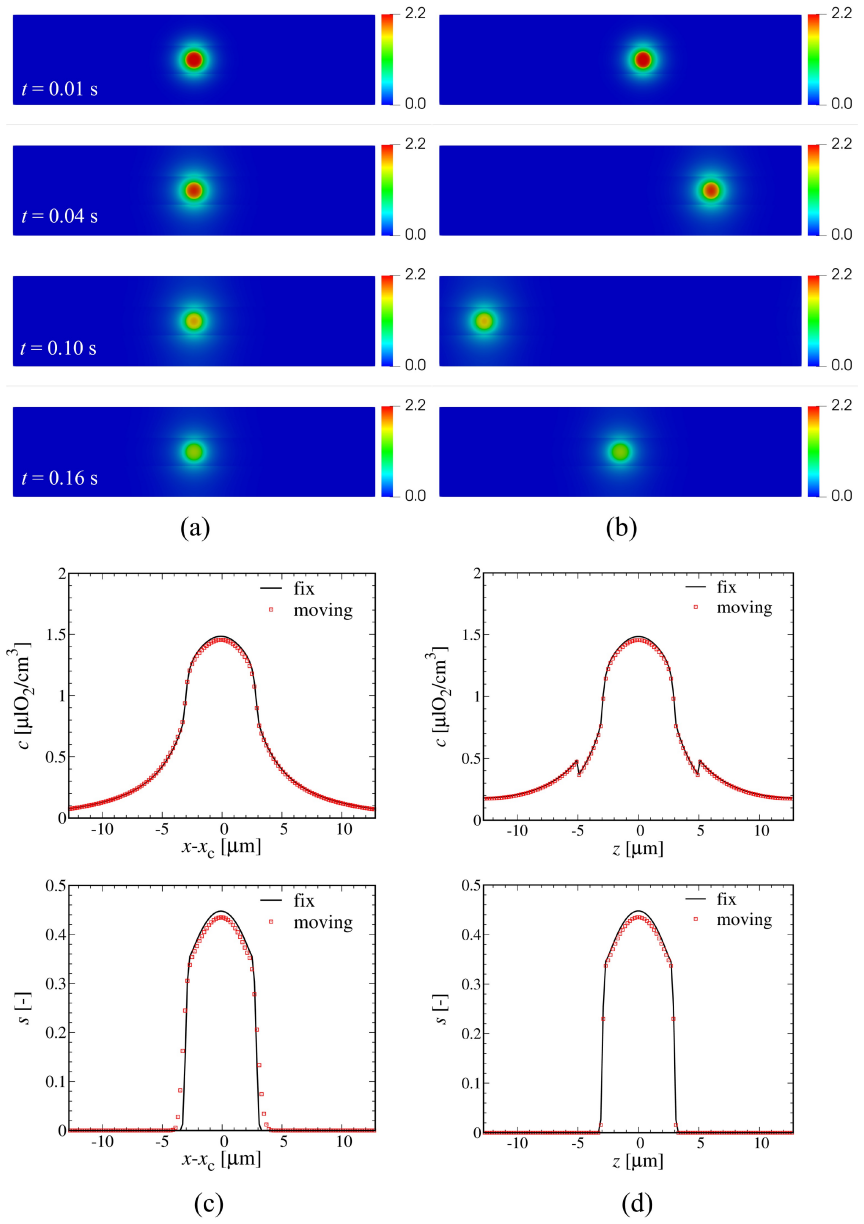
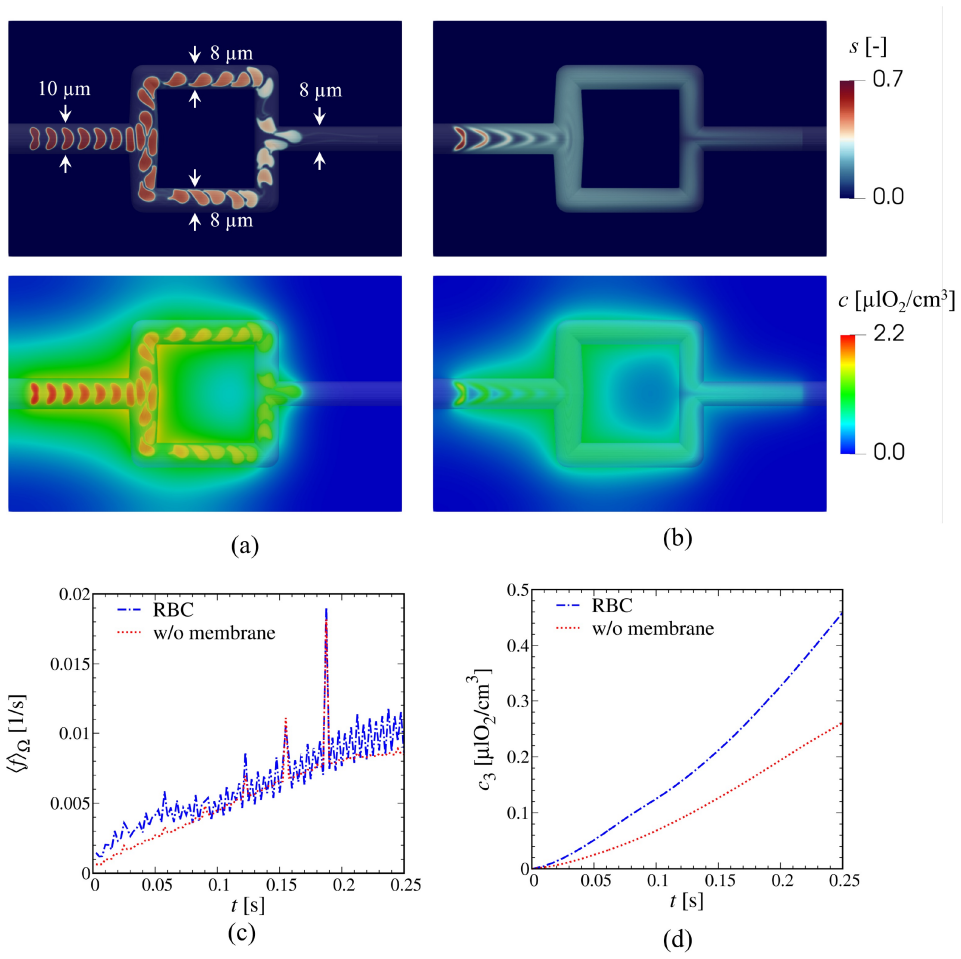
The relationship between the spatiotemporal distribution of oxygen transport and blood flow dynamics, accounting for the motion and deformation of individual red blood cells (RBCs), is of fundamental importance for understanding microcirculation systems. Three-dimensional (3D) modeling is indispensable for addressing complex oxygen transport and cellular behaviors in capillary networks; however, the computational approach is formidable for enforcing interface (or jump) conditions on largely moving and deforming interfaces. In this paper, we propose a diffuse interface approach for the oxygen transport using a mixture formulation. We formulate oxygen transport using an advection-diffusion-reaction equation and rewrite all governing equations in mixture forms using phase indicator functions, where all the interface conditions are included in the governing equations. This innovation avoids the complexity associated with discontinuities for largely moving interfaces in highly dense RBC conditions. We model cellular flow as a fluid-membrane interaction problem using the immersed boundary method (IBM). The method allows the seamless calculation of coupling problems for cellular flows and oxygen transports in the cytoplasm (internal fluid) of the RBC, plasma (external fluid), and tissue regions using a fixed Cartesian coordinate mesh. The proposed method accurately captures the analytical solution for spherically symmetric diffusion, and successfully demonstrates oxygen transport in both straight capillaries and their networks. These rigorous analyses suggest that RBCs can autonomously regulate the oxygen supply to tissues in response to the local tissue oxygenation level, resulting in the establishment of homogeneous tissue oxygenation.
Editorial analysis
A structured set of objections, weighed in public.
Referee Report
Summary. The paper develops a diffuse-interface method for oxygen transport and metabolism coupled to RBC motion and deformation in microcirculatory networks. The advection-diffusion-reaction equations are rewritten in mixture form via phase-indicator functions so that all interface conditions are embedded in the governing equations on a fixed Cartesian mesh; RBC flow is handled by the immersed-boundary method. The approach is shown to recover the analytical solution for spherically symmetric diffusion and is then applied to straight capillaries and capillary networks, from which the authors conclude that RBCs autonomously regulate oxygen supply in response to local tissue oxygenation, producing homogeneous tissue oxygen levels.
Significance. If the mixture formulation is shown to preserve interface conditions to sufficient accuracy under dense RBC packing, the method would supply a practical tool for three-dimensional simulations of coupled flow and oxygen transport without explicit interface tracking. The reported match to the spherical-diffusion solution and the demonstration in network geometries constitute concrete strengths; the autonomous-regulation observation, if robust, would be a noteworthy mechanistic insight for microcirculation physiology.
major comments (2)
- [Abstract] Abstract (paragraph on governing-equation rewrite): the central claim that RBCs autonomously regulate oxygen supply to yield homogeneous tissue oxygenation rests on the assertion that the mixture formulation with phase-indicator functions correctly embeds all jump conditions for oxygen flux and metabolism. No derivation of the mixture equations, no explicit verification that normal-flux continuity and reaction terms remain accurate when RBCs approach contact or walls, and no mesh-convergence or error-bar data are supplied; these omissions directly affect the load-bearing interpretation of the network results.
- [Abstract] Abstract (validation paragraph): the statement that the method 'accurately captures the analytical solution for spherically symmetric diffusion' is presented without quantitative error norms, grid-resolution details, or comparison against a sharp-interface reference solution at comparable hematocrit; without such metrics it is unclear whether the observed regulation effect survives the O(ε) smoothing errors inherent to the diffuse interface.
minor comments (1)
- [Abstract] The abstract does not specify the precise form of the phase-indicator functions or the value of the smoothing length ε used in the reported simulations.
Simulated Author's Rebuttal
We thank the referee for the thoughtful and constructive review of our manuscript. The comments on the need for explicit derivation of the mixture equations and quantitative validation metrics are well taken. We address each major comment below and will incorporate revisions to strengthen the presentation and support for our conclusions.
read point-by-point responses
-
Referee: [Abstract] Abstract (paragraph on governing-equation rewrite): the central claim that RBCs autonomously regulate oxygen supply to yield homogeneous tissue oxygenation rests on the assertion that the mixture formulation with phase-indicator functions correctly embeds all jump conditions for oxygen flux and metabolism. No derivation of the mixture equations, no explicit verification that normal-flux continuity and reaction terms remain accurate when RBCs approach contact or walls, and no mesh-convergence or error-bar data are supplied; these omissions directly affect the load-bearing interpretation of the network results.
Authors: We appreciate the referee highlighting the importance of a transparent derivation. The manuscript introduces the mixture formulation via phase-indicator functions to embed interface conditions on a fixed mesh, but we acknowledge that an expanded, step-by-step derivation would improve clarity. In the revised manuscript we will add a dedicated subsection deriving the mixture advection-diffusion-reaction equations from the sharp-interface jump conditions, explicitly showing how normal-flux continuity and volumetric reaction terms are preserved. We will also include targeted numerical tests for RBCs in near-contact and near-wall configurations, together with mesh-convergence studies and error bars on the network results, to confirm that the autonomous-regulation observation remains robust. revision: yes
-
Referee: [Abstract] Abstract (validation paragraph): the statement that the method 'accurately captures the analytical solution for spherically symmetric diffusion' is presented without quantitative error norms, grid-resolution details, or comparison against a sharp-interface reference solution at comparable hematocrit; without such metrics it is unclear whether the observed regulation effect survives the O(ε) smoothing errors inherent to the diffuse interface.
Authors: We agree that quantitative error metrics are essential to substantiate the validation claim. The revised manuscript will report L2 and L∞ error norms for the spherically symmetric diffusion test, specify the grid resolutions employed, and add a side-by-side comparison against a sharp-interface reference solution at comparable hematocrit. These additions will directly address whether the homogeneous oxygenation pattern persists within the O(ε) smoothing tolerance of the diffuse interface. revision: yes
Circularity Check
No circularity: forward simulation of mixture formulation yields regulation result as output
full rationale
The paper introduces a diffuse-interface mixture formulation by rewriting the advection-diffusion-reaction equation with phase indicator functions so that interface conditions are embedded in the governing equations. This modeling step is presented as a direct rewriting that avoids explicit discontinuity handling; it is not derived from or fitted to the target homogeneous-oxygenation outcome. The method is validated against an independent analytical solution for spherically symmetric diffusion, then applied via IBM-coupled simulations to capillary networks. The observed autonomous regulation and homogeneous tissue oxygenation emerge as simulation outputs under the stated assumptions, without reduction to a fitted parameter, self-citation chain, or definitional equivalence. The central claim therefore remains independent of its own inputs.
Axiom & Free-Parameter Ledger
axioms (2)
- standard math Oxygen transport obeys an advection-diffusion-reaction equation in each region
- domain assumption Phase indicator functions allow all interface conditions to be included inside the governing equations without explicit enforcement
Lean theorems connected to this paper
-
IndisputableMonolith/Foundation/RealityFromDistinction.leanreality_from_one_distinction unclear?
unclearRelation between the paper passage and the cited Recognition theorem.
This innovation avoids the complexity associated with discontinuities for largely moving interfaces in highly dense RBC conditions.
What do these tags mean?
- matches
- The paper's claim is directly supported by a theorem in the formal canon.
- supports
- The theorem supports part of the paper's argument, but the paper may add assumptions or extra steps.
- extends
- The paper goes beyond the formal theorem; the theorem is a base layer rather than the whole result.
- uses
- The paper appears to rely on the theorem as machinery.
- contradicts
- The paper's claim conflicts with a theorem or certificate in the canon.
- unclear
- Pith found a possible connection, but the passage is too broad, indirect, or ambiguous to say the theorem truly supports the claim.
Reference graph
Works this paper leans on
-
[1]
Krogh, The progress of physiology, Science 70 (1929) 200–2 04
A. Krogh, The progress of physiology, Science 70 (1929) 200–2 04. doi:10.1152/ajplegacy.1929.90.2.243
-
[2]
A. H. Ramsook, P. B. Dominelli, S. A. Angus, J. W. Senefeld, C. C. W igginsa, M. J. Joyner, The oxygen transport cascade and exercise: Less ons from compara- tive physiology, Comp. Biochem. Physol. A Mol. Integr. Physiol. 282 ( 2023) 111442. doi:10.1016/j.cbpa.2023.111442
-
[3]
O. Manohar, Right heart pressures and blood-gas tensions in po nies during exercise and laryngeal hemiplegia, Am. J. Physiol. Heart Circ. Physiol. 251 (19 86) H121–H126. doi:10.1152/ajpheart.1986.251.1.H121
-
[4]
E. K. Weir, J. L´ opez-Barneo, K. J. Buckler, S. L. Archer, Mec hanisms of dis- ease acute oxygen-sensing mechanisms, N. Engl. J. Med. 353 (200 5) 2042–2055. doi:10.1056/NEJMc053396
-
[5]
A. Krogh, The number and distribution of capillaries in muscles with c alculations of the oxygen pressure head necessary for supplying the tissue, J. Phy siol. 52 (1919) 409–415. doi:10.1113/jphysiol.1919.sp001839
-
[6]
J. D. Hellums, The resistance to oxygen transport in the capillarie s rela- tive to that in the surrounding tissue, Microvasc. Res. 13 (1977) 1 31–136. doi:10.1016/0026-2862(77)90122-4
-
[7]
W. J. Federspiel, A. S.Popel, A theoretical analysis of the effect o f the particulate nature of blood on oxygen release in capillaries, Microvasc. Res. 32 ( 1986) 164–189. doi:10.1016/0026-2862(86)90052-x
-
[8]
J. D. Hellums, P. K. Nair, N. S. Huang, N. Ohshima, Simulation of intr aluminal gas transport processes in the microcirculation, Ann. Biomed. Eng 24 (1995) 1–24. doi:10.1007/BF02770991
-
[9]
C. H. Wang, A. S. Popel, Effect of red blood cell shape on oxygen t ransport in capillaries, Math Biosci. 116 (1993) 89–110. doi:10.1016/0025-5564(93)90062-f
-
[10]
C. D. Eggleton, A. Vadapalli, T. K. Roy, A. S. Popel, Calculations o f intracap- illary oxygen tension distributions in muscle, Math. Biosci. 167 (2000) 123–143. doi:10.1016/s0025-5564(00)00038-9
-
[11]
A. L¨ ucker, B. Weber, P. Jenny, A dynamic model of oxygen tr ansport from capillaries to tissue with moving red blood cells, Am. J. Physiol. Heart. Circ. Phys iol. 308 (2015) H206–H216. doi:10.1152/ajpheart.00447.2014
-
[12]
A. L¨ ucker, T. W. Secomb, B. Weber, P. Jenny, The relative infl uence of hematocrit and red blood cell velocity on oxygen transport from capillaries to tissue , Microcirculation 24 (2017) e12337. doi:10.1111/micc.12337. 37
-
[13]
C. B. Schaffer, B. Friedman, N. Nishimura, L. F. Schroeder, P. S. Tsai, F. F. Ebner, P. D. Lyden, D. Kleinfeld, Two-photon imaging of cortical surface m icrovessels reveals a robust redistributionin blood flow after vascular occlusion, PLoS B iol. 4 (2006) e22. doi:10.1371/journal.pbio.0040022
-
[14]
J. Lecoq, A. Parpaleix, E. Roussakis, M. Ducros, Y. G. Housse n, S. A. Vinogradov, S. Charpak, Simultaneous two-photon imaging of oxygen and blood fl ow in deep cerebral vessels, Nat. Med. 17 (2011) 893–898. doi:10.1038/nm.2394
-
[15]
D. G. Lyons, A. Parpaleix, M. Roche, S. Charpak, Mapping oxyg en concentration in the awake mouse brain, eLIFE 5 (2016) e12024. doi:10.7554/eLife.12024
-
[16]
M. Moeini, X. Lu, P. K. Avti, R. Damseh, S. B. F. Picard, D. Boas, A. Kakkar, F. Lesage, Compromised microvascular oxygen delivery increases b rain tissue vulnera- bility with age, Sci. Rep. 8 (2018) 8219. doi:10.1038/s41598-018-26543-w
- [17]
-
[18]
doi:10.3389/fncom.2016.00082
-
[19]
I. G. Gould, P. Tsai, D. Kleinfeld, A. Linninger, The capillary bed off ers the largest hemodynamic resistance to the cortical blood supply, J. Cereb. Blo od Flow Metab. 37 (2017) 52––68. doi:10.1177/0271678X16671146
-
[20]
G. Hartung, C. Vesel, R. Morley, A. Alaraj, J. Sled, D. Kleinfeld, A. Linninger, Simulations of blood as a suspension predicts a depth dependent hem atocrit in the circulation throughout the cerebral cortex, PLoS Comput. Biol. 1 4 (2018) e1006549. doi:10.1371/journal.pcbi.1006549
-
[21]
P. W. Sweeney, S. Walker-Samuel, R. J. Shipley, Insights into ce rebral haemodynamics and oxygenation utilising in vivo mural cell imaging and mathematical mo delling, Sci. Rep. 8 (2018) 2373. doi:10.1038/s41598-017-19086-z
-
[22]
D. Goldman, A. S. Popel, A computational study of the effect of capillary network anastomoses and tortuosity on oxygen transport, J. Theor. Bio l. 206 (2000) 181–194. doi:10.1006/jtbi.2000.2113
-
[23]
T. K¨ oppl, E. Vidotto, B. Wohlmuth, A 3D-1D coupled blood flow an d oxygen transport model to generate microvascular networks, Int. J. Numer. Meth . Biomed. Engng. 36 (2020) e3386. doi:10.1002/cnm.3386
-
[24]
N. Takeishi, Y. Imai, K. Nakaaki, T. Yamaguchi, T. Ishikawa, Leu kocyte margination at arteriole shear rate, Physiol. Rep. 2 (2014) e12037. doi:10.14814/phy2.12037
-
[25]
N. Takeishi, Y. Imai, T. Yamaguchi, T. Ishikawa, Flow of a circulat ing tu- mor cell and red blood cells in microvessels, Phys. Rev. E. 92 (2015) 0 63011. doi:10.1103/PhysRevE.92.063011. 38
-
[26]
S. Ii, K. Shimizu, K. Sugiyama, S. Takagi, Continuum and stochas tic approach for cell adhesion process based on eulerian fluid-capsule coupling with lagran gian markers, J. Comput. Phys. 374 (2018) 769–786. doi:10.1016/j.jcp.2018.08.002
-
[27]
P. Balogh, P. Bagchi, Acomputationalapproachtomodeling cellula r-scale blood flow in complex geometry, J. Comput. Phys. 334 (2018) 280–3 07. doi:10.1016/j.jcp.2017.01.007
-
[28]
P. Balogh, P. Bagchi, Direct numerical simulation of cellular-scale blood flow in 3D microvascular networks, Biophys. J. 113 (2017) 2815–28 26. doi:10.1016/j.bpj.2017.10.020
-
[29]
F. Gibou, L. Chen, D. N. adn S. Banerjee, A level-set based sha rp interface method for the multiphase incompressible navier–stokes equations with phase c hange, J. Comput. Phys. 222 (2007) 536–555. doi:10.1016/j.jcp.2006.07.035
-
[30]
F. Gibou, R. P. Fedkiw, L.-T. Cheng, M. Kang, A second-order- accurate symmetric discretization of the poisson equation on irregular domains, Journa l of Computational Physics 176 (1) (2002) 205–227. doi:10.1006/jcph.2001.6977
-
[31]
R. J. LeVeque, Z. Li, The immersed interface method for elliptic e quations with discon- tinuous coefficients and singular sources, SIAM J. Numer. Anal. 31 ( 4) (1994) 1019–1044. doi:10.1137/0731054
-
[32]
A. T. Layton, Modeling water transport across elastic bounda ries using an explicit jump method, SIAM J. Numer. Anal. 28 (6) (2006) 2189–2207. doi:10.1137/050642198
-
[33]
P. G. Jayathilake, B. C. Khoo, Z. Than, N. E. Wijeysundera, De formation and os- motic swelling of an elastic membrane capsule in stokes flows by the imme rsed interface method, Chem. Eng. Sci. 65 (2010) 1237–1252. doi:10.1016/j.ces.2009.09.078
-
[34]
P. G. Jayathilake, B. C. Khoo, Z. Than, N. E. Wijeysundera, Ef ect of membrane perme- ability on capsule substrate adhesion: Computation using immersed in terface method, Chem. Eng. Sci. 65 (2010) 3565–3578. doi:10.1016/j.ces.2010.02.050
-
[35]
P. G. Jayathilake, G. Liu, Z. Tan, B. C. Khoo, Numerical study o f a permeable capsule under stokes flows by the immersed interface method, Chem. Eng. Sci. 66 (2011) 2080–
work page 2011
-
[36]
doi:10.1016/j.ces.2011.02.005
-
[37]
S. Miyauchi, S. Takeuchi, T. Kajishima, A numerical method for m ass transfer by a thin moving membrane with selective permeabilities, J. Comput. Phys. 284 (2015) 490–504. doi:10.1016/j.jcp.2014.12.048
-
[38]
Z. Wang, F. Colin, G. Le, J. Zhang, Counter-extrapolation met hod for conjugate heat and mass transfer with interfacial discontinuity, Int. J. Numer. M ethods Heat Fluid Flow 27 (10) (2017) 2231–2258. doi:10.1108/HFF-10-2016-0422 . 39
-
[39]
F. A. Amiri, J. Zhang, Oxygen transport across tank-treadin g red blood cell: Individual and joint roles of flow convection and oxygen-hemoglobin reaction, Microvasc. Res. 145 (2023) 104447. doi:10.1016/j.mvr.2022.104447
-
[40]
F. A. Amiri, J. Zhang, Tissue oxygenation around capillaries: Effe cts of hematocrit and arteriole oxygen condition, Bull. Math. Biol. 85 (2023 ) 50. doi:10.1007/s11538-023-01155-2
-
[41]
Z. Zhao, J. Yan, Enriched immersed boundary method (eibm) fo r interface-coupled multi-physics and applications to convective conjugate heat trans fer, Comput. Meth. Appl. Mech. Eng. 401 (2022) 115667. doi:10.1016/j.cma.2022.115667
-
[42]
D. Henneaux, P. Schrooyen, P. Chatelain, T. Magin, High-orde r enforcement of jumps conditions between compressible viscous phases: An extended inte rior penalty discon- tinuous galerkin method for sharp interface simulation, Comput. Me th. Appl. Mech. Eng. 415 (2023) 116215. doi:10.1016/j.cma.2023.116215
-
[43]
H. Huang, K. Sugiyama, S. Takagi, An immersed boundary metho d for restricted diffusion with permeable interfaces, J. Comput. Phys. 228 (15) (20 09) 5317–5322. doi:10.1016/j.jcp.2009.04.040
-
[44]
X. Gong, Z. Gong, H. Huang, An immersed boundary method for mass transfer across permeable moving interfaces, J. Comput. Phys. 278 (2014) 148–1 68
work page 2014
-
[45]
X. Wang, X. Gong, K. Sugiyama, S. Takagi, H. Huang, An immerse d boundary method for mass transfer through porous biomembranes under large def ormations, J. Comput. Phys. 413 (2020) 109444. doi:10.1016/j.jcp.2020.109444
-
[46]
F. A. Amiri, J. Zhang, An immersed membrane method for mass tr ansfer across flexible semipermeable membranes in flows, Int. Commun. Heat Mass Transf . 128 (2021) 105601. doi:10.1016/j.icheatmasstransfer.2021.105601
-
[47]
M. Reder, A. Prahs, D. Schneider, B. Nestler, Viscous stress approximations in diffuse interface methods for two-phase flow based on mechanical jump c onditions, Comput. Meth. Appl. Mech. Eng. 432 (2024) 117341. doi:10.1016/j.cma.2024.117341
-
[48]
S. K. Stoter, P. M¨ uller, L. Cicalese, M. Tuveri, D. Schillinger, T. J. Hughes, A diffuse interface method for the navier–stokes/darcy equations: Perf usion profile for a patient- specific human liver based on mri scans, Comput. Meth. Appl. Mech. Eng. 321 (2017) 70–102. doi:10.1016/j.cma.2017.04.002
-
[49]
C. S. Peskin, The immersed boundary method, Acta Numer. 11 ( 2002) 479–517. doi:10.1017/S0962492902000077
-
[50]
A. Clark Jr., W. J. Federspiel, P. A. A. Clark, G. R. Cokelet, Oxyg en delivery from red cells, Biophys. J. 47 (1985) 171–181. doi:10.1016/s0006-3495(85)83890-x
-
[51]
D. Goldman, Theoretical models of microvascular oxygen trans port to tissue, Microcir- culation 15 (2008) 795–811. doi:10.1080/10739680801938289. 40
-
[52]
M. Nicoli, M. Plapp, H. Henry, Tensorial mobilities for accurate so lution of trans- port problems in models with diffuse interfaces, Phys. Rev. E 84 (201 1) 046707. doi:10.1103/PhysRevE.84.046707
-
[53]
R. Skalak, A. Tozeren, R. P. Zarda, S. Chien, Strain energy fu nction of red blood cell membranes, Biophys. J. 13 (1973) 245–264. doi:10.1016/S0006-3495(73)85983-1
-
[54]
O.-Y. Zhong-can, W. Helfrich, Bending energy of vesicle membra nes: Gen- eral expressions for the first, second, and third variation of the shape energy and applications to spheres and cylinders, Phys. Rev. A 39 (1989) 5 280–5288. doi:10.1103/PhysRevA.39.5280
-
[55]
Xu, Convergence of discrete laplace-beltrami operators o ver surfaces, Comput
G. Xu, Convergence of discrete laplace-beltrami operators o ver surfaces, Comput. Math. Appl. 48 (3) (2004) 347–360. doi:10.1016/j.camwa.2004.05.001
-
[56]
M. Reuter, S. Biasotti, D. Giorgi, G. Patan` e, M. Spagnuolo, Dis crete laplace–beltrami operators for shape analysis and segmentation, Comput. Graph. 33 (3) (2009) 381–390. doi:10.1016/j.cag.2009.03.005
-
[57]
A. Yazdani, P. Bagchi, Three-dimensional numerical simulation o f vesicle dy- namics using a front-tracking method, Phys. Rev. E 85 (2012) 056 308. doi:10.1103/PhysRevE.85.056308
-
[58]
S. O. Unverdi, G. Tryggvason, A front-tracking method for v iscous, in- compressible, multi-fluid flows, J. Comput. Phys. 100 (1992) 25–37 . doi:10.1016/0021-9991(92)90307-K
-
[59]
S. Ii, K. Sugiyama, S. Takeuchi, S. Takagi, Y. Matsumoto, F. Xia o, An interface capturing method with a continuous function: the THINC method with multi-dimensional reconstruction, J. Comput. Phys. 231 (201 2) 2328–2358. doi:10.1016/j.jcp.2011.11.038
-
[60]
G. Weymouth, D. K. Yue, Boundary data immersion method for c artesian-grid simu- lations of fluid-body interaction problems, Journal of Computation al Physics 230 (16) (2011) 6233–6247. doi:10.1016/j.jcp.2011.04.022
-
[61]
L. Fu, X. Y. Hu, N. A. Adams, A family of high-order targeted en o schemes for compressible-fluid simulations, J. Comput. Phys. 305 ( 2016) 333–359. doi:10.1016/j.jcp.2015.10.037
-
[62]
H. F. Harlow, J. E. Welch, Numerical calculation of time–depende nt viscous incompress- ible flow of fluid with free surface, Phys. Fluids 8 (1965) 2182. doi:10.1063/1.1761178
-
[63]
S. Ii, M. A. H. M. Adib, Y. Watanabe, S. Wada, Physically consiste nt data assimilation method based on feedback control for patient-specific blood flow analysis, Int. J. Numer. Methods Biomed Eng. 34 (1) (2018) e2910. doi:10.1002/cnm.2910
-
[64]
G.-S. Jiang, C.-W. Shu, Efficient implementation of weighted ENO sc hemes, J. Comput. Phys. 126 (1996) 202–228. doi:10.1006/jcph.1996.0130. 41
-
[65]
F. Xiao, Y. Honma, T. kono, A simple algebraic interface capturin g scheme using hy- perbolic tangent function, Int. J. Numer. Meth. Fluid. 48 (2005) 1 023–1040
work page 2005
-
[66]
N. Mohandas, P. G. Gallagher, Red cell membrane: past, prese nt, and future, Blood 112 (2008) 3939–3948
work page 2008
-
[67]
J. Harkness, R. B. Whittington, Blood-plasma viscosity: an app roximate temperature- invariant arising from generalised concepts, Biorheology 6 (1970) 1 69–187
work page 1970
- [68]
-
[69]
N. Takeishi, Y. Imai, Capture of microparticles by bolus flow of re d blood cells in capillaries, Sci Rep 7 (2017) 5381. doi:10.1038/s41598-017-05924-7
-
[70]
A. R. Pries, D. Neuhaus, P. Gaehtgens, Blood viscosity in tube fl ow: dependence on diameter and hematocrit, Am. J. Physiol. Heart Circ. Physiol. 263 (6 ) (1992) H1770– H1778. doi:10.1152/ajpheart.1992.263.6.H1770
-
[71]
H. Hartridge, F. J. W. Roughton, The rate of distribution of dis solved gases between the red blood corpuscle and its fluid environment, J. Physiol. 62 (192 7) 232–242
-
[72]
Z. Sun, S. Inaba, F. Xiao, Boundary variation diminishing (bvd) r econstruction: A new approach to improve godunov schemes, J. Comput. Phys. 322 (2016) 309–325. doi:10.1016/j.jcp.2016.06.051
-
[73]
H. Wakimura, T. Li, K.-M. Shyue, T. Aoki, F. Xiao, High-resolution boundary variation diminishing scheme for two-phase compressible flow with cavitation an d evaporation, J. Comput. Phys. 513 (2024) 113164. doi:10.1016/j.jcp.2024.113164
-
[74]
H. G. Augustin, G. Y. Koh, Organotypic vascularture: from de scriptive heterogeneity to functional pathophysiology, Science 357 (2017) 771. doi:10.1126/science.aal2379
-
[75]
Popel, Theory of oxygen transport to tissue, Crit
A. Popel, Theory of oxygen transport to tissue, Crit. Rev. Bio med. Eng. 17 (1989) 257–321
work page 1989
-
[76]
B. Li, T. V. Esipova, I. Sencan, K. Kilic, B. Fu, M. Desjardins, M. Moeini, S. Kura, M. A. Yaseen, F. Lesage, L. Østergaard, A. Devor, D. A. Boas, S. A. V inogradov, S. Sakadˇ zi´ c, More homogeneous capillary flow and oxygenation in deeper cortical layers correlate with increased oxygen extraction, eLife 8 (2019) e42299. doi:10.7554/eLife.42299
-
[77]
T. J. McMahon, Red blood cell deformability, vasoactive mediato rs, and adhesion, Front. Physiol. 10 (2019) 1417. doi:10.3389/fphys.2019.01417
-
[78]
D. G. Buerk, Can we model nitric oxide biotransport? A survey o f mathematical models for a simple diatomic molecule with surprisingly complex biological activitie s, Annu. Rev. Biomed. Eng. 3 (2001) 109–143. doi:10.1146/annurev.bioeng.3.1.109
-
[79]
P. Carmeliet, R. K. Jain, Principles and mechanisms of vessel nor malization for cancer and other angiogenic diseases, Nat. Rev. Drug Discov. 10 ( 2011) 417–427. doi:10.1038/nrd3455. 42
discussion (0)
Sign in with ORCID, Apple, or X to comment. Anyone can read and Pith papers without signing in.