The IDEA detector concept for FCC-ee
Pith reviewed 2026-05-18 03:57 UTC · model grok-4.3
The pith
IDEA detector concept pairs a lightweight drift chamber with dual-readout calorimetry for FCC-ee precision measurements.
A machine-rendered reading of the paper's core claim, the machinery that carries it, and where it could break.
Core claim
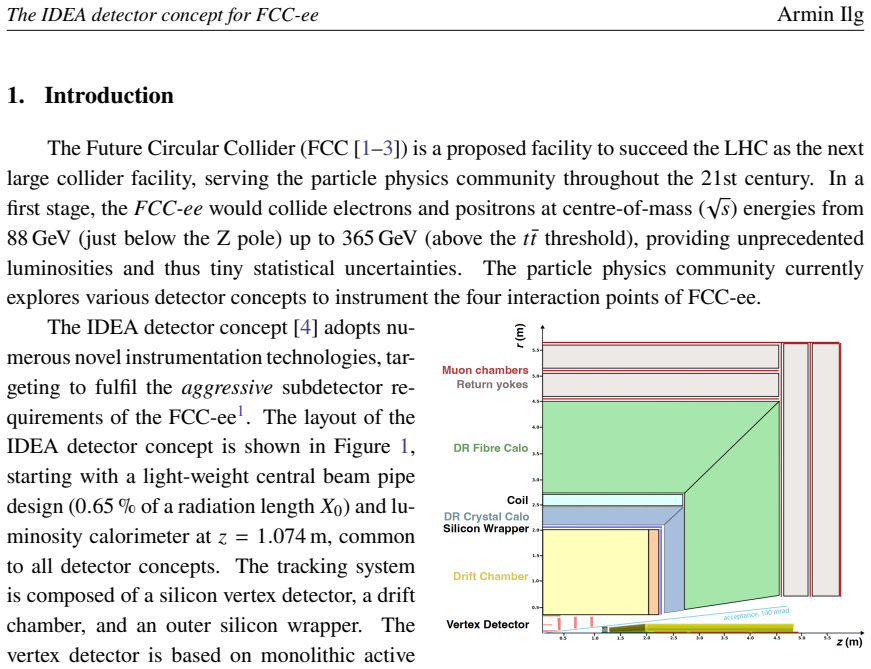
IDEA is a detector concept optimised for FCC-ee and composed of a vertex detector based on MAPS, a very light drift chamber, a silicon wrapper, a high resolution dual-readout crystal electromagnetic calorimeter, an HTS based superconducting solenoid, a dual-readout fibre calorimeter, and three layers of muon chambers embedded in the magnet flux return yoke. The paper discusses the physics requirements and the technical solutions chosen in the various sub-systems to address them, followed by a description of the detector R&D currently in progress, test-beam results, and the expected performance on some key physics benchmarks.
What carries the argument
The IDEA detector concept, which integrates a very light drift chamber for low-material tracking with dual-readout calorimeters for simultaneous electromagnetic and hadronic energy measurement.
If this is right
- The low-mass tracking system enables precise vertex and momentum reconstruction with reduced multiple scattering.
- Dual-readout calorimetry provides simultaneous high-resolution electromagnetic and hadronic measurements in a single device.
- Muon chambers placed in the flux return yoke deliver clean identification over a large solid angle.
- The overall layout supports the high-luminosity FCC-ee physics program by meeting benchmark requirements for Higgs and electroweak measurements.
Where Pith is reading between the lines
- Successful validation of the dual-readout technique could encourage its use in other future collider experiments.
- Integration of the HTS solenoid may reduce cryogenic infrastructure demands compared with conventional low-temperature designs.
- The modular subsystem approach allows independent upgrades if new sensor technologies become available.
Load-bearing premise
The technical solutions chosen for each sub-system will successfully meet the physics requirements and deliver the expected performance on key benchmarks once the ongoing R&D and test-beam validations are complete.
What would settle it
Test-beam data showing that the dual-readout crystal calorimeter fails to reach the targeted electromagnetic energy resolution or that the drift chamber exceeds the allowed material budget would undermine the performance claims for the full detector.
Figures


read the original abstract
The electron-positron stage of the Future Circular Collider (FCC-ee) provides exciting opportunities that are enabled by next generation particle physics detectors. This contribution presents IDEA, a detector concept optimised for FCC-ee and composed of a vertex detector based on MAPS, a very light drift chamber, a silicon wrapper, a high resolution dual-readout crystal electromagnetic calorimeter, an HTS based superconducting solenoid, a dual-readout fibre calorimeter, and three layers of muon chambers embedded in the magnet flux return yoke. In particular, the physics requirements and the technical solutions chosen in the various sub-systems to address them are discussed. This is followed by a description of the detector R&D currently in progress, test-beam results, and the expected performance on some key physics benchmarks.
Editorial analysis
A structured set of objections, weighed in public.
Referee Report
Summary. The manuscript presents the IDEA detector concept optimized for the FCC-ee, detailing its sub-systems (MAPS vertex detector, very light drift chamber, silicon wrapper, dual-readout crystal ECAL, HTS superconducting solenoid, dual-readout fibre HCAL, and muon chambers in the flux return) along with the physics requirements they address, chosen technical solutions, ongoing R&D activities, test-beam results, and expected performance on selected key physics benchmarks.
Significance. If the integrated performance claims are validated, the IDEA concept would represent a technically coherent and low-material-budget detector design well-matched to the precision physics program at FCC-ee, particularly for Higgs recoil mass measurements, jet energy resolution, and flavor tagging. The dual-readout calorimetry and HTS solenoid choices address longstanding challenges in e+e- collider detectors and could influence future designs.
major comments (2)
- [Expected performance on key physics benchmarks] The section on expected performance and benchmarks: the quoted figures for jet energy resolution, Higgs recoil mass resolution, and similar metrics are presented as meeting FCC-ee requirements, yet the text indicates these derive from Monte Carlo studies that assume idealized subsystem interfaces, negligible additional material from services, and perfect alignment. No description is given of a fully coupled simulation or combined test-beam campaign that would confirm the performance remains within specification once all subsystems are integrated inside the solenoid.
- [Detector R&D and test-beam results] R&D and test-beam results section: while subsystem-level test-beam data are cited for the drift chamber, crystal calorimeter, and fibre calorimeter, the manuscript does not quantify how these isolated results propagate to the full-detector level when combined with the MAPS vertex detector and HTS solenoid field; this extrapolation is load-bearing for the central claim that the chosen technical solutions will meet the physics requirements.
minor comments (2)
- [Detector layout figures] Figure captions for the overall detector layout and subsystem schematics could more explicitly label the material budget contributions and the location of services to aid readers in assessing the low-mass claims.
- [Physics requirements discussion] A short table summarizing the key performance targets (e.g., vertex resolution, ECAL energy resolution, muon identification efficiency) versus the values achieved in simulation or test beams would improve clarity.
Simulated Author's Rebuttal
We thank the referee for the thorough review and the encouraging assessment of the IDEA detector concept. We address the major comments in detail below and have made revisions to the manuscript to improve clarity on the simulation assumptions and R&D extrapolations.
read point-by-point responses
-
Referee: [Expected performance on key physics benchmarks] The section on expected performance and benchmarks: the quoted figures for jet energy resolution, Higgs recoil mass resolution, and similar metrics are presented as meeting FCC-ee requirements, yet the text indicates these derive from Monte Carlo studies that assume idealized subsystem interfaces, negligible additional material from services, and perfect alignment. No description is given of a fully coupled simulation or combined test-beam campaign that would confirm the performance remains within specification once all subsystems are integrated inside the solenoid.
Authors: We acknowledge the validity of this observation. The performance metrics presented are indeed obtained from Monte Carlo simulations that incorporate idealized assumptions regarding subsystem interfaces, material budgets, and alignment. These assumptions are based on the design specifications of the low-mass components and are intended to represent the target performance of the concept. A complete, fully coupled simulation of the integrated detector, including all services and the effects of the HTS solenoid field on all subsystems, is currently under development as part of the ongoing R&D program. In the revised version of the manuscript, we have added a new paragraph in the 'Expected performance' section that explicitly states the assumptions used in the current studies and outlines the roadmap towards more comprehensive simulations. We believe this addresses the concern while maintaining the conceptual nature of the paper. revision: yes
-
Referee: [Detector R&D and test-beam results] R&D and test-beam results section: while subsystem-level test-beam data are cited for the drift chamber, crystal calorimeter, and fibre calorimeter, the manuscript does not quantify how these isolated results propagate to the full-detector level when combined with the MAPS vertex detector and HTS solenoid field; this extrapolation is load-bearing for the central claim that the chosen technical solutions will meet the physics requirements.
Authors: The test-beam results are presented at the subsystem level because the full detector integration, particularly combining the MAPS vertex detector with the drift chamber in the presence of the high magnetic field from the HTS solenoid, is still in the R&D phase. We have revised the 'R&D and test-beam results' section to include a discussion on how the individual test-beam performances are expected to contribute to the overall detector capabilities. This includes qualitative assessments of potential synergies and challenges in integration. Quantitative propagation to the full-detector level would require a detailed simulation framework that accounts for all interfaces, which is planned but not yet completed. References to preliminary studies on these integrations have been added. revision: partial
Circularity Check
No circularity: purely descriptive detector concept proposal
full rationale
The paper presents the IDEA detector concept as a descriptive overview of sub-systems (MAPS vertex, light drift chamber, dual-readout calorimeters, HTS solenoid) chosen to meet FCC-ee physics requirements. It discusses R&D progress, test-beam results, and expected benchmark performance without any equations, derivations, fitted parameters, or mathematical predictions. No load-bearing steps reduce to self-citations, self-definitions, or ansatzes by construction. Claims rest on external R&D and simulations presented as ongoing work, rendering the document self-contained with no circular reasoning.
Axiom & Free-Parameter Ledger
Reference graph
Works this paper leans on
- [1]
- [2]
-
[3]
L. Pancheri, R.A. Giampaolo, A.D. Salvo, S. Mattiazzo, T. Corradino, P. Giubilato et al., Fully depleted MAPS in 110-nm CMOS process with 100–300-𝜇m active substrate,IEEE Trans. on Electron Devices67(2020) 2393
work page 2020
-
[4]
I.Peric,A.Andreazza,H.Augustin,M.Barbero,M.Benoit,R.Casanovaetal.,High-Voltage CMOS Active Pixel Sensor,IEEE Journal of Solid-State Circuits56(2021) 2488–2502
work page 2021
-
[5]
M. Boscolo, F. Palla, G. Ammirabile, K.D.J. Andre, G. Baldinelli, P.B. de Sousa et al.,Status of the FCC-ee interaction region design,EPJ Techniques and Instrumentation12(2025) . [9]CLICdpcollaboration, D. Dannheim, K. Krüger, A. Levy, A. Nürnberg, E. Sicking, A. Abusleme Hoffman et al.,Detector technologies for CLIC, CERN Yellow Reports: Monographs, CERN...
-
[6]
E. Brondolin, E. Leogrande, D. Hynds, F. Gaede, M. Petrič, A. Sailer et al.,Conformal tracking for all-silicon trackers at future electron–positron colliders,Nuclear Instruments and Methods in Physics Research Section A: Accelerators, Spectrometers, Detectors and Associated Equipment956(2020) 163304
work page 2020
-
[7]
Miralles,Sensitivity study of𝐵0 →𝐾 ∗0𝜏+𝜏− at FCC-𝑒𝑒,PoSBEAUTY2023(2024) 060
T. Miralles,Sensitivity study of𝐵0 →𝐾 ∗0𝜏+𝜏− at FCC-𝑒𝑒,PoSBEAUTY2023(2024) 060
work page 2024
-
[8]
ALICE collaboration,Technical Design report for the ALICE Inner Tracking System 3 - ITS3 ; A bent wafer-scale monolithic pixel detector, Tech. Rep. CERN-LHCC-2024-003, ALICE-TDR-021, CERN, Geneva (2024)
work page 2024
- [9]
-
[10]
R. Aleksan, L. Oliver and E. Perez,Study of CP violation in𝐵± decays to𝐷0(𝐷 0)𝐾 ± at FCCee,2107.05311
-
[11]
F. Blekman, F. Canelli, A. De Moor, K. Gautam, A. Ilg, A. Macchiolo et al.,Tagging more quark jet flavours at FCC-ee at 91 GeV with a transformer-based neural network,The European Physical Journal C85(2025)
work page 2025
-
[12]
R. Aleksan, E. Perez, G. Polesello and N. Valle,Timing-based mass measurement of exotic long-lived particles at the FCC-ee,The European Physical Journal C85(2025)
work page 2025
- [13]
-
[14]
M. Lucchini, W. Chung, S. Eno, Y. Lai, L. Lucchini, M. Nguyen et al.,New perspectives on segmented crystal calorimeters for future colliders,Journal of Instrumentation15(2020) P11005–P11005
work page 2020
-
[15]
R. Aleksan, L. Oliver and E. Perez,CP violation and determination of the bs flat unitarity triangle at an FCC-ee,Phys. Rev. D105(2022) 053008
work page 2022
-
[16]
S. Kim,Performance of the dual-readout calorimeter for low-energy electromagnetic particles,EPJ Web of Conferences320(2025) 00051
work page 2025
-
[17]
Di Fiore et al.,The𝜇-RWELL technology for the muon system at the IDEA experiment, Nucl
E. Di Fiore et al.,The𝜇-RWELL technology for the muon system at the IDEA experiment, Nucl. Instrum. Meth. A1082(2026) 170960
work page 2026
- [18]
-
[19]
Amoroso et al.,The CGEM-IT readout chain,JINST16(2021) P08065
A. Amoroso et al.,The CGEM-IT readout chain,JINST16(2021) P08065
work page 2021
-
[20]
S. Monteil and G. Wilkinson,Heavy-quark opportunities and challenges at FCC-ee,Eur. Phys. J. Plus136(2021) 837. 9
work page 2021
discussion (0)
Sign in with ORCID, Apple, or X to comment. Anyone can read and Pith papers without signing in.