REVIEW 4 major objections 5 minor 137 references
CROCODILE-DWARF: Assembly and Kinematics of Field Dwarf Galaxies with GADGET4-OSAKA
T0 review · 4 major / 5 minor · reviewed 2026-08-04 · deepseek-v4-flash
Pith's one-line read This paper claims that the present-day kinematics and morphology of dwarf galaxies are set primarily by assembly history — specifically the cumulative mass accreted through mergers — rather than by halo mass alone.
desk verdict The simulation suite is solid and the Vrot/σ–merger fraction trend in Fig. 7 is worth discussing, but the 'dominant factor' claim outruns the evidence: facc is a cumulative assembly measure likely collinear with concentration and assembly epoch, and the analysis lacks significance tests. read the letter →
The pith
A machine-rendered reading of the paper's core claim, the machinery that carries it, and where it could break.
The reading
What carries the argument
The central object is the cumulative merger mass fraction facc = Σ(Macc,peak)/Mmain (Eq. 3 of the paper), the summed peak dark-matter masses of all accreted subhalos with merger ratio > 0.01, normalized by the main halo mass at z = 0. This single number is meant to capture the total dynamical heating a dwarf has experienced from both major and minor mergers. It is combined with two kinematic diagnostics: the orbital circularity parameter ε_circ, used for gas and stars, and the rotational-support ratio Vrot,gas/σgas measured in cylindrical bins. Halo concentration c200,DMO from dark-matter-only resimulations serves as a proxy for assembly time, and the two pathways are framed around it. The a
What would settle it
Resimulate the same set of halos with the same feedback physics but with minor mergers artificially suppressed (or with facc fixed while concentration is varied); if Vrot,gas/σgas no longer tracks facc, the central claim fails. Alternatively, in a larger sample, a multiple regression of Vrot,gas/σgas on facc and c200,DMO where the facc coefficient is not significant once concentration is included would falsify the claim that merger heating is primary.
Extended reading notes
Core claim
Using a suite of zoom-in hydrodynamic simulations with roughly 2x10^3 solar masses of baryonic resolution, the authors study 14 isolated halos of M200 ~ 10^10 solar masses. They find two distinct assembly pathways: early-assembling, high-concentration halos quench early, become gas-poor, and show low gas circularity; late-assembling, low-concentration halos suffer temporary quenching by reionization and supernova feedback but then re-accrete gas at z < 3, remaining gas-rich and more rotationally supported. Quantitatively, they report that gas rotational support anti-correlates with facc = Σ(Macc,peak)/Mmain (their Eq. 3), interpreting this as dynamical heating by mergers being the primary fa
Load-bearing premise
The claim that mergers are the primary factor rests on the assumption that the cumulative merger mass fraction facc directly measures merger-driven dynamical heating and is not a stand-in for other correlated assembly properties such as early formation epoch, halo concentration, or gas accretion history; the paper does not provide a test that separates these.
Editorial extensions
If this is right
- Dwarf galaxies of similar halo mass can end up either gas-poor and spheroidal or gas-rich and rotationally supported purely because of when and how they assembled their mass.
- Kinematic diversity in observed dwarfs may therefore be interpretable as a readout of cumulative merger history rather than of halo mass or feedback strength alone.
- Low-mass halos below roughly 2e11 solar masses should frequently host dispersion-dominated gas because even 'marginal' mergers (mass ratio 0.01–0.1), which occur about ten times more often than major ones, contribute significant heating.
- A late-time major merger can build an extended gas disk by delivering aligned angular momentum; hence the presence of a disk does not imply a quiescent merger history.
- Simulation predictions for dwarfs are sensitive to how completely subhalos of mass ratio ~0.01 are resolved, making resolution and merger-tree completeness a key systematic.
Reading between the lines
- Editorial inference: The paper's causal reading would be strengthened by control experiments that resimulate the same halos with mergers suppressed or with merger histories reshuffled; until then, facc may partially proxy for early formation epoch or halo concentration, which correlate with it.
- Testable extension: In a larger sample, one could examine whether Vrot,gas/σgas correlates with facc after partialling out c200,DMO and gas fraction; if the residual correlation disappears, the 'primary factor' claim should be downgraded.
- Connection: If confirmed, this trend offers an observational discriminant between cold and self-interacting dark matter, since self-interactions can erase or modify the memory of merger heating in the inner halo, potentially decoupling kinematics from facc.
- Consequence for interpretation of observations: Existing surveys of dwarf galaxies could be compared with the predicted facc–Vrot,gas/σgas trend by using star formation histories or resolved stellar populations to estimate assembly epoch, providing a non-simulation-based check.
Editorial analysis
A structured set of objections, weighed in public.
Referee Report
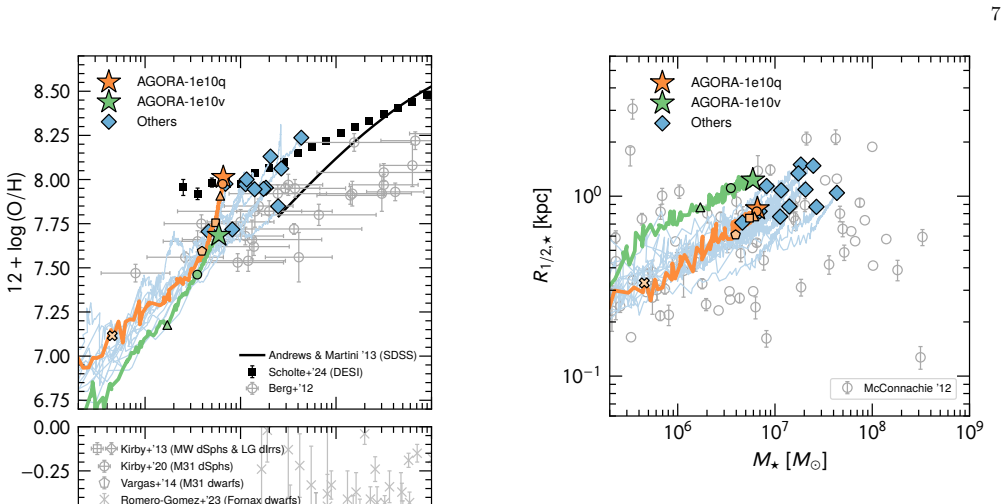
Summary. This paper presents CROCODILE-DWARF, a suite of cosmological zoom-in hydrodynamic simulations of 14 isolated field dwarf galaxies with M200 ~ 10^10 Msun at z=0, using GADGET4-OSAKA with CELib and Grackle. The authors report that the simulations reproduce observed stellar-to-halo mass, mass–metallicity, and size–mass relations, and they emphasize that assembly history, rather than halo mass alone, controls present-day dwarf galaxy diversity. The central kinematic claim is an anti-correlation between gas rotational support Vrot,gas/sigma_gas and the cumulative merger mass fraction facc (Eq. 3, Figure 7), interpreted as evidence that merger-driven dynamical heating is the primary factor shaping dwarf kinematics. The paper also highlights two cases (Halo316, Halo256) where late-time major mergers appear to promote extended gas disks.
Significance. If the claimed anti-correlation survives scrutiny, this paper would make a valuable contribution by linking merger history to the observed kinematic diversity of low-mass field dwarfs within a well-resolved cosmological simulation suite. The simulations achieve high baryonic resolution (~2e3 Msun), use a publicly developed code base, model metal enrichment and non-equilibrium cooling, and compare against several observational scaling relations. The merger-tree analysis and the proposed mechanism for merger-triggered disk formation are concrete and falsifiable. The main weakness is that the central causal claim is currently supported only by an uncontrolled correlation in 14 deliberately selected halos, and by a merger metric that is a cumulative assembly indicator rather than a direct measure of dynamical heating. The paper's strength lies in its data products and physical narrative; the gap is in the statistical and causal inference connecting them.
major comments (4)
- [Section 3.6 / Figure 7 / Abstract] The strength of the central claim is not matched by the presented statistics. Figure 7 shows a binned trend between Vrot,gas/sigma_gas and facc for only 14 halos, with no correlation coefficient, significance test, confidence interval, or bootstrap. The text itself acknowledges 'large scatter' and 'tentative evidence' in Section 3.6, while the Abstract and Section 5 assert that mergers are the 'dominant factor' and that the trend is 'demonstrated.' Please quantify the correlation (e.g., Spearman/Kendall with uncertainties), test against null distributions, and soften the wording to match the evidence. A simple Pearson/Spearman value and a jackknife or bootstrap would substantially increase confidence.
- [Eq. (3) and Section 3.6] The merger fraction facc = Sum(Macc,peak)/Mmain is a cumulative measure of all mergers with mass ratio > 0.01 since z<7. It is not a direct measure of dynamical heating: it ignores merger timing, orbital geometry, gas content, and the actual energy injected into the disk. The paper itself shows in Figure 5 and Section 3.5 that c200,DMO correlates strongly with fgas and M*/M200, and that high-concentration, early-assembling halos become gas-poor and dispersion-dominated. Since facc is likely collinear with assembly epoch and concentration, the Figure 7 anti-correlation may simply be the concentration–gas–kinematics sequence restated. Please provide partial correlations controlling for c200,DMO and assembly epoch (e.g., z_1/2), or matched-halo comparisons with similar concentration but different merger histories, before claiming that merger-driven heating is the primary factor. This is the
- [Appendix A / Section 3.2] The mass–metallicity agreement in Section 3.2 is not an independent validation of the feedback model. Appendix A states that the SN feedback energy zeta_SN was doubled 'as a parameter tuning measure' specifically so that the simulated mass–metallicity relation matches SDSS/DESI observations. This makes the agreement a fit, not a prediction. Please state this clearly in the main text whenever the MZR is cited as a success, and consider adding a remark on whether the kinematic trend in Figure 7 is robust to variations in zeta_SN (even if only for a subset of halos). Without this, the reader cannot tell whether the central merger–kinematics trend is a robust physical result or an artifact of the tuned feedback strength.
- [Section 2.2 / Section 1] The sample is deliberately non-random: halos are chosen to have diverse assembly histories and strict isolation criteria, following Wang et al. (2015) and Fitts et al. (2017). This is appropriate for a controlled comparison, but it means that the distribution of facc and Vrot,gas/sigma_gas in Figure 7 is not representative of the field dwarf population. The paper should discuss how the deliberate selection could affect the apparent anti-correlation and the generality of the 'primary factor' conclusion. For instance, if the sample were drawn without this diversity constraint, the trend might weaken or disappear. Please quantify the selection effects or at least state the limitation explicitly.
minor comments (5)
- [Section 3.6, text near Figure 8] Typo: 'exhibit moderately and disturbed disturbed kinematics' should read 'exhibit moderately disturbed kinematics.'
- [Figure 6 caption] The caption says 'Evolution of the virial radius over time' but the text and axes refer to M200(z)/M200(z=0). Please correct to 'virial mass'.
- [Abstract and Section 5] The wording of the principal claim shifts between 'tentative evidence' (Section 3.6), 'demonstrating that dynamical heating by mergers is the dominant factor' (Abstract), and 'merger-driven dynamical heating is the key process' (Section 5). Please harmonize the strength of these statements with the actual statistical support.
- [Eq. (3) and Section 3.6] The summation in Eq. (3) has no explicit limits; the text describes conditions (z<7, mass ratio>0.01, resolution limit) but these should be stated in the equation or immediately after it for clarity.
- [General] Please add a short data availability statement indicating whether the simulation outputs, merger trees, and analysis scripts will be shared. This would increase reproducibility, especially because the kinematic measurements (e.g., Vrot,gas/sigma_gas) are sensitive to the exact binning and coordinate definitions.
Circularity Check
Mass–metallicity agreement is a tuned fit (ζSN calibrated to SDSS/DESI), but the central merger-kinematics trend is not circular.
-
fitted input called prediction
[Appendix A; see also Section 2.1 and Section 3.2]
"We find that the lower SN feedback energy (0.5ζSN) produces metallicities that lie above the observed mass–metallicity relation at z=0, indicating insufficient metal ejection from the galaxies. Conversely, the higher-energy case (2ζSN) yields lower metallicities than those of the DESI samples (D. Scholte et al. 2024). This comparison demonstrates that our adopted SN feedback energy (ζSN) best reproduces the observed mass–metallicity relation at z=0."
The SN feedback energy ζSN was not derived from first principles; it was chosen from the 0.5ζSN/1ζSN/2ζSN grid specifically because it best matches the observed gas-phase mass–metallicity relation. The paper's later claim that the simulations 'overlap well with the observations' (Section 3.2) is therefore a restatement of the calibration target, not an independent validation. The mass–metallicity relation is forced by construction to lie near the SDSS/DESI data. This circularity is limited to the MZR validation; the central facc–Vrot,gas/σgas relation is not fitted to any observed quantity.
full rationale
The paper's central claim—that assembly history, quantified by the cumulative merger mass fraction facc of Eq. 3, anticorrelates with gas rotational support Vrot,gas/σgas and that merger-driven dynamical heating shapes dwarf kinematics—is not circular. Vrot,gas/σgas and facc are independently measured simulation quantities; no equation defines one in terms of the other, and no parameter was tuned to reproduce the Figure 7 trend. The trend could be confounded by halo concentration or assembly epoch, and the sample is deliberately non-random, but confounding is a correctness risk, not a circularity. The genuine circular step is the mass–metallicity 'reproduction.' Section 2.1 states that the SN energy was doubled 'as a parameter tuning measure,' and Appendix A shows that ζSN was selected because it 'best reproduces the observed mass–metallicity relation at z=0.' Thus the overlap claimed in Section 3.2 is an input to calibration, not an independent prediction. This is a real but peripheral circularity: it affects one validation relation, while the central kinematic claim retains independent content. Self-citations to the GADGET4-OSAKA code and the Oku et al. feedback model are appropriate method citations, not load-bearing circular arguments.
Assumptions & free parameters
free parameters (5)
- SN feedback specific energy ζSN =
2.3×10^49 erg M_sun^-1 (2× CELib standard)
- Star formation efficiency c_* =
0.01
- Star formation density threshold n_H,thres =
1 cm^-3
- Feedback neighbor number N_ngb,FB =
120
- Target entropy K_OF =
10^8 K cm^2
assumptions (5)
- domain assumption ΛCDM cosmology with WMAP7 parameters
- ad hoc to paper Adequacy of the subgrid star formation/SN feedback model
- ad hoc to paper The merger-fraction metric facc reflects dynamical heating
- domain assumption Grackle cooling and UVB model are appropriate
- domain assumption Halo concentration tracks assembly history
Cite this review
Pith. "Pith review of CROCODILE-DWARF: Assembly and Kinematics of Field Dwarf Galaxies with GADGET4-OSAKA." pith.science (2026). https://pith.science/paper/JYPIOPAM
@misc{pith2026251026513,
  author       = {Pith},
  title        = {Pith review of: CROCODILE-DWARF: Assembly and Kinematics of Field Dwarf Galaxies with GADGET4-OSAKA},
  year         = {2026},
  howpublished = {\url{https://pith.science/paper/JYPIOPAM}},
  note         = {Machine review of arXiv:2510.26513}
}
abstract
We present results from CROCODILE-DWARF, a new suite of cosmological zoom-in hydrodynamic simulations of isolated field dwarf galaxies with halo masses of $\sim10^{10}\,M_\odot$ at $z=0$, performed with the GADGET4-OSAKA code. The simulations include detailed modeling of star formation, chemical enrichment, and supernova feedback using the CELib and Grackle libraries, achieving baryonic resolutions of $\sim2\times10^3\,M_\odot$. Our study focuses on how assembly history governs the structural and kinematic diversity of dwarf galaxies within the $\Lambda$CDM framework. The simulated galaxies reproduce the observed stellar-to-halo mass, mass--metallicity, and size--mass relations for nearby dwarf galaxies, including those of the Local Group, yielding stellar masses of $\sim10^7\,M_\odot$. The galaxies display a broad range of rotational support, where gas is generally more rotationally supported than stars. Differences in morphology and kinematics primarily reflect variations in halo assembly timescales and merger activity. Early-assembling, high-concentration halos form stars efficiently and become gas-poor by $z=0$, while late-assembling, low-concentration halos remain gas-rich due to delayed star formation and rejuvenated gas accretion. We find a trend between rotational support and the cumulative merger mass fraction, providing tentative evidence that dynamical heating induced by mergers plays a role in shaping the kinematic diversity. In some cases, late-time mergers induce the formation of extended gas disks by delivering fresh gas and angular momentum. These results demonstrate that it is assembly history, rather than halo mass alone, that shapes the present-day kinematic and morphological diversity of dwarf galaxies.
Figures


Figures from the paper (7 more)


Reference graph
Works this paper leans on
-
[1]
Abadi, M. G., Navarro, J. F., Steinmetz, M., & Eke, V. R. 2003, ApJ, 597, 21, doi: 10.1086/378316
doi:10.1086/378316 2003
-
[2]
Agertz, O., Kravtsov, A. V., Leitner, S. N., & Gnedin, N. Y. 2013, ApJ, 770, 25, doi: 10.1088/0004-637X/770/1/25
-
[3]
Agertz, O., Pontzen, A., Read, J. I., et al. 2020, MNRAS, 491, 1656, doi: 10.1093/mnras/stz3053
-
[4]
Andrews, B. H., & Martini, P. 2013, ApJ, 765, 140, doi: 10.1088/0004-637X/765/2/140
-
[5]
2017, MNRAS, 466, 105, doi: 10.1093/mnras/stw3061
Aoyama, S., Hou, K.-C., Shimizu, I., et al. 2017, MNRAS, 466, 105, doi: 10.1093/mnras/stw3061
-
[6]
Applebaum, E., Brooks, A. M., Christensen, C. R., et al. 2021, ApJ, 906, 96, doi: 10.3847/1538-4357/abcafa Arjona-G´ alvez, E., Di Cintio, A., & Grand, R. J. J. 2024, A&A, 690, A286, doi: 10.1051/0004-6361/202449439
-
[7]
Asplund, M., Grevesse, N., Sauval, A. J., & Scott, P. 2009, ARA&A, 47, 481, doi: 10.1146/annurev.astro.46.060407.145222
arXiv 2009
-
[8]
2020, MNRAS, 498, 5885, doi: 10.1093/mnras/staa2716
Barat, D., D’Eugenio, F., Colless, M., et al. 2020, MNRAS, 498, 5885, doi: 10.1093/mnras/staa2716
Show all 137 references
-
[9]
S., Wechsler, R
Behroozi, P. S., Wechsler, R. H., & Conroy, C. 2013, ApJ, 770, 57, doi: 10.1088/0004-637X/770/1/57
2013 doi
- [10]
-
[11]
2020, MNRAS, 498, 4887, doi: 10.1093/mnras/staa2698 Ben ´ ıtez-Llambay, A., Navarro, J
Benitez-Llambay, A., & Frenk, C. 2020, MNRAS, 498, 4887, doi: 10.1093/mnras/staa2698 Ben ´ ıtez-Llambay, A., Navarro, J. F., Abadi, M. G., et al. 2015, MNRAS, 450, 4207, doi: 10.1093/mnras/stv925
2020 doi
-
[12]
A., Skillman, E
Berg, D. A., Skillman, E. D., Marble, A. R., et al. 2012, ApJ, 754, 98, doi: 10.1088/0004-637X/754/2/98
2012 doi
-
[13]
2008, Galactic Dynamics: Second Edition
Binney, J., & Tremaine, S. 2008, Galactic Dynamics: Second Edition
2008
-
[14]
S., & Kaplinghat, M
Boylan-Kolchin, M., Bullock, J. S., & Kaplinghat, M. 2011, MNRAS, 415, L40, doi: 10.1111/j.1745-3933.2011.01074.x
2011
- [16]
-
[17]
2019, MNRAS, 483, 1314, doi: 10.1093/mnras/sty2913
Frings, J. 2019, MNRAS, 483, 1314, doi: 10.1093/mnras/sty2913
2019 doi
-
[18]
S., & Boylan-Kolchin, M
Bullock, J. S., & Boylan-Kolchin, M. 2017, ARA&A, 55, 343, doi: 10.1146/annurev-astro-091916-055313
2017 doi
-
[19]
2021, MNRAS, 505, L100, doi: 10.1093/mnrasl/slab059
Cardona-Barrero, S., Battaglia, G., Di Cintio, A., Revaz, Y., & Jablonka, P. 2021, MNRAS, 505, L100, doi: 10.1093/mnrasl/slab059
2021 doi
-
[20]
2003, PASP, 115, 763, doi: 10.1086/376392 16
Chabrier, G. 2003, PASP, 115, 763, doi: 10.1086/376392 16
2003 doi
-
[22]
S., & White, S
Davis, M., Efstathiou, G., Frenk, C. S., & White, S. D. M. 1985, ApJ, 292, 371, doi: 10.1086/163168 de los Reyes, M. A. C., Kirby, E. N., Zhuang, Z., et al. 2023, ApJ, 951, 52, doi: 10.3847/1538-4357/acd189
1985 doi
-
[23]
2020, MNRAS, 493, 4126, doi: 10.1093/mnras/staa470
Dekel, A., Ginzburg, O., Jiang, F., et al. 2020, MNRAS, 493, 4126, doi: 10.1093/mnras/staa470
2020 doi
-
[24]
1986, ApJ, 303, 39, doi: 10.1086/164050
Dekel, A., & Silk, J. 1986, ApJ, 303, 39, doi: 10.1086/164050
1986 doi
-
[25]
R., & Oman, K
Downing, E. R., & Oman, K. A. 2023, MNRAS, 522, 3318, doi: 10.1093/mnras/stad868
2023 doi
-
[26]
A., Obreja, A., Wang, L., et al
Dutton, A. A., Obreja, A., Wang, L., et al. 2017, MNRAS, 467, 4937, doi: 10.1093/mnras/stx458
2017 doi
-
[27]
1992, MNRAS, 256, 43P, doi: 10.1093/mnras/256.1.43P
Efstathiou, G. 1992, MNRAS, 256, 43P, doi: 10.1093/mnras/256.1.43P
1992 doi
-
[28]
2000, MNRAS, 317, 697, doi: 10.1046/j.1365-8711.2000.03665.x
Efstathiou, G. 2000, MNRAS, 317, 697, doi: 10.1046/j.1365-8711.2000.03665.x
2000
-
[29]
2016, ApJ, 820, 131, doi: 10.3847/0004-637X/820/2/131
El-Badry, K., Wetzel, A., Geha, M., et al. 2016, ApJ, 820, 131, doi: 10.3847/0004-637X/820/2/131
2016 doi
-
[30]
R., Geha, M., et al
El-Badry, K., Wetzel, A. R., Geha, M., et al. 2017, ApJ, 835, 193, doi: 10.3847/1538-4357/835/2/193
2017 doi
-
[31]
2018, MNRAS, 473, 1930, doi: 10.1093/mnras/stx2482
El-Badry, K., Quataert, E., Wetzel, A., et al. 2018, MNRAS, 473, 1930, doi: 10.1093/mnras/stx2482
2018 doi
-
[32]
L., & Mac Low, M.-M
Emerick, A., Bryan, G. L., & Mac Low, M.-M. 2018, ApJL, 865, L22, doi: 10.3847/2041-8213/aae315
2018 doi
-
[33]
N., et al
Escala, I., Wetzel, A., Kirby, E. N., et al. 2018, MNRAS, 474, 2194, doi: 10.1093/mnras/stx2858
2018 doi
- [34]
-
[35]
D., et al
Fitts, A., Boylan-Kolchin, M., Elbert, O. D., et al. 2017, MNRAS, 471, 3547, doi: 10.1093/mnras/stx1757
2017 doi
- [36]
-
[37]
2023, MNRAS, 525, 3760, doi: 10.1093/mnras/stad2526
Fukushima, K., Nagamine, K., & Shimizu, I. 2023, MNRAS, 525, 3760, doi: 10.1093/mnras/stad2526
2023 doi
-
[38]
Gnedin, N. Y. 2000, ApJ, 542, 535, doi: 10.1086/317042
2000 doi
-
[39]
Y., & Kaurov, A
Gnedin, N. Y., & Kaurov, A. A. 2014, ApJ, 793, 30, doi: 10.1088/0004-637X/793/1/30
2014 doi
-
[40]
A., Pfrommer, C., Bryan, G
Gutcke, T. A., Pfrommer, C., Bryan, G. L., et al. 2022, ApJ, 941, 120, doi: 10.3847/1538-4357/aca1b4
2022 doi
-
[41]
2012, ApJ, 746, 125, doi: 10.1088/0004-637X/746/2/125
Haardt, F., & Madau, P. 2012, ApJ, 746, 125, doi: 10.1088/0004-637X/746/2/125
2012 doi
-
[43]
2022, MNRAS, 514, 4912, doi: 10.1093/mnras/stac1659
Haidar, H., Habouzit, M., Volonteri, M., et al. 2022, MNRAS, 514, 4912, doi: 10.1093/mnras/stac1659
2022 doi
-
[44]
2013, ApJS, 208, 19, doi: 10.1088/0067-0049/208/2/19
Hinshaw, G., Larson, D., Komatsu, E., et al. 2013, ApJS, 208, 19, doi: 10.1088/0067-0049/208/2/19
2013 doi
-
[45]
2006, MNRAS, 371, 401, doi: 10.1111/j.1365-2966.2006.10678.x
Hoeft, M., Yepes, G., Gottl¨ ober, S., & Springel, V. 2006, MNRAS, 371, 401, doi: 10.1111/j.1365-2966.2006.10678.x
2006
-
[46]
F., Grudi´ c, M
Hopkins, P. F., Grudi´ c, M. Y., Wetzel, A., et al. 2020, MNRAS, 491, 3702, doi: 10.1093/mnras/stz3129
2020 doi
-
[47]
F., Squire, J., Chan, T
Hopkins, P. F., Squire, J., Chan, T. K., et al. 2021, MNRAS, 501, 4184, doi: 10.1093/mnras/staa3691
2021 doi
-
[48]
F., Wetzel, A., Kereˇ s, D., et al
Hopkins, P. F., Wetzel, A., Kereˇ s, D., et al. 2018a, MNRAS, 477, 1578, doi: 10.1093/mnras/sty674
-
[49]
F., Wetzel, A., Kereˇ s, D., et al
Hopkins, P. F., Wetzel, A., Kereˇ s, D., et al. 2018b, MNRAS, 480, 800, doi: 10.1093/mnras/sty1690
-
[50]
2019, MNRAS, 483, 3363, doi: 10.1093/mnras/sty3252
Hu, C.-Y. 2019, MNRAS, 483, 3363, doi: 10.1093/mnras/sty3252
2019 doi
-
[51]
A., Ficut-Vicas, D., Ashley, T., et al
Hunter, D. A., Ficut-Vicas, D., Ashley, T., et al. 2012, AJ, 144, 134, doi: 10.1088/0004-6256/144/5/134
2012 doi
-
[52]
2017, MNRAS, 466, 4159, doi: 10.1093/mnras/stw3285
Iorio, G., Fraternali, F., Nipoti, C., et al. 2017, MNRAS, 466, 4159, doi: 10.1093/mnras/stw3285
2017 doi
-
[53]
2023, ApJ, 951, 102, doi: 10.3847/1538-4357/accc87
Isobe, Y., Ouchi, M., Nakajima, K., et al. 2023, ApJ, 951, 102, doi: 10.3847/1538-4357/accc87
2023 doi
-
[54]
2024, ApJ, 964, 123, doi: 10.3847/1538-4357/ad245b
Jung, M., Roca-F` abrega, S., Kim, J.-H., et al. 2024, ApJ, 964, 123, doi: 10.3847/1538-4357/ad245b
2024 doi
-
[55]
2020, MNRAS, 494, 2200, doi: 10.1093/mnras/staa639
Katz, H., Ramsoy, M., Rosdahl, J., et al. 2020, MNRAS, 494, 2200, doi: 10.1093/mnras/staa639
2020 doi
-
[56]
W., & Kruijssen, J
Keller, B. W., & Kruijssen, J. M. D. 2022, MNRAS, 512, 199, doi: 10.1093/mnras/stac511
2022 doi
-
[57]
W., Kruijssen, J
Keller, B. W., Kruijssen, J. M. D., & Wadsley, J. W. 2020, MNRAS, 493, 2149, doi: 10.1093/mnras/staa380
2020 doi
-
[58]
2014, ApJS, 210, 14, doi: 10.1088/0067-0049/210/1/14
Kim, J.-h., Abel, T., Agertz, O., et al. 2014, ApJS, 210, 14, doi: 10.1088/0067-0049/210/1/14
2014 doi
-
[59]
2018, MNRAS, 475, 4617, doi: 10.1093/mnras/sty126
Kimm, T., Haehnelt, M., Blaizot, J., et al. 2018, MNRAS, 475, 4617, doi: 10.1093/mnras/sty126
2018 doi
-
[60]
N., Cohen, J
Kirby, E. N., Cohen, J. G., Guhathakurta, P., et al. 2013, ApJ, 779, 102, doi: 10.1088/0004-637X/779/2/102
2013 doi
-
[61]
N., Gilbert, K
Kirby, E. N., Gilbert, K. M., Escala, I., et al. 2020, AJ, 159, 46, doi: 10.3847/1538-3881/ab5f0f
2020 doi
-
[62]
V., Valenzuela, O., & Prada, F
Klypin, A., Kravtsov, A. V., Valenzuela, O., & Prada, F. 1999, ApJ, 522, 82, doi: 10.1086/307643
1999 doi
-
[63]
A., Trujillo-Gomez, S., & Primack, J
Klypin, A. A., Trujillo-Gomez, S., & Primack, J. 2011, ApJ, 740, 102, doi: 10.1088/0004-637X/740/2/102
2011 doi
-
[64]
M., Dunkley, J., et al
Komatsu, E., Smith, K. M., Dunkley, J., et al. 2011, ApJS, 192, 18, doi: 10.1088/0067-0049/192/2/18
2011 doi
-
[65]
A., & Smith, M
Koudmani, S., Sijacki, D., Bourne, M. A., & Smith, M. C. 2019, MNRAS, 484, 2047, doi: 10.1093/mnras/stz097
2019 doi
-
[67]
R., Eke, V., Frenk, C
Lovell, M. R., Eke, V., Frenk, C. S., et al. 2012, MNRAS, 420, 2318, doi: 10.1111/j.1365-2966.2011.20200.x
2012
-
[68]
D., Schaye, J., & Bower, R
Ludlow, A. D., Schaye, J., & Bower, R. 2019a, MNRAS, 488, 3663, doi: 10.1093/mnras/stz1821 17
-
[69]
D., Schaye, J., Schaller, M., & Bower, R
Ludlow, A. D., Schaye, J., Schaller, M., & Bower, R. 2020, MNRAS, 493, 2926, doi: 10.1093/mnras/staa316
2020 doi
-
[70]
D., Schaye, J., Schaller, M., & Richings, J
Ludlow, A. D., Schaye, J., Schaller, M., & Richings, J. 2019b, MNRAS, 488, L123, doi: 10.1093/mnrasl/slz110
-
[71]
A., Kaviraj, S., et al
Martin, G., Jackson, R. A., Kaviraj, S., et al. 2021, MNRAS, 500, 4937, doi: 10.1093/mnras/staa3443
2021 doi
-
[72]
G., et al
Martin-Alvarez, S., Sijacki, D., Haehnelt, M. G., et al. 2023, MNRAS, 525, 3806, doi: 10.1093/mnras/stad2559
2023 doi
-
[73]
Mateo, M. L. 1998, ARA&A, 36, 435, doi: 10.1146/annurev.astro.36.1.435
1998 doi
-
[74]
2012, ApJL, 755, L35, doi: 10.1088/2041-8205/755/2/L35
Mashchenko, S. 2012, ApJL, 755, L35, doi: 10.1088/2041-8205/755/2/L35
2012 doi
-
[75]
McConnachie, A. W. 2012, AJ, 144, 4, doi: 10.1088/0004-6256/144/1/4
2012 doi
-
[76]
Blok, W. J. G. 2000, ApJL, 533, L99, doi: 10.1086/312628
2000 doi
-
[77]
McQuinn, K. B. W., Berg, D. A., Skillman, E. D., et al. 2020, ApJ, 891, 181, doi: 10.3847/1538-4357/ab7447
2020 doi
-
[78]
McQuinn, K. B. W., Telidevara, A. K., Fuson, J., et al. 2021, ApJ, 918, 23, doi: 10.3847/1538-4357/ac03ae
2021 doi
-
[79]
McQuinn, K. B. W., Adams, E. A. K., Cannon, J. M., et al. 2022, ApJ, 940, 8, doi: 10.3847/1538-4357/ac9285
2022 doi
-
[80]
1994, Nature, 370, 629, doi: 10.1038/370629a0
Moore, B. 1994, Nature, 370, 629, doi: 10.1038/370629a0
1994 doi
-
[81]
1999, ApJL, 524, L19, doi: 10.1086/312287
Moore, B., Ghigna, S., Governato, F., et al. 1999, ApJL, 524, L19, doi: 10.1086/312287
1999 doi
-
[82]
P., Naab, T., & White, S
Moster, B. P., Naab, T., & White, S. D. M. 2013, MNRAS, 428, 3121, doi: 10.1093/mnras/sts261
2013 doi
-
[83]
M., Christensen, C., et al
Munshi, F., Brooks, A. M., Christensen, C., et al. 2019, ApJ, 874, 40, doi: 10.3847/1538-4357/ab0085
2019 doi
-
[84]
2021, ApJ, 914, 66, doi: 10.3847/1538-4357/abfa16
Nagamine, K., Shimizu, I., Fujita, K., et al. 2021, ApJ, 914, 66, doi: 10.3847/1538-4357/abfa16
2021 doi
- [85]
-
[86]
F., Eke, V
Navarro, J. F., Eke, V. R., & Frenk, C. S. 1996, MNRAS, 283, L72, doi: 10.1093/mnras/283.3.L72 O˜ norbe, J., Boylan-Kolchin, M., Bullock, J. S., et al. 2015, MNRAS, 454, 2092, doi: 10.1093/mnras/stv2072 O˜ norbe, J., Garrison-Kimmel, S., Maller, A. H., et al. 2014, MNRAS, 437,...
1996 doi
-
[87]
A., Brinks, E., et al
Oh, S.-H., Hunter, D. A., Brinks, E., et al. 2015, AJ, 149, 180, doi: 10.1088/0004-6256/149/6/180
2015 doi
-
[88]
R., Frenk, C
Okamoto, T., Eke, V. R., Frenk, C. S., & Jenkins, A. 2005, MNRAS, 363, 1299, doi: 10.1111/j.1365-2966.2005.09525.x
2005
-
[89]
2008, MNRAS, 390, 920, doi: 10.1111/j.1365-2966.2008.13830.x
Okamoto, T., Gao, L., & Theuns, T. 2008, MNRAS, 390, 920, doi: 10.1111/j.1365-2966.2008.13830.x
2008
-
[90]
2024, ApJ, 975, 183, doi: 10.3847/1538-4357/ad77d3
Oku, Y., & Nagamine, K. 2024, ApJ, 975, 183, doi: 10.3847/1538-4357/ad77d3
2024 doi
-
[91]
2022, ApJS, 262, 9, doi: 10.3847/1538-4365/ac77ff
Oku, Y., Tomida, K., Nagamine, K., Shimizu, I., & Cen, R. 2022, ApJS, 262, 9, doi: 10.3847/1538-4365/ac77ff
2022 doi
-
[92]
Orkney, M. D. A., Read, J. I., Rey, M. P., et al. 2021, MNRAS, 504, 3509, doi: 10.1093/mnras/stab1066
2021 doi
-
[93]
M., & Springel, V
Pakmor, R., Pfrommer, C., Simpson, C. M., & Springel, V. 2016, ApJL, 824, L30, doi: 10.3847/2041-8205/824/2/L30
2016 doi
-
[95]
2014, Nature, 506, 171, doi: 10.1038/nature12953
Pontzen, A., & Governato, F. 2014, Nature, 506, 171, doi: 10.1038/nature12953
2014 doi
-
[96]
F., Jenkins, A., et al
Power, C., Navarro, J. F., Jenkins, A., et al. 2003, MNRAS, 338, 14, doi: 10.1046/j.1365-8711.2003.05925.x
2003
-
[98]
I., Iorio, G., Agertz, O., & Fraternali, F
Read, J. I., Iorio, G., Agertz, O., & Fraternali, F. 2017, MNRAS, 467, 2019, doi: 10.1093/mnras/stx147
2017 doi
-
[99]
Rees, M. J. 1986, MNRAS, 218, 25P, doi: 10.1093/mnras/218.1.25P
1986 doi
-
[100]
2018, A&A, 616, A96, doi: 10.1051/0004-6361/201832669
Revaz, Y., & Jablonka, P. 2018, A&A, 616, A96, doi: 10.1051/0004-6361/201832669
2018 doi
-
[101]
P., Pontzen, A., Agertz, O., et al
Rey, M. P., Pontzen, A., Agertz, O., et al. 2020, MNRAS, 497, 1508, doi: 10.1093/mnras/staa1640
2020 doi
-
[102]
P., Pontzen, A., Agertz, O., et al
Rey, M. P., Pontzen, A., Agertz, O., et al. 2019, ApJL, 886, L3, doi: 10.3847/2041-8213/ab53dd
2019 doi
-
[103]
P., Taylor, E., Gray, E
Rey, M. P., Taylor, E., Gray, E. I., et al. 2025, MNRAS, 541, 1195, doi: 10.1093/mnras/staf1058
2025 doi
-
[104]
Romano, L. E. C., Nagamine, K., & Hirashita, H. 2022a, MNRAS, 514, 1441, doi: 10.1093/mnras/stac1385
-
[105]
Romano, L. E. C., Nagamine, K., & Hirashita, H. 2022b, MNRAS, 514, 1461, doi: 10.1093/mnras/stac1386 Romero-G´ omez, J., Peletier, R. F., Aguerri, J. A. L., et al. 2023, MNRAS, 522, 130, doi: 10.1093/mnras/stad953
2023 doi
-
[106]
Kaisina, E. I. 2013, MNRAS, 436, L104, doi: 10.1093/mnrasl/slt123
2013 doi
-
[107]
Saitoh, T. R. 2017, AJ, 153, 85, doi: 10.3847/1538-3881/153/2/85
2017 doi
-
[108]
V., Wetzel, A., & Fattahi, A
Sales, L. V., Wetzel, A., & Fattahi, A. 2022, Nature Astronomy, 6, 897, doi: 10.1038/s41550-022-01689-w
2022 doi
-
[109]
2023, A&A, 669, A94, doi: 10.1051/0004-6361/202244309
Sanati, M., Jeanquartier, F., Revaz, Y., & Jablonka, P. 2023, A&A, 669, A94, doi: 10.1051/0004-6361/202244309
2023 doi
-
[110]
2024, A&A, 690, A59, doi: 10.1051/0004-6361/202449822
Sanati, M., Martin-Alvarez, S., Schober, J., et al. 2024, A&A, 690, A59, doi: 10.1051/0004-6361/202449822
2024 doi
-
[111]
2020, A&A, 643, A54, doi: 10.1051/0004-6361/202038382 S´ anchez-Janssen, R., M´ endez-Abreu, J., & Aguerri, J
Jablonka, P. 2020, A&A, 643, A54, doi: 10.1051/0004-6361/202038382 S´ anchez-Janssen, R., M´ endez-Abreu, J., & Aguerri, J. A. L. 2010, MNRAS, 406, L65, doi: 10.1111/j.1745-3933.2010.00883.x 18
2020
-
[112]
Sardone, A., Peter, A. H. G., Brooks, A. M., & Kaczmarek, J. 2024, ApJ, 964, 135, doi: 10.3847/1538-4357/ad250f
2024 doi
-
[114]
S., Fattahi, A., et al
Sawala, T., Frenk, C. S., Fattahi, A., et al. 2016, MNRAS, 457, 1931, doi: 10.1093/mnras/stw145
2016 doi
-
[115]
2014, Nature Physics, 10, 496, doi: 10.1038/nphys2996
Schive, H.-Y., Chiueh, T., & Broadhurst, T. 2014, Nature Physics, 10, 496, doi: 10.1038/nphys2996
2014 doi
-
[116]
1959, ApJ, 129, 243, doi: 10.1086/146614
Schmidt, M. 1959, ApJ, 129, 243, doi: 10.1086/146614
1959 doi
-
[117]
1963, ApJ, 137, 758, doi: 10.1086/147553
Schmidt, M. 1963, ApJ, 137, 758, doi: 10.1086/147553
1963 doi
-
[118]
2024, MNRAS, 535, 2341, doi: 10.1093/mnras/stae2477
Scholte, D., Saintonge, A., Moustakas, J., et al. 2024, MNRAS, 535, 2341, doi: 10.1093/mnras/stae2477
2024 doi
-
[119]
Searle, L., & Sargent, W. L. W. 1972, ApJ, 173, 25, doi: 10.1086/151398
1972 doi
-
[120]
R., Giroux, M
Shapiro, P. R., Giroux, M. L., & Babul, A. 1994, ApJ, 427, 25, doi: 10.1086/174120
1994 doi
-
[121]
2019, MNRAS, 484, 2632, doi: 10.1093/mnras/stz098
Shimizu, I., Todoroki, K., Yajima, H., & Nagamine, K. 2019, MNRAS, 484, 2632, doi: 10.1093/mnras/stz098
2019 doi
-
[122]
2017, ApJL, 839, L13, doi: 10.3847/2041-8213/aa67da
Silk, J. 2017, ApJL, 839, L13, doi: 10.3847/2041-8213/aa67da
2017 doi
-
[123]
Simon, J. D. 2019, ARA&A, 57, 375, doi: 10.1146/annurev-astro-091918-104453
2019 doi
-
[124]
C., Kassin, S
Simons, R. C., Kassin, S. A., Weiner, B. J., et al. 2015, MNRAS, 452, 986, doi: 10.1093/mnras/stv1298
2015 doi
-
[125]
D., Bryan, G
Smith, B. D., Bryan, G. L., Glover, S. C. O., et al. 2017, MNRAS, 466, 2217, doi: 10.1093/mnras/stw3291
2017 doi
-
[126]
C., Bryan, G
Smith, M. C., Bryan, G. L., Somerville, R. S., et al. 2021, MNRAS, 506, 3882, doi: 10.1093/mnras/stab1896
2021 doi
-
[127]
2021, MNRAS, 506, 2871, doi: 10.1093/mnras/stab1855
Springel, V., Pakmor, R., Zier, O., & Reinecke, M. 2021, MNRAS, 506, 2871, doi: 10.1093/mnras/stab1855
2021 doi
-
[128]
Springel, V., White, S. D. M., Tormen, G., & Kauffmann, G. 2001, MNRAS, 328, 726, doi: 10.1046/j.1365-8711.2001.04912.x
2001
- [130]
-
[131]
2007, MNRAS, 382, 1050, doi: 10.1111/j.1365-2966.2007.12070.x
Tornatore, L., Borgani, S., Dolag, K., & Matteucci, F. 2007, MNRAS, 382, 1050, doi: 10.1111/j.1365-2966.2007.12070.x
2007
-
[132]
J., Smith, B
Turk, M. J., Smith, B. D., Oishi, J. S., et al. 2011, The Astrophysical Journal Supplement Series, 192, 9, doi: 10.1088/0067-0049/192/1/9
2011 doi
-
[134]
C., Geha, M
Vargas, L. C., Geha, M. C., & Tollerud, E. J. 2014, ApJ, 790, 73, doi: 10.1088/0004-637X/790/1/73
2014 doi
-
[135]
2012, MNRAS, 423, 3740, doi: 10.1111/j.1365- 2966.2012.21182.x10.1002/asna.19141991009
Vogelsberger, M., Zavala, J., & Loeb, A. 2012, MNRAS, 423, 3740, doi: 10.1111/j.1365- 2966.2012.21182.x10.1002/asna.19141991009
2012
-
[136]
A., Stinson, G
Wang, L., Dutton, A. A., Stinson, G. S., et al. 2015, MNRAS, 454, 83, doi: 10.1093/mnras/stv1937
2015 doi
-
[137]
H., Bullock, J
Wechsler, R. H., Bullock, J. S., Primack, J. R., Kravtsov, A. V., & Dekel, A. 2002, ApJ, 568, 52, doi: 10.1086/338765
2002 doi
-
[138]
R., Dolphin, A
Weisz, D. R., Dolphin, A. E., Skillman, E. D., et al. 2014, ApJ, 789, 147, doi: 10.1088/0004-637X/789/2/147
2014 doi
-
[139]
R., Dalcanton, J
Weisz, D. R., Dalcanton, J. J., Williams, B. F., et al. 2011, ApJ, 739, 5, doi: 10.1088/0004-637X/739/1/5
2011 doi
-
[140]
R., Hopkins, P
Wetzel, A. R., Hopkins, P. F., Kim, J.-h., et al. 2016, ApJL, 827, L23, doi: 10.3847/2041-8205/827/2/L23
2016 doi
-
[141]
B., Bullock, J
Wheeler, C., Pace, A. B., Bullock, J. S., et al. 2017, MNRAS, 465, 2420, doi: 10.1093/mnras/stw2583
2017 doi
-
[142]
F., Pace, A
Wheeler, C., Hopkins, P. F., Pace, A. B., et al. 2019, MNRAS, 490, 4447, doi: 10.1093/mnras/stz2887
2019 doi
-
[143]
Wiersma, R. P. C., Schaye, J., Theuns, T., Dalla Vecchia, C., & Tornatore, L. 2009, MNRAS, 399, 574, doi: 10.1111/j.1365-2966.2009.15331.x
2009
-
[144]
2024, ApJ, 961, 49, doi: 10.3847/1538-4357/ad06ab
Xu, Y., Ouchi, M., Isobe, Y., et al. 2024, ApJ, 961, 49, doi: 10.3847/1538-4357/ad06ab
2024 doi
-
[145]
2017, ApJ, 846, 30, doi: 10.3847/1538-4357/aa82b5
Vecchia, C. 2017, ApJ, 846, 30, doi: 10.3847/1538-4357/aa82b5
2017 doi
-
[146]
2024, MNRAS, 532, 2558, doi: 10.1093/mnras/stae1651
Zeng, G., Wang, L., Gao, L., & Yang, H. 2024, MNRAS, 532, 2558, doi: 10.1093/mnras/stae1651
2024 doi
Reviewed August 4, 2026 · model on record in the stance chip above.
Discussion (0). Continue with ORCID to comment.