A Radial and Tangential Framework for Studying Transient Reactivity in Two-Dimensional Systems
Pith reviewed 2026-05-18 02:53 UTC · model grok-4.3
The pith
Decomposing 2D linear systems into radial and tangential components quantifies transient reactivity hidden by eigenanalysis.
A machine-rendered reading of the paper's core claim, the machinery that carries it, and where it could break.
Core claim
In two-dimensional linear systems that possess a globally attracting equilibrium at the origin, small disturbances can produce large transient excursions before decay. The vector field is decomposed into sinusoidal radial and tangential components, from which an orthostructure dual to the eigenstructure is constructed. Alternative matrix representations that combine both structures capture transient growth and asymptotic stability simultaneously, permitting an analytical formula for maximal amplification and new insight into the possible instability of nonautonomous systems whose instantaneous frozen versions are all stable.
What carries the argument
The orthostructure of orthovectors and orthovalues obtained from the sinusoidal radial-tangential decomposition of the vector field, used to form alternative matrix representations that expose reactivity.
If this is right
- Maximal transient amplification in any globally attracting 2D linear system can be computed exactly from the combined eigen- and orthostructures.
- Nonautonomous linear systems can be unstable overall even when every fixed-time frozen system is asymptotically stable.
- Reactivity features appear directly in the proposed matrix forms rather than being obscured by diagonalization.
- Both short-term amplification and long-term convergence are encoded in single matrix representations for 2D systems.
Where Pith is reading between the lines
- The radial-tangential decomposition could be tested on specific non-normal matrices drawn from population models to predict outbreak sizes before stabilization.
- The orthostructure might supply bounds on transient growth that complement existing numerical methods for higher-dimensional or nonlinear extensions.
- Time-varying coefficients could be examined by treating the frozen systems as a continuous family and tracking how orthovalues evolve with time.
Load-bearing premise
The vector field admits a decomposition into sinusoidal radial and tangential components that is sufficient to reveal reactivity features masked by the eigenstructure alone.
What would settle it
A concrete 2D linear system whose numerically computed peak deviation from the origin differs from the value given by the analytical maximal-amplification formula derived from the alternative matrix forms.
Figures




read the original abstract
Even if a linear system of ordinary differential equations has a globally attracting equilibrium at the origin, small disturbances from the equilibrium may lead to large transient excursions before the system stabilizes. This counter-intuitive phenomenon of transient amplification is called reactivity and is often associated with systems that are non-normal. Here, we establish a new framework for analyzing reactivity and transient dynamics in two-dimensional linear ODEs. Our work is facilitated by decomposing the corresponding vector field into sinusoidal radial and tangential components. Using this decomposition, we introduce a structure of orthovectors and orthovalues as dual to the eigenstructure. Since diagonalization masks transient reactivity, we combine the eigenstructure and the orthostructure to propose alternative matrix forms which capture both transient and asymptotic behavior and which highlight reactivity features more directly. Leveraging these matrix forms, we analytically quantify the maximal amplification in globally attracting systems, and we provide new insight into how a nonautonomous linear system can be unstable, even when all the frozen-time systems are stable.
Editorial analysis
A structured set of objections, weighed in public.
Referee Report
Summary. The manuscript introduces a radial-tangential decomposition of the vector field for two-dimensional linear ODEs to analyze transient reactivity. It defines orthovectors and orthovalues as dual to the eigenstructure, proposes alternative matrix forms that combine both structures, analytically quantifies maximal amplification in globally attracting systems, and provides insight into how nonautonomous linear systems can be unstable even when all frozen-time systems are stable.
Significance. If the central claims hold, the framework supplies an explicit, parameter-free analytical quantification of transient amplification via the radial component (the numerical abscissa) and clarifies reactivity features that eigenstructure alone obscures. The decomposition into trigonometric polynomials of order 2 in the polar angle is valid in 2D and yields a legitimate change of basis that preserves the linear dynamics, offering a useful complementary tool for non-normal and time-varying systems.
major comments (2)
- [§4] §4 (alternative matrix forms): the claim that these forms 'capture both transient and asymptotic behavior' and 'highlight reactivity features more directly' requires an explicit verification that the combined eigen-orthostructure representation yields a closed-form expression for the maximal amplification without reverting to numerical maximization of the Rayleigh quotient; the abstract asserts analytical quantification, but the load-bearing step from orthovalues to the bound is not yet shown to be tight.
- [§5] §5 (nonautonomous insight): the argument that a nonautonomous system can be unstable while all frozen-time systems are stable relies on the instantaneous numerical abscissa being positive; this needs a concrete example or theorem showing that the time-varying radial component can drive growth even when the spectral abscissa of each A(t) remains negative, to confirm the insight is not merely restating the known distinction between numerical and spectral abscissae.
minor comments (3)
- [§2] Notation for orthovectors/orthovalues should be introduced with a clear comparison table to eigenvectors/eigenvalues to avoid reader confusion in the early sections.
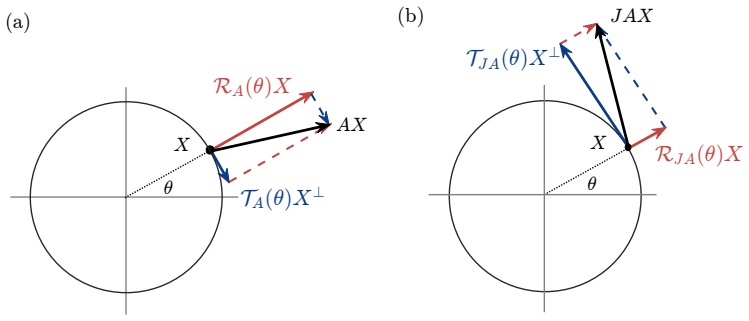
- [Figure 2] Figure 2 (or equivalent) illustrating the radial and tangential components would benefit from explicit labeling of the angle at which the radial component achieves its maximum.
- [Conclusion] A short remark on the extension (or lack thereof) to higher dimensions would help contextualize the 2D restriction.
Simulated Author's Rebuttal
We thank the referee for the careful reading, positive assessment of the framework's potential, and constructive suggestions. The comments have helped us clarify the analytical steps and strengthen the nonautonomous illustration. We address each major comment below and have revised the manuscript accordingly.
read point-by-point responses
-
Referee: [§4] §4 (alternative matrix forms): the claim that these forms 'capture both transient and asymptotic behavior' and 'highlight reactivity features more directly' requires an explicit verification that the combined eigen-orthostructure representation yields a closed-form expression for the maximal amplification without reverting to numerical maximization of the Rayleigh quotient; the abstract asserts analytical quantification, but the load-bearing step from orthovalues to the bound is not yet shown to be tight.
Authors: We agree that an explicit verification improves clarity. In the revised manuscript we have added a proposition in §4 that derives the maximal amplification directly from the combined eigen-orthostructure matrix. The derivation uses the order-2 trigonometric polynomial for the radial component to obtain a closed-form expression equal to the numerical abscissa; this expression is obtained analytically from the orthovalues and does not require numerical maximization of the Rayleigh quotient. We also include a short tightness argument showing that the bound is attained for suitable initial conditions in globally attracting systems. revision: yes
-
Referee: [§5] §5 (nonautonomous insight): the argument that a nonautonomous system can be unstable while all frozen-time systems are stable relies on the instantaneous numerical abscissa being positive; this needs a concrete example or theorem showing that the time-varying radial component can drive growth even when the spectral abscissa of each A(t) remains negative, to confirm the insight is not merely restating the known distinction between numerical and spectral abscissae.
Authors: We appreciate the request for a concrete demonstration. The revised §5 now contains an explicit two-dimensional example in which every frozen-time matrix A(t) has negative spectral abscissa, yet the time-dependent radial component (numerical abscissa) is positive on a positive-measure set of times. We also add a short theorem that integrates the radial contribution over an interval and shows that the accumulated growth can produce instability even though each instantaneous frozen-time system is asymptotically stable. This construction uses the radial-tangential decomposition to make the mechanism explicit rather than restating the general numerical-versus-spectral distinction. revision: yes
Circularity Check
No significant circularity
full rationale
The paper's derivation begins with the standard decomposition of a 2D linear vector field into radial (Rayleigh quotient of the symmetric part) and tangential sinusoidal components, which is a direct trigonometric identity in polar coordinates and not a self-referential definition. From this, orthovectors and orthovalues are introduced as the extremal directions of the symmetric part, positioned explicitly as dual to the eigenstructure of the full matrix. Alternative matrix forms are then constructed by combining these two structures via a change of basis that preserves the original linear dynamics. The analytic quantification of maximal amplification in globally attracting systems follows directly from the resulting closed-form expressions for transient growth, without any fitted parameters or reduction to input data. The insight on nonautonomous instability (positive instantaneous numerical abscissa despite negative spectral abscissae) is a standard consequence of time-varying coefficients and does not rely on self-citation chains or imported uniqueness theorems. All steps are mathematically self-contained and externally verifiable from the 2D polar decomposition alone.
Axiom & Free-Parameter Ledger
axioms (1)
- domain assumption The system is a two-dimensional linear ODE with a globally attracting equilibrium at the origin.
invented entities (1)
-
orthovectors and orthovalues
no independent evidence
Reference graph
Works this paper leans on
-
[1]
Alternatives to resilience for measuring the responses of ecological systems to perturbations,
M. G. Neubert and H. Caswell, “Alternatives to resilience for measuring the responses of ecological systems to perturbations,” Ecology, vol. 78, no. 3, pp. 653–665, 1997
work page 1997
-
[2]
S. Townley and D. J. Hodgson, “Erratum et addendum: transient amplification and attenuation in stage-structured population dynamics,” Journal of Applied Ecology, vol. 45, no. 6, pp. 1836–1839, 2008
work page 2008
-
[3]
Transient phenomena in ecology,
A. Hastings, K. C. Abbott, K. Cuddington, T. Francis, G. Gellner, Y.-C. Lai, A. Morozov, S. Petrovskii, K. Scranton, and M. L. Zeeman, “Transient phenomena in ecology,” Science, vol. 361, no. 6406, p. eaat6412, 2018
work page 2018
-
[4]
Management implications of long transients in ecological systems,
T. B. Francis, K. C. Abbott, K. Cuddington, G. Gellner, A. Hastings, Y.-C. Lai, A. Morozov, S. Petrovskii, and M. L. Zeeman, “Management implications of long transients in ecological systems,” Nature Ecology & Evolution, vol. 5, no. 3, pp. 285–294, 2021
work page 2021
-
[5]
Quantifying resilience to recurrent ecosystem disturbances using flow–kick dynamics,
K. Meyer, A. Hoyer-Leitzel, S. Iams, I. Klasky, V. Lee, S. Ligtenberg, E. Bussmann, and M. L. Zeeman, “Quantifying resilience to recurrent ecosystem disturbances using flow–kick dynamics,” Nature Sustainability, vol. 1, no. 11, pp. 671–678, 2018
work page 2018
-
[6]
Classifying flow-kick equilibria: Reactivity and transient be- havior in the variational equation,
A. Haslam, “Classifying flow-kick equilibria: Reactivity and transient be- havior in the variational equation,” Bachelor’s Thesis, Bowdoin College, https://digitalcommons.bowdoin.edu/honorsprojects/191, 2020
work page 2020
-
[7]
Unstable solutions of nonautonomous linear differential equa- tions,
K. Josi´ c and R. Rosenbaum, “Unstable solutions of nonautonomous linear differential equa- tions,” SIAM review, vol. 50, no. 3, pp. 570–584, 2008
work page 2008
-
[8]
Instability in linear cooperative systems of ordinary differential equations,
J. Mierczynski, “Instability in linear cooperative systems of ordinary differential equations,” SIAM Review, vol. 59, no. 3, pp. 649–670, 2017
work page 2017
-
[9]
Sensitivity to switching rates in stochastically switched odes,
S. D. Lawley, J. C. Mattingly, and M. C. Reed, “Sensitivity to switching rates in stochastically switched odes,” Communications in Mathematical Sciences, 2013
work page 2013
-
[10]
N. S. Nise, Control systems engineering. John Wiley & Sons, 2019
work page 2019
-
[11]
Ogata, Modern control engineering
K. Ogata, Modern control engineering. Prentice hall, 2010
work page 2010
-
[12]
D. J. Higham and L. N. Trefethen, “Stiffness of odes,” BIT Numerical Mathematics, vol. 33, pp. 285–303, 1993. 37
work page 1993
-
[13]
Reactivity, attenuation, and tran- sients in metapopulations,
P. D. Harrington, M. A. Lewis, and P. van den Driessche, “Reactivity, attenuation, and tran- sients in metapopulations,” SIAM Journal on Applied Dynamical Systems, vol. 21, no. 2, pp. 1287–1321, 2022
work page 2022
-
[14]
M. W. Hirsch, S. Smale, and R. L. Devaney, Differential equations, dynamical systems, and an introduction to chaos. Academic press, 2012. 38
work page 2012
discussion (0)
Sign in with ORCID, Apple, or X to comment. Anyone can read and Pith papers without signing in.