A Survey on Generative Recommendation: Data, Model, and Tasks
Pith reviewed 2026-05-18 03:44 UTC · model grok-4.3
The pith
Generative recommendation reframes user-item matching as a generation task instead of scoring.
A machine-rendered reading of the paper's core claim, the machinery that carries it, and where it could break.
Core claim
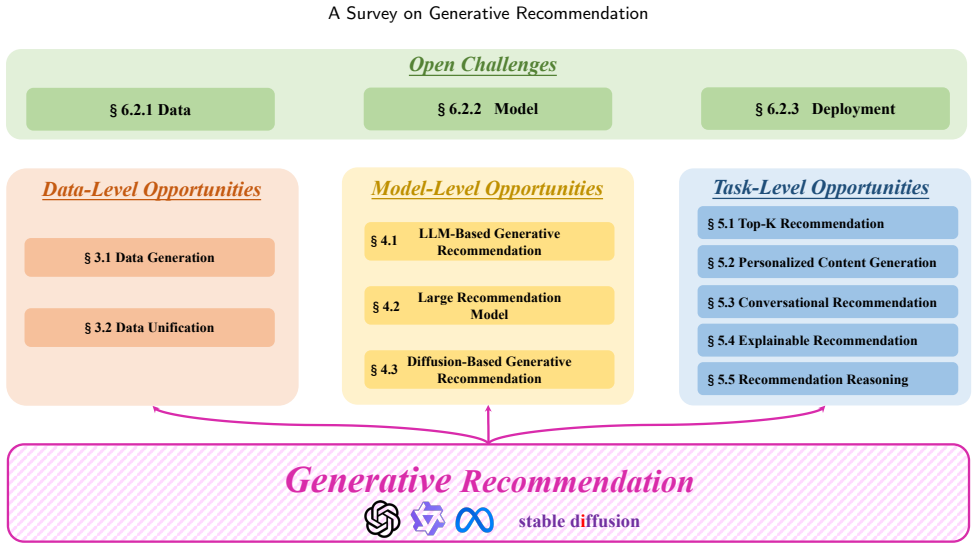
The paper states that generative recommendation reconceptualizes the core matching problem as a generation task rather than discriminative scoring. It supplies a unified tripartite framework across data, model, and task dimensions and decomposes the literature into the stages of data augmentation and unification, model alignment and training, and task formulation and execution. At each stage the authors catalog techniques such as knowledge-infused augmentation, agent-based simulation, LLM alignment methods, and new task formats that support conversational interaction, explainable reasoning, and personalized content generation. They identify five resulting advantages: world knowledge, natural
What carries the argument
The tripartite framework of data augmentation and unification, model alignment and training, and task formulation and execution that organizes LLM-based methods, large recommendation models, and diffusion approaches.
Load-bearing premise
The existing literature on generative recommendation can be fully and cleanly decomposed into the stages of data augmentation and unification, model alignment and training, and task formulation and execution without major omissions or overlaps.
What would settle it
A later review that identifies a sizable set of generative recommendation papers whose methods do not fit into the proposed data-model-task stages or that fail to demonstrate the five listed advantages.
Figures



read the original abstract
Recommender systems serve as foundational infrastructure in modern information ecosystems, helping users navigate digital content and discover items aligned with their preferences. At their core, recommender systems address a fundamental problem: matching users with items. Over the past decades, the field has experienced successive paradigm shifts, from collaborative filtering and matrix factorization in the machine learning era to neural architectures in the deep learning era. Recently, the emergence of generative models, especially large language models (LLMs) and diffusion models, have sparked a new paradigm: generative recommendation, which reconceptualizes recommendation as a generation task rather than discriminative scoring. This survey provides a comprehensive examination through a unified tripartite framework spanning data, model, and task dimensions. Rather than simply categorizing works, we systematically decompose approaches into operational stages-data augmentation and unification, model alignment and training, task formulation and execution. At the data level, generative models enable knowledge-infused augmentation and agent-based simulation while unifying heterogeneous signals. At the model level, we taxonomize LLM-based methods, large recommendation models, and diffusion approaches, analyzing their alignment mechanisms and innovations. At the task level, we illuminate new capabilities including conversational interaction, explainable reasoning, and personalized content generation. We identify five key advantages: world knowledge integration, natural language understanding, reasoning capabilities, scaling laws, and creative generation. We critically examine challenges in benchmark design, model robustness, and deployment efficiency, while charting a roadmap toward intelligent recommendation assistants that fundamentally reshape human-information interaction.
Editorial analysis
A structured set of objections, weighed in public.
Referee Report
Summary. This survey paper examines generative recommendation as an emerging paradigm that reconceptualizes recommendation as a generation task using models such as LLMs and diffusion models, rather than traditional discriminative scoring. It organizes the literature via a unified tripartite framework that decomposes approaches into operational stages of data augmentation and unification, model alignment and training (covering LLM-based methods, large recommendation models, and diffusion approaches), and task formulation and execution (including conversational interaction, explainable reasoning, and personalized content generation). The paper identifies five key advantages—world knowledge integration, natural language understanding, reasoning capabilities, scaling laws, and creative generation—while critically discussing challenges in benchmark design, model robustness, and deployment efficiency, and outlining a roadmap toward intelligent recommendation assistants.
Significance. If the tripartite framework proves comprehensive without major omissions or forced categorizations, the survey could provide a valuable organizing lens for an emerging subfield, helping researchers map the shift from neural recommender systems to generative ones. By taxonomizing methods across data, model, and task dimensions and explicitly naming advantages and open challenges, it may accelerate identification of research gaps in areas like agent-based simulation and scaling laws for recommendation.
major comments (2)
- [Abstract / tripartite framework] Abstract and framework description: the central claim that the literature can be systematically decomposed into data augmentation/unification, model alignment/training, and task formulation/execution without major overlaps or omissions is load-bearing for the survey's utility; the manuscript should add an explicit discussion (perhaps in a dedicated taxonomy subsection) of boundary cases, such as works that span data unification and task execution, to demonstrate the framework's robustness.
- [Advantages discussion] Five key advantages section: the advantages (world knowledge integration, natural language understanding, reasoning capabilities, scaling laws, creative generation) are presented as distinguishing features of the paradigm shift, but each should be tied to at least two concrete cited works with brief evidence of the claimed benefit to avoid appearing as high-level assertions.
minor comments (3)
- [Model level] Add a summary table in the model-level section that cross-references the three model categories (LLM-based, large recommendation models, diffusion) against alignment mechanisms and representative papers for improved readability.
- [Challenges] The challenges section on benchmark design would benefit from citing specific existing benchmarks in generative recommendation and explicitly noting which ones fail to evaluate the claimed advantages such as creative generation.
- [Introduction / Conclusion] Ensure consistent use of terminology (e.g., 'generative recommendation' vs. 'generative models for recommendation') throughout the introduction and conclusion to prevent minor reader confusion.
Simulated Author's Rebuttal
We thank the referee for the constructive feedback and positive overall assessment of our survey on generative recommendation. The suggestions regarding the tripartite framework and the advantages section are helpful for strengthening the manuscript's clarity and rigor. We address each major comment below and will incorporate the revisions in the next version.
read point-by-point responses
-
Referee: [Abstract / tripartite framework] Abstract and framework description: the central claim that the literature can be systematically decomposed into data augmentation/unification, model alignment/training, and task formulation/execution without major overlaps or omissions is load-bearing for the survey's utility; the manuscript should add an explicit discussion (perhaps in a dedicated taxonomy subsection) of boundary cases, such as works that span data unification and task execution, to demonstrate the framework's robustness.
Authors: We agree that an explicit discussion of boundary cases would better demonstrate the framework's robustness and address potential overlaps or ambiguities. In the revised manuscript, we will add a dedicated subsection (or expanded paragraph) within the taxonomy discussion that analyzes boundary cases, including examples of works spanning data unification and task execution. This will explain how such works are accommodated in the tripartite structure, any necessary clarifications, and why the decomposition remains systematic without major omissions or forced categorizations. revision: yes
-
Referee: [Advantages discussion] Five key advantages section: the advantages (world knowledge integration, natural language understanding, reasoning capabilities, scaling laws, creative generation) are presented as distinguishing features of the paradigm shift, but each should be tied to at least two concrete cited works with brief evidence of the claimed benefit to avoid appearing as high-level assertions.
Authors: We appreciate this observation. While the advantages are drawn from patterns across the surveyed literature, we acknowledge that grounding them with specific citations would make the claims more concrete and less high-level. In the revision, we will expand the five key advantages section to tie each advantage to at least two concrete cited works, including brief evidence of the claimed benefit drawn from those works (e.g., empirical results or qualitative demonstrations in the original papers). This will substantiate the discussion without altering the overall structure or identified advantages. revision: yes
Circularity Check
No significant circularity: descriptive survey with no derivations or fitted predictions
full rationale
This is a literature survey paper that organizes prior work on generative recommendation into a tripartite framework (data augmentation/unification, model alignment/training, task formulation/execution) without presenting any original mathematical derivations, equations, predictions, or parameter-fitting procedures. All claims about advantages and paradigms rest on citations to external prior literature rather than self-referential reductions or self-citation chains that bear the central load. The structure is an organizing lens for an emerging field and introduces no self-definitional, fitted-input, or ansatz-smuggling circularities.
Axiom & Free-Parameter Ledger
axioms (1)
- domain assumption Recommender systems address a fundamental problem of matching users with items and have undergone paradigm shifts from collaborative filtering to neural architectures.
Forward citations
Cited by 7 Pith papers
-
On the Equivalence Between Auto-Regressive Next Token Prediction and Full-Item-Vocabulary Maximum Likelihood Estimation in Generative Recommendation--A Short Note
Auto-regressive next-token prediction is strictly equivalent to full-vocabulary maximum likelihood estimation in generative recommendation under bijective item-to-token-sequence mapping.
-
Tencent Advertising Algorithm Challenge 2025: All-Modality Generative Recommendation
Releases TencentGR-1M and TencentGR-10M datasets with baselines for all-modality generative recommendation in advertising, including weighted evaluation for conversions.
-
Differentiable Semantic ID for Generative Recommendation
DIGER makes semantic IDs in generative recommendation differentiable via Gumbel noise and decay schedules, yielding consistent gains on public datasets by aligning indexing and recommendation losses.
-
A Cascaded Generative Approach for e-Commerce Recommendations
A cascaded generative merchandising framework with placement theme generation, constrained keyword generation, and teacher-student fine-tuning achieves a 2.7% lift in cart adds per page view over a strong baseline in ...
-
RoTE: Coarse-to-Fine Multi-Level Rotary Time Embedding for Sequential Recommendation
RoTE is a multi-level rotary time embedding module that explicitly models time spans in sequential recommendation and improves NDCG@5 by up to 20.11% when added to standard backbones on public benchmarks.
-
How Personal Characteristics Shape User Exploration of Diverse Movie Recommendations with a LLM-Based Multi-Agent System
A multi-agent LLM recommender boosts perceived novelty and diversity in movie suggestions, with effects shaped by user conscientiousness, extraversion, GenAI experience, and skepticism.
-
A Cascaded Generative Approach for e-Commerce Recommendations
A cascaded generative system for e-commerce recommendations using theme and keyword generation with teacher-student fine-tuning achieves a 2.7% lift in cart adds per page view.
Reference graph
Works this paper leans on
-
[1]
Ao, X., Wang, X., Luo, L., Qiao, Y., He, Q., Xie, X., 2021. Pens: A dataset and generic framework for personalized news headline generation, in: Proceedings of the 59th Annual Meeting of the As- sociation for Computational Linguistics and the 11th International JointConferenceonNaturalLanguageProcessing(Volume1:Long Papers), pp. 82–92
work page 2021
-
[2]
Bai, T., Huang, L., Yu, Y., Yang, C., Hou, C., Zhao, Z., Shi, C.,
-
[3]
ACM Transactions on Information Systems
Efficientmulti-taskprompttuningforrecommendation. ACM Transactions on Information Systems
-
[4]
Abi-stepgroundingparadigmforlarge language models in recommendation systems
Bao, K., Zhang, J., Wang, W., Zhang, Y., Yang, Z., Luo, Y., Chen, C.,Feng,F.,Tian,Q.,2025. Abi-stepgroundingparadigmforlarge language models in recommendation systems. ACM Transactions on Recommender Systems 3, 1–27
work page 2025
-
[5]
Bao, K., Zhang, J., Zhang, Y., Wang, W., Feng, F., He, X., 2023. Tallrec: An effective and efficient tuning framework to align large language model with recommendation, in: Proceedings of the 17th ACM Conference on Recommender Systems, pp. 1007–1014
work page 2023
-
[6]
Simuser:Simulatinguserbehavior with large language models for recommender system evaluation
Bougie,N.,Watanabe,N.,2025. Simuser:Simulatinguserbehavior with large language models for recommender system evaluation. arXiv preprint arXiv:2504.12722
-
[7]
Generating user-engaging news headlines, in: Rogers, A., Boyd-Graber, J., Okazaki, N
Cai, P., Song, K., Cho, S., Wang, H., Wang, X., Yu, H., Liu, F., Yu, D., 2023. Generating user-engaging news headlines, in: Rogers, A., Boyd-Graber, J., Okazaki, N. (Eds.), Proceedings of the 61st Annual Meeting of the Association for Computational Linguistics (Volume 1: Long Papers), Association for Computational Linguis- tics,Toronto,Canada.pp.3265–3280...
-
[8]
Cai,Z.,Wang,S.,Chu,V.W.,Naseem,U.,Wang,Y.,Chen,F.,2025. Unleashing the potential of diffusion models towards diversified sequential recommendations, in: Proceedings of the 48th Interna- tional ACM SIGIR Conference on Research and Development in Information Retrieval, pp. 1476–1486
work page 2025
-
[9]
Chang, S., Chaszczewicz, A., Wang, E., Josifovska, M., Pierson, E., Leskovec, J., 2025. Llms generate structurally realistic social networks but overestimate political homophily, in: Proceedings of the International AAAI Conference on Web and Social Media, pp. 341–371
work page 2025
-
[10]
Chen, J., Chi, L., Peng, B., Yuan, Z., 2024a. Hllm: Enhancing sequential recommendations via hierarchical large language models for item and user modeling. arXiv preprint arXiv:2409.12740
-
[11]
Chen, J., He, J., Li, H., Wang, S., Cao, Y., Wei, K., Yang, Z., Ji, Y., 2025a. Hierarchical intent-guided optimization with pluggable llm- driven semantics for session-based recommendation, in: Proceed- ings of the 48th International ACM SIGIR Conference on Research and Development in Information Retrieval, pp. 1655–1665
-
[12]
Chen, J., Xu, Y., Jiang, Y., 2025b. Unlocking the power of diffu- sion models in sequential recommendation: A simple and effective Min Hou et al.:Preprint submitted to ElsevierPage 22 of 30 A Survey on Generative Recommendation approach,in:Proceedingsofthe31stACMSIGKDDConferenceon Knowledge Discovery and Data Mining, pp. 155–166
-
[13]
Chen,J.,Yang,X.,Yang,C.,Bao,J.,Guo,Z.,Li,Y.,Shi,C.,2025c. Corona: A coarse-to-fine framework for graph-based recommenda- tion with large language models, in: Proceedings of the 48th Inter- national ACM SIGIR Conference on Research and Development in Information Retrieval, pp. 2048–2058
work page 2048
-
[14]
Cp-rec: Contextual prompting for conversational recommender systems
Chen, K., Sun, S., 2023. Cp-rec: Contextual prompting for conversational recommender systems. Proceedings of the AAAI Conference on Artificial Intelligence 37, 12635– 12643. URL:https://ojs.aaai.org/index.php/AAAI/article/view/ 26487, doi:10.1609/aaai.v37i11.26487
-
[15]
Enhancing id-based recommendation with large language models
Chen,L.,Gao,C.,Du,X.,Luo,H.,Jin,D.,Li,Y.,Wang,M.,2025d. Enhancing id-based recommendation with large language models. ACM Transactions on Information Systems 43, 1–30
-
[16]
Enhancing item tokenization for generative recommendation through self-improvement
Chen, R., Ju, M., Bui, N., Antypas, D., Cai, S., Wu, X., Neves, L., Wang, Z., Shah, N., Zhao, T., 2024b. Enhancing item tokenization for generative recommendation through self-improvement. arXiv preprint arXiv:2412.17171
-
[17]
Cheng, W., Qin, Z., Wu, Z., Zhou, P., Huang, T., 2025. Large languagemodelsenhancedhyperbolicspacerecommendersystems, in: Proceedings of the 48th International ACM SIGIR Conference on Research and Development in Information Retrieval, pp. 1944– 1953
work page 2025
-
[18]
Leveraging large language models for pre-trained recommender systems
Chu, Z., Hao, H., Ouyang, X., Wang, S., Wang, Y., Shen, Y., Gu, J., Cui, Q., Li, L., Xue, S., Zhang, J.Y., Li, S., 2023. Leveraging large language models for pre-trained recommender systems. URL: https://arxiv.org/abs/2308.10837,arXiv:2308.10837
-
[19]
Suber: An rl environment with simulated human behavior for recommender systems
Corecco, N., Piatti, G., Lanzendörfer, L.A., Fan, F.X., Wattenhofer, R., 2024. Suber: An rl environment with simulated human behavior for recommender systems. arXiv preprint arXiv:2406.01631
-
[20]
Cui, Y., Liu, F., Wang, P., Wang, B., Tang, H., Wan, Y., Wang, J., Chen, J., 2024. Distillation matters: empowering sequential recommenders to match the performance of large language models, in: Proceedings of the 18th ACM Conference on Recommender Systems, pp. 507–517
work page 2024
-
[21]
M6-rec: Gen- erative pretrained language models are open-ended recommender systems
Cui, Z., Ma, J., Zhou, C., Zhou, J., Yang, H., 2022. M6-rec: Gen- erative pretrained language models are open-ended recommender systems. arXiv preprint arXiv:2205.08084
-
[22]
Dao, H., Deng, Y., Le, D.D., Liao, L., 2024. Broadening the view:Demonstration-augmentedpromptlearningforconversational recommendation, in: Proceedings of the 47th International ACM SIGIR Conference on Research and Development in Information Retrieval, Association for Computing Machinery, New York, NY, USA. p. 785–795. URL:https://doi.org/10.1145/3626772....
-
[23]
Deldjoo, Y., He, Z., McAuley, J., Korikov, A., Sanner, S., Ramisa, A., Vidal, R., Sathiamoorthy, M., Kasirzadeh, A., Milano, S., 2024. Areviewofmodernrecommendersystemsusinggenerativemodels (gen-recsys),in:Proceedingsofthe30thACMSIGKDDconference on Knowledge Discovery and Data Mining, pp. 6448–6458
work page 2024
-
[24]
OneRec: Unifying Retrieve and Rank with Generative Recommender and Iterative Preference Alignment
Deng, J., Wang, S., Cai, K., Ren, L., Hu, Q., Ding, W., Luo, Q., Zhou, G., 2025. Onerec: Unifying retrieve and rank with generative recommender and iterative preference alignment. arXiv preprint arXiv:2502.18965
work page internal anchor Pith review Pith/arXiv arXiv 2025
-
[25]
Federated recommender system based on diffusion augmentation and guided denoising
Di, Y., Shi, H., Wang, X., Ma, R., Liu, Y., 2025. Federated recommender system based on diffusion augmentation and guided denoising. ACM Transactions on Information Systems 43, 1–36
work page 2025
-
[26]
ACM Transactions on Information Systems 43, 1–26
Dong,Z.,Hu,L.,Chen,J.,Wang,Z.,Wu,F.,2025.Comprehendthen predict:Promptinglargelanguagemodelsforrecommendationwith semantic and collaborative data. ACM Transactions on Information Systems 43, 1–26
work page 2025
-
[27]
Du, Y., Luo, D., Yan, R., Wang, X., Liu, H., Zhu, H., Song, Y., Zhang, J., 2024. Enhancing job recommendation through llm- basedgenerativeadversarialnetworks,in:ProceedingsoftheAAAI conference on artificial intelligence, pp. 8363–8371
work page 2024
-
[28]
Lusifer: Llm-based user simulated feedback environment for online recommender systems
Ebrat, D., Paradalis, E., Rueda, L., 2024. Lusifer: Llm-based user simulated feedback environment for online recommender systems. arXiv preprint arXiv:2405.13362
-
[31]
Reason4rec: Large language models for recommendation with deliberative user preference alignment
Fang, Y., Wang, W., Zhang, Y., Zhu, F., Wang, Q., Feng, F., He, X., 2025c. Reason4rec: Large language models for recommendation with deliberative user preference alignment. URL:https://arxiv. org/abs/2502.02061,arXiv:2502.02061
-
[32]
A unified framework for multi-domain ctr prediction via large language models
Fu, Z., Li, X., Wu, C., Wang, Y., Dong, K., Zhao, X., Zhao, M., Guo, H., Tang, R., 2025. A unified framework for multi-domain ctr prediction via large language models. ACM Transactions on Information Systems
work page 2025
- [33]
-
[34]
Gao,C.,Gao,M.,Fan,C.,Yuan,S.,Shi,W.,He,X.,2025b. Process- supervised llm recommenders via flow-guided tuning, in: Proceed- ings of the 48th International ACM SIGIR Conference on Research and Development in Information Retrieval, pp. 1934–1943
work page 1934
-
[35]
S$^3$: Social-network Simulation System with Large Language Model-Empowered Agents
Gao, C., Lan, X., Lu, Z., Mao, J., Piao, J., Wang, H., Jin, D., Li, Y., 2023a. S3: Social-network simulation system with large language model-empowered agents. arXiv preprint arXiv:2307.14984
work page internal anchor Pith review Pith/arXiv arXiv
-
[36]
Gao, J., Chen, B., Zhao, X., Liu, W., Li, X., Wang, Y., Wang, W., Guo, H., Tang, R., 2025c. Llm4rerank: Llm-based auto-reranking framework for recommendations, in: Proceedings of the ACM on Web Conference 2025, pp. 228–239
work page 2025
-
[38]
Chat- rec: Towards interactive and explainable llms-augmented recommender system,
Gao,Y.,Sheng,T.,Xiang,Y.,Xiong,Y.,Wang,H.,Zhang,J.,2023c. Chat-rec: Towards interactive and explainable llms-augmented rec- ommender system. arXiv preprint arXiv:2303.14524
-
[39]
Geng, S., Liu, S., Fu, Z., Ge, Y., Zhang, Y., 2022. Recommenda- tion as language processing (rlp): A unified pretrain, personalized prompt & predict paradigm (p5), in: Proceedings of the 16th ACM Conference on Recommender Systems, pp. 299–315
work page 2022
-
[40]
Shilling attacks against recommender systems: a comprehensive survey
Gunes, I., Kaleli, C., Bilge, A., Polat, H., 2014. Shilling attacks against recommender systems: a comprehensive survey. Artificial Intelligence Review 42, 767–799
work page 2014
-
[41]
doi: 10.1038/s41586-025-09422-z
Guo, D., Yang, D., Zhang, H., Song, J., Zhang, R., Xu, R., Zhu, Q., Ma, S., Wang, P., Liang, W., et al., 2025a. Deepseek-r1: Incentivizing reasoning capability in llms via reinforcement learn- ing. Nature645,633–638. URL:https://www.nature.com/articles/ s41586-025-09422-z, doi:10.1038/s41586-025-09422-z
-
[42]
Request-only optimization for recommendation systems
Guo, L., Li, W., Liao, L., Cheng, H., Zhang, R., Shi, Y., Wang, Y., Huang, Y., Zhai, K., Wang, P., Shi, T., Cao, X., Wang, S., Cai, R., Gong, Z., Vichare, O., Jian, R., Gao, L., Deng, S., Liu, X., Zhang, X., Li, F., Xie, W., Wen, B., Li, R., Fang, L., Liu, X., Zhai, J., 2025b. Request-only optimization for recommendation systems. URL:https://arxiv.org/abs...
-
[43]
Semantic-enhanced co-attention prompt learning for non- overlapping cross-domain recommendation
Guo, L., Song, C., Guo, F., Han, X., Chang, X., Zhu, L., 2025c. Semantic-enhanced co-attention prompt learning for non- overlapping cross-domain recommendation. ACM Transactions on Information Systems
-
[44]
Onesug: The unified end-to-end generative framework for e-commerce query suggestion
Guo, X., Chen, B., Wang, S., Yang, Y., Lei, C., Ding, Y., Li, H., 2025d. Onesug: The unified end-to-end generative framework for e-commerce query suggestion. arXiv preprint arXiv:2506.06913
-
[45]
Han, R., Li, Q., Jiang, H., Li, R., Zhao, Y., Li, X., Lin, W., 2024. Enhancing ctr prediction through sequential recommendation pre- training: Introducing the srp4ctr framework, in: Proceedings of the 33rdACMInternationalConferenceonInformationandKnowledge Management, pp. 3777–3781. Min Hou et al.:Preprint submitted to ElsevierPage 23 of 30 A Survey on Ge...
work page 2024
-
[47]
Mtgr: Industrial-scale generative recommendation framework in meituan
Han, R., Yin, B., Chen, S., Jiang, H., Jiang, F., Li, X., Ma, C., Huang, M., Li, X., Jing, C., et al., 2025b. Mtgr: Industrial-scale generative recommendation framework in meituan. arXiv preprint arXiv:2505.18654
-
[48]
Harrison,R.M.,Dereventsov,A.,Bibin,A.,2023. Zero-shotrecom- mendations with pre-trained large language models for multimodal nudging, in: 2023 IEEE International Conference on Data Mining Workshops (ICDMW), IEEE. pp. 1535–1542
work page 2023
-
[49]
He, Y., Liu, X., Zhang, A., Ma, Y., Chua, T.S., 2025. Llm2rec: Largelanguagemodelsarepowerfulembeddingmodelsforsequen- tial recommendation, in: Proceedings of the 31st ACM SIGKDD Conference on Knowledge Discovery and Data Mining, pp. 896– 907
work page 2025
-
[50]
He, Z., Xie, Z., Jha, R., Steck, H., Liang, D., Feng, Y., Majumder, B.P., Kallus, N., Mcauley, J., 2023. Large language models as zero-shotconversationalrecommenders,in:Proceedingsofthe32nd ACM International Conference on Information and Knowledge Management, Association for Computing Machinery, New York, NY, USA. p. 720–730. URL:https://doi.org/10.1145/3...
-
[51]
He, Z., Zhao, H., Wang, Z., Lin, Z., Kale, A., Mcauley, J., 2022. Query-aware sequential recommendation, in: Proceedings of the 31st ACM International Conference on Information & Knowledge Management, pp. 4019–4023
work page 2022
-
[52]
Molorec:Ageneralizableandefficientframework for llm-based recommendation
Hou, M., Bai, C., Wu, L., Liu, H., Zhang, K., Zhang, K., Hong, R., Wang,M.,2025a. Molorec:Ageneralizableandefficientframework for llm-based recommendation. arXiv preprint arXiv:2502.08271
-
[53]
Hou,Y.,Li,J.,Shin,A.,Jeon,J.,Santhanam,A.,Shao,W.,Hassani, K., Yao, N., McAuley, J., 2025b. Generating long semantic ids in parallel for recommendation, in: Proceedings of the 31st ACM SIGKDD Conference on Knowledge Discovery and Data Mining, pp. 956–966
-
[54]
Hou, Y., Ni, J., He, Z., Sachdeva, N., Kang, W.C., Chi, E.H., McAuley, J., Cheng, D.Z., 2025c. Actionpiece: Contextually tok- enizing action sequences for generative recommendation, in: Forty- second International Conference on Machine Learning
-
[55]
Hou, Y., Zhang, J., Lin, Z., Lu, H., Xie, R., McAuley, J., Zhao, W.X., 2024. Large language models are zero-shot rankers for recommender systems, in: European Conference on Information Retrieval, Springer. pp. 364–381
work page 2024
-
[56]
Up5: Unbiased foun- dation model for fairness-aware recommendation
Hua,W.,Ge,Y.,Xu,S.,Ji,J.,Zhang,Y.,2023a.Up5:Unbiasedfoun- dation model for fairness-aware recommendation. arXiv preprint arXiv:2305.12090
-
[57]
Hua, W., Xu, S., Ge, Y., Zhang, Y., 2023b. How to index item ids for recommendation foundation models, in: Proceedings of the Annual International ACM SIGIR Conference on Research and Development in Information Retrieval in the Asia Pacific Region, Association for Computing Machinery, New York, NY, USA. p. 195–204. URL:https://doi.org/10.1145/3624918.3625...
-
[58]
Huang, F., Bei, Y., Yang, Z., Jiang, J., Chen, H., Shen, Q., Wang, S., Karray, F., Yu, P.S., 2025a. Large language model simulator for cold-startrecommendation,in:ProceedingsoftheEighteenthACM InternationalConferenceonWebSearchandDataMining,pp.261– 270
-
[59]
Huang, F., Bei, Y., Yang, Z., Jiang, J., Chen, H., Shen, Q., Wang, S., Karray, F., Yu, P.S., 2025b. Large language model simulator for cold-startrecommendation,in:ProceedingsoftheEighteenthACM InternationalConferenceonWebSearchandDataMining,pp.261– 270
-
[60]
Huang, M., Bu, C., He, Y., Wu, X., 2025c. How to mitigate information loss in knowledge graphs for graphrag: Leveraging triple context restoration and query-driven feedback. arXiv preprint arXiv:2501.15378
-
[61]
Towards large-scale generative ranking.arXiv preprint arXiv:2505.04180, 2025
Huang,Y.,Chen,Y.,Cao,X.,Yang,R.,Qi,M.,Zhu,Y.,Han,Q.,Liu, Y., Liu, Z., Yao, X., et al., 2025d. Towards large-scale generative ranking. arXiv preprint arXiv:2505.04180
-
[62]
Huang, Y., Liang, K., Dong, Z., Qu, X., Tianxiang, W., Han, Y., Xu, J., Zhou, B., Wang, Y., 2025e. Flow matching for denoised social recommendation, in: Forty-second International Conference on Machine Learning
-
[63]
Jia, J., Wang, Y., Li, Y., Chen, H., Bai, X., Liu, Z., Liang, J., Chen, Q.,Li,H.,Jiang,P.,etal.,2025. Learn:Knowledgeadaptationfrom large language model to recommendation for practical industrial application, in: Proceedings of the AAAI Conference on Artificial Intelligence, pp. 11861–11869
work page 2025
-
[64]
Large language model as universal retriever in industrial-scale recommender system
Jiang, J., Huang, Y., Liu, B., Kong, X., Li, X., Xu, Z., Zhu, H., Xu, J., Zheng, B., 2025a. Large language model as universal retriever in industrial-scale recommender system. arXiv preprint arXiv:2502.03041
-
[65]
Jiang, M., Bao, K., Zhang, J., Wang, W., Yang, Z., Feng, F., He, X., 2024a. Item-sidefairnessoflargelanguagemodel-basedrecommen- dation system, in: Proceedings of the ACM Web Conference 2024, pp. 4717–4726
work page 2024
-
[66]
Jiang, Y., Yang, Y., Xia, L., Luo, D., Lin, K., Huang, C., 2025b. Reclm: Recommendation instruction tuning, in: Proceedings of the 63rdAnnualMeetingoftheAssociationforComputationalLinguis- tics (Volume 1: Long Papers), p. 15443–15459
-
[67]
Casevo: A cognitive agents and social evolution simulator
Jiang, Z., Shi, Y., Li, M., Xiao, H., Qin, Y., Wei, Q., Wang, Y., Zhang, Y., 2024b. Casevo: A cognitive agents and social evolution simulator. arXiv preprint arXiv:2412.19498
-
[68]
arXiv preprint arXiv:2305.06474 , year=
Kang,W.C.,Ni,J.,Mehta,N.,Sathiamoorthy,M.,Hong,L.,Chi,E., Cheng,D.Z.,2023. Dollmsunderstanduserpreferences?evaluating llms on user rating prediction. arXiv preprint arXiv:2305.06474
-
[69]
Kim, J., Kim, H., Cho, H., Kang, S., Chang, B., Yeo, J., Lee, D., 2025a. Review-driven personalized preference reasoning with large language models for recommendation, in: Proceedings of the 48th International ACM SIGIR Conference on Research and Develop- ment in Information Retrieval, pp. 1697–1706
- [70]
-
[71]
Kim, S., Kang, H., Kim, K., Kim, J., Kim, D., Yang, M., Oh, K., McAuley, J., Park, C., 2025b. Lost in sequence: Do large language models understand sequential recommendation? arXiv preprint arXiv:2502.13909
-
[72]
Kojima, T., Gu, S.S., Reid, M., Matsuo, Y., Iwasawa, Y., 2022. Large language models are zero-shot reasoners, in: Proceedings of the36thInternationalConferenceonNeuralInformationProcessing Systems, Curran Associates Inc., Red Hook, NY, USA
work page 2022
-
[73]
Customizing language models with instance-wise lora for sequential recommendation
Kong, X., Wu, J., Zhang, A., Sheng, L., Lin, H., Wang, X., He, X., 2024. Customizing language models with instance-wise lora for sequential recommendation. Advances in Neural Information Processing Systems 37, 113072–113095
work page 2024
-
[74]
Matrix factorization tech- niques for recommender systems
Koren, Y., Bell, R., Volinsky, C., 2009. Matrix factorization tech- niques for recommender systems. Computer 42, 30–37
work page 2009
-
[75]
Kweon, W., Jang, S., Kang, S., Yu, H., 2025. Uncertainty quan- tification and decomposition for llm-based recommendation, in: Proceedings of the ACMon Web Conference 2025, pp. 4889–4901
work page 2025
-
[76]
Li,H.,Shen,D.,Wang,C.,Liu,Y.,Gu,J.,2025a. Canllmsenhance fairnessinrecommendationsystems?adataaugmentationapproach, in:Proceedingsofthe48thInternationalACMSIGIRConferenceon Research and Development in Information Retrieval, pp. 570–580
-
[77]
Li, J., Li, Y., Shen, X., Zhang, C., Qi, G., Sheng, B., 2025b. Open-world attribute mining for e-commerce products with multi- modalself-correctioninstructiontuning,in:Proceedingsofthe63rd Annual Meeting of the Association for Computational Linguistics (Volume 1: Long Papers), pp. 1702–1714
-
[78]
Li, J., Wang, S., Zhang, Q., Yu, S., Chen, F., 2025c. Generating with fairness: A modality-diffused counterfactual framework for Min Hou et al.:Preprint submitted to ElsevierPage 24 of 30 A Survey on Generative Recommendation incomplete multimodal recommendations, in: Proceedings of the ACM on Web Conference 2025, pp. 2787–2798
work page 2025
-
[79]
Li, L., Zhang, Y., Chen, L., 2020. Generate neural template expla- nations for recommendation, in: Proceedings of the 29th ACM In- ternational Conference on Information & Knowledge Management, Association for Computing Machinery, New York, NY, USA. p. 755–764. URL:https://doi.org/10.1145/3340531.3411992, doi:10. 1145/3340531.3411992
-
[80]
Personalized transformer for explainable recommendation, in: ACL
Li, L., Zhang, Y., Chen, L., 2021. Personalized transformer for explainable recommendation, in: ACL
work page 2021
-
[81]
Large language models forgenerativerecommendation:Asurveyandvisionarydiscussions
Li, L., Zhang, Y., Liu, D., Chen, L., 2023a. Large language models forgenerativerecommendation:Asurveyandvisionarydiscussions. arXiv preprint arXiv:2309.01157
-
[82]
Li, W., Huang, R., Zhao, H., Liu, C., Zheng, K., Liu, Q., Mou, N., Zhou, G., Lian, D., Song, Y., et al., 2025d. Dimerec: a unified framework for enhanced sequential recommendation via generative diffusion models, in: Proceedings of the Eighteenth ACM Interna- tional Conference on Web Search and Data Mining, pp. 726–734
-
[83]
Li, X., Chen, C., Zhao, X., Zhang, Y., Xing, C., 2023b. E4srec: An elegant effective efficient extensible solution of large lan- guage models for sequential recommendation. arXiv preprint arXiv:2312.02443
-
[84]
Li, X., Tang, H., Sheng, J., Zhang, X., Gao, L., Cheng, S., Yin, D., Liu, T., 2025e. Exploring preference-guided diffusion model for cross-domain recommendation, in: Proceedings of the 31st ACM SIGKDD Conference on Knowledge Discovery and Data Mining, pp. 719–728
discussion (0)
Sign in with ORCID, Apple, or X to comment. Anyone can read and Pith papers without signing in.