REVIEW 3 major objections 5 minor 3 cited by
Strange Matter
T0 review · 3 major / 5 minor · reviewed 2026-08-04 · deepseek-v4-flash
Pith's one-line read Pulsar-like objects are strange stars, not neutron stars.
desk verdict A readable review of the strangeon-star program that is honest in the text but overclaims in the abstract; useful as an entry point, not as evidence. read the letter →
The pith
A machine-rendered reading of the paper's core claim, the machinery that carries it, and where it could break.
The reading
What carries the argument
The central object is the strangeon: a color-singlet cluster of N_q valence quarks (typically N_q=18, in a flavor-spin-color symmetric state) that binds through a Lennard-Jones potential u(r) = u0[4(r/r0)^12 − 4(r/r0)^6]. The paper uses the corresponding-state principle to transfer the equation of state of noble gases—which interact via the same functional form—to strangeon matter, with u0 and r0 as free parameters fitted to pulsar mass-radius data. This machinery yields EOSs for polytropic, Lennard-Jones, H-dibaryon, and linked-bag models, and supports the solid strangeon star picture that drives the glitch and merger predictions.
What would settle it
A falsifier would be a precise measurement of the radius of a 1.4-solar-mass compact star exceeding about 14 km (from independent X-ray or gravitational-wave observations), which would conflict with the small-radius predictions of the strangeon models presented here; conversely, confirming that HESS J1731-347 has a mass near 0.77 solar masses and a radius near 10.4 km would support the strange star picture.
Extended reading notes
Core claim
The paper's central claim is that pulsar-like objects are composed of strange matter rather than neutron-rich matter. Strange matter is either strange quark matter—a Fermi liquid of u, d, s quasi-particles—or strangeon matter, a solid of quark clusters ('strangeons') that are multibaryon states with three-flavour symmetry, typically containing N_q=18 valence quarks. Because strange matter is self-bound, strange stars have a sharp surface at supra-nuclear density instead of a gravitationally bound crust. The authors argue this resolves several observational puzzles: the absence of atomic spectral lines from isolated pulsars, the small radius and low mass of HESS J1731-347, glitches as large a
Load-bearing premise
The strangeon-star scenario rests on the assumptions that strangeons—clusters of typically 18 valence quarks—exist as stable color-singlet units, that their pair interaction is well approximated by a Lennard-Jones potential, and that the corresponding-state principle transfers the noble-gas equation of state to strangeon matter with the potential depth u0 and equilibrium distance r0 treated as free parameters; if any of these fails, the strangeon-star model collapses.
Editorial extensions
If this is right
- Strange stars have a sharp, self-bound surface with no atomic crust; this naturally explains the absence of hydrogen/helium spectral lines in isolated pulsars and predicts electron-oscillation absorption features like those seen in the central compact object 1E 1207.4-5209.
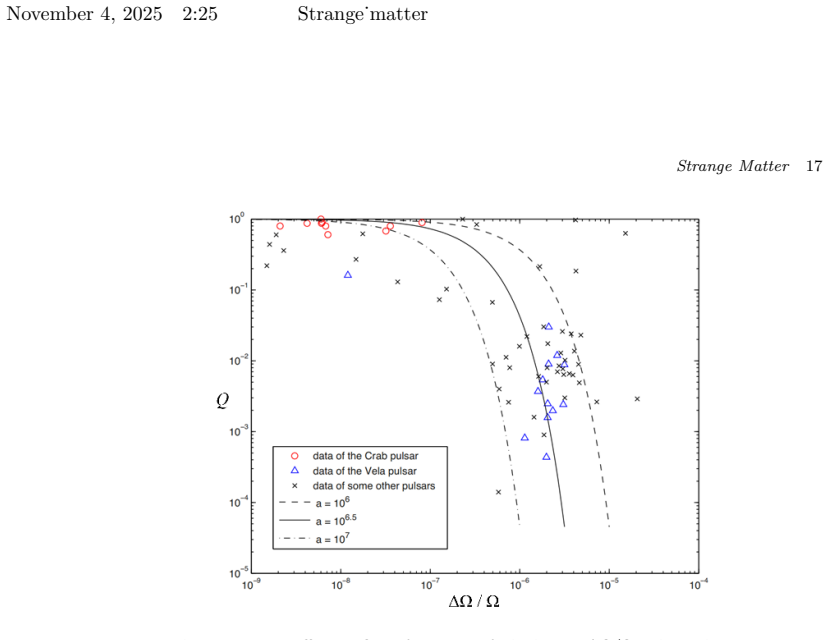
- Solid strangeon matter has a high shear modulus, so starquakes in the solid core can power large glitches (Δν/ν up to ~10^-6) and unify the Crab and Vela glitch behaviors in a single model with plastic and elastic motion.
- Strange stars are smaller and stiffer than neutron stars for a given mass, satisfying the GW170817 tidal-deformability constraint while still allowing maximum masses above 2.3 solar masses; the low-mass, small-radius object HESS J1731-347 is a natural strange star that neutron star models struggle to explain.
- Binary strange star mergers produce ejecta and kilonova light curves matching observations, and a long-lived supramassive strangeon remnant can explain X-ray plateaus in short gamma-ray bursts and a starquake-powered precursor for events like GRB 211211A.
Reading between the lines
- A solid strangeon star has a finite shear modulus and a characteristic seismic spectrum; detecting a continuous gravitational-wave or oscillation signal from a spinning pulsar would directly probe the solid-core picture in a way the review does not fully develop.
- The corresponding-state principle implies that improving laboratory measurements of dense Lennard-Jones fluids would tighten the predicted EOS for strangeon matter, offering a cross-check of the model independent of astrophysical mass-radius fits.
- The electron-spin magnetization mechanism for strangeon nuggets implies a specific scaling between nugget mass, magnetic moment, and interaction cross-section; searches with underwater acoustic detectors could be designed to test this scaling and distinguish strangeon dark matter from other macroscopic dark matter candidates.
Editorial analysis
A structured set of objections, weighed in public.
Referee Report
Summary. The manuscript is a review of the 'strange matter' hypothesis for pulsar-like compact objects. It argues that pulsars may be strange quark stars or strangeon stars rather than neutron stars. Sections 2-3 provide historical background and introduce strangeons as multibaryon quark clusters. Section 4 presents six EOS models (MIT bag, polytropic, Lennard-Jones, corresponding-state, Yukawa/H-dibaryon, linked-bag) with explicit formulas. Section 5 compares the resulting mass-radius relations and tidal deformabilities with observations (NICER pulsars, GW170817, HESS J1731-347), discusses surface emission lines, glitch mechanisms, merger simulations and electromagnetic counterparts, and closes with strangeon nuggets as dark matter. The abstract claims pulsars are 'actually composed' of strange matter, although the body repeatedly states that definitive verification remains an open question.
Significance. The review is a timely and readable synthesis of a minority but long-standing hypothesis. Its strengths are the explicit presentation of six EOS models, the TOV-based M-R plots, the discussion of testable phenomena (glitches, tidal deformability, merger thresholds), and the inclusion of recent NICER and GW170817 constraints. The paper also gives a concrete falsifiable prediction: strangeon stars have M_TOV > 3 Msun and are self-bound with small radii. However, the central 'actually composed' claim is not established by the evidence presented; several model parameters (Nq, u0, r0, bag constants) are fitted to the same observations that are later cited as support. Thus the paper is a valuable review of a speculative scenario, not a demonstration of the scenario's correctness.
major comments (3)
- [Abstract and Sec. 1] The abstract's assertion that pulsars 'are actually composed of strange matter' is not supported by the body of the review. Section 1 (p. 3) itself states 'there is observational evidence for strange stars, but a definitive verification remains an open question,' and Section 5 discusses models as possible explanations. This is more than a wording issue: a review whose abstract makes a categorical claim while the internal evidence supports only a possibility will mislead a non-specialist reader. Recommend replacing 'actually composed' with 'may be composed' and clearly framing the paper as a status report on a hypothesis.
- [Sec. 4.3 and Secs. 5.2/5.4.1] The selection of Nq=18 in Eq. (16)/(Sec. 4.3) is justified by 'state-of-art observations on the masses and radii of pulsars' (Ref. 41). Yet Sec. 5.2 and Sec. 5.4.1 use the same mass-radius observations (HESS J1731-347, NICER PSR J0030+0451, PSR J0740+6620, PSR J0437-4715) as evidence supporting strangeon stars and to conclude that Nq=18 is 'more favorable'. This is a circular use of data: the model parameter is calibrated to a dataset and then the agreement with that dataset is presented as validation. The review should either explicitly separate calibration from prediction or refrain from citing this agreement as independent support.
- [Sec. 4.4, Eqs. (20) and (22)] The corresponding-state EOS (Eq. 20) is obtained by fitting the reduced EOS of noble gases and mapping it to strangeon matter through the free parameters u0 and r0. Equation (22) similarly transfers the melting heat H from Xe, Kr, Ar, Ne, H2, He to strangeon matter with no justification beyond an assumed Lennard-Jones universality. In Secs. 5.2 and 5.4.1, the small radii and high M_TOV of strangeon models are then compared favorably with observations (GW170817, HESS J1731-347). Because u0 and r0 are chosen to reproduce the desired mass-radius behavior (with Nq=18 selected in Sec. 4.3), the consistency is guaranteed, not tested. The manuscript should acknowledge that the corresponding-state predictions are not parameter-free and that the mapping to the strong interaction is an assumption.
minor comments (5)
- [Sec. 5.5, Eqs. (39)-(43)] The notation is unclear: 'overline d_e' in Eq. (39) is not defined; 'xi mu' after Eq. (42) mixes the magnetic moment with a chemical potential symbol; and the definition of B0 as 'xi mu / r0^3' should be stated with units.
- [Sec. 5.5, p. 24] Typo: 'untraheavy' should be 'ultraheavy'.
- [Sec. 5.2, p. 16] The phrase 'supporting stiff EOS models' is vague; specify which models (e.g., those with M_TOV > 2.5 Msun) and what constraints are being referenced.
- [Sec. 5.1, p. 14] Grammar: 'unless in the presence of super-strong magnetic field' should be 'unless there is a super-strong magnetic field' or 'except in the presence of'.
- [Fig. 10 and caption] The axis labels 'lg[m/GeV]' and 'lg[R/cm]' and the annotations 'mass gap', 'Dark Sector?', and '2f/3f' are not self-explanatory; expand the caption to explain the figure's content and the empirical basis of the mass ranges.
Circularity Check
Partial circularity: Nq=18 is chosen to fit mass-radius data and the same data are then presented as evidence for the strangeon model.
-
fitted input called prediction
[Sec. 4.3 (Lennard-Jones Model) and Sec. 5.4.1 / Sec. 5.2, Figs. 3, 7]
"A typical configuration is the “flavor-spin-color” symmetric state with N q = 18, like the quark-α. 40 In fact, N q = 18 is favorable according to the state-of-art observations on the masses and radii of pulsars. 41 ... It is found that the existing observational data indicates that the number of quarks inside a strangeon Nq = 18 is more favorable. 41"
The review first fixes Nq=18 by appealing to observed masses and radii (Ref. 41); the same mass-radius observations (PSR J0030+0451, PSR J0740+6620, PSR J0437-4715 and GW170817 constraints in Sec. 5.2/5.4.1) are then used as evidence that the strangeon model is supported. The M-R curves in Fig. 3 are computed with the calibrated Nq=18, so their consistency with the calibration data is expected by construction. This is calibration presented as confirmation.
full rationale
The paper is a review, not a new derivation, and much of it is model construction plus comparison with data. The clearest circular step is the use of Nq=18: Sec. 4.3 adopts Nq=18 because it is 'favorable according to the state-of-art observations on the masses and radii of pulsars' (Ref. 41, a self-citation), and Sec. 5.4.1 then reports that the same data indicate Nq=18 is favorable, while Sec. 5.2/Fig. 3 presents Nq=18 EOS curves against these same mass-radius constraints. That specific piece of 'observational support' reduces to calibration. Other claimed evidence is not circular in the same way: the absence of H/He spectral lines, the GW170817 tidal-deformability consistency (allowed-region statements), the glitch/starquake models, and the GRB-plateau explanation use data that are not obviously the same quantities used to fix u0, r0, ns, or the bag parameters. The noble-gas-fitted melting heat H is transferred to strangeon matter and then compared with GRB plateaus; this is a genuine (if fragile) prediction conditional on the Lennard-Jones/corresponding-state ansatz. The paper itself concedes 'a definitive verification remains an open question,' which limits the strength of the abstract's 'actually composed' claim. No uniqueness theorem is imported, and no ansatz is hidden behind a citation beyond the stated Lennard-Jones assumption. Because one load-bearing piece of the confirmation is a calibrated parameter renamed as evidence, the score is 6 rather than higher; the central claim is not fully forced by the input.
Assumptions & free parameters
free parameters (7)
- N_q =
18
- u_0 =
30-40 MeV
- r_0 =
2.5 fm
- B (bag constant) =
B^{1/4}=145 MeV
- alpha_BR =
0.1-0.2
- n_s/Surface density =
2 n0
- B2, B3, z0 =
162.3 MeV/fm^3, 100 MeV/fm^3, 2.843
assumptions (7)
- domain assumption Bodmer-Witten conjecture: strange quark matter is more stable than iron at high density
- ad hoc to paper Strangeons exist as stable multibaryon clusters with three-flavour symmetry
- ad hoc to paper Lennard-Jones potential approximates the strong interaction between strangeons
- domain assumption Corresponding states principle applies: noble-gas EOS can be mapped to strangeon matter
- ad hoc to paper Solid strangeon matter forms a simple cubic lattice with nearest-neighbor interactions
- domain assumption Brown-Rho scaling reduces meson/baryon masses with density
- standard math TOV equation describes hydrostatic equilibrium in general relativity
invented entities (3)
-
Strangeon
-
Strangeon nuggets/strangelets as dark matter
-
H-dibaryon
independent evidence
Cite this review
Pith. "Pith review of Strange Matter." pith.science (2026). https://pith.science/paper/ZKTCNY3G
@misc{pith2026251101146,
  author       = {Pith},
  title        = {Pith review of: Strange Matter},
  year         = {2026},
  howpublished = {\url{https://pith.science/paper/ZKTCNY3G}},
  note         = {Machine review of arXiv:2511.01146}
}
read the original abstract
Pulsar-like objects are extremely compact, with an average density that exceeds nuclear saturation density, where the fundamental strong interaction plays an essential role, particularly in the low-energy regime. The internal structures and properties of those objects are profoundly connected to phenomena such as supernova explosions, gamma-ray bursts, fast radio bursts, high/low-mass compact stars, and even to issues like dark matter and cosmic rays. However, due to the non-perturbative nature of quantum chromodynamics, significant uncertainties remain in our current understanding of the composition and equation of state (EOS) for the dense matter inside them. Drawing on three-flavour symmetry and the strong coupling between light quarks, this paper presents a novel perspective on the nature of pulsars: they are actually composed of strange matter, in the form of either strange quark matter or strangeon (analogous to nucleons and representing multibaryon states with three-flavour symmetry) matter. As both strange quark matter and strangeon matter contain non-zero strangeness, we refer to them collectively as ``strange matter'', and to the corresponding compact stars as ``strange stars''. We then briefly introduce several physical models describing strange matter and present the resulting structures and properties of strange stars. This includes discussions on the EOSs, surface properties, mass-radius relations, glitches, binary compact star mergers, and dark matter. Furthermore, we will explore how observational properties of pulsar-like objects support the strange star model.
Figures


Figures from the paper (7 more)


Forward citations
Cited by 3 Pith papers
-
Strangeon Ergostars
Strangeon-matter equations of state support dynamically stable, uniformly rotating ergostars with about 0.01 solar masses of extractable energy.
-
Tidal deformation and strain accumulation of solid compact stars
Solid strangeon stars of 1.4 Msun differ by ~40% in tidal deformability from fluid counterparts and release up to 10^46 erg via central-peaking strain fracture at hundreds of Hz.
-
A Poincar\'e-covariant study of strange quark stars
A Poincaré-covariant vector-vector contact interaction yields an equation of state for strange quark matter whose mass-radius and tidal properties match pulsar and gravitational-wave constraints for two tuned parameter sets.
Reference graph
Works this paper leans on
-
[1]
Landau,Phys
L. Landau,Phys. Z. Sowjetunion1, 285 (1932). November 4, 2025 2:25 Strange˙matter Strange Matter25
1932
-
[2]
W. Baade and F. Zwicky,Phys. Rev.46, 76 (Jul 1934), doi:10.1103/PhysRev.46.76.2
-
[3]
Hewish, S
A. Hewish, S. J. Bell, J. D. H. Pilkington, P. F. Scott and R. A. Collins,Nature217, 709 (1968)
1968
-
[4]
N. Itoh,Prog. Theor. Phys.44, 291 (1970), doi:10.1143/PTP.44.291
-
[5]
A. R. Bodmer,Phys. Rev. D4, 1601 (Sep 1971), doi:10.1103/PhysRevD.4.1601
-
[6]
E. Witten,Phys. Rev. D30, 272 (Jul 1984), doi:10.1103/PhysRevD.30.272
-
[7]
C. Alcock, E. Farhi and A. Olinto,Astrophys. J.310, 261 (November 1986), doi: 10.1086/164679
doi:10.1086/164679 1986
-
[8]
Alford, M
M. Alford, M. Braby, M. Paris and S. Reddy,Astrophys. J.629, 969 (2005)
2005
Show all 98 references
-
[9]
Xu,Astrophys
R.-X. Xu,Astrophys. J.596, L59 (2003)
2003
-
[10]
Alford, K
M. Alford, K. Rajagopal and F. Wilczek,Phys. Lett. B422, 247 (1998), doi:https: //doi.org/10.1016/S0370-2693(98)00051-3
1998 doi
-
[11]
E. S. Fraga, R. D. Pisarski and J. Schaffner-Bielich,Phys. Rev. D63, 121702 (May 2001), doi:10.1103/PhysRevD.63.121702
2001 doi
-
[12]
Zhang, Y
C. Zhang, Y. Gao, C.-J. Xia and R. Xu,Phys. Rev. D108, 123031 (Dec 2023), doi: 10.1103/PhysRevD.108.123031
2023 doi
-
[13]
E. S. Fraga, A. Kurkela and A. Vuorinen,Astrophys. J.781, L25 (2014)
2014
-
[14]
Kurkela, E
A. Kurkela, E. S. Fraga, J. Schaffner-Bielich and A. Vuorinen,Astrophys. J.789, 127 (2014)
2014
-
[15]
J. F. Xu, G. X. Peng, F. Liu, D.-F. Hou and L.-W. Chen,Phys. Rev. D92, 025025 (Jul 2015), doi:10.1103/PhysRevD.92.025025
2015 doi
-
[16]
Xia and S.-G
C.-J. Xia and S.-G. Zhou,Nucl. Phys. B916, 669 (2017), doi:http://dx.doi.org/10. 1016/j.nuclphysb.2017.01.022
2017
-
[17]
C.-J. Xia, T. Maruyama, N. Yasutake and T. Tatsumi,Phys. Rev. D99, 103017 (May 2019), doi:10.1103/PhysRevD.99.103017
2019 doi
-
[18]
Holdom, J
B. Holdom, J. Ren and C. Zhang,Phys. Rev. Lett.120, 222001 (May 2018), doi: 10.1103/PhysRevLett.120.222001
2018 doi
-
[19]
E.-P. Zhou, X. Zhou and A. Li,Phys. Rev. D97, 083015 (Apr 2018), doi:10.1103/ PhysRevD.97.083015
2018
-
[20]
Miao, J.-L
Z. Miao, J.-L. Jiang, A. Li and L.-W. Chen,Astrophys. J.917, L22 (Aug 2021), doi:10.3847/2041-8213/ac194d
2021 doi
-
[21]
C. D. Roberts and A. G. Williams,Prog. Part. Nucl. Phys.33, 477 (1994), doi: http://dx.doi.org/10.1016/0146-6410(94)90049-3
1994 doi
-
[22]
Alkofer and L
R. Alkofer and L. von Smekal,Phys. Rep.353, 281 (2001), doi:https://doi.org/10. 1016/S0370-1573(01)00010-2
2001
-
[23]
G. X. Peng, A. Li and U. Lombardo,Phys. Rev. C77, 065807 (Jun 2008), doi:10. 1103/PhysRevC.77.065807
2008
-
[24]
C. J. Xia, G. X. Peng, S. W. Chen, Z. Y. Lu and J. F. Xu,Phys. Rev. D89, 105027 (May 2014), doi:10.1103/PhysRevD.89.105027
2014 doi
-
[25]
R. D. Pisarski,Nucl. Phys. A498, 423 (1989), doi:10.1016/0375-9474(89)90620-9
1989 doi
-
[26]
Schertler, C
K. Schertler, C. Greiner and M. H. Thoma,J. Phys. G23, 2051 (1997)
-
[27]
Schertler, C
K. Schertler, C. Greiner and M. Thoma,Nucl. Phys. A616, 659 (1997), doi:10.1016/ S0375-9474(97)00014-6
1997
-
[28]
Buballa,Phys
M. Buballa,Phys. Rep.407, 205 (2005), doi:http://dx.doi.org/10.1016/j.physrep. 2004.11.004
2005 doi
-
[29]
Gholami, I
H. Gholami, I. A. Rather, M. Hofmann, M. Buballa and J. Schaffner-Bielich,Phys. Rev. D111, 103034 (May 2025), doi:10.1103/PhysRevD.111.103034
2025 doi
-
[31]
X. Y. Lai and R. X. Xu,Mon. Not. Roy. Astron. Soc.398, L31 (09 2009), doi: November 4, 2025 2:25 Strange˙matter 26Chengjun Xia, Xiaoyu Lai, and Renxin Xu 10.1111/j.1745-3933.2009.00701.x
2009
-
[32]
Guo, X.-Y
Y.-J. Guo, X.-Y. Lai and R.-X. Xu,Chin. Phys. C38, 055101 (May 2014), doi: 10.1088/1674-1137/38/5/055101
2014 doi
-
[33]
X. Y. Lai, C. Y. Gao and R. X. Xu,Mon. Not. R. Astron. Soc.431, 3282 (2013), doi:10.1093/mnras/stt407
2013 doi
-
[34]
Miao, C.-J
Z.-Q. Miao, C.-J. Xia, X.-Y. Lai, T. Maruyama, R.-X. Xu and E.-P. Zhou,Int. J. Mod. Phys. E31, 2250037 (2022), doi:10.1142/S0218301322500379
2022 doi
-
[35]
Weissenborn, I
S. Weissenborn, I. Sagert, G. Pagliara, M. Hempel and J. Schaffner-Bielich,Astrophys. J.740, L14 (2011)
2011
-
[36]
J. P. Pereira, C. V. Flores and G. Lugones,Astrophys. J.860, 12 (Jun 2018), doi: 10.3847/1538-4357/aabfbf
2018 doi
-
[37]
Zhang and R
C. Zhang and R. B. Mann,Phys. Rev. D103, 063018 (Mar 2021), doi:10.1103/ PhysRevD.103.063018
2021
-
[38]
P. Ning, L. Li and D.-f. Min,Fundamentals of nuclear physics: nucleon and nucleus (Beijing: Higher Education Press
-
[39]
Huang and R.-Q
K. Huang and R.-Q. Han,Solid state physics(Beijing: Higher Education Press
-
[40]
F. C. Michel,Phys. Rev. Lett.60, 677 (Feb 1988), doi:10.1103/PhysRevLett.60.677
1988 doi
-
[41]
W.-L. Yuan, C. Huang, C. Zhang, E. Zhou and R. Xu,Phys. Rev. D111, 063033 (Mar 2025), doi:10.1103/PhysRevD.111.063033
2025 doi
-
[42]
S. Dai, L. Li and R. Xu,Sci. China-Phys. Mech. Astron.54, 1541 (2011), doi:10.1007/ s11433-011-4384-z
2011
-
[43]
R. L. Jaffe,Phys. Rev. Lett.38, 195 (Jan 1977), doi:10.1103/PhysRevLett.38.195
1977 doi
-
[44]
NPLQCD Collaboration Collaboration (S. R. Beane, E. Chang, W. Detmold, B. Joo, H. W. Lin, T. C. Luu, K. Orginos, A. Parre˜ no, M. J. Savage, A. Torok and A. Walker-Loud),Phys. Rev. Lett.106, 162001 (Apr 2011), doi:10.1103/PhysRevLett. 106.162001
2011 doi
-
[45]
Inoue, N
HAL QCD Collaboration Collaboration (T. Inoue, N. Ishii, S. Aoki, T. Doi, T. Hat- suda, Y. Ikeda, K. Murano, H. Nemura and K. Sasaki),Phys. Rev. Lett.106, 162002 (Apr 2011), doi:10.1103/PhysRevLett.106.162002
2011 doi
-
[46]
Faessler, A
A. Faessler, A. Buchmann, M. Krivoruchenko and B. Martemyanov,Phys. Lett. B 391, 255 (1997), doi:https://doi.org/10.1016/S0370-2693(96)01482-7
1997 doi
-
[47]
Brown and M
G. Brown and M. Rho,Phys. Lett. B237, 3 (1990), doi:https://doi.org/10.1016/ 0370-2693(90)90450-K
1990
-
[48]
Brown and M
G. Brown and M. Rho,Phys. Rep.396, 1 (2004), doi:https://doi.org/10.1016/j. physrep.2004.02.002
2004 doi
-
[49]
G. E. Brown, A. Sethi and N. M. Hintz,Phys. Rev. C44, 2653 (Dec 1991), doi: 10.1103/PhysRevC.44.2653
1991 doi
-
[50]
M. S. Berger and R. L. Jaffe,Phys. Rev. C35, 213 (Jan 1987), doi:10.1103/PhysRevC. 35.213
1987 doi
- [51]
- [52]
- [53]
-
[54]
Shuryak,Phys
E. Shuryak,Phys. Lett. B79, 135 (1978), doi:http://dx.doi.org/10.1016/ 0370-2693(78)90453-7
1978
-
[55]
DeGrand, R
T. DeGrand, R. L. Jaffe, K. Johnson and J. Kiskis,Phys. Rev. D12, 2060 (Oct 1975), doi:10.1103/PhysRevD.12.2060
-
[56]
R. X. Xu, G. J. Qiao and B. Zhang,Astrophys. J.522, L109 (Sep 1999), doi:10.1086/ 312226
1999
-
[57]
Yu and R.-X
J.-W. Yu and R.-X. Xu,Res. Astron. Astrophys.10, 815 (2010), doi:10.1088/ 1674-4527/10/9/001. November 4, 2025 2:25 Strange˙matter Strange Matter27
2010
-
[58]
J. Lu, B. Peng, R. Xu, M. Yu, S. Dai, W. Zhu, Y.-Z. Yu, P. Jiang, Y. Yue, L. Wang and F. A. S. T. Collaboration,Science China Physics, Mechanics & Astronomy62, 959505 (2019), doi:10.1007/s11433-019-9394-x
2019 doi
-
[59]
Xu, W.-Y
Z.-H. Xu, W.-Y. Wang and R.-X. Xu (6 2025),arXiv:2506.12305 [astro-ph.HE]
2025
-
[60]
Xu and W
R. Xu and W. Wang,Astron. Nachr.345, e230153 (2024),https://onlinelibrary.wiley.com/doi/pdf/10.1002/asna.20230153, doi: https://doi.org/10.1002/asna.20230153
2024 doi
-
[61]
A. Chen, T. Yu and R. Xu,Astrophys. J.668, L55 (Sep 2007), doi:10.1086/522777
2007 doi
-
[62]
W. Wang, J. Lu, H. Tong, M. Ge, Z. Li, Y. Men and R. Xu,Astrophys. J.837, 81 (Mar 2017), doi:10.3847/1538-4357/aa5e52
2017 doi
-
[63]
R.-X. Xu,Res. Astron. Astrophys.14, 617 (May 2014), doi:10.1088/1674-4527/14/6/ 001
2014 doi
-
[64]
R. X. Xu, S. I. Bastrukov, F. Weber, J. W. Yu and I. V. Molodtsova,Phys. Rev. D 85, 023008 (Jan 2012), doi:10.1103/PhysRevD.85.023008
2012 doi
-
[65]
Akmal and V
A. Akmal and V. R. Pandharipande,Phys. Rev. C56, 2261 (Oct 1997), doi:10.1103/ PhysRevC.56.2261
1997
-
[66]
Antoniadis, P
J. Antoniadis, P. C. C. Freire, N. Wex, T. M. Tauris, R. S. Lynch, M. H. van Kerk- wijk, M. Kramer, C. Bassa, V. S. Dhillon, T. Driebe, J. W. T. Hessels, V. M. Kaspi, V. I. Kondratiev, N. Langer, T. R. Marsh, M. A. McLaughlin, T. T. Pennucci, S. M. Ransom, I. H. Stairs, J. van...
2013 doi
-
[67]
Yang, X.-Y
X.-Y. Yang, X.-Y. Lai, W.-W. Tan and R.-X. Xu,Res. Astron. Astrophys.24, 035005 (2024), doi:10.1088/1674-4527/ad2127
2024 doi
-
[68]
Annala, T
E. Annala, T. Gorda, A. Kurkela and A. Vuorinen,Phys. Rev. Lett.120, 172703 (Apr 2018), doi:10.1103/PhysRevLett.120.172703
2018 doi
-
[69]
Haensel, J
P. Haensel, J. L. Zdunik and F. Douchin,A&A385, 301 (2002), doi:10.1051/ 0004-6361:20020131
2002
-
[70]
Doroshenko, V
V. Doroshenko, V. Suleimanov, G. P¨ uhlhofer and A. Santangelo,Nat. Astron.6, 1444 (2022), doi:10.1038/s41550-022-01800-1
2022 doi
-
[71]
Li, Z.-J
Z.-S. Li, Z.-J. Qu, L. Chen, Y.-J. Guo, J.-L. Qu and R.-X. Xu,Astrophys. J.798, 56 (2015)
2015
-
[72]
R. X. Xu, D. J. Tao and Y. Yang,Mon. Not. R. Astron. Soc.373, L85 (11 2006), doi:10.1111/j.1745-3933.2006.00248.x
2006
-
[73]
Xu and E
R. Xu and E. Liang,Sci. China-Phys. Mech. Astron.52, 315 (2009), doi:10.1007/ s11433-009-0045-x
2009
-
[74]
S. Chen, Y. Gao, E. Zhou and R. Xu,Res. Astron. Astrophys.24, 025005 (2024), doi:10.1088/1674-4527/ad1430
2024 doi
-
[75]
Wang, J.-C
W.-Y. Wang, J.-C. Jiang, J. Lu, H. Xu, J. Xu, K. Lee, J. Liu and R. Xu,Science China Physics, Mechanics, and Astronomy65, 289511 (August 2022),arXiv:2112.06719 [astro-ph.HE], doi:10.1007/s11433-021-1912-0
2022 arXiv
-
[76]
Wang, Y.-P
W.-Y. Wang, Y.-P. Yang, C.-H. Niu, R. Xu and B. Zhang,Astrophys. J.927, 105 (March 2022),arXiv:2111.11841 [astro-ph.HE], doi:10.3847/1538-4357/ac4097
2022 arXiv
-
[77]
Wang, J.-C
W.-Y. Wang, J.-C. Jiang, K. Lee, R. Xu and B. Zhang,Mon. Not. R. Astron. Soc. 517, 5080 (December 2022),arXiv:2210.04401 [astro-ph.HE], doi:10.1093/mnras/ stac3070
2022 arXiv
-
[78]
Andersson, K
N. Andersson, K. Glampedakis, W. C. G. Ho and C. M. Espinoza,Phys. Rev. Lett. 109, 241103 (Dec 2012), doi:10.1103/PhysRevLett.109.241103
2012 doi
-
[79]
X. Y. Lai, C. A. Yun, J. G. Lu, G. L. L¨ u, Z. J. Wang and R. X. Xu,Mon. Not. R. Astron. Soc.476, 3303 (02 2018), doi:10.1093/mnras/sty474
2018 doi
-
[80]
A. Zhou, R. Xu, X. Wu and N. Wang,Astropart. Phys.22, 73 (2004), doi:https: November 4, 2025 2:25 Strange˙matter 28Chengjun Xia, Xiaoyu Lai, and Renxin Xu //doi.org/10.1016/j.astropartphys.2004.05.007
2004 doi
-
[81]
Peng and R
C. Peng and R. X. Xu,Mon. Not. R. Astron. Soc.384, 1034 (07 2008), doi:10.1111/ j.1365-2966.2007.12575.x
2008
-
[82]
E. P. Zhou, J. G. Lu, H. Tong and R. X. Xu,Mon. Not. R. Astron. Soc.443, 2705 (08 2014), doi:10.1093/mnras/stu1370
2014 doi
-
[83]
R. Lu, H. Yue, X. Lai, W. Wang, S. Zhang and R. Xu,Mon. Not. R. Astron. Soc.520, 4289 (2023), https://academic.oup.com/mnras/article-pdf/520/3/4289/49283936/stad270.pdf, doi:10.1093/mnras/stad270
2023 doi
-
[84]
X. Y. Lai, W. H. Wang, J. P. Yuan, R. P. Lu, H. Yue and R. X. Xu,Mon. Not. R. Astron. Soc.523, 3967 (2023), https://academic.oup.com/mnras/article-pdf/523/3/3967/50620947/stad1653.pdf, doi:10.1093/mnras/stad1653
2023 doi
-
[85]
LIGO Scientific and Virgo Collaborations,Phys. Rev. Lett.119, 161101 (Oct 2017), doi:10.1103/PhysRevLett.119.161101
2017 doi
-
[86]
X. Lai, E. Zhou and R. Xu,Eur. Phys. J. A55, 60 (Apr 2019), doi:10.1140/epja/ i2019-12720-8
2019 doi
-
[87]
T. E. Riley, A. L. Watts, S. Bogdanov, P. S. Ray, R. M. Ludlam, S. Guillot, Z. Arzou- manian, C. L. Baker, A. V. Bilous, D. Chakrabarty, K. C. Gendreau, A. K. Harding, W. C. G. Ho, J. M. Lattimer, S. M. Morsink and T. E. Strohmayer,Astrophys. J. 887, L21 (Dec 2019), doi:10.384...
2019 doi
-
[88]
T. E. Riley, A. L. Watts, P. S. Ray, S. Bogdanov, S. Guillot, S. M. Morsink, A. V. Bilous, Z. Arzoumanian, D. Choudhury, J. S. Deneva, K. C. Gendreau, A. K. Hard- ing, W. C. G. Ho, J. M. Lattimer, M. Loewenstein, R. M. Ludlam, C. B. Mark- wardt, T. Okajima, C. Prescod-Weinstei...
2021 doi
-
[89]
Choudhury, T
D. Choudhury, T. Salmi, S. Vinciguerra, T. E. Riley, Y. Kini, A. L. Watts, B. Dorsman, S. Bogdanov, S. Guillot, P. S. Ray, D. J. Reardon, R. A. Remillard, A. V. Bilous, D. Huppenkothen, J. M. Lattimer, N. Rutherford, Z. Arzoumanian, K. C. Gendreau, S. M. Morsink and W. C. G. H...
2024
-
[90]
E. Zhou, K. Kiuchi, M. Shibata, A. Tsokaros and K. b. o. Ury¯ u,Phys. Rev. D106, 103030 (Nov 2022), doi:10.1103/PhysRevD.106.103030
2022 doi
-
[91]
Lai, Y.-W
X.-Y. Lai, Y.-W. Yu, E.-P. Zhou, Y.-Y. Li and R.-X. Xu,Res. Astron. Astrophys.18, 024 (2018)
2018
-
[92]
Lai, C.-J
X.-Y. Lai, C.-J. Xia, Y.-W. Yu and R.-X. Xu,Res. Astron. Astrophys.21, 250 (Nov 2021), doi:10.1088/1674-4527/21/10/250
2021 doi
-
[93]
E. Zhou, Y. Gao, Y. Zhou, X. Lai, L. Shao, W. Wang, S. Xiong, R. Xu, S. Yi, G. Yim, H. Yue and Z. Zhang,Res. Astron. Astrophys.24, 025019 (2024), doi: 10.1088/1674-4527/ad0825
2024 doi
-
[94]
C. Xia, Y. Gao and R. Xu,Strange matter and strange stars(Peking University Press
-
[95]
Madsen and J
J. Madsen and J. M. Larsen,Phys. Rev. Lett.90, 121102 (Mar 2003), doi:10.1103/ PhysRevLett.90.121102
2003
-
[96]
Lai and R
X. Lai and R. Xu,J. Cosmol. Astropart. P.2010, 028 (May 2010), doi:10.1088/ 1475-7516/2010/05/028
2010
-
[97]
Qi and R.-X
H.-Y. Qi and R.-X. Xu,Res. Astron. Astrophys.25, 095010 (2025), doi:10.1088/ 1674-4527/ade953
2025
-
[98]
Lai and R.-X
X.-Y. Lai and R.-X. Xu,Chin. Phys. C40, 095102 (Sep 2016), doi:10.1088/1674-1137/ November 4, 2025 2:25 Strange˙matter Strange Matter29 40/9/095102
2016 doi
-
[99]
Cleaver, C
D. Cleaver, C. McCabe and C. A. J. O’Hare,Phys. Rev. D112, 063060 (2025), doi: 10.1103/jpzr-msx1
2025 doi
Reviewed August 4, 2026 · model on record in the stance chip above.
Discussion (0). Sign in to comment.