Envelopes created by sphere families in Euclidean 3-space
Pith reviewed 2026-05-18 01:23 UTC · model grok-4.3
The pith
Sphere families in three-dimensional Euclidean space generate envelopes whose existence, explicit form, count, and definitional relations are all fully determined.
A machine-rendered reading of the paper's core claim, the machinery that carries it, and where it could break.
Core claim
For a regular and smooth family of spheres in Euclidean 3-space, an envelope surface exists, admits an explicit local representation in terms of the sphere centers and radii, occurs in a finite and determinable number, and satisfies every standard definition of an envelope in a mutually consistent way.
What carries the argument
The envelope of a sphere family, the surface that is tangent to each sphere at the points where the family touches it.
If this is right
- Any regular sphere family yields at least one envelope surface that can be written down locally from its defining data.
- The number of distinct envelopes is finite and can be read off from the family parameters.
- All common definitions of envelope coincide once regularity holds.
- The representation gives a direct way to compute the envelope without solving auxiliary equations.
Where Pith is reading between the lines
- The same four-problem structure may apply to envelopes of other families, such as planes or cylinders, once regularity is imposed.
- Explicit formulas could be turned into algorithms for computing envelopes in computer-aided design.
- The equivalence of definitions suggests that older literature using different envelope notions can be reconciled without loss.
Load-bearing premise
The sphere families satisfy the usual regularity and smoothness conditions of differential geometry that make the four problems well-posed.
What would settle it
A concrete regular sphere family in R^3 for which either no envelope exists, the explicit representation fails, the counted number is incorrect, or two standard definitions of envelope disagree.
Figures


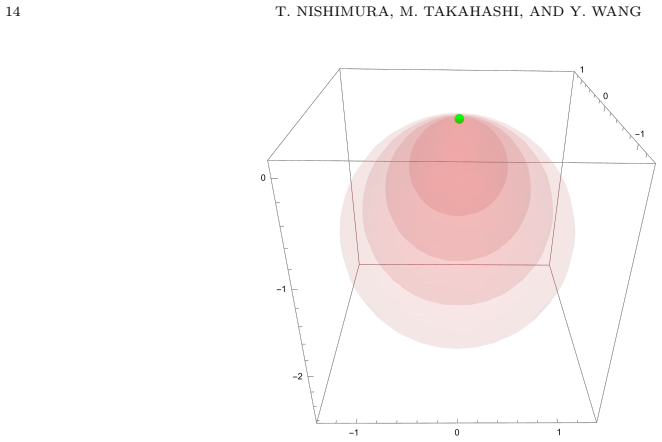
read the original abstract
In this paper, on envelopes created by sphere families in Euclidean 3-space, all four basic problems (existence problem, representation problem, problem on the number of envelopes, problem on relationships of definitions) are solved.
Editorial analysis
A structured set of objections, weighed in public.
Referee Report
Summary. The manuscript asserts that all four basic problems on envelopes generated by sphere families in Euclidean 3-space—the existence problem, the representation problem, the problem on the number of envelopes, and the problem on relationships of definitions—are solved.
Significance. A rigorous resolution of these four problems would constitute a notable contribution to classical differential geometry by clarifying existence, multiplicity, and definitional equivalence for envelopes of sphere families, provided the results are supported by explicit derivations under stated hypotheses.
major comments (2)
- [Abstract] Abstract: the claim that all four problems are solved is stated without any derivations, proofs, explicit regularity hypotheses on the sphere families (e.g., C^2 smoothness or non-vanishing curvature), or illustrative examples, rendering the central assertions unverifiable from the given text.
- The well-posedness of the envelope equations depends on unstated regularity conditions; without these, the existence and representation results cannot be confirmed to hold in the generality asserted.
Simulated Author's Rebuttal
We thank the referee for the careful reading and constructive comments. We address each major comment below and agree that explicit regularity hypotheses and illustrative examples strengthen the manuscript. Revisions have been made to clarify these aspects while preserving the core results on the four envelope problems.
read point-by-point responses
-
Referee: [Abstract] Abstract: the claim that all four problems are solved is stated without any derivations, proofs, explicit regularity hypotheses on the sphere families (e.g., C^2 smoothness or non-vanishing curvature), or illustrative examples, rendering the central assertions unverifiable from the given text.
Authors: The abstract is intended as a concise summary of the paper's main achievements. Full derivations, proofs, and the detailed treatment of the existence, representation, number, and definitional equivalence problems appear in the body of the manuscript. To address the concern, we have revised the abstract to mention the key regularity assumptions (C^2 smoothness of the sphere family together with non-vanishing curvature conditions where required for non-degeneracy). We have also added a short section containing concrete illustrative examples that verify the statements under these hypotheses. revision: yes
-
Referee: The well-posedness of the envelope equations depends on unstated regularity conditions; without these, the existence and representation results cannot be confirmed to hold in the generality asserted.
Authors: The referee correctly notes that the regularity hypotheses were not stated explicitly in a single location in the original submission. In the revised manuscript we have inserted a preliminary subsection that lists the standing assumptions: the one-parameter families of spheres are of class C^2, the center curve is regular, and the radius function satisfies a non-vanishing curvature condition that guarantees the envelope equations remain well-posed (either elliptic or hyperbolic). Under precisely these hypotheses the existence and representation theorems are proved in the subsequent sections; the results are therefore not claimed in greater generality than the stated conditions allow. revision: yes
Circularity Check
No circularity: self-contained theoretical claims on envelope problems
full rationale
The paper asserts solutions to four basic problems (existence, representation, number of envelopes, and definitional relationships) for sphere families in Euclidean 3-space. No equations, parameter fits, self-citations, or ansatzes are exhibited in the abstract or provided text that reduce any claimed result to its own inputs by construction. The treatment relies on standard differential-geometric regularity assumptions without visible self-referential definitions or load-bearing citations to prior author work that would force the outcomes. This is a normal non-finding for a pure existence/representation theorem paper whose central claims remain independent of the inputs under inspection.
Axiom & Free-Parameter Ledger
axioms (1)
- domain assumption Sphere families are sufficiently smooth (C^infty or C^2) for envelope theory to apply
Lean theorems connected to this paper
-
IndisputableMonolith/Foundation/AlexanderDuality.leanalexander_duality_circle_linking echoes?
echoesECHOES: this paper passage has the same mathematical shape or conceptual pattern as the Recognition theorem, but is not a direct formal dependency.
Theorem 1. ... the sphere family S(x,λ) creates an envelope if and only if S(x,λ) is creative. ... the number of envelopes ... characterized as follows: (3-i) unique if Σ2 or Σ3 dense; (3-ii) exactly two if Σ1 dense; (3-∞) uncountably many if Σ1∪Σ2∪Σ3 not dense.
-
IndisputableMonolith/Foundation/AbsoluteFloorClosure.leanreality_from_one_distinction unclear?
unclearRelation between the paper passage and the cited Recognition theorem.
We call (x,n,s):U→R³×Δ a framed surface if xu·n=0 and xv·n=0 ... basic invariants A, F1, F2 ... integrability conditions (4)(5).
What do these tags mean?
- matches
- The paper's claim is directly supported by a theorem in the formal canon.
- supports
- The theorem supports part of the paper's argument, but the paper may add assumptions or extra steps.
- extends
- The paper goes beyond the formal theorem; the theorem is a base layer rather than the whole result.
- uses
- The paper appears to rely on the theorem as machinery.
- contradicts
- The paper's claim conflicts with a theorem or certificate in the canon.
- unclear
- Pith found a possible connection, but the passage is too broad, indirect, or ambiguous to say the theorem truly supports the claim.
Reference graph
Works this paper leans on
-
[1]
Blaschke, Pedal coordinates, dark Kepler, and other force problems, J
P. Blaschke, Pedal coordinates, dark Kepler, and other force problems, J. Math. Phys.,58(2017) 063505. https://doi.org/10.1063/1.4984905
-
[2]
P. Blaschke, F. Blascchke, M. Blaschke, Pedal coordinates and free double linkage, J. Gemo. Phys.,171(2022) 104397. https://doi.org/10.1016/j.geomphys.2021.104397
-
[3]
J. W. Bruce and P. J. Giblin, Curves and Singularities (second edition), Cambridge University Press, Cambridge, 1992. https://doi.org/10.1017/CBO9781139172615
-
[4]
R. F. Craig, Craigs Soil Mechanics, 7th Ed., Taylor and Francis Group Press, New York, (2004). ISBN:9780415332941
work page 2004
-
[5]
S. Ei, K. Fujii, T. Kunihiro, Renormalization-group method for reduction of evolution equations; invariant manifolds and envelopes, Ann. Phys.,280(2000) 236–298
work page 2000
-
[6]
T. Fukunaga and M. Takahashi, Framed Surfaces in the Euclidean Space, Bull. Braz. Math. Soc., New Series,50 (2019), 37–65. https://doi.org/10.1007/s00574-018-0090-z
-
[7]
Ishikawa, Singularities of frontals, Adv
G. Ishikawa, Singularities of frontals, Adv. Stud. Pure Math.,78, 55–106, Math. Soc. Japan, Tokyo, 2018. https://doi.org/10.2969/aspm/07810055
-
[8]
G. Ishikawa, Frontal Singularities and Related Problems, Handbook of Geometry and Topology of Singularities VII, 203–271, Springer, Cham, 2025. https://doi.org/10.1007/978-3-031-68711-2 4
-
[9]
Izumiya, Singular solutions of first order differential equations, Bull
S. Izumiya, Singular solutions of first order differential equations, Bull. London Math. Soc.,26(1994), 69–74. https://doi.org/10.1112/blms/26.1.69
-
[10]
S. Kobayashi and K. Nomizu, Foundations of Differential Geometry, Volume 1, Wiley Classics Library, John Wiley & Sons, United States, 1996. ISBN 9780471157335
work page 1996
-
[11]
R. Murakami and T. Yamamoto, Envelopes created by parabola families in the plane (in Japanese), Bull. Tokyo Gakugei Univ. Div. Nat. Sci.,76(2024), 1–14. https://doi.org/10.50889/0002000686
-
[12]
N. Nakatsuyama and M. Takahashi Bertrand framed surfaces in the Euclidean 3-space and its applications, Res. Math. Sci.,12(2025), 86. https://doi.org/10.1007/s40687-025-00569-9
-
[13]
S. Janeczko and T. Nishimura, Anti-orthotomics of frontals and their applications, J. Math. Anal. Appl.,487(2020), 124019. https://doi.org/10.1016/j.jmaa.2020.124019
-
[14]
T. Nishimura, Hyperplane families creating envelopes, Nonlinearity,35(2022), 2588. https://doi.org/10.1088/1361- 6544/ac61a0
-
[15]
Nishimura, Envelopes of straight line families in the plane, to be published in Hokkaido Math
T. Nishimura, Envelopes of straight line families in the plane, to be published in Hokkaido Math. J. (preprint version is available at arXiv:2307.07232 [math.DG])
-
[16]
Y. Wang, T. Nishimura, Envelopes created by circle families in the plane, J. Geom.,15(2024), 7. https://doi.org/10.1007/s00022-023-00708-z. Research Institute of Environment and Information Sciences, Yokohama National University, Yokohama 240-8501, Japan Email address:nishimura-takashi-yx@ynu.ac.jp Muroran Institute of Technology, Muroran 050-8585, Japan ...
discussion (0)
Sign in with ORCID, Apple, or X to comment. Anyone can read and Pith papers without signing in.