Data-driven Radiative Magnetohydrodynamics Simulations with the MURaM Code: Coronal Heating and Dynamics in an Emerging Active Region
Pith reviewed 2026-05-18 01:41 UTC · model grok-4.3
The pith
Data-driven radiative MHD simulations of solar active region 11640 reproduce observed EUV features and show heating rate proportional to B squared.
A machine-rendered reading of the paper's core claim, the machinery that carries it, and where it could break.
Core claim
By driving the radiative MHD model with time-dependent observational boundaries, the evolution of active region 11640 is followed, reproducing key EUV emission features. Coronal loops are seen connecting sunspots or extending to boundaries. The volumetric heating rate in bright coronal loops is proportional to the square of the magnetic field. Emission-measure-weighted velocities indicate vigorous dynamics and MHD waves across temperature ranges.
What carries the argument
Hybrid strategy coupling long-term zero-beta idealized magnetic field models with shorter-period radiative MHD simulations incorporating observed time-dependent boundaries.
Load-bearing premise
The hybrid coupling between long-term zero-beta idealized models and shorter-period radiative MHD runs introduces no significant artifacts and the observational magnetic field boundaries accurately represent the true photospheric evolution without unresolved small-scale flux.
What would settle it
Observation of significant discrepancies between the synthesized EUV images from the simulation and actual remote sensing data of active region 11640 would indicate that the model does not faithfully reproduce the coronal emission features.
Figures




read the original abstract
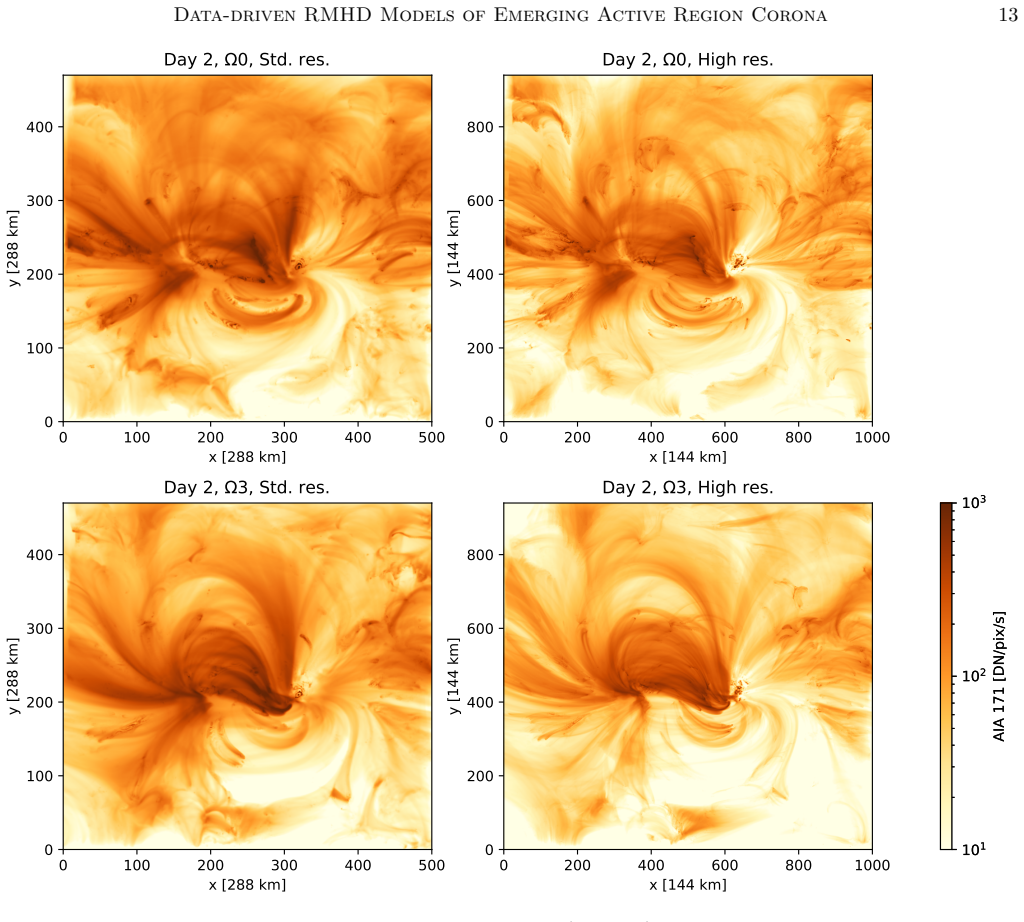
We present the application of the data-driven branch of the MURaM code, which follows the evolution of the active region 11640 over 4 days starting from 2012 December 30 at 12:00 UT and reproduces many key coronal extreme-ultraviolet (EUV) emission features seen in remote sensing observations. Radiative magnetohydrodynamic (MHD) simulations that account for sophisticated energy transport processes, such as those in the real corona, have been extended with the ability to use observations as time-dependent boundaries such that the models follow the evolution of actual active regions. This opens the possibility of a one-to-one model of a target region over an extensive time period. We use a hybrid strategy that combines fast-evolving idealized zero-$\beta$ models that capture the evolution of the large-scale active region magnetic field over a long time period and sophisticated radiative MHD models for a shorter time period of interest. The synthesized EUV images illustrate the formation of coronal loops that connect the two sunspots or fan out to the domain boundary. The model reveals in three-dimensional space fine structure in the coronal heating and plasma properties, which are usually concealed behind the EUV observables. The volumetric heating rate in bright coronal loops is proportional to $\mathbf{B}^{2}$. The emission-measure-weighted line-of-sight velocity, which represents the Doppler shift of a spectral line forming in a certain temperature range, reveals vigorous dynamics in plasma at different temperatures and ubiquitous MHD waves, as expected in the real solar corona.
Editorial analysis
A structured set of objections, weighed in public.
Referee Report
Summary. The manuscript applies the data-driven branch of the MURaM code to simulate the evolution of active region 11640 over approximately 4 days starting 2012 December 30. It employs a hybrid strategy that evolves the large-scale magnetic field with idealized zero-β models for long timescales before switching to full radiative MHD for shorter periods of interest. The work claims to reproduce many key EUV emission features observed in remote-sensing data, reveals three-dimensional fine structure in coronal heating and plasma properties, reports that the volumetric heating rate in bright coronal loops scales proportionally to B², and identifies vigorous plasma dynamics and ubiquitous MHD waves via emission-measure-weighted line-of-sight velocities.
Significance. If the central results are robust, the paper makes a valuable contribution by demonstrating practical data-driven radiative MHD modeling of a real emerging active region over multi-day timescales. The hybrid approach enables efficient capture of long-term magnetic evolution while incorporating realistic energy transport, and the reported B² heating scaling together with the 3D diagnostics of loop fine structure and wave activity provide testable insights into coronal heating mechanisms that can be compared directly against observations.
major comments (2)
- [Abstract and Methods] Abstract and Methods: The hybrid zero-β to radiative-MHD interface is load-bearing for the reported heating-B² relation, yet the manuscript provides no quantitative checks (e.g., continuity of magnetic topology, plasma β, or Poynting flux across the switch time) that would demonstrate the absence of transient artifacts capable of biasing subsequent ohmic or viscous dissipation inside the loops.
- [Results] Results: The claim that the volumetric heating rate in bright coronal loops is proportional to B² is presented without fitted slope, correlation coefficient, uncertainty estimates, or explicit description of how loop selection and post-processing thresholds influence the reported scaling; this absence weakens the ability to evaluate the robustness of the central observational-model comparison.
minor comments (2)
- [Abstract] Abstract: Specify the exact duration and start time of the shorter radiative-MHD segment relative to the overall 4-day zero-β evolution to clarify the temporal coverage.
- [Figures] Figures: Include side-by-side quantitative comparisons (e.g., intensity histograms or loop-width statistics) between synthesized EUV images and the corresponding AIA observations of AR 11640 to strengthen the reproduction claim.
Simulated Author's Rebuttal
We thank the referee for their careful and constructive review. The comments identify areas where additional quantitative detail will strengthen the manuscript, and we will incorporate the requested validations and statistical information in the revised version.
read point-by-point responses
-
Referee: [Abstract and Methods] Abstract and Methods: The hybrid zero-β to radiative-MHD interface is load-bearing for the reported heating-B² relation, yet the manuscript provides no quantitative checks (e.g., continuity of magnetic topology, plasma β, or Poynting flux across the switch time) that would demonstrate the absence of transient artifacts capable of biasing subsequent ohmic or viscous dissipation inside the loops.
Authors: We agree that explicit checks at the hybrid interface would increase confidence in the robustness of the subsequent heating results. In the revised manuscript we will add a dedicated subsection in the Methods that quantifies continuity of the magnetic topology, plasma β, and vertical Poynting flux immediately before and after the switch from the zero-β to the full radiative-MHD run. Time series and spatial maps will be included to show that any transients decay rapidly and do not systematically affect the ohmic or viscous dissipation inside the coronal loops. revision: yes
-
Referee: [Results] Results: The claim that the volumetric heating rate in bright coronal loops is proportional to B² is presented without fitted slope, correlation coefficient, uncertainty estimates, or explicit description of how loop selection and post-processing thresholds influence the reported scaling; this absence weakens the ability to evaluate the robustness of the central observational-model comparison.
Authors: We accept that the current presentation of the B² scaling lacks the statistical detail needed for a rigorous assessment. In the revised Results section we will report the best-fit slope with uncertainties, the Pearson correlation coefficient, and the number of loops analyzed. We will also provide a clear description of the loop-selection algorithm, the emission-measure and temperature thresholds used to define “bright coronal loops,” and a short sensitivity test showing how the reported scaling changes when these thresholds are varied by ±20 %. revision: yes
Circularity Check
No significant circularity: heating-B² relation extracted from data-driven simulation output
full rationale
The paper drives MURaM simulations with external observational magnetic-field boundaries over 4 days for AR 11640, using a hybrid zero-β idealized model for long-term evolution followed by shorter radiative MHD segments. The central claim that volumetric heating rate in bright coronal loops is proportional to B² is presented as an output extracted from the model results in three-dimensional space, not imposed by construction, fitted to a subset of data, or justified via self-citation chains. No equations or ansatzes in the abstract reduce the reported proportionality to the inputs by definition, and the hybrid interface is described as a methodological choice without load-bearing uniqueness theorems from prior author work. The derivation remains self-contained against external observational benchmarks.
Axiom & Free-Parameter Ledger
axioms (1)
- domain assumption The MURaM radiative MHD code and its zero-β extension accurately capture the dominant energy transport and magnetic evolution in the solar corona when driven by observed boundaries.
Lean theorems connected to this paper
-
IndisputableMonolith/Cost/FunctionalEquation.leanwashburn_uniqueness_aczel unclear?
unclearRelation between the paper passage and the cited Recognition theorem.
The volumetric heating rate in bright coronal loops is proportional to B².
-
IndisputableMonolith/Foundation/AbsoluteFloorClosure.leanreality_from_one_distinction unclear?
unclearRelation between the paper passage and the cited Recognition theorem.
hybrid strategy that combines fast-evolving idealized zero-β models ... and sophisticated radiative MHD models
What do these tags mean?
- matches
- The paper's claim is directly supported by a theorem in the formal canon.
- supports
- The theorem supports part of the paper's argument, but the paper may add assumptions or extra steps.
- extends
- The paper goes beyond the formal theorem; the theorem is a base layer rather than the whole result.
- uses
- The paper appears to rely on the theorem as machinery.
- contradicts
- The paper's claim conflicts with a theorem or certificate in the canon.
- unclear
- Pith found a possible connection, but the passage is too broad, indirect, or ambiguous to say the theorem truly supports the claim.
Reference graph
Works this paper leans on
-
[1]
Afanasyev, A. N., Fan, Y., Kazachenko, M. D., & Cheung, M. C. M. 2023, ApJ, 952, 136, doi: 10.3847/1538-4357/acd7e9
-
[2]
2014, Nature, 514, 465, doi: 10.1038/nature13815
Amari, T., Canou, A., & Aly, J.-J. 2014, Nature, 514, 465, doi: 10.1038/nature13815
-
[3]
Amari, T., Luciani, J. F., Aly, J. J., Mikic, Z., & Linker, J. 2003a, ApJ, 585, 1073, doi: 10.1086/345501
-
[4]
Amari, T., Luciani, J. F., Aly, J. J., Mikic, Z., & Linker, J. 2003b, ApJ, 595, 1231, doi: 10.1086/377444
-
[5]
2011, A&A, 530, A112, doi: 10.1051/0004-6361/201016019
Bingert, S., & Peter, H. 2011, A&A, 530, A112, doi: 10.1051/0004-6361/201016019
-
[6]
Bourdin, P. A., Bingert, S., & Peter, H. 2013, A&A, 555, A123, doi: 10.1051/0004-6361/201321185
-
[7]
2022, A&A, 658, A45, doi: 10.1051/0004-6361/202141451
Breu, C., Peter, H., Cameron, R., et al. 2022, A&A, 658, A45, doi: 10.1051/0004-6361/202141451
-
[8]
2024, MNRAS, 530, 2361, doi: 10.1093/mnras/stae899
Moortel, I. 2024, MNRAS, 530, 2361, doi: 10.1093/mnras/stae899
-
[9]
Chae, J., Yun, H. S., & Poland, A. I. 1998, ApJS, 114, 151, doi: 10.1086/313064
-
[10]
Chen, F., Cheung, M. C. M., Rempel, M., & Chintzoglou, G. 2023a, ApJ, 949, 118, doi: 10.3847/1538-4357/acc8c5
-
[11]
2015, A&A, 581, A137, doi: 10.1051/0004-6361/201526237
Chen, F., & Peter, H. 2015, A&A, 581, A137, doi: 10.1051/0004-6361/201526237
-
[12]
Chen, F., Peter, H., Bingert, S., & Cheung, M. C. M. 2015, Nature Physics, 11, 492, doi: 10.1038/nphys3315
-
[13]
2022, ApJ, 937, 91, doi: 10.3847/1538-4357/ac8f95
Chen, F., Rempel, M., & Fan, Y. 2022, ApJ, 937, 91, doi: 10.3847/1538-4357/ac8f95
-
[14]
2023b, ApJL, 950, L3, doi: 10.3847/2041-8213/acda2e
Chen, F., Rempel, M., & Fan, Y. 2023b, ApJL, 950, L3, doi: 10.3847/2041-8213/acda2e
-
[15]
Chen, Y., Peter, H., Przybylski, D., Iijima, H., & Chitta, L. P. 2025, A&A, 702, L4, doi: 10.1051/0004-6361/202556696
-
[16]
2021, ApJ, 920, 116, doi: 10.3847/1538-4357/ac1792
Chen, Y., Li, W., Tian, H., et al. 2021, ApJ, 920, 116, doi: 10.3847/1538-4357/ac1792
-
[17]
Cheung, M. C. M., & DeRosa, M. L. 2012, ApJ, 757, 147, doi: 10.1088/0004-637X/757/2/147
-
[18]
Cheung, M. C. M., De Pontieu, B., Tarbell, T. D., et al. 2015, ApJ, 801, 83, doi: 10.1088/0004-637X/801/2/83
-
[19]
Cheung, M. C. M., Rempel, M., Chintzoglou, G., et al. 2019, Nature Astronomy, 3, 160, doi: 10.1038/s41550-018-0629-3
-
[20]
Downs, C., Linker, J. A., Caplan, R. M., et al. 2025, Science, 388, 1306, doi: 10.1126/science.adq0872
-
[21]
Fan, Y., Kazachenko, M. D., Afanasyev, A. N., & Fisher, G. H. 2024, ApJ, 975, 206, doi: 10.3847/1538-4357/ad7f53
-
[22]
Fisher, G. H., Kazachenko, M. D., Welsch, B. T., et al. 2020, ApJS, 248, 2, doi: 10.3847/1538-4365/ab8303
-
[23]
Skirvin, S. J. 2023, ApJ, 955, 73, doi: 10.3847/1538-4357/acf454
-
[24]
Gudiksen, B. V., & Nordlund, ˚A. 2005a, ApJ, 618, 1020, doi: 10.1086/426063
-
[25]
Gudiksen, B. V., & Nordlund, ˚A. 2005b, ApJ, 618, 1031, doi: 10.1086/426064
-
[26]
Guo, J. H., Ni, Y. W., Zhong, Z., et al. 2023, ApJS, 266, 3, doi: 10.3847/1538-4365/acc797
-
[27]
Guo, J. H., Ni, Y. W., Guo, Y., et al. 2024, ApJ, 961, 140, doi: 10.3847/1538-4357/ad088d
-
[28]
2023, ApJL, 949, L1, doi: 10.3847/2041-8213/acd347
Guo, M., Duckenfield, T., Van Doorsselaere, T., et al. 2023, ApJL, 949, L1, doi: 10.3847/2041-8213/acd347
-
[29]
2024, A&A, 687, A30, doi: 10.1051/0004-6361/202449991
Guo, M., Van Doorsselaere, T., Li, B., & Goossens, M. 2024, A&A, 687, A30, doi: 10.1051/0004-6361/202449991
-
[30]
Guo, Y., Xia, C., Keppens, R., Ding, M. D., & Chen, P. F. 2019, ApJL, 870, L21, doi: 10.3847/2041-8213/aafabf
-
[31]
2015, ApJ, 811, 106, doi: 10.1088/0004-637X/811/2/106
Hansteen, V., Guerreiro, N., De Pontieu, B., & Carlsson, M. 2015, ApJ, 811, 106, doi: 10.1088/0004-637X/811/2/106
-
[32]
Harra, L. K., Sakao, T., Mandrini, C. H., et al. 2008, ApJL, 676, L147, doi: 10.1086/587485
-
[33]
2018, ApJ, 855, 11, doi: 10.3847/1538-4357/aaacd8
Hayashi, K., Feng, X., Xiong, M., & Jiang, C. 2018, ApJ, 855, 11, doi: 10.3847/1538-4357/aaacd8
-
[34]
T., Liu, Y., Hayashi, K., et al
Hoeksema, J. T., Liu, Y., Hayashi, K., et al. 2014, SoPh, 289, 3483, doi: 10.1007/s11207-014-0516-8
-
[35]
2023, ApJL, 951, L47, doi: 10.3847/2041-8213/acdde0
Iijima, H., Matsumoto, T., Hotta, H., & Imada, S. 2023, ApJL, 951, L47, doi: 10.3847/2041-8213/acdde0
-
[36]
2022, arXiv e-prints, arXiv:2210.07492
Inoue, S., Hayashi, K., & Miyoshi, T. 2022, arXiv e-prints, arXiv:2210.07492. https://arxiv.org/abs/2210.07492
-
[37]
2018, Nature Communications, 9, 174, doi: 10.1038/s41467-017-02616-8
Inoue, S., Kusano, K., B¨ uchner, J., & Sk´ ala, J. 2018, Nature Communications, 9, 174, doi: 10.1038/s41467-017-02616-8
-
[38]
2024, Science China Earth Sciences, 67, 3765, doi: 10.1007/s11430-023-1402-3
Jiang, C. 2024, Science China Earth Sciences, 67, 3765, doi: 10.1007/s11430-023-1402-3
-
[39]
2022, The Innovation, 3, 100236, doi: 10.1016/j.xinn.2022.100236
Jiang, C., Feng, X., Guo, Y., & Hu, Q. 2022, The Innovation, 3, 100236, doi: 10.1016/j.xinn.2022.100236
-
[40]
2018, ApJ, 867, 122, doi: 10.3847/1538-4357/aae1fd
Jin, M., Petrosian, V., Liu, W., et al. 2018, ApJ, 867, 122, doi: 10.3847/1538-4357/aae1fd
-
[41]
2021, ApJ, 909, 155, doi: 10.3847/1538-4357/abe414
Kaneko, T., Park, S.-H., & Kusano, K. 2021, ApJ, 909, 155, doi: 10.3847/1538-4357/abe414
-
[42]
Kazachenko, M. D., Fisher, G. H., & Welsch, B. T. 2014, ApJ, 795, 17, doi: 10.1088/0004-637X/795/1/17
-
[43]
Kolotkov, D. Y., Duckenfield, T. J., & Nakariakov, V. M. 2020, A&A, 644, A33, doi: 10.1051/0004-6361/202039095
-
[44]
2019, Atmosphere, 10, doi: 10.3390/atmos10090488
Li, S., Jaroszynski, S., Pearse, S., Orf, L., & Clyne, J. 2019, Atmosphere, 10, doi: 10.3390/atmos10090488
-
[45]
2023, MNRAS, 519, 5579, doi: 10.1093/mnras/stad062 24F
Lopin, I., & Nagorny, I. 2023, MNRAS, 519, 5579, doi: 10.1093/mnras/stad062 24F. Chen
-
[46]
Lu, Z., Chen, F., Ding, M. D., et al. 2024a, Nature Astronomy, 8, 706, doi: 10.1038/s41550-024-02244-5
-
[47]
Lu, Z., Chen, F., Guo, J. H., et al. 2024b, ApJL, 973, L1, doi: 10.3847/2041-8213/ad73d2
-
[48]
Lumme, E., Pomoell, J., Price, D. J., et al. 2022, A&A, 658, A200, doi: 10.1051/0004-6361/202038744
-
[49]
Klimchuk, J. A., & Rempel, M. 2022, ApJ, 927, 1, doi: 10.3847/1538-4357/ac3df9
-
[50]
Mandal, S., Chitta, L. P., Antolin, P., et al. 2022, A&A, 666, L2, doi: 10.1051/0004-6361/202244403 Miki´ c, Z., Downs, C., Linker, J. A., et al. 2018, Nature Astronomy, 2, 913, doi: 10.1038/s41550-018-0562-5
-
[51]
J., Gao, Y., Tajfirouze, E., et al
Morton, R. J., Gao, Y., Tajfirouze, E., et al. 2025, Nature Astronomy, doi: 10.1038/s41550-025-02690-9
-
[52]
M., Pilipenko, V., Heilig, B., et al
Nakariakov, V. M., Pilipenko, V., Heilig, B., et al. 2016, SSRv, 200, 75, doi: 10.1007/s11214-015-0233-0
-
[53]
2022, ApJ, 926, 64, doi: 10.3847/1538-4357/ac4090
Ofman, L., & Wang, T. 2022, ApJ, 926, 64, doi: 10.3847/1538-4357/ac4090
-
[54]
Peter, H., & Judge, P. G. 1999, ApJ, 522, 1148
work page 1999
-
[55]
2019, SoPh, 294, 41, doi: 10.1007/s11207-019-1430-x
Pomoell, J., Lumme, E., & Kilpua, E. 2019, SoPh, 294, 41, doi: 10.1007/s11207-019-1430-x
-
[56]
2014, ApJ, 789, 132, doi: 10.1088/0004-637X/789/2/132 20Sowmya et al
Rempel, M. 2014, ApJ, 789, 132, doi: 10.1088/0004-637X/789/2/132
-
[57]
2017, ApJ, 834, 10, doi: 10.3847/1538-4357/834/1/10
Rempel, M. 2017, ApJ, 834, 10, doi: 10.3847/1538-4357/834/1/10
-
[58]
Rempel, M., Chintzoglou, G., Cheung, M. C. M., Fan, Y., & Kleint, L. 2023, ApJ, 955, 105, doi: 10.3847/1538-4357/aced4d
-
[59]
Rosner, R., Tucker, W. H., & Vaiana, G. S. 1978, ApJ, 220, 643, doi: 10.1086/155949
-
[60]
2007, Science, 318, 1585, doi: 10.1126/science.1147292
Sakao, T., Kano, R., Narukage, N., et al. 2007, Science, 318, 1585, doi: 10.1126/science.1147292
-
[61]
Scherrer, P. H., Schou, J., Bush, R. I., et al. 2012, SoPh, 275, 207, doi: 10.1007/s11207-011-9834-2
-
[62]
2024, Reviews of Modern Plasma Physics, 8, 27, doi: 10.1007/s41614-024-00166-3
Schmieder, B., Guo, J., & Poedts, S. 2024, Reviews of Modern Plasma Physics, 8, 27, doi: 10.1007/s41614-024-00166-3
-
[63]
Shi, M., Nakariakov, V. M., Li, B., & Guo, M. 2025, ApJ, 990, 1, doi: 10.3847/1538-4357/adf647
-
[64]
2021, ApJ, 908, 233, doi: 10.3847/1538-4357/abda54
Shi, M., Van Doorsselaere, T., Guo, M., et al. 2021, ApJ, 908, 233, doi: 10.3847/1538-4357/abda54
-
[65]
2022, ApJ, 928, 34, doi: 10.3847/1538-4357/ac52ab
Shi, T., Manchester, IV, W., Landi, E., et al. 2022, ApJ, 928, 34, doi: 10.3847/1538-4357/ac52ab
-
[66]
2024, ApJ, 961, 60, doi: 10.3847/1538-4357/ad0df2
Shi, T., Manchester, W., Landi, E., et al. 2024, ApJ, 961, 60, doi: 10.3847/1538-4357/ad0df2
-
[67]
2018, ApJ, 854, 174, doi: 10.3847/1538-4357/aaaae6
Tian, H., Zhu, X., Peter, H., et al. 2018, ApJ, 854, 174, doi: 10.3847/1538-4357/aaaae6
-
[68]
Toriumi, S., Katsukawa, Y., & Cheung, M. C. M. 2017, ApJ, 836, 63, doi: 10.3847/1538-4357/836/1/63 Van Damme, H. J., De Moortel, I., Pagano, P., & Johnston, C. D. 2020, A&A, 635, A174, doi: 10.1051/0004-6361/201937266 Van Doorsselaere, T., Srivastava, A. K., Antolin, P., et al. 2020, SSRv, 216, 140, doi: 10.1007/s11214-020-00770-y
-
[69]
2019, A&A, 624, L12, doi: 10.1051/0004-6361/201935385
Warnecke, J., & Peter, H. 2019, A&A, 624, L12, doi: 10.1051/0004-6361/201935385
-
[70]
Warren, H. P., Ugarte-Urra, I., Young, P. R., & Stenborg, G. 2011, ApJ, 727, 58, doi: 10.1088/0004-637X/727/1/58
-
[71]
Winebarger, A., Tripathi, D., Mason, H. E., & Del Zanna, G. 2013, ApJ, 767, 107, doi: 10.1088/0004-637X/767/2/107
-
[72]
2024, Science, 386, 76, doi: 10.1126/science.ado2993
Yang, Z., Tian, H., Tomczyk, S., et al. 2024, Science, 386, 76, doi: 10.1126/science.ado2993
-
[73]
2020, Science, 369, 694, doi: 10.1126/science.abb4462
Yang, Z., Bethge, C., Tian, H., et al. 2020, Science, 369, 694, doi: 10.1126/science.abb4462
-
[74]
Zhong, Z., Guo, Y., & Ding, M. D. 2021, Nature Communications, 12, 2734, doi: 10.1038/s41467-021-23037-8
-
[75]
2025, A&A, 701, A205, doi: 10.1051/0004-6361/202555618
Zhu, Y., Harra, L., Barczynski, K., et al. 2025, A&A, 701, A205, doi: 10.1051/0004-6361/202555618
discussion (0)
Sign in with ORCID, Apple, or X to comment. Anyone can read and Pith papers without signing in.