About subspaces the most deviating from the coordinate ones
Pith reviewed 2026-05-18 01:36 UTC · model grok-4.3
The pith
k-dimensional subspaces from weighted series-parallel graphs deviate from every coordinate k-subspace by at least arccos(1/sqrt(n)).
A machine-rendered reading of the paper's core claim, the machinery that carries it, and where it could break.
Core claim
We construct k-dimensional subspaces which deviate from every coordinate k-subspace by at least arccos(1/sqrt n). The subspaces are scaled star spaces of 2-connected series-parallel graphs with k+1 vertices and n edges, equipped with a particular positive edge weighting. The largest principal angles take two values, arccos(1/sqrt n) and pi/2, depending on whether a k-edge subgraph corresponding to a coordinate k-subspace is a spanning tree or not. For a fixed series-parallel graph, the constructed weighting is the unique positive one, up to scaling, for which the corresponding k-subspace deviates from all coordinate k-subspaces by at least arccos(1/sqrt n).
What carries the argument
Scaled star spaces of 2-connected series-parallel graphs equipped with a specific positive edge weighting that forces the largest principal angle to equal arccos(1/sqrt(n)) precisely when the selected edges form a spanning tree.
If this is right
- The minimum deviation achieved is exactly arccos(1/sqrt(n)) for every coordinate k-subspace.
- Principal angles between the subspace and coordinate subspaces take only the two discrete values arccos(1/sqrt(n)) and pi/2.
- For each fixed 2-connected series-parallel graph the edge weighting realizing the bound is unique up to positive scaling.
- These subspaces therefore meet the separation value hypothesized to be maximal for all n > k > 0.
Where Pith is reading between the lines
- The same graph-plus-weighting method could be tested on other families of graphs to see whether the deviation bound extends beyond series-parallel graphs.
- The appearance of spanning trees as the critical subgraphs suggests possible links to matroid or combinatorial optimization problems that select bases with controlled angles.
- If the conjecture holds, these constructions supply explicit examples that could be used to benchmark numerical algorithms measuring subspace separation.
- Small-n exhaustive searches over random subspaces could serve as a direct check on whether any k-plane exceeds the stated minimum deviation.
Load-bearing premise
The largest principal angle between the constructed subspace and any coordinate subspace depends only on whether the corresponding k edges form a spanning tree once the edge weights are chosen to fix the Gram-matrix angles.
What would settle it
For small concrete values such as n=4 and k=2, compute the largest principal angles of the constructed subspace against all coordinate 2-subspaces and check whether any coordinate 2-subspace yields an angle strictly smaller than arccos(1/2).
Figures


read the original abstract
Using the largest principal angle as a distance between same-dimensional linear subspaces of $\mathbb{R}^n$, we construct $k$-dimensional subspaces which deviate from every coordinate $k$-subspace by at least $\arccos(1/\sqrt n)$. The construction is motivated by the hypothesis of Goreinov, Tyrtyshnikov and Zamarashkin that this value is the largest possible one for all $n > k > 0$. The subspaces are scaled star spaces of $2$-connected series-parallel graphs with $k+1$ vertices and $n$ edges, equipped with a particular positive edge weighting, while the largest principal angles take two values -- $\arccos(1 / \sqrt{n})$ and $\pi/2$, depending on whether a $k$-edge subgraph corresponding to a coordinate $k$-subspace is a spanning tree or not. For a fixed series-parallel graph, we also prove that the constructed weighting is the unique positive one, up to scaling, for which the corresponding $k$-subspace deviates from all coordinate $k$-subspaces by at least $\arccos(1 / \sqrt{n})$.
Editorial analysis
A structured set of objections, weighed in public.
Referee Report
Summary. The paper constructs k-dimensional subspaces of R^n that deviate from every coordinate k-subspace by a largest principal angle of at least arccos(1/sqrt(n)). The subspaces are realized as scaled star spaces of 2-connected series-parallel graphs with k+1 vertices and n edges, equipped with a specific positive edge weighting. The resulting principal angles take exactly two values—arccos(1/sqrt(n)) when the corresponding k-edge subgraph is a spanning tree and pi/2 otherwise. For any fixed such graph the weighting is shown to be the unique positive weighting (up to scaling) that achieves this minimal deviation bound.
Significance. If the algebraic verification holds, the work supplies an explicit, graph-theoretic family of subspaces attaining the conjectured optimal lower bound on maximal principal angle proposed by Goreinov, Tyrtyshnikov and Zamarashkin. The construction is parameter-free once the graph and weighting are fixed, and the uniqueness statement for the weighting adds a rigidity result that may be useful in frame theory or in the design of well-conditioned coordinate projections. The manuscript provides a concrete, falsifiable construction together with an algebraic proof of the angle spectrum.
major comments (2)
- [§3] §3 (Construction and weighting): the claim that the chosen positive edge weighting produces principal angles taking exactly the two values arccos(1/sqrt(n)) and pi/2 according to whether the k-edge subgraph is a spanning tree is load-bearing for the central existence statement. The derivation from the weighted incidence matrix to the Gram matrix eigenvalues (or singular values of the projection) should be written out in full for general n and k rather than illustrated on small cases, so that the identity can be verified directly.
- [§5] §5 (Uniqueness): the proof that the weighting is unique up to scaling among positive weightings that guarantee deviation at least arccos(1/sqrt(n)) from all coordinate subspaces relies on showing that any other weighting would force at least one angle below the bound. The argument would be strengthened by an explicit statement of the linear system solved by the weights and by confirming that the solution remains positive for every 2-connected series-parallel graph in the family.
minor comments (3)
- [Abstract] Abstract: the phrase 'while the largest principal angles take two values' is slightly ambiguous; rephrase to make explicit that the two values are attained precisely according to the spanning-tree property of the k-edge subgraph.
- [§3] Notation: the scaling factor applied to the star space is introduced without a displayed equation; add a short displayed definition (e.g., Eq. (3.2)) so that the normalization is unambiguous when computing inner products.
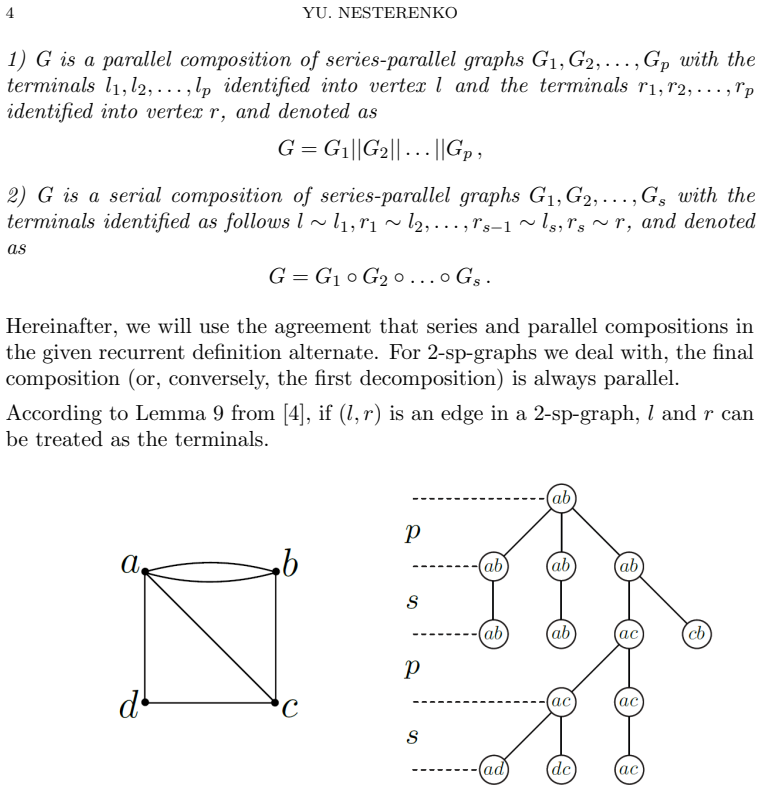
- [Figure 1] Figure 1 (or the illustrative graph diagram): the edge labels for the weighting are not shown; include them or add a caption that states the explicit positive values used in the example.
Simulated Author's Rebuttal
We thank the referee for the positive evaluation and the constructive suggestions that will improve the clarity of the central proofs. We address the two major comments below and will revise the manuscript accordingly.
read point-by-point responses
-
Referee: [§3] §3 (Construction and weighting): the claim that the chosen positive edge weighting produces principal angles taking exactly the two values arccos(1/sqrt(n)) and pi/2 according to whether the k-edge subgraph is a spanning tree is load-bearing for the central existence statement. The derivation from the weighted incidence matrix to the Gram matrix eigenvalues (or singular values of the projection) should be written out in full for general n and k rather than illustrated on small cases, so that the identity can be verified directly.
Authors: We agree that a self-contained general derivation strengthens the exposition. In the revised version we will present the full computation: starting from the weighted incidence matrix B of the 2-connected series-parallel graph, we form the Gram matrix of the scaled star space and compute its eigenvalues explicitly in terms of n and k. The argument proceeds by partitioning the edges according to the spanning-tree condition and showing that the spectrum consists of the value 1/n with multiplicity k (corresponding to arccos(1/sqrt(n))) together with zeros, while all other coordinate projections yield the orthogonal case pi/2. This replaces the small-case illustrations with a uniform algebraic identity valid for arbitrary n > k > 0. revision: yes
-
Referee: [§5] §5 (Uniqueness): the proof that the weighting is unique up to scaling among positive weightings that guarantee deviation at least arccos(1/sqrt(n)) from all coordinate subspaces relies on showing that any other weighting would force at least one angle below the bound. The argument would be strengthened by an explicit statement of the linear system solved by the weights and by confirming that the solution remains positive for every 2-connected series-parallel graph in the family.
Authors: We accept the suggestion to make the linear algebra explicit. The revised §5 will state the homogeneous linear system whose solution space is one-dimensional and whose positive ray yields the desired weighting. We will then prove, using the recursive decomposition of series-parallel graphs (series and parallel compositions), that this system admits a strictly positive solution for every 2-connected member of the family; positivity follows by induction on the number of edges, with the base case being the cycle graph and the inductive step preserving positivity under the two composition rules. revision: yes
Circularity Check
No significant circularity; explicit construction from graph data and weighting
full rationale
The paper's central result is an explicit construction of k-dimensional subspaces as scaled star spaces of 2-connected series-parallel graphs equipped with a chosen positive edge weighting. The largest principal angles are shown to take exactly the values arccos(1/sqrt(n)) or pi/2 depending on whether the corresponding k-edge subgraph is a spanning tree. This follows directly from the incidence structure and the algebraic choice of weights; the uniqueness of the weighting (up to scaling) for a fixed graph is proved from the same local Gram-matrix identities. No step reduces a prediction to a fitted input by construction, invokes a self-citation as load-bearing justification, or renames a known result. The derivation is self-contained and does not rely on external fitted parameters or circular definitions.
Axiom & Free-Parameter Ledger
axioms (2)
- domain assumption The largest principal angle between two k-subspaces is a valid distance that captures directional deviation.
- ad hoc to paper For the chosen positive edge weighting on a 2-connected series-parallel graph, the principal angles with coordinate subspaces are exactly arccos(1/sqrt n) or pi/2 according to whether the k-edge subgraph is a spanning tree.
Reference graph
Works this paper leans on
-
[1]
W. Wu A. Kassel. Transfer current and pattern fields in spanning trees.Probab. Theory Relat. Fields, 163:89–121, 2015
work page 2015
-
[2]
R. B. Bapat. Mixed discriminants and spanning trees.Sankhy¯ a: The Indian Journal of Statistics, Series B (1960-2002), 54:49–55, 1992
work page 1960
-
[3]
R.J Duffin. Topology of series-parallel networks.Journal of Mathematical Analysis and Applications, 10:303–318, 1965
work page 1965
- [4]
-
[5]
G.H. Golub and C.F. Van Loan.Matrix Computations, pages 84–85. Johns Hopkins U.P., 4th ed. edition, 2013
work page 2013
-
[6]
S.A. Goreinov, E.E. Tyrtyshnikov, and N.L. Zamarashkin. A theory of pseudo-skeleton approximations.Linear Algebra Appl., 261:1–21, 1997
work page 1997
-
[7]
G. R. Grimmett.Probability on Graphs, Random Processes on Graphs and Lattices, pages 6–8. Cambridge University Press, 2nd ed. edition, 2018
work page 2018
-
[8]
OEIS.https://oeis.org
-
[9]
R. Pemantle R. Burton. Local characteristics, entropy and limit theorems for spanning trees and domino tilings via transfer-impedances.The Annals of Probability, 21:1329– 1371, 1993
work page 1993
-
[10]
YY. Lee RH. Jan, LH. Hsu. The most vital edges with respect to the number of spanning trees in two-terminal series-parallel graphs.BIT Numerical Mathematics, 32:403–412, 1992
work page 1992
-
[11]
D. E. Speyer.https://oeis.org/A115594, 2006. 14 YU. NESTERENKO 7.Appendix Algorithm 1Subspace optimization procedureOptimize(A) d←Distance(A)▷Initial target function value M←M init ▷Some initial perturbation magnitude repeat Anew ←P erturbate(A, M)▷A new subspace candidate dnew ←Distance(A new)▷Its target function value ifd new > dthen▷Update the current ...
work page 2006
discussion (0)
Sign in with ORCID, Apple, or X to comment. Anyone can read and Pith papers without signing in.