Structure and realizability for rational maps
Pith reviewed 2026-05-21 19:57 UTC · model grok-4.3
The pith
Rational maps realize branch data collections of k partitions whenever k exceeds the shortest partition length by more than one
A machine-rendered reading of the paper's core claim, the machinery that carries it, and where it could break.
Core claim
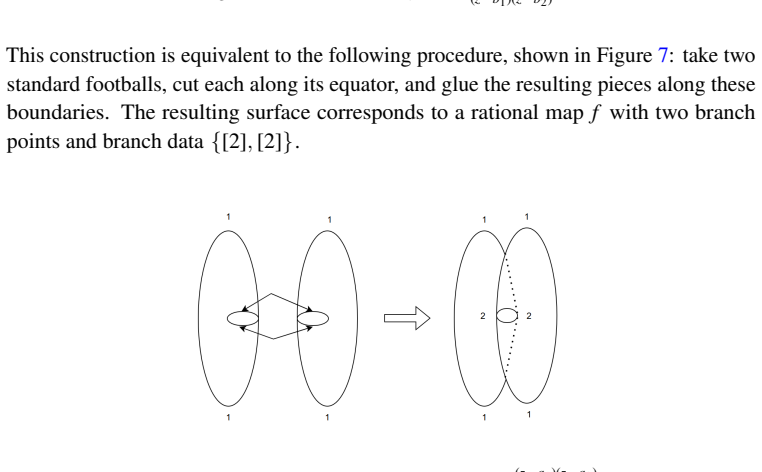
We establish a structure theorem for rational maps f from the Riemann sphere to itself: the pullback metric f^* ds_0^2 admits a canonical decomposition into finitely many footballs by cutting along a finite set of geodesics. This geometric decomposition provides a new framework for the Hurwitz existence problem. As an application, we prove that a collection D of k nontrivial partitions of a positive integer d satisfying the Riemann-Hurwitz condition is realizable as the branch datum of a rational map whenever k > l + 1, where l is the minimum partition length.
What carries the argument
The canonical decomposition of the pullback metric into footballs obtained by cutting along geodesics, which turns the realizability of branch data into a question about assembling these footballs.
If this is right
- The result unifies Thom's theorem for l equal to one, Pakovich's theorem for l equal to two, and Barański's theorem for k at least d.
- It confirms Zheng's conjecture in the special case where the number of partitions is sufficiently large compared to the shortest partition length.
- The geometric framework may be used to construct explicit rational maps from given partition data.
Where Pith is reading between the lines
- This decomposition suggests that similar cutting procedures could apply to rational maps with more complicated singularities or to functions on higher genus curves.
- Future work might determine the precise boundary between realizable and non-realizable collections by examining the case k equal to l plus one.
- The method could lead to effective algorithms for deciding realizability or even finding the map coefficients.
Load-bearing premise
The pullback metric admits a canonical decomposition into finitely many footballs by cutting along a finite set of geodesics.
What would settle it
A collection of exactly l+1 partitions of d that satisfies the Riemann-Hurwitz condition but is not the branch datum of any rational map of degree d would serve as a counterexample.
Figures




read the original abstract
We establish a structure theorem for rational maps $f:\overline{\mathbb{C}}\to\overline{\mathbb{C}}$: the pullback metric $f^{*}{\rm d}s_{0}^{2}$ of the standard metric ${\rm d}s_{0}^{2}$ admits a canonical decomposition into finitely many footballs -- Riemann spheres with two antipodal conical singularities of equal angle -- by cutting along a finite set of geodesics. This geometric decomposition provides a new framework for the Hurwitz existence problem. As an application, we prove that a collection $\mathcal{D}$ of $k$ nontrivial partitions of a positive integer $d$ satisfying the Riemann--Hurwitz condition is realizable as the branch datum of a rational map whenever $k>l+1$, where $l$ is the minimum partition length. This unifies the classical results of Thom ($l = 1$), Pakovich ($l = 2$) and Bara\'{n}ski ($k\geq d$), and confirms a conjecture of Zheng in an important special case.
Editorial analysis
A structured set of objections, weighed in public.
Referee Report
Summary. The manuscript establishes a structure theorem for rational maps f: Riemann sphere to itself: the pullback metric f^* ds_0^2 admits a canonical decomposition into finitely many footballs (Riemann spheres with two antipodal conical singularities of equal angle) obtained by cutting along a finite collection of geodesics. This geometric framework is then applied to the Hurwitz existence problem, yielding a realizability theorem: any collection D of k nontrivial partitions of a positive integer d that satisfies the Riemann-Hurwitz condition is realizable as the branch datum of a rational map whenever k > l + 1, where l denotes the minimum partition length. The result unifies the classical theorems of Thom (l=1), Pakovich (l=2), and Barański (k ≥ d) and confirms Zheng's conjecture in an important special case.
Significance. If the central claims hold, the work supplies a new geometric approach to the Hurwitz existence problem by exploiting the local Euclidean structure of the pullback metric and an explicit geodesic-cutting construction via the developing map. The realizability statement is a concrete advance that recovers and extends several prior results while resolving a special case of a known conjecture; the parameter-counting argument that becomes positive precisely when k > l + 1 is a clean, falsifiable criterion.
major comments (2)
- [§2] §2 (Structure theorem): the proof that each component after cutting is a football with equal conical angles relies on the developing map and the fact that the metric is locally Euclidean away from conical points of angle 2πm (m integer). Please supply the precise local coordinate computation showing that the two singularities in each component necessarily have identical angles; this step is load-bearing for the subsequent assignment of partitions.
- [§3] §3 (Realizability theorem): the counting argument that the number of free parameters is positive exactly when k > l + 1 must be checked against the global topology of the sphere; confirm that the assignment of the given partitions to the footballs automatically satisfies the total branching index required by Riemann-Hurwitz and does not overcount or undercount the moduli.
minor comments (3)
- [§1] The term 'football' is introduced in the abstract and §1; add an explicit one-sentence definition at first appearance in the main text.
- [Figure 1] Figure 1 (schematic of geodesic cuts) would benefit from labels indicating the conical angles on each football component.
- [Theorem 1.2] In the statement of the main theorem, replace the informal phrase 'nontrivial partitions' with the precise numerical condition used in the proof.
Simulated Author's Rebuttal
We thank the referee for the positive evaluation and constructive comments. We address each major comment below and have revised the manuscript accordingly to incorporate additional details and clarifications.
read point-by-point responses
-
Referee: [§2] §2 (Structure theorem): the proof that each component after cutting is a football with equal conical angles relies on the developing map and the fact that the metric is locally Euclidean away from conical points of angle 2πm (m integer). Please supply the precise local coordinate computation showing that the two singularities in each component necessarily have identical angles; this step is load-bearing for the subsequent assignment of partitions.
Authors: We agree that an explicit local computation strengthens the argument. In the revised Section 2, we have inserted a new paragraph providing the requested coordinate computation. Let z be a local coordinate centered at a conical point of angle 2πm. The developing map φ satisfies φ(z) = z^m + higher terms near the singularity. After cutting along the geodesic, the complementary component is a sphere with two such points. Because the metric is pulled back from the flat metric on the target sphere and the developing map extends continuously across the cut, the monodromy around the two singularities must be conjugate, forcing the conical angles to be identical (both 2πm for the same integer m determined by the local degree). This identification is canonical and directly assigns the partition data to each football. revision: yes
-
Referee: [§3] §3 (Realizability theorem): the counting argument that the number of free parameters is positive exactly when k > l + 1 must be checked against the global topology of the sphere; confirm that the assignment of the given partitions to the footballs automatically satisfies the total branching index required by Riemann-Hurwitz and does not overcount or undercount the moduli.
Authors: The parameter count in Section 3 is already compatible with the global topology. Each football arising from the canonical decomposition carries a pair of partitions whose lengths sum to the local degree; the total branching index over all footballs equals the global branching index required by the Riemann-Hurwitz formula for a degree-d rational map. Because the decomposition is obtained by cutting along a finite geodesic graph whose Euler characteristic is fixed, there is no overcounting of moduli: the dimension of the configuration space of the k footballs on the sphere is 3k-6 minus the constraints from the cuts, which becomes positive precisely when k > l+1. We have added a short remark in the revised text confirming this topological consistency and verifying that the assignment respects the total degree. revision: yes
Circularity Check
No significant circularity; derivation self-contained via explicit construction
full rationale
The paper derives the structure theorem by explicitly constructing the cutting geodesics from the developing map of the pullback metric, using that the metric is locally Euclidean away from finitely many conical singularities of integer multiplicity. Each component is shown to be a football with equal conical angles. The realizability statement then follows by assigning the given partitions to these footballs and applying a direct counting argument on free parameters, which is positive precisely when k > l + 1. This chain relies on standard properties of the spherical metric and Riemann-Hurwitz rather than any fitted parameters, self-definitions, or load-bearing self-citations. The unification of prior results (Thom, Pakovich, Barański) and the special case of Zheng's conjecture are presented as consequences of the new decomposition, not as inputs. No step reduces by construction to its own outputs.
Axiom & Free-Parameter Ledger
axioms (1)
- standard math The Riemann-Hurwitz formula holds for branched covers between Riemann spheres and supplies the necessary numerical condition on partitions.
invented entities (1)
-
football
no independent evidence
Lean theorems connected to this paper
-
IndisputableMonolith/Cost/FunctionalEquation.leanwashburn_uniqueness_aczel unclear?
unclearRelation between the paper passage and the cited Recognition theorem.
the pullback metric f^* ds_0^2 ... admits a canonical decomposition ... into finitely many pieces, each isometric to a football
-
IndisputableMonolith/Foundation/AlexanderDuality.leanalexander_duality_circle_linking unclear?
unclearRelation between the paper passage and the cited Recognition theorem.
Theorem 1.4 ... if k ≥ |π_k| + 2 then D is realizable
What do these tags mean?
- matches
- The paper's claim is directly supported by a theorem in the formal canon.
- supports
- The theorem supports part of the paper's argument, but the paper may add assumptions or extra steps.
- extends
- The paper goes beyond the formal theorem; the theorem is a base layer rather than the whole result.
- uses
- The paper appears to rely on the theorem as machinery.
- contradicts
- The paper's claim conflicts with a theorem or certificate in the canon.
- unclear
- Pith found a possible connection, but the passage is too broad, indirect, or ambiguous to say the theorem truly supports the claim.
Reference graph
Works this paper leans on
-
[1]
On realizability of branched coverings of the sphere.Topology Appl.116 (2001), no
Bara´nski, K. On realizability of branched coverings of the sphere.Topology Appl.116 (2001), no. 3, 279–291
work page 2001
-
[2]
Baroni, F. and Petronio, C. Solution of the Hurwitz problem with a length-2 partition. Illinois J. Math.68(2024), no. 3, 479–511
work page 2024
-
[3]
Cycles comme produit de deux permutations de classes donn´ees.Discrete Math.58(1982), 129–142
Boccara, G. Cycles comme produit de deux permutations de classes donn´ees.Discrete Math.58(1982), 129–142
work page 1982
-
[4]
Chen, Q., Wang, W., Wu, Y . Y ., and Xu, B. Conformal metrics with constant curvature one and finitely many conical singularities on compact Riemann surfaces.Pacific J. Math.273(2015), no. 1, 75–100
work page 2015
-
[5]
Cui, W. W. and Hu, J. Totally ramified rational maps.Conform. Geom. Dyn.26(2022), 208–234
work page 2022
-
[6]
Edmonds, A. L., Kulkarni, R. S., and Stong, R. E. Realizability of branched coverings of surfaces.Trans. Amer. Math. Soc.282(1984), no. 2, 773–790
work page 1984
-
[7]
Moduli of spherical tori with one conical point.Geom
Eremenko, A., Mondello, M., and Panov, D. Moduli of spherical tori with one conical point.Geom. Topol.27(2023), no. 9, 3619–3698
work page 2023
-
[8]
Ezell, C. L. Branch point structure of covering maps onto nonorientable surfaces.Trans. Amer. Math. Soc.243(1978), 123–133
work page 1978
-
[9]
Gersten, S. M. On branched covers of the 2-sphere by the 2-sphere.Proc. Amer. Math. Soc.101(1987), no. 4, 761–766
work page 1987
-
[10]
Ueber Riemann’sche Fl¨achen mit gegebenen Verzweigungspunkten.Math
Hurwitz, A. Ueber Riemann’sche Fl¨achen mit gegebenen Verzweigungspunkten.Math. Ann.39(1891), no. 1, 1–60
-
[11]
Husemoller, D. H. Ramified coverings of Riemann surfaces.Duke Math. J.29(1962), 167–174. Structure and realizability for rational maps29
work page 1962
-
[12]
Khovanskii, A. G. and Zdravkovska, S. Branched covers ofS2 and braid groups.J. Knot Theory Ramifications5(1996), no. 1, 55–75
work page 1996
-
[13]
Luisto, R. and Pankka, P. Sto ¨ılow’s theorem revisited.Expo. Math.(2019). https://doi.org/10.1016/j.exmath.2019.04.002
-
[14]
Mazzeo, R. and Zhu, X. W. Conical metrics on Riemann surfaces, I: The compactified configuration space and regularity.Geom. Topol.24(2020), no. 1, 309–372
work page 2020
-
[15]
Mazzeo, R. and Zhu, X. W. Conical metrics on Riemann surfaces, II: Spherical metrics. Int. Math. Res. Not.2022(2022), no. 12, 9044–9113
work page 2022
-
[16]
McOwen, R. C. Point singularities and conformal metrics on Riemann surfaces.Proc. Amer. Math. Soc.103(1988), no. 1, 222–224
work page 1988
-
[17]
Mednykh, A. D. Nonequivalent coverings of Riemann surfaces with a prescribed ramification type.Sibirsk. Mat. Zh.25(1984), no. 4, 120–142 (Russian)
work page 1984
-
[18]
Mednykh, A. D. Branched coverings of Riemann surfaces whose branch orders coincide with the multiplicity.Comm. Algebra18(1990), no. 5, 1517–1533
work page 1990
-
[19]
Mondello, G. and Panov, D. Spherical metrics with conical singularities on a 2-sphere: angle constraints.Int. Math. Res. Not.2016(2016), no. 16, 4937–4995
work page 2016
-
[20]
Mondello, G. and Panov, D. Spherical surfaces with conical points: systole inequality and moduli spaces with many connected components.Geom. Funct. Anal.29(2019), no. 4, 1110–1193
work page 2019
-
[21]
Monni, S., Song, J. S., and Song, Y . S. The Hurwitz enumeration problem of branched covers and Hodge integrals.J. Geom. Phys.50(2004), no. 1-4, 223–256
work page 2004
-
[22]
Okounkov, A. and Pandharipande, R. Gromov-Witten theory, Hurwitz theory, and completed cycles.Ann. of Math.163(2006), no. 2, 517–560
work page 2006
-
[23]
Solution of the Hurwitz problem for Laurent polynomials.J
Pakovich, F. Solution of the Hurwitz problem for Laurent polynomials.J. Knot Theory Ramifications18(2009), no. 2, 271–302
work page 2009
-
[24]
Hurwitz existence problem and fiber products.arXiv:2408.10874v1 [math.CV] (2024)
Pakovich, F. Hurwitz existence problem and fiber products.arXiv:2408.10874v1 [math.CV] (2024)
-
[25]
Pascali, M. A. and Petronio, C. Surface branched covers and geometric 2-orbifolds. Trans. Amer. Math. Soc.361(2009), no. 11, 5885–5920
work page 2009
-
[26]
Pascali, M. A. and Petronio, C. Branched covers of the sphere and the prime-degree conjecture.Ann. Mat. Pura Appl.191(2012), no. 3, 563–594
work page 2012
-
[27]
Pervova, E. and Petronio, C. On the existence of branched coverings between surfaces with prescribed branch data, I.Algebr. Geom. Topol.6(2006), 1957–1985
work page 2006
-
[28]
Pervova, E. and Petronio, C. Realizability and exceptionality of candidate surface branched covers: methods and results. In:Geometry Seminars. 2005–2009(Italian)
work page 2005
-
[29]
Pervova, E. and Petronio, C. On the existence of branched coverings between surfaces with prescribed branch data, II.J. Knot Theory Ramifications17(2008), no. 7, 787–816. 30Zhiqiang Wei
work page 2008
-
[30]
The Hurwitz existence problem for surface branched covers.Winter Braids Lect
Petronio, C. The Hurwitz existence problem for surface branched covers.Winter Braids Lect. Notes7(2020), Winter Braids X (Pisa, 2020), Exp. No. 2, 43 pp
work page 2020
-
[31]
Song, J. J. and Xu, B. On rational functions with more than three branch points.Algebra Colloq.27(2020), no. 2, 231–246
work page 2020
-
[32]
Sur les transformations continues et la topologie des fonctions analytiques
Sto¨ılow, S. Sur les transformations continues et la topologie des fonctions analytiques. Ann. Sci. ´Ec. Norm. Sup´er.45(1928), 347–382
work page 1928
-
[33]
L’equivalence d’une fonction diff´erentiable et d’un polynˆome.Topology3 (1965), suppl
Thom, R. L’equivalence d’une fonction diff´erentiable et d’un polynˆome.Topology3 (1965), suppl. 2, 297–307
work page 1965
-
[34]
Wang, G. F. and Zhu, X. H. Extremal Hermitian metrics on Riemann surfaces with singularities.Duke Math. J.104(2000), no. 2, 181–210
work page 2000
- [35]
- [36]
-
[37]
Realizability of branched covering ofS 2 .Topology Appl.153(2006), no
Zheng, H. Realizability of branched covering ofS 2 .Topology Appl.153(2006), no. 12, 2124–2134
work page 2006
-
[38]
Zhu, X. W. Spherical conic metrics and realizability of branched covers.Proc. Amer. Math. Soc.147(2019), no. 4, 1805–1815. School of Mathematics and Statistics, Henan University, Kaifeng, China Center for Applied Mathematics of Henan Province, Henan University, Zhengzhou, China weizhiqiang15@mails.ucas.edu.cn ~~or~~10100123@vip.henu.edu.cn
work page 2019
discussion (0)
Sign in with ORCID, Apple, or X to comment. Anyone can read and Pith papers without signing in.