Scale setting of SU(N) Yang--Mills theory, topology and large-N volume independence
Pith reviewed 2026-05-17 23:51 UTC · model grok-4.3
The pith
Twisted boundary conditions and parallel tempering enable accurate gradient-flow scale setting in SU(N) Yang-Mills down to lattice spacings of 0.025 fm for N=3,5,8 and the large-N limit.
A machine-rendered reading of the paper's core claim, the machinery that carries it, and where it could break.
Core claim
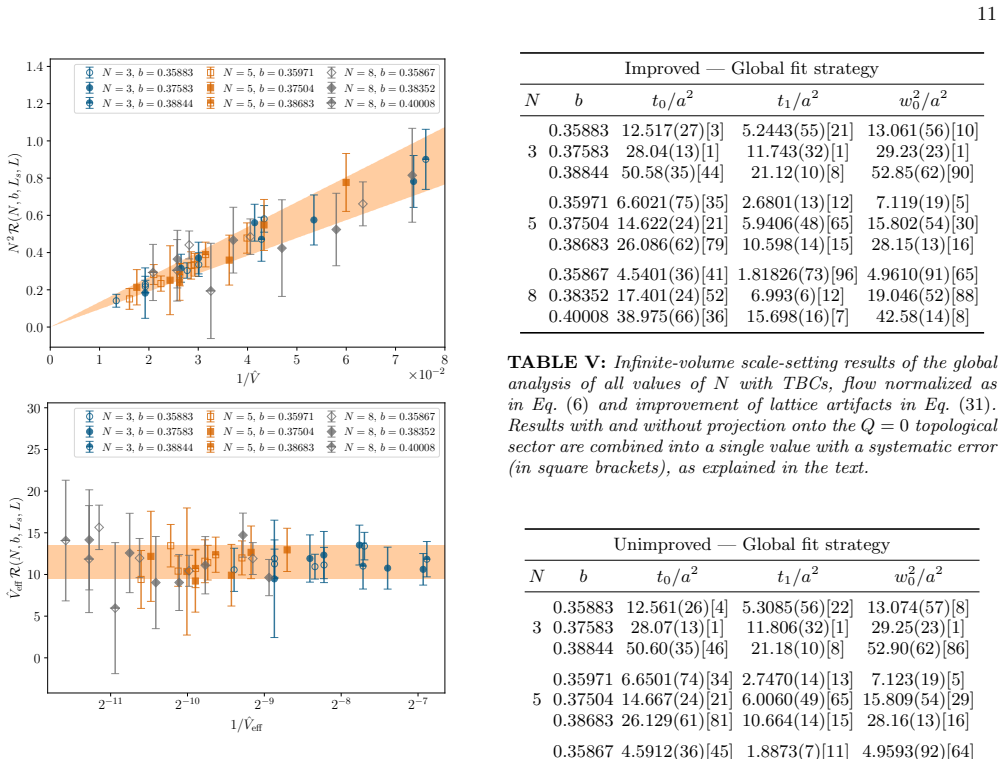
We determine the gradient-flow scales t0 and w0 for SU(N) Yang-Mills with N=3,5,8 and extrapolate to large N, reaching lattice spacings as fine as approximately 0.025 fm for every N studied. Twisted boundary conditions implement large-N volume reduction while the Parallel Tempering on Boundary Conditions algorithm eliminates topological freezing, allowing ergodic sampling in a regime previously inaccessible. Finite-size systematics associated with topological freezing are estimated precisely, and the expected suppression of finite-volume effects from large-N twisted volume reduction is observed.
What carries the argument
The combination of twisted boundary conditions, which realizes large-N volume independence, and the Parallel Tempering on Boundary Conditions algorithm, which restores ergodicity by exchanging configurations across topological sectors.
If this is right
- Gradient-flow scales can be determined with controlled errors down to lattice spacings of 0.025 fm for all explored N.
- Finite-size effects from topological freezing can be quantified and shown to diminish as expected under large-N volume reduction.
- The setup provides a practical route to step-scaling computations of the large-N Lambda parameter.
- Volume independence at large N allows reliable results on modest physical volumes once the twist is imposed.
Where Pith is reading between the lines
- If the observed volume independence persists at still finer spacings, the computational cost of large-N studies of other observables could be reduced by working on smaller lattices.
- The same algorithmic combination might be tested on theories with dynamical fermions to reach the large-N limit of full QCD.
- Discrepancies between different scale-setting methods at 0.025 fm would point to residual lattice artifacts that must be understood before continuum extrapolations.
Load-bearing premise
The Parallel Tempering on Boundary Conditions algorithm together with twisted boundaries removes topological freezing and finite-volume systematics without introducing uncontrolled new biases even at the finest lattice spacings reached.
What would settle it
An independent determination of the same gradient-flow scales at a approximately 0.025 fm that disagrees beyond quoted uncertainties, or direct observation of persistent topological freezing in the generated ensembles, would falsify the central claim.
Figures




read the original abstract
We set the scale of SU($N$) Yang--Mills theories for $N=3,5,8$ and in the large-$N$ limit via gradient flow, as a first step towards the computation of the large-$N$ $\Lambda$-parameter using step scaling. We adopt twisted boundary conditions to achieve large-$N$ volume reduction and the Parallel Tempering on Boundary Conditions algorithm to tame topological freezing. This setup allows accurate determinations of the gradient-flow scales down to lattice spacings as fine as $\sim 0.025$ fm for all the explored values of $N$, a regime that has never been reached with ergodic algorithms. Moreover, we are able to precisely estimate the finite-size systematics related to topological freezing, and to show the suppression of finite-volume effects expected by virtue of large-$N$ twisted volume reduction.
Editorial analysis
A structured set of objections, weighed in public.
Referee Report
Summary. The manuscript reports scale setting in SU(N) Yang-Mills theory for N=3,5,8 and the large-N limit using gradient flow. Twisted boundary conditions are used to realize large-N volume reduction, while the Parallel Tempering on Boundary Conditions algorithm is employed to suppress topological freezing. The central claims are that this combination permits accurate gradient-flow scale determinations down to a≈0.025 fm (a regime previously inaccessible with ergodic algorithms), that finite-size systematics associated with topological freezing can be precisely quantified, and that finite-volume effects are suppressed as expected from large-N twisted volume reduction.
Significance. If the sampling remains unbiased, the work is significant for large-N studies because it extends the reachable lattice spacings for higher-N Yang-Mills theories, providing a practical route toward step-scaling determinations of the large-N Λ-parameter. The successful deployment of PTBC together with twisted boundaries constitutes a concrete technical advance that addresses the long-standing topological-freezing barrier in fine-lattice simulations.
major comments (2)
- [§4] §4 (algorithm validation): The assertion that PTBC plus twisted boundaries fully eliminates topological bias at a≈0.025 fm rests on indirect estimators (topological charge histories and swap acceptance rates). No direct cross-check against an independent ergodic reference (open boundaries or multi-level methods) is reported at the finest spacing; without such a comparison the quoted scale values could still carry an undetected systematic.
- [Table 3] Table 3 (scale results): The error budgets listed for the gradient-flow scales at the finest lattice spacings do not include a dedicated contribution from possible residual topological freezing. Because this is the load-bearing assumption for the accuracy claim, an explicit upper bound or sensitivity test is required.
minor comments (2)
- [Abstract] The abstract states that the scales are 'accurate' but supplies neither numerical values nor error estimates; adding a brief quantitative summary would improve immediate readability.
- [§3] Notation for the gradient-flow scales (t0, w0, etc.) is introduced without an explicit equation reference in the first results section; a single equation defining each scale would remove ambiguity.
Simulated Author's Rebuttal
We thank the referee for their careful reading of the manuscript and for the constructive major comments. We address each point below and indicate the revisions we will make to improve the clarity and robustness of our claims.
read point-by-point responses
-
Referee: [§4] §4 (algorithm validation): The assertion that PTBC plus twisted boundaries fully eliminates topological bias at a≈0.025 fm rests on indirect estimators (topological charge histories and swap acceptance rates). No direct cross-check against an independent ergodic reference (open boundaries or multi-level methods) is reported at the finest spacing; without such a comparison the quoted scale values could still carry an undetected systematic.
Authors: We acknowledge the referee's concern that a direct cross-check against an independent ergodic method at a≈0.025 fm is not reported. Performing such a comparison for N=5 and N=8 at the finest spacing is computationally prohibitive with present resources. The manuscript instead relies on indirect but quantitative indicators: topological charge histories that exhibit frequent tunneling and PTBC swap acceptance rates that remain high across all ensembles, including the finest ones. These are supplemented by our estimates of finite-size systematics associated with topological freezing. We will revise §4 to expand the discussion of the reliability of these indirect estimators, include a quantitative bound on possible residual bias derived from the measured autocorrelation times of the topological charge, and explicitly state the limitations of the current validation. revision: yes
-
Referee: [Table 3] Table 3 (scale results): The error budgets listed for the gradient-flow scales at the finest lattice spacings do not include a dedicated contribution from possible residual topological freezing. Because this is the load-bearing assumption for the accuracy claim, an explicit upper bound or sensitivity test is required.
Authors: We agree that the error budgets in Table 3 should contain an explicit term for possible residual topological freezing at the finest spacings. Although the manuscript already quantifies finite-size systematics related to topological freezing in the text, this contribution was not folded into the tabulated uncertainties. In the revised manuscript we will add a dedicated systematic uncertainty to the error budgets of Table 3, obtained via a sensitivity test that examines the variation of the gradient-flow scales when configurations are partitioned according to topological charge. This will make the accuracy claim fully transparent. revision: yes
Circularity Check
No significant circularity; results are direct lattice measurements
full rationale
The paper reports direct numerical computations of gradient-flow scales (t0, w0) on SU(N) lattices using PTBC + twisted BC. No load-bearing step derives a target quantity from a fitted parameter or prior self-result by construction; the scales are extracted from the flow equation applied to simulated configurations. The work is self-contained as a computational measurement campaign against external physical units, with no renaming of known results or ansatz smuggling via citation chains. Minor self-citations (if present) are not load-bearing for the central scale determinations.
Axiom & Free-Parameter Ledger
axioms (2)
- domain assumption Gradient flow provides a reliable scale-setting observable independent of the specific flow time chosen within a window.
- domain assumption Twisted boundary conditions achieve large-N volume independence for the quantities measured.
Lean theorems connected to this paper
-
IndisputableMonolith/Cost/FunctionalEquation.leanwashburn_uniqueness_aczel unclear?
unclearRelation between the paper passage and the cited Recognition theorem.
The scale of SU(N) Yang–Mills theories can be conveniently set using the gradient flow... φ(t) ≡ N/(N²−1) ⟨t²E(t)⟩
What do these tags mean?
- matches
- The paper's claim is directly supported by a theorem in the formal canon.
- supports
- The theorem supports part of the paper's argument, but the paper may add assumptions or extra steps.
- extends
- The paper goes beyond the formal theorem; the theorem is a base layer rather than the whole result.
- uses
- The paper appears to rely on the theorem as machinery.
- contradicts
- The paper's claim conflicts with a theorem or certificate in the canon.
- unclear
- Pith found a possible connection, but the passage is too broad, indirect, or ambiguous to say the theorem truly supports the claim.
Reference graph
Works this paper leans on
-
[1]
= 1 10 = 0.1,(9) φ′(t′
-
[2]
= 1 20 = 0.05,(10) and tdφ′(t) dt t=w ′2 0 = 1 10 = 0.1.(11) where φ′(t)≡ 1 N ⟨t2E(t)⟩.(12) These definitions, adopted in twisted-reduced models whereN∼ O(10 2 −10 3) is so large thatN 2 −1≃N 2, define scales with a finite large-Nlimit too, but only co- incide with the previous ones forN= 3. Finally, to study the effect of topology on the scale set- ting,...
-
[3]
Links that crossDorthogonally (i.e., temporal links) are multiplied by a real factorc(r). For the physical replica (i.e., the one on which observables are computed) c(0) = 1, so the defect has no effect and links enjoy PBCs. The other replicas interpolate between periodic and open boundary conditions on the defect:c(N r −1) = 0 for the last replica and 0<...
-
[4]
These can be compared with the same quanti- ties recently obtained within the Twisted Eguchi–Kawaii (TEK) model [55–57] in the large-Nlimit. We find t0/t′ 0 = 1.1433(42) andt ′ 1/t′ 0 = 0.3744(11), in good agree- ment with TEK resultst 0/t′ 0 = 1.140(3) andt ′ 1/t′ 0 = 0.3953(125). Finally, let us conclude our discussion by using our scale-setting results...
work page 2022
-
[5]
The anomalous magnetic moment of the muon in the Standard Model: an update
R. Alibertiet al., Phys. Rept.1143, 1 (2025), arXiv:2505.21476 [hep-ph]
work page internal anchor Pith review Pith/arXiv arXiv 2025
- [6]
-
[7]
Infinite N phase transitions in continuum Wilson loop operators
R. Narayanan and H. Neuberger, JHEP03(2006), 064, arXiv:hep-th/0601210
work page internal anchor Pith review Pith/arXiv arXiv 2006
-
[8]
Trivializing maps, the Wilson flow and the HMC algorithm
M. Luscher, Commun. Math. Phys.293, 899 (2010), arXiv:0907.5491 [hep-lat]
work page internal anchor Pith review Pith/arXiv arXiv 2010
-
[9]
Properties and uses of the Wilson flow in lattice QCD
M. L¨ uscher, JHEP08(2010), 071, [Erratum: JHEP 03, 092 (2014)], arXiv:1006.4518 [hep-lat]
work page internal anchor Pith review Pith/arXiv arXiv 2010
-
[10]
Continuous smearing of Wilson Loops
R. Lohmayer and H. Neuberger, PoSLA TTICE2011, 249 (2011), arXiv:1110.3522 [hep-lat]
work page internal anchor Pith review Pith/arXiv arXiv 2011
-
[11]
Critical slowing down and the gradient flow coupling in the Schr\"odinger functional
P. Fritzsch, A. Ramos, and F. Stollenwerk, PoSLat- tice2013, 461 (2014), arXiv:1311.7304 [hep-lat]
work page internal anchor Pith review Pith/arXiv arXiv 2014
- [12]
- [13]
-
[14]
Critical slowing down of topological modes
L. Del Debbio, G. M. Manca, and E. Vicari, Phys. Lett. B594, 315 (2004), arXiv:hep-lat/0403001
work page internal anchor Pith review Pith/arXiv arXiv 2004
-
[15]
Critical slowing down and error analysis in lattice QCD simulations
S. Schaefer, R. Sommer, and F. Virotta (ALPHA), Nucl. Phys. B845, 93 (2011), arXiv:1009.5228 [hep-lat]
work page internal anchor Pith review Pith/arXiv arXiv 2011
- [16]
-
[17]
S. Aoki, H. Fukaya, S. Hashimoto, and T. Onogi, Phys. Rev. D76, 054508 (2007), arXiv:0707.0396 [hep-lat]
work page internal anchor Pith review Pith/arXiv arXiv 2007
- [18]
- [19]
- [20]
- [21]
-
[22]
J. L. Dasilva Gol´ an,Topology and volume dependence in SU (N) Yang-Mills theories, Ph.D. thesis, U. Autonoma, Madrid (main) (2023)
work page 2023
-
[23]
C. Bonanno, J. L. Dasilva Gol´ an, M. D’Elia, M. Garc´ ıa P´ erez, and A. Giorgieri, Eur. Phys. J. C84, 916 (2024), arXiv:2403.13607 [hep-lat]
-
[24]
Fighting topological freezing in the two-dimensional CP$^{N-1}$ model
M. Hasenbusch, Phys. Rev. D96, 054504 (2017), arXiv:1706.04443 [hep-lat]
work page internal anchor Pith review Pith/arXiv arXiv 2017
- [25]
-
[26]
C. Bonanno, Phys. Rev. D107, 014514 (2023), arXiv:2212.02330 [hep-lat]
-
[27]
C. Bonanno, G. Clemente, M. D’Elia, L. Maio, and L. Parente, JHEP08(2024), 236, arXiv:2404.14151 [hep- lat]
-
[28]
C. Bonanno, C. Bonati, and M. D’Elia, JHEP03(2021), 111, arXiv:2012.14000 [hep-lat]
-
[29]
C. Bonanno, M. D’Elia, B. Lucini, and D. Vadacchino, Phys. Lett. B833, 137281 (2022), arXiv:2205.06190 [hep- lat]
-
[30]
C. Bonanno, M. D’Elia, and L. Verzichelli, JHEP02 (2024), 156, arXiv:2312.12202 [hep-lat]
-
[31]
C. Bonanno, C. Bonati, M. Papace, and D. Vadacchino, JHEP05(2024), 163, arXiv:2402.03096 [hep-lat]
-
[32]
C. Bonanno, (2025), arXiv:2510.08006 [hep-lat]
- [33]
- [34]
-
[35]
Large $N$ reduction with the Twisted Eguchi-Kawai model
A. Gonzalez-Arroyo and M. Okawa, JHEP07(2010), 043, arXiv:1005.1981 [hep-th]
work page internal anchor Pith review Pith/arXiv arXiv 2010
-
[36]
Volume independence for Yang-Mills fields on the twisted torus
M. Garc´ ıa P´ erez, A. Gonzalez-Arroyo, and M. Okawa, Int. J. Mod. Phys. A29, 1445001 (2014), arXiv:1406.5655 [hep-th]
work page internal anchor Pith review Pith/arXiv arXiv 2014
-
[37]
Garc´ ıa P´ erez, PoSLA TTICE2019, 276 (2020), arXiv:2001.10859 [hep-lat]
M. Garc´ ıa P´ erez, PoSLA TTICE2019, 276 (2020), arXiv:2001.10859 [hep-lat]
- [38]
-
[39]
L. Giusti and M. L¨ uscher, Eur. Phys. J. C79, 207 (2019), arXiv:1812.02062 [hep-lat]
-
[40]
M. C` e, M. Garcia Vera, L. Giusti, and S. Schaefer, Phys. Lett. B762, 232 (2016), arXiv:1607.05939 [hep-lat]
work page internal anchor Pith review Pith/arXiv arXiv 2016
-
[41]
High-precision scale setting in lattice QCD
S. Bors´ anyi, S. D¨ urr, Z. Fodor, C. Hoelbling, S. D. Katz, S. Krieg, T. Kurth, L. Lellouch, T. Lippert, and C. Mc- Neile (BMW), JHEP09(2012), 010, arXiv:1203.4469 [hep-lat]
work page internal anchor Pith review Pith/arXiv arXiv 2012
- [42]
-
[43]
The $SU(\infty)$ twisted gradient flow running coupling
M. Garc´ ıa P´ erez, A. Gonz´ alez-Arroyo, L. Keegan, and M. Okawa, JHEP01(2015), 038, arXiv:1412.0941 [hep- lat]
work page internal anchor Pith review Pith/arXiv arXiv 2015
-
[44]
M. Garc´ ıa P´ erez, A. Gonz´ alez-Arroyo, and M. Okawa, JHEP04(2021), 230, arXiv:2011.13061 [hep-lat]
-
[45]
Tachyonic instabilities in 2+1 dimensional Yang-Mills theory and its connection to Number Theory
F. Chamizo and A. Gonzalez-Arroyo, J. Phys. A50, 265401 (2017), arXiv:1610.07972 [hep-th]
work page internal anchor Pith review Pith/arXiv arXiv 2017
-
[46]
The gradient flow coupling in the Schr\"odinger Functional
P. Fritzsch and A. Ramos, JHEP10(2013), 008, arXiv:1301.4388 [hep-lat]
work page internal anchor Pith review Pith/arXiv arXiv 2013
-
[47]
Lattice QCD without topology barriers
M. L¨ uscher and S. Schaefer, JHEP07(2011), 036, arXiv:1105.4749 [hep-lat]
work page internal anchor Pith review Pith/arXiv arXiv 2011
-
[48]
M. L¨ uscher, EPJ Web Conf.175, 01002 (2018), arXiv:1707.09758 [hep-lat]
- [49]
-
[50]
A. D. Kennedy and B. J. Pendleton, Phys. Lett. B156, 393 (1985)
work page 1985
- [51]
-
[52]
The gradient flow running coupling with twisted boundary conditions
A. Ramos, JHEP11(2014), 101, arXiv:1409.1445 [hep- lat]
work page internal anchor Pith review Pith/arXiv arXiv 2014
-
[53]
E. I. Bribian and M. Garc´ ıa P´ erez, JHEP03(2019), 200, arXiv:1903.08029 [hep-lat]
work page internal anchor Pith review Pith/arXiv arXiv 2019
-
[54]
Symanzik improvement of the gradient flow in lattice gauge theories
A. Ramos and S. Sint, Eur. Phys. J. C76, 15 (2016), arXiv:1508.05552 [hep-lat]
work page internal anchor Pith review Pith/arXiv arXiv 2016
-
[55]
Perturbative contributions to Wilson loops in twisted lattice boxes and reduced models
M. Garc´ ıa P´ erez, A. Gonz´ alez-Arroyo, and M. Okawa, JHEP10(2017), 150, arXiv:1708.00841 [hep-lat]
work page internal anchor Pith review Pith/arXiv arXiv 2017
-
[56]
Testing volume independence of SU(N) pure gauge theories at large N
A. Gonzalez-Arroyo and M. Okawa, JHEP12(2014), 106, arXiv:1410.6405 [hep-lat]
work page internal anchor Pith review Pith/arXiv arXiv 2014
-
[57]
M. C` e, C. Consonni, G. P. Engel, and L. Giusti, Phys. Rev. D92, 074502 (2015), arXiv:1506.06052 [hep-lat]
work page internal anchor Pith review Pith/arXiv arXiv 2015
-
[58]
A. Athenodorou and M. Teper, JHEP12(2021), 082, arXiv:2106.00364 [hep-lat]
-
[59]
C. Bonanno, M. Garc´ ıa P´ erez, A. Gonz´ alez-Arroyo, K.-I. Ishikawa, and M. Okawa, (2025), arXiv:2508.05446 [hep- lat]
-
[60]
P. Butti and A. Gonzalez-Arroyo, PoSLA TTICE2023, 381 (2024), arXiv:2311.18696 [hep-lat]
-
[61]
Butti,Gauge theories with dynamical adjoint fermions at large-Nc, Ph.D
P. Butti,Gauge theories with dynamical adjoint fermions at large-Nc, Ph.D. thesis, U. Autonoma, Madrid (main) (2023)
work page 2023
discussion (0)
Sign in with ORCID, Apple, or X to comment. Anyone can read and Pith papers without signing in.