REVIEW 3 major objections 5 minor 1 cited by
Handlebody-knots obtained by tangle replacement
T0 review · 3 major / 5 minor · reviewed 2026-08-03 · deepseek-v4-flash
Pith's one-line read Tangle replacement on the four-crossing handcuff graph G4_1 is injective on atoroidal τ-tangles up to the y–z swapping symmetry.
desk verdict A genuinely new classification of tangle replacements on G4_1, worth a serious referee; the proof is coherent but hinges on a terse rectangle enumeration and slope computation that need to be expanded. read the letter →
The pith
A machine-rendered reading of the paper's core claim, the machinery that carries it, and where it could break.
The reading
What carries the argument
The central object is the exterior E(Vτ) split along an essential 3-punctured sphere S, yielding a 'shaded' 3-manifold (Ê(Vτ), P∪F) whose boundary contains two copies of S and a distinguished 4-punctured sphere P and annulus F. Essential annuli and Möbius bands in E(Vτ) become 'good rectangles'—proper disks meeting the shaded boundary in two essential arcs—in this shaded manifold. The key step is Lemma 2.5, an exhaustive classification of good rectangles disjoint from the rectangle Q cut out by the Möbius band M; Lemma 2.6 translates each rectangle type into a rationality condition on the τ-tangle. Uniqueness of the Möbius band and of the 3-punctured M-surface S then forces any homeomorphism
What would settle it
Run the case analysis behind Lemma 2.5 exhaustively: exhibit a good rectangle in (Ê(Vτ), P∪F) disjoint from Q whose type is not among the seven listed—equivalently, produce a τ-tangle for which Lemma 2.6's rationality correspondence fails. A smaller, concrete check is the asserted impossibility: compute the boundary slope of the annulus obtained from a +{bc,bc} rectangle and verify it cannot be half-integral; a counterexample would show the classification is incomplete.
Extended reading notes
Core claim
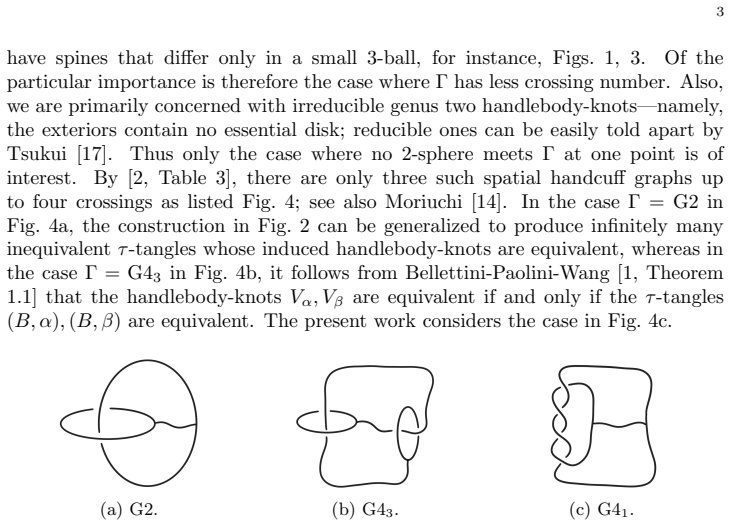
The paper proves that for the spatial handcuff graph G4_1, performing a τ-tangle replacement in a small ball around a trivalent vertex produces a handlebody-knot Vτ that remembers the tangle: for atoroidal tangles (B,α) and (B,β), Vα and Vβ are equivalent if and only if (B,α) is equivalent to (B,β) or to (B,β*), where β* is obtained by swapping the two endpoints y,z of the tangle (Theorem 1.3). The same statement holds for every twisted version Vτ^(k) of the graph (Theorem 2.14). Along the way the authors classify the essential annuli in the exterior of Vτ (Theorem 1.4): infinitely many if the tangle is ±1/3-rational, exactly two if it is 1/n-rational for odd n with |n|>3, and exactly one ot
Load-bearing premise
The case analysis in Lemma 2.5 listing all possible rectangle shapes is the load-bearing step, and it is terse at one point—the claim that a certain +{bc,bc} pattern is impossible because it would give a half-integral boundary slope in a knot exterior; if the list is missing a shape, the 'only if' direction of Theorems 2.8, 2.10, and Theorem 1.3 can fail.
Editorial extensions
If this is right
- The handlebody-knots 6_12 and 7_39 are inequivalent, even though their exteriors are homeomorphic; the same holds for 7_59 and 7_60.
- For atoroidal tangles that are not 1/n-rational, Vτ is chiral and its symmetry group is either Z2 or trivial.
- An orientation-preserving homeomorphism between Vα and Vβ forces, up to isotopy, a homeomorphism of the tangle ball fixing x and preserving or swapping y,z, so handlebody-knot equivalence is effectively tangle equivalence.
- The classification extends to all twists Γ^(k) of G4_1, so the same rigidity holds for infinitely many spatial handcuff graphs.
- Theorem 1.4 gives a classification of essential annuli in E(Vτ) in terms of the rationality of the tangle, a useful invariant for distinguishing handlebody-knots.
Reading between the lines
- If the result extends to other prime handcuff graphs with low crossing number, tangle replacement could become a general injective construction for handlebody-knots, with the y–z swap as the only ambiguity.
- The rationality parameter n of the tangle is encoded in the slope (n−4)/2 of the second essential annulus, so handlebody-knot equivalence forces equality of these slopes; this arithmetic signature could be developed into a numerical tangle invariant.
- A direct proof of the half-integral-slope impossibility asserted in Lemma 2.5 would remove the tersest spot in the completeness argument; checking that pattern computationally is a natural next step.
- The method may help distinguish mutant-like pairs of knots by passing to their induced handlebody-knots, since the neighborhood of a spatial graph seems to remember local replacements better than the ambient knot exterior does.
Editorial analysis
A structured set of objections, weighed in public.
Referee Report
Summary. The paper studies τ-tangle replacement on the spatial handcuff graph G4_1. For atoroidal τ-tangles (B,α),(B,β), it proves (Theorem 1.3) that the resulting handlebody-knots V_α and V_β are equivalent if and only if the tangles are equivalent or related by swapping the two endpoints y,z. This is extended in Theorem 2.14 to handlebody-knots obtained from G4_1 by twisting a disk. The proof strategy is to split the exterior along an essential 3-punctured sphere S, classify good rectangles in the resulting shaded 3-manifold (Lemma 2.5), use these to classify essential annuli (Theorem 1.4), and then compare slopes of annuli and the uniqueness of the M-surface (Lemmas 2.7, 2.9) to recover the tangle. Applications include distinguishing 6_12 from 7_39 and 7_59 from 7_60 and determining symmetry groups.
Significance. If correct, the main theorem is a strong rigidity statement: tangle replacement on G4_1 remembers the tangle up to a fixed involution, even at the level of neighborhood equivalence. This goes beyond what computational invariants can distinguish and provides a clean tool for chirality and symmetry questions in handlebody-knot theory. The paper also contributes a concrete classification of essential annuli (Theorem 1.4) and identifies the subtle role of the Möbius band. The applications to the seven-crossing table are concrete and useful. However, the proof rests on a few very terse local arguments whose verification is essential.
major comments (3)
- [Lemma 2.5, Case 2] The exclusion of a +{bc,bc}-rectangle rests on the assertion that it “implies there exists a disk with a half integral boundary slope in a knot exterior, an impossibility.” No definition of the knot exterior, of the slope, or of the disk construction is given, and no reference is cited. Since Lemma 2.5's exhaustive list is the basis for Lemma 2.6, Lemma 2.9, and Theorem 1.4, a missing or incorrect rectangle type would break the “only if” direction of Theorems 2.8/2.10 and hence Theorem 1.3. Please provide the actual construction and prove the half-integral-slope impossibility, or replace this step with a complete and checkable argument.
- [Lemma 2.7] The proof is the one-line “It follows from Figs. 6e, 8c.” The two slopes −1/2 and (n−4)/2 are used in Theorem 2.8 to conclude k=l from equality of slopes, so a framing or arithmetic error here would collapse the rational case. Please include the actual computation: specify the solid torus whose core defines the slope, the meridian–longitude coordinates, and how Figs. 6e and 8c determine both slopes. The same request applies to the slope formula (4k+n−4)/2 in the proof of Theorem 2.14.
- [Lemma 2.5, Case 1] The enumeration of possible (st,uv)-rectangles is compressed: statements such as “there are five possibilities” and “there are nine possibilities” are not followed by the actual lists, and the exclusions are not justified. A reader cannot check completeness without reconstructing the entire case analysis. Given the load-bearing nature of this lemma, please expand the enumeration, list all candidates, and justify each exclusion (including the precise role of the rectangle being disjoint from Q).
minor comments (5)
- [Lemma 2.6] The notation for the one-sided rectangles is inconsistent: −{cc, ac} appears interchangeably with −{ac, cc}. Please standardize, e.g., always write the endpoints in cyclic order.
- [Lemma 2.9] In the proof of “S∩S′ contains no arcs,” the sentences “The former contradicts minimality, while the latter implies that c2 cuts off a disk from P, contradicting the minimality” are too terse. A figure reference or a more detailed explanation would help.
- [Section 2.1] In the paragraph after Lemma 2.3, the statement that “any three of the homology classes [b+], [a−], [c+], [c−] form a basis of H1(Ê(Vτ)) is used without proof. A short justification would be helpful.
- [Theorem 1.4 / proof] The proof of Theorem 1.4 relies on Lemma 2.4, which is quoted from [12], and on the JSJ classification from [21] and [11]. Please state explicitly which results from these references are being used, and confirm the current status of [12] so that a reader can verify the dependencies.
- [Applications] The handlebody-knots 5_2, 6_13, 6_12, etc. are referred to by the table in [5]. A figure or table number pointing to the relevant entries would improve readability.
Circularity Check
No definitional circularity; the main if-and-only-if is proved in the paper, but its tangle-rationality input is imported from same-authors' [12].
-
self citation load bearing
[Section 2.1, Lemma 2.4; used via Lemma 2.6 in Theorem 1.4 and Theorem 2.8]
"Lemma 2.4 ([12]). Suppose (B, τ) admits a good rectangle R in its shaded exterior. Then (B, τ) is rational at s∈{x,y,z}, and R is either a {su,sv}-rectangle or a {ss,su}- or {ss,sv}-rectangle ... In addition, it is the former if and only if (B, τ) is ±1/n-rational ... and is the latter if and only if (B, τ) is ±1/3-rational."
Lemma 2.6 converts this imported dictionary into the G4_1-specific statement '(bc,ac)-rectangle exists iff (B,τ) is ±1/n-rational' and '(bc,cc)-, +{bc,cc}-, (cc,ac)-, or -{ac,cc}-rectangles exists iff (B,τ) is ±1/3-rational'. Theorem 1.4's essential-annulus count and Theorem 2.8's slope comparison then both rely on this conversion. Because [12] (and the preceding sentence's [11]) are by Koda-Ozawa-Wang, overlapping with the present author Y.-S. Wang, the rationality side of the classification is imported from the authors' own prior work. This is not a fit or definitional identity, so it does not make Theorem 1.3 vacuous, but it is load-bearing self-citation.
full rationale
The paper is not definitionally circular and contains no fitted-parameter 'prediction'. The equivalence theorem for G4_1 is established by new work in Section 2: Lemma 2.5's rectangle enumeration (though terse and with an unproved slope-impossibility assertion — a correctness risk, not circularity), Lemma 2.9's uniqueness of the M-surface, and Theorem 2.10's homeomorphism-extension argument. The main circularity-adjacent feature is the reuse of same-authors' prior classifications ([11], [12], [10], [20], [21]) as the dictionary between good rectangles and rationality, which is load-bearing for the annulus-count part of Theorem 1.4 and hence for the 'only if' direction. Because that dictionary is imported rather than derived and is not machine-checked or externally benchmarked in this manuscript, the self-citation weight justifies a moderate score; it does not rise to 6 because Theorem 1.3 is not simply a restatement of those prior results.
Assumptions & free parameters
assumptions (5)
- standard math Standard 3-manifold topology background: prime factorization, JSJ decomposition, characteristic annuli, Hatcher's theorem on homeomorphisms of P2-irreducible 3-manifolds.
- standard math Koda-Ozawa-Wang classification of good rectangles in shaded exteriors of τ-tangles (Lemma 2.4 from [12]).
- domain assumption Atoroidality and non-triviality of (B,τ); equivalently, atoroidality of V_τ (Lemma 2.1).
- domain assumption Reduction of scope to irreducible genus-two handlebody-knots and to the three handcuff graphs G2, G4_3, G4_1, based on [2, Table 3].
- standard math Essentiality of the 3-punctured sphere S and of the splitting surfaces, proved in Lemmas 2.2-2.3 using atoroidality and standard surface theory.
Cite this review
Pith. "Pith review of Handlebody-knots obtained by tangle replacement." pith.science (2026). https://pith.science/paper/KNKR33GI
@misc{pith2026251107796,
  author       = {Pith},
  title        = {Pith review of: Handlebody-knots obtained by tangle replacement},
  year         = {2026},
  howpublished = {\url{https://pith.science/paper/KNKR33GI}},
  note         = {Machine review of arXiv:2511.07796}
}
read the original abstract
We study tangle replacement in the context of handlebody-knots. The main results classify the handlebody-knots obtained by performing tangle replacement on the prime spatial handcuff graph with four crossings, and determine their symmetry. The work is motivated by the study of small crossing handlebody-knots that are difficult to distinguish with computational invariants and by their chirality problem.
Figures


Figures from the paper (2 more)

Forward citations
Cited by 1 Pith paper
-
A table of genus two handlebody-knots with seven crossings
All irreducible and reducible genus-two handlebody-knots with seven crossings are enumerated up to mirror image, extending the known table from six crossings.
Reference graph
Works this paper leans on
-
[12]
Y. Koda, M. Ozawa, Y.-S. Wang:Tritangle decompositions of genus two handlebody-knots, (2005)
2005
-
[1]
Bellettini, M
G. Bellettini, M. Paolini, Y.-S. Wang:Unique3-decomposition and mapping classes of knotted handlebodies, Geom. Dedicata29(74), (2025)
2025
-
[2]
Bellettini, M
G. Bellettini, M. Paolini, G. Paolini, Y.-S. Wang:A table of genus-2 handlebody knots with seven crossings.(2025)
2025
-
[3]
Funayoshi, Y
K. Funayoshi, Y. Koda:Extending automorphisms of the genus-2 surface over the3-sphere, Q. J. Math.71(2020), 175–196
2020
-
[4]
Hatcher:Homeomorphisms of sufficiently largeP 2-irreducible3-manifolds, J
A. Hatcher:Homeomorphisms of sufficiently largeP 2-irreducible3-manifolds, J. Topol., 15(4) (1976), 343–347
1976
-
[5]
Ishii, K
A. Ishii, K. Kishimoto, H. Moriuchi, M. Suzuki:A table of genus two handlebody-knots up to six crossings, J. Knot Theory Ramifications21(2012), 1250035 (9 pages). 15
2012
-
[6]
Ishii, K
A. Ishii, K. Kishimoto, M. Ozawa:Knotted handle decomposing spheres for handlebody-knots, J. Math. Soc. Japan67(2015), 407–417
2015
-
[7]
Kawauchi:A Survey of Knot Theory, Birkh¨ auser Verlag, Basel, 1996
A. Kawauchi:A Survey of Knot Theory, Birkh¨ auser Verlag, Basel, 1996
1996
Show all 21 references
-
[8]
Koda:Automorphisms of the 3-sphere that preserve spatial graphs and handlebody-knots, Math
Y. Koda:Automorphisms of the 3-sphere that preserve spatial graphs and handlebody-knots, Math. Proc. Camb. Phil. Soc.159(1), (2015), 1–22
2015
-
[9]
Y. Koda, M. Ozawa, with an appendix by C. Gordon:Essential surfaces of non-negative Euler characteristic in genus two handlebody exteriors, Trans. Amer. Math. Soc.367(2015), no. 4, 2875–2904
2015
-
[10]
Y. Koda, M. Ozawa, Y.-S. Wang:Essential annuli in genus two handlebody exteriors, to appear in Algebr. Geom. Topol
-
[11]
Y. Koda, M. Ozawa, Y.-S. Wang:On symmetry and exterior problems of knotted handlebod- ies, arXiv:2506.06713
-
[13]
J. H. Lee, S. Lee:Inequivalent handlebody-knots with homeomorphic complements, Algebr. Geom. Topol.12(2012), 1059—1079
2012
-
[14]
Moriuchi:A table of handcuff graphs with up to seven crossings, OCAMI Studies Vol 1
H. Moriuchi:A table of handcuff graphs with up to seven crossings, OCAMI Studies Vol 1. Knot Theory for Scientific objects (2007) 179–300
2007
-
[15]
Motto:Inequivalent genus two handlebodies inS 3 with homeomorphic complements, Topology Appl.36(3) (1990), 283–290
M. Motto:Inequivalent genus two handlebodies inS 3 with homeomorphic complements, Topology Appl.36(3) (1990), 283–290
1990
-
[16]
Motohashi:A prime decomposition theorem for handcuff graphs inS 3, Topology Appl
T. Motohashi:A prime decomposition theorem for handcuff graphs inS 3, Topology Appl. 154(18), (2007), 3135–3139
2007
-
[17]
Tsukui,On surfaces in 3-space, Yokohama Math
Y. Tsukui,On surfaces in 3-space, Yokohama Math. J.18(1970), 93–104
1970
-
[18]
Wang:Unknotting annuli and handlebody-knot symmetry, Topol
Y.-S. Wang:Unknotting annuli and handlebody-knot symmetry, Topol. Appl.305(1) (2022), 107884
2022
-
[19]
Wang:Rigidity and symmetry of cylindrical handlebody-knots, Osaka J
Y.-S. Wang:Rigidity and symmetry of cylindrical handlebody-knots, Osaka J. Math.60 (2023), 267–304
2023
-
[20]
Wang:Annulus configurations in handlebody-knot exteriors, Adv
Y.-S. Wang:Annulus configurations in handlebody-knot exteriors, Adv. Geom.24(3), (2004), 341–355
2004
-
[21]
Wang:JSJ decomposition for handlebody-knots, J
Y.-S. Wang:JSJ decomposition for handlebody-knots, J. Math. Soc. Japan76(4) (2024), 1049–1085. Dipartimento di Scienze Matematiche, Informatiche e Fisiche, via delle Scienze 206, 33100 Udine UD, Italy and International Centre for Theoretical Physics ICTP, Math- ematics Section...
2024
Reviewed August 3, 2026 · model on record in the stance chip above.
Discussion (0). Sign in to comment.