Constructive quasi-uniform sequences over triangles
Pith reviewed 2026-05-18 00:13 UTC · model grok-4.3
The pith
Voronoi-guided greedy packing on any triangle reaches mesh ratio at most 2 after finite steps.
A machine-rendered reading of the paper's core claim, the machinery that carries it, and where it could break.
Core claim
The Voronoi-guided greedy packing algorithm iteratively selects the point farthest from the current set among candidates extracted from the Voronoi diagram of the triangle; after a finite number of iterations the mesh ratio of the resulting point set is at most 2, which is optimal.
What carries the argument
Voronoi-guided greedy packing, which builds a finite candidate set from the Voronoi diagram of the current points and greedily adds the candidate that maximizes the minimum distance to existing points.
If this is right
- Quasi-uniform point sets with the optimal mesh ratio can be constructed algorithmically for every given triangle.
- The sequences are suitable for numerical integration or sampling tasks that require even distribution inside a triangle.
- Two common low-discrepancy constructions on triangles are now known to be quasi-uniform because their mesh ratios remain bounded.
- The constructive procedure supplies an efficient practical generator of high-quality point sets on individual triangles.
Where Pith is reading between the lines
- The same Voronoi-candidate selection idea could be tested on other polygonal domains to see whether a similar finite bound on mesh ratio holds.
- Point sets with guaranteed mesh ratio 2 may improve error constants in quadrature or finite-element schemes restricted to triangular regions.
- The finite convergence property might be used to derive explicit constructions for low-discrepancy sequences on triangles without external optimization.
Load-bearing premise
The finite candidate set extracted from the Voronoi diagram always contains a point that advances the mesh ratio toward the global optimum without trapping the greedy process in a configuration whose ratio exceeds 2.
What would settle it
A concrete triangle together with a sequence of points chosen by the algorithm for which the mesh ratio exceeds 2 after any finite number of additions.
Figures




read the original abstract
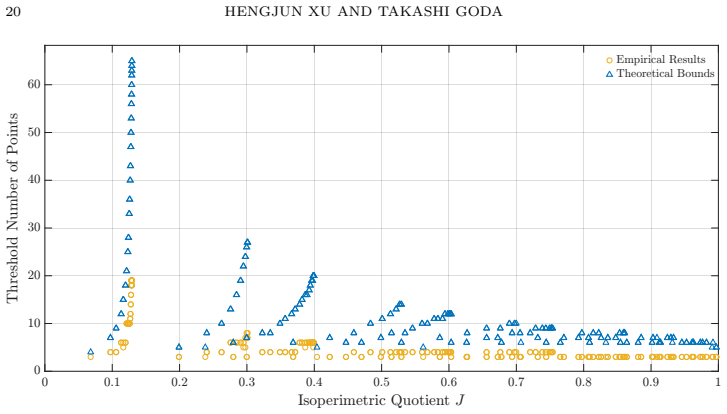
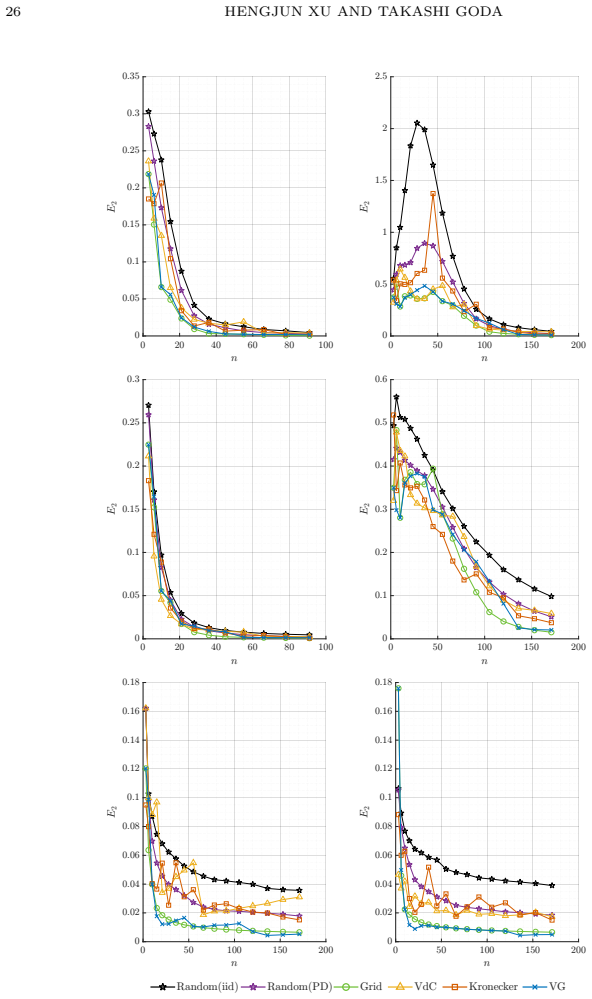
In this paper, we develop constructive algorithms for generating quasi-uniform point sets and sequences over arbitrary two-dimensional triangular domains. Our proposed method, called the \emph{Voronoi-guided greedy packing} algorithm, iteratively selects the point farthest from the current set among a finite candidate set determined by the Voronoi diagram of the triangle. Our main theoretical result shows that, after a finite number of iterations, the mesh ratio of the generated point set is at most~2, which is known to be optimal. We further analyze two existing triangular low-discrepancy point sets and prove that their mesh ratios are uniformly bounded, thereby establishing their quasi-uniformity. Finally, through a series of numerical experiments, we demonstrate that the proposed method provides an efficient and practical strategy for generating high-quality point sets on individual triangles.
Editorial analysis
A structured set of objections, weighed in public.
Referee Report
Summary. The manuscript develops a Voronoi-guided greedy packing algorithm that iteratively inserts points into a triangular domain by selecting the farthest candidate from a finite set extracted from the current Voronoi diagram. The central theoretical claim is that after finitely many iterations the mesh ratio μ = h/s of the generated point set satisfies μ ≤ 2, which is optimal. The paper additionally proves that two existing low-discrepancy triangular point sets have uniformly bounded mesh ratios and reports numerical experiments on efficiency and quality.
Significance. If the finite-iteration bound holds, the algorithm supplies a constructive, deterministic procedure that achieves the known optimal mesh ratio on arbitrary triangles, which is directly useful for mesh generation, quadrature rules, and sampling in numerical PDE solvers. The boundedness results for existing sets also strengthen the literature on quasi-uniformity over triangles.
major comments (2)
- [§4, Theorem 4.1] §4, Theorem 4.1 (finite-iteration proof): the argument that the greedy step always produces a point with insertion distance d ≥ 2s whenever the current μ > 2 assumes the finite Voronoi-derived candidate set contains a global maximizer of min-distance to the existing sites. It is not shown that this set includes all Voronoi-edge maximizers and all boundary points of the triangle; without this, the proof does not rule out insertion of a point with d < 2s that fails to decrease μ below 2.
- [§3.1] §3.1 (candidate-set construction): when the triangle is obtuse or has high aspect ratio, the location that maximizes min-distance to the current point set can lie on a Voronoi edge or on the boundary rather than at a Voronoi vertex. The manuscript must explicitly verify that the extracted finite candidate list contains such points, otherwise the claimed descent property does not hold for all admissible triangles.
minor comments (2)
- [§2] The notation h (covering radius) and s (minimum separation) is introduced only in the abstract and should be defined at the beginning of §2 with the mesh-ratio definition.
- [§5] Numerical tables in §5 would be clearer if each row also reported the number of iterations required to reach μ ≤ 2.
Simulated Author's Rebuttal
We thank the referee for the detailed and constructive report. The comments identify important clarifications needed in the candidate-set construction and the finite-iteration proof. We address each point below and will revise the manuscript to make the arguments fully rigorous.
read point-by-point responses
-
Referee: [§4, Theorem 4.1] §4, Theorem 4.1 (finite-iteration proof): the argument that the greedy step always produces a point with insertion distance d ≥ 2s whenever the current μ > 2 assumes the finite Voronoi-derived candidate set contains a global maximizer of min-distance to the existing sites. It is not shown that this set includes all Voronoi-edge maximizers and all boundary points of the triangle; without this, the proof does not rule out insertion of a point with d < 2s that fails to decrease μ below 2.
Authors: We appreciate this observation on the completeness of the descent argument. The manuscript constructs the candidate set from the Voronoi diagram of the current sites clipped to the triangle, but the current text does not contain an explicit lemma verifying that this finite set always includes a point achieving the global maximum min-distance (including on edges and boundaries). We will add such a lemma in the revised Section 3, together with a precise characterization of the extracted points, thereby closing the gap and ensuring Theorem 4.1 holds for arbitrary triangles. revision: yes
-
Referee: [§3.1] §3.1 (candidate-set construction): when the triangle is obtuse or has high aspect ratio, the location that maximizes min-distance to the current point set can lie on a Voronoi edge or on the boundary rather than at a Voronoi vertex. The manuscript must explicitly verify that the extracted finite candidate list contains such points, otherwise the claimed descent property does not hold for all admissible triangles.
Authors: We agree that the maximizer of min-distance can occur on a Voronoi edge or on the boundary when the triangle is obtuse or has large aspect ratio. Our algorithmic description in §3.1 intends to include such locations by sampling appropriate points on the relevant Voronoi edges and triangle sides, but this is not stated with sufficient precision. In the revision we will expand §3.1 with an explicit enumeration of the candidate-generation rules (including boundary and edge cases), a short proof that the selected finite list contains a sufficiently distant point, and, if helpful, a small illustrative figure. revision: yes
Circularity Check
No significant circularity in derivation of mesh ratio bound
full rationale
The paper defines the Voronoi-guided greedy packing algorithm and states that its iterative selection from Voronoi-derived candidates produces mesh ratio μ ≤ 2 after finitely many steps, with 2 noted as known to be optimal. This claim rests on the geometric construction of the candidate set and the greedy rule rather than any self-referential definition, fitted parameter renamed as prediction, or load-bearing self-citation chain. No equations or steps in the provided text reduce the target bound to the algorithm's inputs by construction; the result is presented as a theorem proved from the algorithm's properties. The derivation is therefore self-contained against external benchmarks for the stated optimality.
Axiom & Free-Parameter Ledger
axioms (1)
- domain assumption Voronoi diagrams of finite point sets inside a triangle yield a finite set of candidate locations sufficient for greedy farthest-point selection.
Reference graph
Works this paper leans on
-
[1]
I. Babuˇ ska and A. K. Aziz,On the angle condition in the finite element method, SIAM J. Numer. Anal.13(1976), no. 2, 214–226
work page 1976
-
[2]
Owen,Low discrepancy constructions in the triangle, SIAM J
Kinjal Basu and Art B. Owen,Low discrepancy constructions in the triangle, SIAM J. Numer. Anal.53(2015), no. 2, 743–761
work page 2015
-
[3]
Philippe G. Ciarlet,The finite element method for elliptic problems, Studies in Mathemat- ics and its Applications, vol. Vol. 4, North-Holland Publishing Co., Amsterdam-New York- Oxford, 1978
work page 1978
-
[4]
Stefano De Marchi and Robert Schaback,Stability of kernel-based interpolation, Adv. Comput. Math.32(2010), no. 2, 155–161
work page 2010
- [5]
- [6]
-
[7]
Gracia Yunruo Dong, Erik Hintz, Marius Hofert, and Christiane Lemieux,Randomized quasi– Monte Carlo methods on triangles: extensible lattices and sequences, Methodol. Comput. Appl. Probab.26(2024), no. 2, Paper No. 15, 31
work page 2024
-
[8]
Daniel Dunbar and Greg Humphreys,A spatial data structure for fast Poisson-disk sample generation, ACM Trans. Graph.25(2006), no. 3, 503–508
work page 2006
-
[9]
Kai-Tai Fang, Runze Li, and Agus Sudjianto,Design and modeling for computer experiments, Chapman & Hall/CRC Computer Science and Data Analysis Series, Chapman & Hall/CRC, Boca Raton, FL, 2006
work page 2006
-
[10]
S Fortune,A sweepline algorithm for Voronoi diagrams, Algorithmica2(1987), no. 1, 153– 174
work page 1987
-
[11]
Takashi Goda,One-dimensional quasi-uniform Kronecker sequences, Arch. Math. (Basel)123 (2024), no. 5, 499–505
work page 2024
-
[12]
,The Sobol’ sequence is not quasi-uniform in dimension 2, Proc. Amer. Math. Soc. 152(2024), no. 8, 3209–3213
work page 2024
-
[13]
Takashi Goda, Kosuke Suzuki, and Takehito Yoshiki,Quasi-Monte Carlo integration for twice differentiable functions over a triangle, J. Math. Anal. Appl.454(2017), no. 1, 361–384
work page 2017
-
[14]
D. P. Hardin, T. Michaels, and E. B. Saff,A comparison of popular point configurations on S2, Dolomites Res. Notes Approx.9(2016), no. 1, 16–49
work page 2016
-
[15]
M. E. Johnson, L. M. Moore, and D. Ylvisaker,Minimax and maximin distance designs, J. Statist. Plann. Inference26(1990), no. 2, 131–148
work page 1990
-
[16]
Roshan Joseph,Space-filling designs for computer experiments: A review, Qual
V. Roshan Joseph,Space-filling designs for computer experiments: A review, Qual. Eng.28 (2016), no. 1, 28–35
work page 2016
-
[17]
Leif Kobbelt, Swen Campagna, and Hans-Peter Seidel,A general framework for mesh deci- mation, Proceedings of the Graphics Interface 1998 Conference, June 18-20, 1998, Vancouver, BC, Canada, 1998, pp. 43–50
work page 1998
-
[18]
L. Kuipers and H. Niederreiter,Uniform distribution of sequences, Pure and Applied Mathe- matics, Wiley-Interscience, New York-London-Sydney, 1974
work page 1974
-
[19]
E. Larsson and B. Fornberg,A numerical study of some radial basis function based solution methods for elliptic PDEs, Comput. Math. Appl.46(2003), no. 5-6, 891–902
work page 2003
-
[20]
63, Society for Industrial and Applied Mathematics (SIAM), Philadelphia, PA, 1992
Harald Niederreiter,Random number generation and quasi-Monte Carlo methods, CBMS- NSF Regional Conference Series in Applied Mathematics, vol. 63, Society for Industrial and Applied Mathematics (SIAM), Philadelphia, PA, 1992
work page 1992
-
[21]
Erich Novak,Deterministic and stochastic error bounds in numerical analysis, Lecture Notes in Mathematics, Springer Berlin, Heidelberg, 1988
work page 1988
-
[22]
L. Pronzato and A. Zhigljavsky,Quasi-uniform designs with optimal and near-optimal uni- formity constant, J. Approx. Theory294(2023), Paper No. 105931, 14
work page 2023
-
[23]
M¨ uller,Design of computer experiments: space filling and beyond, Stat
Luc Pronzato and Werner G. M¨ uller,Design of computer experiments: space filling and beyond, Stat. Comput.22(2012), no. 3, 681–701
work page 2012
-
[24]
Thomas J. Santner, Brian J. Williams, and William I. Notz,The design and analysis of computer experiments, Springer Series in Statistics, Springer-Verlag, New York, 2003. 28 HENGJUN XU AND TAKASHI GODA
work page 2003
-
[25]
Robert Schaback,Error estimates and condition numbers for radial basis function interpola- tion, Adv. Comput. Math.3(1995), no. 3, 251–264
work page 1995
-
[26]
Robert Schaback and Holger Wendland,Kernel techniques: from machine learning to mesh- less methods, Acta Numer.15(2006), 543–639
work page 2006
-
[27]
William J. Schroeder, Jonathan A. Zarge, and William E. Lorensen,Decimation of triangle meshes, Proceedings of the 19th Annual Conference on Computer Graphics and Interactive Techniques (SIGGRAPH ’92), ACM, 1992, pp. 65–70
work page 1992
-
[28]
Indexing the Sphere with the Hierarchical Triangular Mesh
Alexander S. Szalay, Jim Gray, George Fekete, Peter Z. Kunszt, Peter Kukol, and Ani Thakar, Indexing the sphere with the hierarchical triangular mesh, 2007, arXiv:cs/0701164,https: //arxiv.org/abs/cs/0701164
work page internal anchor Pith review Pith/arXiv arXiv 2007
-
[29]
17, Cambridge University Press, Cambridge, 2005
Holger Wendland,Scattered data approximation, Cambridge Monographs on Applied and Computational Mathematics, vol. 17, Cambridge University Press, Cambridge, 2005
work page 2005
-
[30]
T. Wenzel, G. Santin, and B. Haasdonk,A novel class of stabilized greedy kernel approxi- mation algorithms: Convergence, stability and uniform point distribution, J. Approx. Theory 262(2021), Paper No. 105508, 30. Graduate School of Engineering, The University of Tokyo, 7-3-1 Hongo, Bunkyo-ku, Tokyo 113-8656, Japan Email address:jokokun@g.ecc.u-tokyo.ac.j...
work page 2021
discussion (0)
Sign in with ORCID, Apple, or X to comment. Anyone can read and Pith papers without signing in.