pith. machine review for the scientific record. sign in

arxiv: 2511.08266 · v3 · submitted 2025-11-11 · 🌌 astro-ph.CO

Euclid preparation: LXXXVII. Non-Gaussianity of 2-point statistics likelihood: Precise analysis of the matter power spectrum distribution

Euclid Collaboration , J. Bel , S. Gouyou Beauchamps , P. Baratta , L. Blot , C. Carbone , P.-S. Corasaniti , E. Sefusatti
show 276 more authors
S. Escoffier W. Gillard A. Amara S. Andreon N. Auricchio C. Baccigalupi M. Baldi S. Bardelli P. Battaglia A. Biviano E. Branchini M. Brescia J. Brinchmann S. Camera G. Ca\~nas-Herrera V. Capobianco V. F. Cardone J. Carretero S. Casas M. Castellano G. Castignani S. Cavuoti K. C. Chambers A. Cimatti C. Colodro-Conde G. Congedo C. J. Conselice L. Conversi Y. Copin A. Costille F. Courbin H. M. Courtois A. Da Silva H. Degaudenzi S. de la Torre G. De Lucia F. Dubath C. A. J. Duncan X. Dupac M. Farina R. Farinelli F. Faustini S. Ferriol F. Finelli N. Fourmanoit M. Frailis E. Franceschi M. Fumana S. Galeotta K. George B. Gillis C. Giocoli J. Gracia-Carpio A. Grazian F. Grupp L. Guzzo S. V. H. Haugan W. Holmes F. Hormuth A. Hornstrup K. Jahnke M. Jhabvala B. Joachimi E. Keih\"anen S. Kermiche B. Kubik M. Kunz H. Kurki-Suonio A. M. C. Le Brun S. Ligori P. B. Lilje V. Lindholm I. Lloro G. Mainetti D. Maino E. Maiorano O. Mansutti O. Marggraf K. Markovic M. Martinelli N. Martinet F. Marulli R. Massey E. Medinaceli Y. Mellier M. Meneghetti E. Merlin G. Meylan A. Mora M. Moresco L. Moscardini C. Neissner S.-M. Niemi C. Padilla S. Paltani F. Pasian K. Pedersen W. J. Percival V. Pettorino S. Pires G. Polenta M. Poncet L. A. Popa F. Raison A. Renzi J. Rhodes G. Riccio F. Rizzo E. Romelli M. Roncarelli R. Saglia Z. Sakr A. G. S\'anchez D. Sapone B. Sartoris P. Schneider T. Schrabback M. Scodeggio A. Secroun G. Seidel M. Seiffert S. Serrano P. Simon C. Sirignano G. Sirri L. Stanco J. Steinwagner P. Tallada-Cresp\'i A. N. Taylor I. Tereno N. Tessore S. Toft R. Toledo-Moreo F. Torradeflot I. Tutusaus L. Valenziano J. Valiviita T. Vassallo A. Veropalumbo Y. Wang J. Weller G. Zamorani E. Zucca M. Ballardini E. Bozzo C. Burigana R. Cabanac M. Calabrese D. Di Ferdinando J. A. Escartin Vigo L. Gabarra J. Mart\'in-Fleitas S. Matthew N. Mauri R. B. Metcalf A. Pezzotta M. P\"ontinen C. Porciani I. Risso V. Scottez M. Sereno M. Tenti M. Viel M. Wiesmann Y. Akrami S. Alvi I. T. Andika S. Anselmi M. Archidiacono F. Atrio-Barandela D. Bertacca M. Bethermin A. Blanchard S. Borgani M. L. Brown S. Bruton A. Calabro B. Camacho Quevedo F. Caro C. S. Carvalho T. Castro F. Cogato S. Conseil S. Contarini A. R. Cooray S. Davini G. Desprez A. D\'iaz-S\'anchez J. J. Diaz S. Di Domizio J. M. Diego A. Enia Y. Fang A. G. Ferrari A. Finoguenov A. Franco K. Ganga J. Garc\'ia-Bellido T. Gasparetto V. Gautard E. Gaztanaga F. Giacomini F. Gianotti G. Gozaliasl M. Guidi C. M. Gutierrez A. Hall C. Hern\'andez-Monteagudo H. Hildebrandt J. Hjorth J. J. E. Kajava Y. Kang V. Kansal D. Karagiannis K. Kiiveri C. C. Kirkpatrick S. Kruk M. Lattanzi J. Le Graet L. Legrand M. Lembo F. Lepori G. Leroy G. F. Lesci J. Lesgourgues L. Leuzzi T. I. Liaudat J. Macias-Perez G. Maggio M. Magliocchetti F. Mannucci R. Maoli C. J. A. P. Martins L. Maurin M. Miluzio P. Monaco C. Moretti G. Morgante S. Nadathur K. Naidoo A. Navarro-Alsina S. Nesseris L. Pagano F. Passalacqua K. Paterson L. Patrizii A. Pisani D. Potter S. Quai M. Radovich P. Reimberg P.-F. Rocci G. Rodighiero S. Sacquegna M. Sahl\'en D. B. Sanders E. Sarpa A. Schneider D. Sciotti E. Sellentin L. C. Smith J. G. Sorce K. Tanidis C. Tao G. Testera R. Teyssier S. Tosi A. Troja M. Tucci C. Valieri A. Venhola D. Vergani F. Vernizzi G. Verza P. Vielzeuf N. A. Walton
This is my paper

Pith reviewed 2026-05-17 23:40 UTC · model grok-4.3

classification 🌌 astro-ph.CO
keywords matter power spectrumnon-Gaussianitylikelihoodtrispectrumpentaspectrumredshift-space distortionsEuclidskewness
0
0 comments X

The pith

The likelihood of the matter power spectrum deviates from Gaussianity on nonlinear scales, driven mainly by pentaspectrum contributions.

A machine-rendered reading of the paper's core claim, the machinery that carries it, and where it could break.

The paper sets out to show that the distribution of estimated matter power spectrum multipoles is non-Gaussian, especially at low redshift and on nonlinear scales. It builds an analytical link between this skewness and the trispectrum plus pentaspectrum of the underlying density field, then tests the effects of redshift-space distortions, survey geometry, binning, integral constraint, and shot noise using 100,000 mock realizations. The results indicate that the pentaspectrum term dominates the departure from Gaussianity at intermediate scales. This matters because standard cosmological analyses of large-scale structure data assume Gaussian likelihoods; a significant departure would affect parameter inference in surveys such as Euclid.

Core claim

The likelihood of the estimated matter power spectrum multipoles deviates significantly from a Gaussian assumption on nonlinear scales, particularly at low redshift. This departure is primarily driven by the pentaspectrum contribution, which dominates over the trispectrum at intermediate scales. The finiteness of the survey geometry and the integral constraint amplify the skewness in the context of the Euclid mission.

What carries the argument

Analytical framework that expresses the skewness of the power spectrum distribution in terms of the trispectrum and pentaspectrum of the density field.

If this is right

  • Redshift-space distortions modify the measured skewness of the power spectrum distribution.
  • The finite survey geometry and integral constraint increase the overall non-Gaussianity.
  • Fourier binning and shot noise further shape the departure from Gaussianity.
  • These effects must be included when constructing likelihoods for Euclid-like analyses on nonlinear scales.

Where Pith is reading between the lines

These are editorial extensions of the paper, not claims the author makes directly.

  • Cosmological parameter constraints from power-spectrum data on nonlinear scales will carry systematic biases unless non-Gaussian likelihood models are adopted.
  • The observed dominance of the pentaspectrum suggests that still-higher correlation functions may need explicit treatment in future analyses.
  • Similar mock-based tests could be applied to other two-point statistics to check where Gaussian assumptions remain valid.

Load-bearing premise

The analytical expressions correctly isolate the trispectrum and pentaspectrum contributions to power-spectrum skewness without substantial contamination from still-higher-order terms or breakdown of perturbation theory.

What would settle it

A quantitative mismatch between the analytically predicted skewness (from the pentaspectrum term) and the skewness measured directly in the 100,000 COVMOS realizations at a fixed nonlinear wavenumber and low redshift.

Figures

Figures reproduced from arXiv: 2511.08266 by A. Amara, A. Biviano, A. Blanchard, A. Calabro, A. Cimatti, A. Costille, A. Da Silva, A. D\'iaz-S\'anchez, A. Enia, A. Finoguenov, A. Franco, A. G. Ferrari, A. Grazian, A. G. S\'anchez, A. Hall, A. Hornstrup, A. M. C. Le Brun, A. Mora, A. Navarro-Alsina, A. N. Taylor, A. Pezzotta, A. Pisani, A. R. Cooray, A. Renzi, A. Schneider, A. Secroun, A. Troja, A. Venhola, A. Veropalumbo, B. Camacho Quevedo, B. Gillis, B. Joachimi, B. Kubik, B. Sartoris, C. A. J. Duncan, C. Baccigalupi, C. Burigana, C. Carbone, C. C. Kirkpatrick, C. Colodro-Conde, C. Giocoli, C. Hern\'andez-Monteagudo, C. J. A. P. Martins, C. J. Conselice, C. M. Gutierrez, C. Moretti, C. Neissner, C. Padilla, C. Porciani, C. S. Carvalho, C. Sirignano, C. Tao, C. Valieri, D. Bertacca, D. B. Sanders, D. Di Ferdinando, D. Karagiannis, D. Maino, D. Potter, D. Sapone, D. Sciotti, D. Vergani, E. Bozzo, E. Branchini, E. Franceschi, E. Gaztanaga, E. Keih\"anen, E. Maiorano, E. Medinaceli, E. Merlin, E. Romelli, E. Sarpa, E. Sefusatti, E. Sellentin, Euclid Collaboration, E. Zucca, F. Atrio-Barandela, F. Caro, F. Cogato, F. Courbin, F. Dubath, F. Faustini, F. Finelli, F. Giacomini, F. Gianotti, F. Grupp, F. Hormuth, F. Lepori, F. Mannucci, F. Marulli, F. Pasian, F. Passalacqua, F. Raison, F. Rizzo, F. Torradeflot, F. Vernizzi, G. Ca\~nas-Herrera, G. Castignani, G. Congedo, G. De Lucia, G. Desprez, G. F. Lesci, G. Gozaliasl, G. Leroy, G. Maggio, G. Mainetti, G. Meylan, G. Morgante, G. Polenta, G. Riccio, G. Rodighiero, G. Seidel, G. Sirri, G. Testera, G. Verza, G. Zamorani, H. Degaudenzi, H. Hildebrandt, H. Kurki-Suonio, H. M. Courtois, I. Lloro, I. Risso, I. T. Andika, I. Tereno, I. Tutusaus, J. A. Escartin Vigo, J. Bel, J. Brinchmann, J. Carretero, J. Garc\'ia-Bellido, J. Gracia-Carpio, J. G. Sorce, J. Hjorth, J. J. Diaz, J. J. E. Kajava, J. Le Graet, J. Lesgourgues, J. Macias-Perez, J. Mart\'in-Fleitas, J. M. Diego, J. Rhodes, J. Steinwagner, J. Valiviita, J. Weller, K. C. Chambers, K. Ganga, K. George, K. Jahnke, K. Kiiveri, K. Markovic, K. Naidoo, K. Paterson, K. Pedersen, K. Tanidis, L. A. Popa, L. Blot, L. Conversi, L. C. Smith, L. Gabarra, L. Guzzo, L. Legrand, L. Leuzzi, L. Maurin, L. Moscardini, L. Pagano, L. Patrizii, L. Stanco, L. Valenziano, M. Archidiacono, M. Baldi, M. Ballardini, M. Bethermin, M. Brescia, M. Calabrese, M. Castellano, M. Farina, M. Frailis, M. Fumana, M. Guidi, M. Jhabvala, M. Kunz, M. Lattanzi, M. L. Brown, M. Lembo, M. Magliocchetti, M. Martinelli, M. Meneghetti, M. Miluzio, M. Moresco, M. Poncet, M. P\"ontinen, M. Radovich, M. Roncarelli, M. Sahl\'en, M. Scodeggio, M. Seiffert, M. Sereno, M. Tenti, M. Tucci, M. Viel, M. Wiesmann, N. Auricchio, N. A. Walton, N. Fourmanoit, N. Martinet, N. Mauri, N. Tessore, O. Mansutti, O. Marggraf, P. Baratta, P. Battaglia, P. B. Lilje, P.-F. Rocci, P. Monaco, P. Reimberg, P. Schneider, P.-S. Corasaniti, P. Simon, P. Tallada-Cresp\'i, P. Vielzeuf, R. B. Metcalf, R. Cabanac, R. Farinelli, R. Maoli, R. Massey, R. Saglia, R. Teyssier, R. Toledo-Moreo, S. Alvi, S. Andreon, S. Anselmi, S. Bardelli, S. Borgani, S. Bruton, S. Camera, S. Casas, S. Cavuoti, S. Conseil, S. Contarini, S. Davini, S. de la Torre, S. Di Domizio, S. Escoffier, S. Ferriol, S. Galeotta, S. Gouyou Beauchamps, S. Kermiche, S. Kruk, S. Ligori, S. Matthew, S.-M. Niemi, S. Nadathur, S. Nesseris, S. Paltani, S. Pires, S. Quai, S. Sacquegna, S. Serrano, S. Toft, S. Tosi, S. V. H. Haugan, T. Castro, T. Gasparetto, T. I. Liaudat, T. Schrabback, T. Vassallo, V. Capobianco, V. F. Cardone, V. Gautard, V. Kansal, V. Lindholm, V. Pettorino, V. Scottez, W. Gillard, W. Holmes, W. J. Percival, X. Dupac, Y. Akrami, Y. Copin, Y. Fang, Y. Kang, Y. Mellier, Y. Wang, Z. Sakr.

Figure 1
Figure 1. Figure 1: Estimated skewness, S (ℓ) 3 (left panels), and kurtosis, S (ℓ) 4 (right panels), of the distribution of power spectrum multipoles P (ℓ) (k) in real space for the reference ΛCDM cosmology and for the five redshifts considered in this work (from top to bottom panels ℓ = 0, 2, 4). In each panel, the black line shows the prediction for a Gaussian field. 0.0 0.1 S (0) 3 (k) z=0.0 z=0.5 z=1.0 z=1.5 z=2.0 S (l) n… view at source ↗
Figure 2
Figure 2. Figure 2: Same as Fig.1 but in redshift space. Article number, page 7 of 19 [PITH_FULL_IMAGE:figures/full_fig_p007_2.png] view at source ↗
Figure 3
Figure 3. Figure 3: Number of triplets, k1, k2, k3, per k-shell depending on the con￾sidered configuration, N1, N2, N3, and N4. The purple diamonds show the total number of triplets, and the black line shows the corresponding expected number. 0.1 0.2 0.3 0.4 k [h/Mpc] 10 3 10 2 10 1 10 0 10 1 10 2 r3 = X 3 c / X 3 G c 1 r3 3r2 b Eq.(38) [PITH_FULL_IMAGE:figures/full_fig_p008_3.png] view at source ↗
Figure 4
Figure 4. Figure 4: Measurement ofr3 from the ΛCDM simulation at z=0 and its dif￾ferent contributions. The solid line shows the total relative difference r3, while the dashed and dot-dashed lines show the trispectrum and bispec￾trum contribution, 3r2 and b, respectively. The dotted black line shows a rough estimation of b based on Eq. (39). sections. Thus, we are left with two terms that contribute to the relative excess of s… view at source ↗
Figure 6
Figure 6. Figure 6: Estimated skewness S (ℓ) 3 of the distribution of the power spec￾trum multipoles (from top to bottom panels ℓ = 0, 2, 4) P (ℓ) (k) in real (left) and redshift space (right) for the ΛCDM cosmology and its two extensions, 16nu and w9p3. In each panel the black line is the skewness expected for a Gaussian field. This shows that the excess of skewness is directly related to the ratio between the shell averaged… view at source ↗
Figure 7
Figure 7. Figure 7: Estimated skewness of the power spectrum monopole in real space for different estimator settings on a reduced set of 10 000 realisa￾tions. We focus on the real-space distribution, which maximises the excess of skewness. 4.2.1. Aliasing and mass assignment scheme Despite the soundness of the results presented above, we want to verify their robustness against changes in the choices made for the settings of t… view at source ↗
Figure 9
Figure 9. Figure 9: Impact of the shot noise. Top: Mean power spectrum for the ref￾erence sample and the different level of shot noise corresponding to each density. Bottom: Estimated skewness for the different densities consid￾ered (coloured lines) and the Gaussian field prediction (black line). our case. The fact that the shot noise reduces the skewness was also observed in Lin et al. (2020) in the case of weak lensing two-… view at source ↗
Figure 10
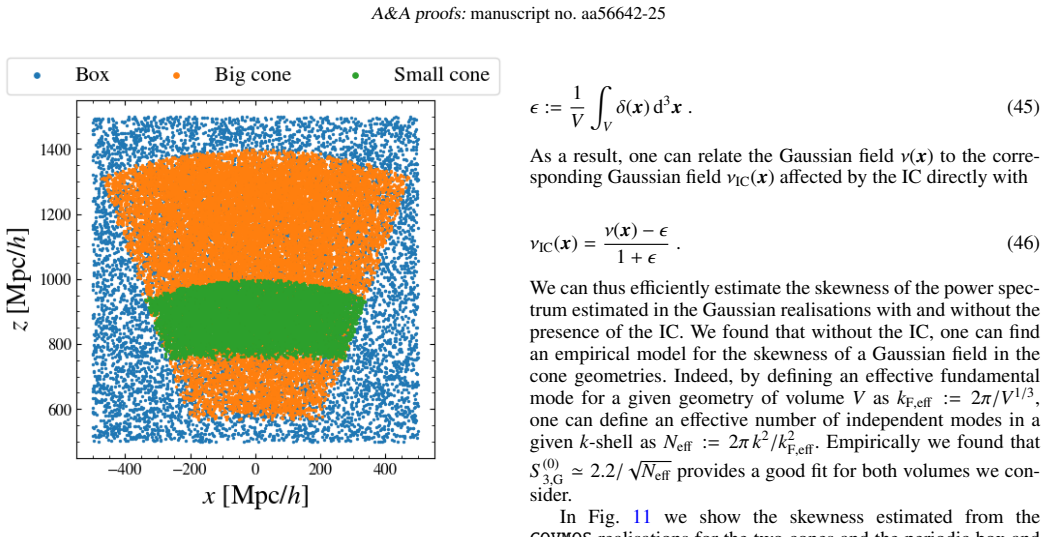
Figure 10. Figure 10: Two-dimensional projection of a sample of particles from the three different geometries considered: the periodic box and the big and small cone. erage power spectrum from 50 realisations of a uniform random distribution following the cone geometries with 20 times the ref￾erence density. From the distribution of the measured power spectra we can estimate the skewness of its distribution (Eq. 23) in the sma… view at source ↗
Figure 12
Figure 12. Figure 12: Relative difference between the cumulants (up to an order of five) of each individual mode and their predictions in the case of a Gaus￾sian field (see Eq. 47). The error bars show the dispersion obtained for the 1000 considered wave modes. the 1000 modes) and the corresponding dispersion over the con￾sidered shell. We can see a very good agreement between the estimation and its prediction in the case of a… view at source ↗
read the original abstract

We investigate the non-Gaussian features in the distribution of the matter power spectrum multipoles. Using the COVMOS method, we generate 100\,000 mock realisations of dark matter density fields in both real and redshift space across multiple redshifts and cosmological models. We derive an analytical framework linking the non-Gaussianity of the power spectrum distribution to higher-order statistics of the density field, including the trispectrum and pentaspectrum. We explore the effect of redshift-space distortions, the geometry of the survey, the Fourier binning, the integral constraint, and the shot noise on the skewness of the distribution of the power spectrum measurements. Our results demonstrate that the likelihood of the estimated matter power spectrum deviates significantly from a Gaussian assumption on nonlinear scales, particularly at low redshift. This departure is primarily driven by the pentaspectrum contribution, which dominates over the trispectrum at intermediate scales. We also examine the impact of the finiteness of the survey geometry in the context of the Euclid mission and find that both the shape of the survey and the integral constraint amplify the skewness.

Editorial analysis

A structured set of objections, weighed in public.

Desk editor's note, referee report, simulated authors' rebuttal, and a circularity audit. Tearing a paper down is the easy half of reading it; the pith above is the substance, this is the friction.

Referee Report

2 major / 2 minor

Summary. The manuscript investigates non-Gaussian features in the distribution of the matter power spectrum multipoles using 100,000 COVMOS mock realizations of dark matter density fields in real and redshift space. It derives an analytical framework linking the skewness of the power spectrum distribution to higher-order density-field statistics (trispectrum and pentaspectrum), and quantifies the impact of redshift-space distortions, survey geometry, Fourier binning, integral constraint, and shot noise. The central claim is that the estimated power spectrum likelihood deviates significantly from Gaussian on nonlinear scales (especially at low redshift), with the pentaspectrum contribution dominating the trispectrum at intermediate scales; survey finiteness and the integral constraint further amplify the skewness, with implications for Euclid analyses.

Significance. If the central results hold, the work provides concrete evidence and modeling tools for non-Gaussian likelihoods in power-spectrum analyses, which is load-bearing for unbiased cosmological inference with Euclid and similar surveys. The large mock suite supplies direct, high-statistics measurements of skewness, while the analytical framework offers a perturbative route to include trispectrum and pentaspectrum contributions without purely empirical fitting. These elements strengthen the case for moving beyond Gaussian assumptions on nonlinear scales.

major comments (2)
  1. [§5] The attribution of non-Gaussianity primarily to pentaspectrum dominance (abstract and §5) rests on the analytical isolation of skewness terms up to fifth order. The manuscript should explicitly demonstrate that hexaspectrum and higher contributions remain sub-dominant on the reported intermediate scales and low redshifts, for example by showing the magnitude of the next-order term or by comparing the truncated prediction directly to the measured skewness from the mocks.
  2. [§4.3] The perturbative expansion for the density field is invoked to link power-spectrum skewness to the trispectrum and pentaspectrum. On the nonlinear scales where the largest deviations are reported, the expansion parameter (density variance) approaches order unity; the paper should quantify the convergence of this expansion or provide a direct test (e.g., residual after subtracting the pentaspectrum term) to confirm that omitted higher-order correlators do not alter the relative importance of the pentaspectrum.
minor comments (2)
  1. [§3.2] Clarify the precise definition of the analytical skewness expression (Eq. (X)) and how the integral constraint is incorporated; the current presentation leaves the subtraction of the mean power spectrum ambiguous.
  2. [Fig. 7] Figure 7 (or equivalent) comparing analytical predictions to mock measurements would benefit from error bars on the mock skewness and a quantitative goodness-of-fit metric to assess agreement beyond visual inspection.

Simulated Author's Rebuttal

2 responses · 0 unresolved

We thank the referee for their careful reading of the manuscript and for the constructive comments, which have helped us clarify the scope and limitations of the perturbative analysis. We address the two major comments below and have revised the manuscript accordingly to include additional tests and quantifications.

read point-by-point responses
  1. Referee: [§5] The attribution of non-Gaussianity primarily to pentaspectrum dominance (abstract and §5) rests on the analytical isolation of skewness terms up to fifth order. The manuscript should explicitly demonstrate that hexaspectrum and higher contributions remain sub-dominant on the reported intermediate scales and low redshifts, for example by showing the magnitude of the next-order term or by comparing the truncated prediction directly to the measured skewness from the mocks.

    Authors: We agree that an explicit check on the size of sixth- and higher-order contributions would strengthen the central claim. In the revised manuscript we have added a new paragraph and accompanying calculation in §5 that estimates the hexaspectrum term via the perturbative scaling with an extra factor of the density variance. On the intermediate scales (0.05 < k < 0.3 h Mpc⁻¹) and redshifts z ≤ 1 that dominate our conclusions, this term is suppressed by a factor of approximately 4–6 relative to the pentaspectrum. We also now show a direct comparison of the fifth-order analytical prediction against the skewness measured in the full set of 100 000 mocks; the residuals are consistent with the expected statistical uncertainty and do not indicate a systematic excess that would require sixth-order terms. These additions support the statement that the pentaspectrum provides the leading contribution in the reported regime, while we have slightly softened the abstract wording to “primarily driven by the pentaspectrum contribution.” revision: yes

  2. Referee: [§4.3] The perturbative expansion for the density field is invoked to link power-spectrum skewness to the trispectrum and pentaspectrum. On the nonlinear scales where the largest deviations are reported, the expansion parameter (density variance) approaches order unity; the paper should quantify the convergence of this expansion or provide a direct test (e.g., residual after subtracting the pentaspectrum term) to confirm that omitted higher-order correlators do not alter the relative importance of the pentaspectrum.

    Authors: We acknowledge that the density variance reaches O(0.5–1) on the smallest scales examined, so the perturbative ordering is not guaranteed a priori. The revised §4.3 now includes an explicit plot of the measured density variance versus wavenumber and redshift for the cosmologies used. In addition, we subtract the analytical pentaspectrum contribution from the mock-measured skewness and display the residuals as a function of scale. On the intermediate scales where pentaspectrum dominance is claimed, the residuals lie within the 1σ mock uncertainty and show no coherent trend that would imply missing higher-order correlators of comparable size. On more deeply nonlinear scales the residuals grow, but they remain smaller than the pentaspectrum term itself. This empirical test, together with the large mock ensemble, provides a direct validation that the relative importance of the pentaspectrum is not altered by omitted terms within the precision of our measurements. revision: yes

Circularity Check

0 steps flagged

No significant circularity detected

full rationale

The paper obtains its central results on non-Gaussianity of the power-spectrum distribution through direct measurements on 100,000 independent COVMOS mock realizations and an analytical derivation that expresses the skewness in terms of the trispectrum and pentaspectrum of the density field. No load-bearing step reduces a claimed prediction to a fitted parameter by construction, invokes a self-citation as an unverified uniqueness theorem, or renames a known empirical pattern. The derivation chain remains self-contained against the external benchmark of the mocks, with the reported pentaspectrum dominance arising from explicit comparison rather than definitional equivalence.

Axiom & Free-Parameter Ledger

0 free parameters · 1 axioms · 0 invented entities

The claim rests on the accuracy of the COVMOS mock generation for capturing higher-order statistics and on the perturbative link between power spectrum moments and the trispectrum/pentaspectrum.

axioms (1)
  • domain assumption COVMOS mocks faithfully reproduce the higher-order statistics of the real dark matter density field across the redshifts and cosmologies considered.
    Invoked when using the mocks to measure skewness and to validate the analytical framework.

pith-pipeline@v0.9.0 · 7078 in / 1153 out tokens · 29796 ms · 2026-05-17T23:40:59.504383+00:00 · methodology

discussion (0)

Sign in with ORCID, Apple, or X to comment. Anyone can read and Pith papers without signing in.

Forward citations

Cited by 2 Pith papers

Reviewed papers in the Pith corpus that reference this work. Sorted by Pith novelty score.

  1. \textit{Euclid} preparation. Baryon acoustic oscillations extraction techniques: comparison and optimisation

    astro-ph.CO 2026-05 conditional novelty 4.0

    End-to-end validation on Euclid-like mocks shows RecSym and RecIso reconstruction yield unbiased BAO measurements, improving figure of merit for Omega_m and H0 rs by factor of ~3 across 0.9<z<1.8.

  2. Euclid preparation. Three-dimensional galaxy clustering in configuration space: Three-point correlation function estimation

    astro-ph.CO 2026-05 unverdicted novelty 4.0

    Euclid collaboration develops and validates direct and spherical-harmonic estimators plus a random-split optimization for measuring the three-point galaxy correlation function at the scale of the full Euclid survey.

Reference graph

Works this paper leans on

2 extracted references · 2 canonical work pages · cited by 2 Pith papers · 1 internal anchor

  1. [1]

    DESI 2024 III: Baryon Acoustic Oscillations from Galaxies and Quasars

    Abbott, T. M. C., Aguena, M., Alarcon, A., et al. 2022, Phys. Rev. D, 105, 023520 Agrawal, A., Makiya, R., Chiang, C.-T., et al. 2017, JCAP, 10, 003 Alonso, D., Ferreira, P. G., & Santos, M. G. 2014, MNRAS, 444, 3183 Asgari, M., Lin, C.-A., Joachimi, B., et al. 2021, A&A, 645, A104 Baratta, P., Bel, J., Gouyou Beauchamps, S., & Carbone, C. 2023, A&A, 673,...

  2. [2]

    of parameterθ i :=P(k i), and thus P(Xi)= 1 θi e−Xi/θi .(A.3) Its associated moment generating functionM(t i) :=⟨e tiXi⟩is therefore given by M(ti)= 1 1−θ iti ,(A.4) and the moment generating function ofY i :=X ia(ℓ) i is given by MY(ti)=M a(ℓ) i ti . Since we assume that eachX i variable is independent from each other, the same property holds for theY i ...