Hierarchical Strategic Decision-Making in Layered Mobility Systems
Pith reviewed 2026-05-17 22:58 UTC · model grok-4.3
The pith
A projected two-point feedback scheme lets municipalities optimize taxes and incentives in a tri-level mobility game more effectively than Bayesian optimization or genetic algorithms.
A machine-rendered reading of the paper's core claim, the machinery that carries it, and where it could break.
Core claim
By casting mobility as a tri-level Stackelberg game closed by a projected two-point feedback scheme, the municipality can iteratively update policies using only evaluations of lower-level equilibria and thereby attain substantially better municipal objectives than Bayesian optimization or genetic algorithms on a real Zurich multimodal network, while also surfacing integration incentives that increase multimodal usage and improve operator objectives.
What carries the argument
The projected two-point (gradient-free) feedback scheme that updates municipal taxes, subsidies, and constraints based on approximate traveler equilibria and operator best responses without requiring gradients through the equilibrium maps.
If this is right
- Municipalities obtain concrete policy vectors that improve their objectives while respecting operational constraints.
- Identified integration incentives raise multimodal usage and simultaneously improve operator profits.
- The approach scales to higher-dimensional policy spaces without explicit differentiation through equilibrium maps.
- Constraint enforcement and accommodation of heterogeneous users occur naturally inside the feedback loop.
Where Pith is reading between the lines
- The same feedback structure could be applied to other layered systems such as energy markets where regulators, utilities, and consumers interact hierarchically.
- If the scheme remains robust under real-time data streams, it could support dynamic policy adjustment rather than static planning.
- Extending the lower-level models to include behavioral biases or learning dynamics might reveal additional policy levers not visible in equilibrium-only settings.
Load-bearing premise
The projected two-point feedback scheme still converges to useful policies when lower-level equilibria are computed only approximately and when traveler heterogeneity and mode choices are captured by the chosen equilibrium models.
What would settle it
On the Zurich network, replace the exact Frank-Wolfe equilibria with coarser approximations or alter the user heterogeneity model and check whether the municipal objective still exceeds the performance of Bayesian optimization and genetic algorithms by a clear margin.
Figures


read the original abstract
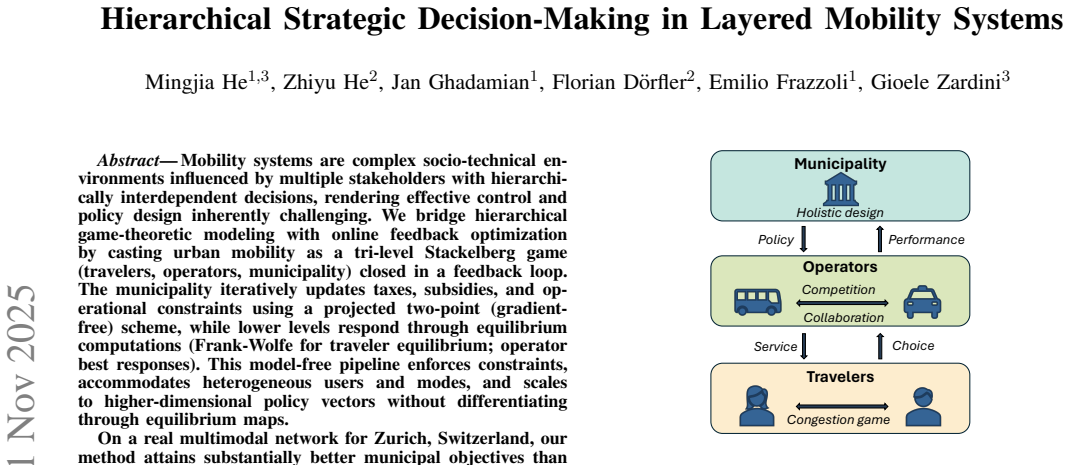
Mobility systems are complex socio-technical environments influenced by multiple stakeholders with hierarchically interdependent decisions, rendering effective control and policy design inherently challenging. We bridge hierarchical game-theoretic modeling with online feedback optimization by casting urban mobility as a tri-level Stackelberg game (travelers, operators, municipality) closed in a feedback loop. The municipality iteratively updates taxes, subsidies, and operational constraints using a projected two-point (gradient-free) scheme, while lower levels respond through equilibrium computations (Frank-Wolfe for traveler equilibrium; operator best responses). This model-free pipeline enforces constraints, accommodates heterogeneous users and modes, and scales to higher-dimensional policy vectors without differentiating through equilibrium maps. On a real multimodal network for Zurich, Switzerland, our method attains substantially better municipal objectives than Bayesian optimization and Genetic algorithms, and identifies integration incentives that increase multimodal usage while improving both operator objectives. The results show that feedback-based regulation can steer competition toward cooperative outcomes and deliver tangible welfare gains in complex, data-rich mobility ecosystems.
Editorial analysis
A structured set of objections, weighed in public.
Referee Report
Summary. The paper casts urban mobility as a tri-level Stackelberg game (travelers, operators, municipality) and closes it with a model-free projected two-point feedback scheme at the municipal level. Lower levels are solved via Frank-Wolfe for traveler equilibria and best-response computations for operators; the municipality iteratively updates taxes, subsidies, and constraints without differentiating through the equilibrium maps. On the Zurich multimodal network the method is reported to outperform Bayesian optimization and genetic algorithms on municipal objectives while identifying integration incentives that raise multimodal usage and improve operator payoffs.
Significance. If the feedback updates remain effective under inexact lower-level solves, the approach supplies a scalable, gradient-free route to hierarchical policy design that avoids full differentiation through equilibrium maps and accommodates heterogeneous users. The real-network demonstration and direct comparison to standard black-box optimizers constitute a concrete strength; reproducible code or parameter-free derivations are not mentioned.
major comments (2)
- [§4] §4 (Algorithm description): the projected two-point scheme is presented without error bounds, sensitivity analysis, or convergence guarantees that quantify how residuals from the Frank-Wolfe traveler solver and operator best-response computations propagate into the estimated update directions or constraint projections. This directly affects the reliability of the Zurich performance claims.
- [§5.2] §5.2 (Numerical results): the reported superiority on municipal objectives is given without error bars, number of random seeds or initial conditions, or explicit checks that the feedback loop remains stable when equilibrium solvers are run to finite tolerance; these omissions make the headline empirical claim difficult to assess.
minor comments (2)
- [§3] Notation for the tri-level objective and the projection operator could be introduced earlier and used consistently to improve readability.
- [Abstract] The abstract states 'substantially better' without numerical deltas or reference objective values; adding these would strengthen the claim.
Simulated Author's Rebuttal
We thank the referee for the constructive comments. We address each major comment below and indicate the changes we will make to the manuscript.
read point-by-point responses
-
Referee: [§4] §4 (Algorithm description): the projected two-point scheme is presented without error bounds, sensitivity analysis, or convergence guarantees that quantify how residuals from the Frank-Wolfe traveler solver and operator best-response computations propagate into the estimated update directions or constraint projections. This directly affects the reliability of the Zurich performance claims.
Authors: We acknowledge that §4 does not contain explicit error-propagation bounds or convergence guarantees for inexact lower-level solves. The projected two-point scheme was selected precisely to remain model-free and avoid differentiation through the equilibrium maps. Deriving tight analytic bounds for residual propagation in this tri-level setting is technically involved and was outside the original scope. In the revision we will add a short discussion in §4 on the practical effect of solver tolerances together with a sensitivity study in the numerical section that quantifies how moderate residuals affect the municipal updates. revision: yes
-
Referee: [§5.2] §5.2 (Numerical results): the reported superiority on municipal objectives is given without error bars, number of random seeds or initial conditions, or explicit checks that the feedback loop remains stable when equilibrium solvers are run to finite tolerance; these omissions make the headline empirical claim difficult to assess.
Authors: We agree that the empirical claims would be stronger with statistical reporting. The Zurich experiments used fixed solver tolerances and a single set of initial conditions for all methods to ensure comparability, but variability across random seeds was not quantified. We will revise §5.2 to report results over multiple random seeds, include error bars or standard deviations on the municipal objective values, and add explicit checks confirming that the feedback loop remains stable when the lower-level solvers are terminated at finite but practical tolerances. revision: yes
Circularity Check
No significant circularity in the derivation chain
full rationale
The paper casts mobility as a tri-level Stackelberg game and applies a projected two-point feedback scheme at the municipality level, with traveler equilibria solved by Frank-Wolfe and operator best responses. The central empirical claim reports superior municipal objectives versus Bayesian optimization and genetic algorithms on the real Zurich multimodal network, plus identified integration incentives. These gains are measured against external algorithmic benchmarks on fixed real data rather than being recovered by construction from parameters fitted inside the same loop. The pipeline is described as model-free and does not differentiate through equilibrium maps. No load-bearing step reduces to a self-definitional relation, a fitted input renamed as prediction, or a self-citation chain whose cited result itself depends on the target claim. Absence of convergence bounds under approximate lower-level solves is a limitation in guarantees, not a circular reduction of the reported performance to the method's own inputs.
Axiom & Free-Parameter Ledger
axioms (2)
- domain assumption Traveler and operator subgames admit computable equilibria via Frank-Wolfe and best-response methods.
- domain assumption The projected two-point gradient-free scheme produces stable policy updates without differentiation through the equilibrium map.
Lean theorems connected to this paper
-
IndisputableMonolith/Cost/FunctionalEquation.leanwashburn_uniqueness_aczel unclear?
unclearRelation between the paper passage and the cited Recognition theorem.
municipality iteratively updates taxes, subsidies, and operational constraints using a projected two-point (gradient-free) scheme, while lower levels respond through equilibrium computations (Frank-Wolfe for traveler equilibrium; operator best responses)
-
IndisputableMonolith/Foundation/RealityFromDistinction.leanreality_from_one_distinction unclear?
unclearRelation between the paper passage and the cited Recognition theorem.
On a real multimodal network for Zurich, Switzerland, our method attains substantially better municipal objectives than Bayesian optimization and Genetic algorithms
What do these tags mean?
- matches
- The paper's claim is directly supported by a theorem in the formal canon.
- supports
- The theorem supports part of the paper's argument, but the paper may add assumptions or extra steps.
- extends
- The paper goes beyond the formal theorem; the theorem is a base layer rather than the whole result.
- uses
- The paper appears to rely on the theorem as machinery.
- contradicts
- The paper's claim conflicts with a theorem or certificate in the canon.
- unclear
- Pith found a possible connection, but the passage is too broad, indirect, or ambiguous to say the theorem truly supports the claim.
Forward citations
Cited by 1 Pith paper
-
Implementation-Based Incentive Design for Autonomous Mobility-on-Demand and Transit Systems
Develops a k-implementation framework with tailored optimization oracles to calculate minimum incentive transfers for AMoD and PT operators to achieve social targets in multimodal networks, validated on NYC data.
Reference graph
Works this paper leans on
-
[1]
R. Martin, “A V futures or futures with A Vs? Bridging sociotechnical imaginaries and a multi-level perspective of autonomous vehicle visu- alisations in praxis,”Humanities and Social Sciences Communications, vol. 8, no. 1, pp. 1–15, 2021
work page 2021
-
[2]
National roadway safety strat- egy,
U.S. Department of Transportation, “National roadway safety strat- egy,” https://www.transportation.gov/NRSS, 2022
work page 2022
-
[3]
14th five-year plan for a modern comprehensive transport system,
State Council of the People’s Republic of China, “14th five-year plan for a modern comprehensive transport system,” https://www.gov.cn/ zhengce/content/2022-01/18/content 5668971.htm, 2022
work page 2022
-
[4]
When efficiency meets equity in congestion pricing and revenue refunding schemes,
D. Jalota, K. Solovey, K. Gopalakrishnan, S. Zoepf, H. Balakrishnan, and M. Pavone, “When efficiency meets equity in congestion pricing and revenue refunding schemes,” inProceedings of the 1st ACM Conference on Equity and Access in Algorithms, Mechanisms, and Optimization, 2021, pp. 1–11. TABLE I OVERVIEW OF MODEL PARAMETERS Para. Description Value Unit R...
work page 2021
-
[5]
D. Kurmankhojayev, H. Tan, and A. Chen, “A methodological founda- tion for proactive disruption mitigation in transport networks: Integrat- ing route similarity and elastic demand in stochastic user equilibrium- based link criticality analysis,”Reliability Engineering & System Safety, vol. 261, p. 111084, 2025
work page 2025
-
[6]
Improving public transportation via line-based integration of on-demand ridepooling,
A. Fielbaum, A. Tirachini, and J. Alonso-Mora, “Improving public transportation via line-based integration of on-demand ridepooling,” Transportation Research Part A: Policy and Practice, vol. 190, p. 104289, 2024
work page 2024
-
[7]
M. He, X. Ma, J. Wang, and M. Zhu, “Geographically weighted multinomial logit models for modelling the spatial heterogeneity in the bike-sharing renting-returning imbalance: A case study on nanjing, china,”Sustainable Cities and Society, vol. 83, p. 103967, 2022
work page 2022
-
[8]
Pricing and competition in a trans- portation market with empty equipment repositioning,
W.-H. Zhou and C.-Y . Lee, “Pricing and competition in a trans- portation market with empty equipment repositioning,”Transportation Research Part B: Methodological, vol. 43, no. 6, pp. 677–691, 2009
work page 2009
-
[9]
The cost of non-coordination in urban on-demand mobility,
D. Kondor, I. Bojic, G. Resta, F. Duarte, P. Santi, and C. Ratti, “The cost of non-coordination in urban on-demand mobility,”Scientific reports, vol. 12, no. 1, p. 4669, 2022
work page 2022
-
[10]
Analysis and control of autonomous mobility-on-demand systems,
G. Zardini, N. Lanzetti, M. Pavone, and E. Frazzoli, “Analysis and control of autonomous mobility-on-demand systems,”Annual Review of Control, Robotics, and Autonomous Systems, vol. 5, no. 1, pp. 633– 658, 2022
work page 2022
-
[11]
Competition between shared autonomous vehicles and public transit: A case study in singapore,
B. Mo, Z. Cao, H. Zhang, Y . Shen, and J. Zhao, “Competition between shared autonomous vehicles and public transit: A case study in singapore,”Transportation Research Part C: Emerging Technologies, vol. 127, p. 103058, 2021
work page 2021
-
[12]
Anomalous supply shortages from dynamic pricing in on-demand mobility,
M. Schr ¨oder, D.-M. Storch, P. Marszal, and M. Timme, “Anomalous supply shortages from dynamic pricing in on-demand mobility,”Na- ture communications, vol. 11, no. 1, p. 4831, 2020
work page 2020
-
[13]
Y . Gu, X. Cai, D. Han, and D. Z. Wang, “A tri-level optimization model for a private road competition problem with traffic equilibrium constraints,”European Journal of Operational Research, vol. 273, no. 1, pp. 190–197, 2019
work page 2019
-
[14]
F. Dandl, R. Engelhardt, M. Hyland, G. Tilg, K. Bogenberger, and H. S. Mahmassani, “Regulating mobility-on-demand services: Tri- level model and Bayesian optimization solution approach,”Trans- portation Research Part C: Emerging Technologies, vol. 125, p. 103075, 2021
work page 2021
-
[15]
Impacts of congestion pricing on ride-hailing ridership: Evidence from chicago,
Y . Zheng, P. Meredith-Karam, A. Stewart, H. Kong, and J. Zhao, “Impacts of congestion pricing on ride-hailing ridership: Evidence from chicago,”Transportation Research Part A: Policy and Practice, vol. 170, p. 103639, 2023
work page 2023
-
[16]
Designing optimal personalized incentive for traffic routing using big hype,
P. D. Grontas, C. Cenedese, M. Fochesato, G. Belgioioso, J. Lygeros, and F. D ¨orfler, “Designing optimal personalized incentive for traffic routing using big hype,” in2023 62nd IEEE Conference on Decision and Control (CDC), 2023, pp. 3142–3147
work page 2023
-
[17]
Y . Kim, N. Duan, G. Zardini, S. Samaranayake, and D. Wischik, “Strategic pricing and routing to maximize profit in congested roads considering interactions with travelers,”IEEE Transactions on Control of Network Systems, 2025
work page 2025
-
[18]
Game theory to study interactions between mobility stakeholders,
G. Zardini, N. Lanzetti, L. Guerrini, E. Frazzoli, and F. D ¨orfler, “Game theory to study interactions between mobility stakeholders,” in2021 IEEE International Intelligent Transportation Systems Conference (ITSC). IEEE, 2021, pp. 2054–2061
work page 2021
-
[19]
Strategic interactions in multi-modal mo- bility systems: A game-theoretic perspective,
G. Zardini, N. Lanzetti, G. Belgioioso, C. Hartnik, S. Bolognani, F. D¨orfler, and E. Frazzoli, “Strategic interactions in multi-modal mo- bility systems: A game-theoretic perspective,” in2023 IEEE 26th In- ternational Conference on Intelligent Transportation Systems (ITSC). IEEE, 2023, pp. 5452–5459
work page 2023
-
[20]
Mobility service providers’ interacting strategies under multi-modal equilibrium,
C. Bandiera, R. D. Connors, and F. Viti, “Mobility service providers’ interacting strategies under multi-modal equilibrium,”Transportation Research Part C: Emerging Technologies, vol. 168, p. 104766, 2024
work page 2024
-
[21]
Time-varying convex optimization: Time-structured algorithms and applications,
A. Simonetto, E. Dall’Anese, S. Paternain, G. Leus, and G. B. Gian- nakis, “Time-varying convex optimization: Time-structured algorithms and applications,”Proceedings of the IEEE, vol. 108, no. 11, pp. 2032– 2048, 2020
work page 2032
-
[22]
Opti- mization algorithms as robust feedback controllers,
A. Hauswirth, Z. He, S. Bolognani, G. Hug, and F. D ¨orfler, “Opti- mization algorithms as robust feedback controllers,”Annual Reviews in Control, vol. 57, 2024, Art. no. 100941
work page 2024
-
[23]
Model-free nonlinear feedback optimization,
Z. He, S. Bolognani, J. He, F. D ¨orfler, and X. Guan, “Model-free nonlinear feedback optimization,”IEEE Transactions on Automatic Control, vol. 69, no. 7, pp. 4554–4569, 2024
work page 2024
-
[24]
State of the art estimates of the swiss value of travel time savings,
K. W. Axhausen, S. Hess, A. K ¨onig, G. Abay, J. Bates, and M. Bier- laire, “State of the art estimates of the swiss value of travel time savings,” vol. 383. ETH Z ¨urich, Institut f ¨ur Verkehrsplanung und Transportsysteme, 2006
work page 2006
-
[25]
Modified bureau of public roads link function,
N. Gore, S. Arkatkar, G. Joshi, and C. Antoniou, “Modified bureau of public roads link function,”Transportation Research Record, vol. 2677, no. 5, pp. 966–990, 2023
work page 2023
-
[26]
Traffic equilibrium and variational inequalities,
S. Dafermos, “Traffic equilibrium and variational inequalities,”Trans- portation Science, vol. 14, no. 1, pp. 42–54, 1980
work page 1980
-
[27]
The elements of differentiable program- ming,
M. Blondel and V . Roulet, “The elements of differentiable program- ming,”arXiv preprint arXiv:2403.14606, 2024
- [28]
-
[29]
T. Bas ¸ar and G. J. Olsder,Dynamic Noncooperative Game Theory. Society for Industrial and Applied Mathematics, 1998, vol. 23
work page 1998
-
[30]
S. Liu, P.-Y . Chen, B. Kailkhura, G. Zhang, A. O. Hero III, and P. K. Varshney, “A primer on zeroth-order optimization in signal processing and machine learning: Principals, recent advances, and applications,” IEEE Signal Processing Magazine, vol. 37, no. 5, pp. 43–54, 2020
work page 2020
-
[31]
OpenStreetMap, https://www.openstreetmap.org, 2025
work page 2025
-
[32]
Swiss Federal Statistical Office. (2025) Statistics. [Online]. Available: https://www.bfs.admin.ch/bfs/en/home/statistics.html
work page 2025
-
[33]
Taking the human out of the loop: A review of Bayesian optimiza- tion,
B. Shahriari, K. Swersky, Z. Wang, R. P. Adams, and N. De Freitas, “Taking the human out of the loop: A review of Bayesian optimiza- tion,”Proceedings of the IEEE, vol. 104, no. 1, pp. 148–175, 2015
work page 2015
-
[34]
A review on genetic algo- rithm: past, present, and future,
S. Katoch, S. S. Chauhan, and V . Kumar, “A review on genetic algo- rithm: past, present, and future,”Multimedia Tools and Applications, vol. 80, no. 5, pp. 8091–8126, 2021
work page 2021
-
[35]
Z ¨urich Taxi, “Zurich taxi price,” https://en.zurichtaxi.ch/price, 2025
work page 2025
-
[36]
Single tickets in the zvv region,
Z ¨urich Transport Network (ZVV), “Single tickets in the zvv region,” 2025. [Online]. Available: https://www.zvv.ch/en/ travelcards-and-tickets/tickets/single-tickets.html
work page 2025
-
[37]
Das metronom von tram und bus,
Verkehrsbetriebe Z ¨urich (VBZ), “Das metronom von tram und bus,” 2022. [Online]. Available: https://vbzonline.ch/ das-metronom-von-tram-und-bus/
work page 2022
-
[38]
(2025) Switzerland gasoline prices
GlobalPetrolPrices. (2025) Switzerland gasoline prices. [Online]. Available: https://www.globalpetrolprices.com/Switzerland/gasoline prices/
work page 2025
-
[39]
Em- bedded system for learning smooth and energy-efficient tram driving techniques,
A. Konieczka, D. Stachowiak, S. Feli ´nski, and M. Dworza ´nski, “Em- bedded system for learning smooth and energy-efficient tram driving techniques,”Energies, vol. 16, no. 19, 2023
work page 2023
-
[40]
(2025) Switzerland electricity prices
GlobalPetrolPrices.com. (2025) Switzerland electricity prices. [Online]. Available: https://www.globalpetrolprices.com/Switzerland/ electricity prices/
work page 2025
-
[41]
(2025) Taxi driver salary in z ¨urich, switzerland (2025)
ERI SalaryExpert. (2025) Taxi driver salary in z ¨urich, switzerland (2025). [Online]. Available: https://www.salaryexpert.com/salary/job/ taxi-driver/switzerland/zurich
work page 2025
-
[42]
(2025) Tram driver salary in Z ¨urich, switzerland (2025)
——. (2025) Tram driver salary in Z ¨urich, switzerland (2025). [Online]. Available: https://www.salaryexpert.com/salary/job/ tram-driver/switzerland/zurich
work page 2025
-
[43]
Cost-based analysis of autonomous mobility services,
P. M. B ¨osch, F. Becker, H. Becker, and K. W. Axhausen, “Cost-based analysis of autonomous mobility services,” ETH Z ¨urich, Institute for Transport Planning and Systems, Tech. Rep., 2018
work page 2018
-
[44]
(2019) First flexity Z ¨urich tram delivered
Metro Report International. (2019) First flexity Z ¨urich tram delivered. [Online]. Available: https://www.railwaygazette.com/ urban-rail/first-flexity-zurich-tram-delivered/55126.article
work page 2019
discussion (0)
Sign in with ORCID, Apple, or X to comment. Anyone can read and Pith papers without signing in.