SL₂(mathbb R)-representations and left-orderable surgeries of (-2, 3, 2n+1)-pretzel knots
Pith reviewed 2026-05-22 11:51 UTC · model grok-4.3
The pith
Continuous paths of SL(2,R)-representations establish left-orderability for m/l-surgeries on (-2,3,2n+1)-pretzel knots when m/l is below 2 floor((2n+4)/3).
A machine-rendered reading of the paper's core claim, the machinery that carries it, and where it could break.
Core claim
We provide an explicit construction of continuous paths of SL(2,R)-representations of the knot groups of (-2,3,2n+1)-pretzel knots. As an application, we show that the fundamental group of the 3-manifold obtained from the 3-sphere by m/l-surgery along the (-2,3,2n+1)-pretzel knot, where n ≥ 3 is an integer and n ≠ 4, is left-orderable if m/l < 2 ⌊(2n+4)/3⌋.
What carries the argument
Explicitly constructed continuous paths of SL(2,R)-representations of the knot groups, which satisfy conditions for a criterion that implies left-orderability of the resulting surgery manifold groups.
If this is right
- For each fixed n satisfying the conditions, left-orderability holds for every surgery slope below the n-dependent bound.
- The proven interval of left-orderable slopes lengthens as n increases.
- The result supplies an infinite family of explicit examples of left-orderable fundamental groups arising from surgery on pretzel knots.
Where Pith is reading between the lines
- The representation-path technique might extend to other pretzel knot families to produce analogous slope bounds for left-orderability.
- The given bound may not be sharp, so left-orderability could persist for some larger slopes that the current method does not capture.
- These examples help map the transition between left-orderable and non-left-orderable surgery manifolds across knot families.
Load-bearing premise
The constructed continuous paths of SL(2,R)-representations must satisfy non-triviality or irreducibility conditions required by the criterion used to conclude left-orderability.
What would settle it
A specific integer n ≥ 3 with n ≠ 4 and a slope m/l below 2 floor((2n+4)/3) for which the fundamental group of the surgery manifold is shown not to be left-orderable, for instance by exhibiting a non-left-orderable finite quotient.
Figures
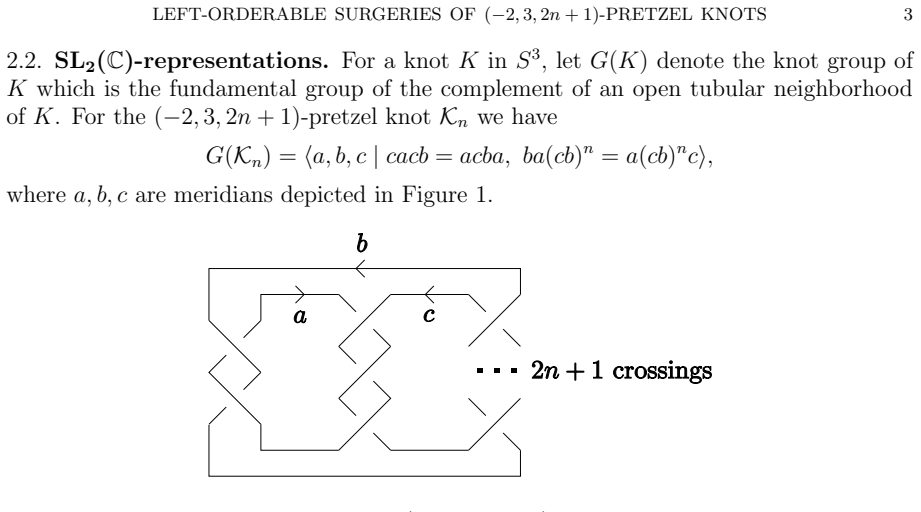
read the original abstract
In this paper, we provide an explicit construction of continuous paths of $\mathrm{SL}_2(\mathbb R)$-representations of the knot groups of $(-2,3,2n+1)$-pretzel knots. As an application, we show that the fundamental group of the $3$-manifold obtained from the $3$-sphere by $\frac{m}{l}$-surgery along the $(-2,3,2n+1)$-pretzel knot, where $n \ge 3$ is an integer and $n \not= 4$, is left-orderable if $\frac{m}{l}< 2 \lfloor \frac{2n+4}{3} \rfloor$.
Editorial analysis
A structured set of objections, weighed in public.
Referee Report
Summary. The manuscript constructs explicit continuous paths of SL(2,ℝ)-representations of the knot groups of the (-2,3,2n+1)-pretzel knots for integers n ≥ 3 with n ≠ 4. As an application, it proves that the fundamental group of the 3-manifold obtained by m/l-surgery on such a knot is left-orderable whenever m/l < 2⌊(2n+4)/3⌋.
Significance. If the constructions and verifications hold, the work supplies explicit, parameter-free paths of representations that yield concrete slope bounds for left-orderability of surgeries on this infinite family of pretzel knots. The explicitness of the paths is a strength, as it permits direct checking of the non-triviality conditions needed to apply standard criteria linking non-abelian SL(2,ℝ)-representations of surgered groups to left-orderability. This contributes concrete data to the program relating representation varieties of knot groups to left-orderability and the L-space conjecture.
major comments (1)
- [§5.3] §5.3, the descent argument after imposing the surgery relation: the claim that the path ρ_t remains non-trivial on the quotient group for all m/l below the stated bound requires an explicit verification that the image of the surgery curve avoids central elements (±I) uniformly in t and for the full range of n. The current argument invokes continuity of the path but does not supply a uniform lower bound on |tr(ρ_t(γ)) − 2| or an equivalent irreducibility check on the peripheral torus after quotienting; this step is load-bearing for the left-orderability conclusion.
minor comments (3)
- [Theorem 1.1] The statement of the main theorem (Theorem 1.1) should explicitly recall the precise left-orderability criterion (e.g., the variant of Boyer–Gordon–Watson or the SL(2,ℝ) non-abelian representation theorem) being applied, rather than citing it only in the introduction.
- [§4] Notation for the peripheral elements (meridian μ and longitude λ) is introduced in §2 but used without redefinition in the representation formulas of §4; a short reminder of the Wirtinger generators would improve readability.
- [Introduction] The exclusion of n=4 is stated without explanation; a brief remark on why the construction fails or requires separate treatment for this case would clarify the scope.
Simulated Author's Rebuttal
We thank the referee for their careful reading of the manuscript and for their positive assessment of its significance. We address the major comment below.
read point-by-point responses
-
Referee: [§5.3] §5.3, the descent argument after imposing the surgery relation: the claim that the path ρ_t remains non-trivial on the quotient group for all m/l below the stated bound requires an explicit verification that the image of the surgery curve avoids central elements (±I) uniformly in t and for the full range of n. The current argument invokes continuity of the path but does not supply a uniform lower bound on |tr(ρ_t(γ)) − 2| or an equivalent irreducibility check on the peripheral torus after quotienting; this step is load-bearing for the left-orderability conclusion.
Authors: We agree that the current exposition in §5.3 would benefit from a more explicit verification of non-triviality on the quotient. In the revised version we will add a new lemma immediately following the descent argument. The lemma uses the explicit matrix forms of ρ_t from §4 to compute tr(ρ_t(γ)) as a continuous function of t (a rational function in the parameter t whose coefficients depend on n but remain bounded for n ≥ 3, n ≠ 4). By evaluating the minimum of |tr(ρ_t(γ)) − 2| over the compact interval t ∈ [0,1] and over the discrete set of admissible n, we obtain a uniform positive lower bound that depends only on the slope threshold 2⌊(2n+4)/3⌋. This bound is strictly positive for all m/l below the stated threshold, ensuring ρ_t(γ) ≠ ±I uniformly in t. We will also include a short irreducibility check for the peripheral torus representation after quotienting. These additions make the passage to the surgered group fully rigorous. revision: yes
Circularity Check
No significant circularity; explicit construction stands independently
full rationale
The paper presents an explicit construction of continuous paths of SL(2,R)-representations of the knot groups for the specified pretzel knots, then applies them to conclude left-orderability of surgery manifolds for slopes below the given bound. No quoted step reduces the central claim to a self-definition, a fitted input renamed as prediction, or a load-bearing self-citation whose content is itself unverified within the paper. The derivation relies on direct construction rather than tautological renaming or imported uniqueness theorems from the same authors, rendering it self-contained with independent mathematical content.
Axiom & Free-Parameter Ledger
axioms (2)
- standard math Standard properties of fundamental groups of knot complements and 3-manifolds obtained by Dehn surgery.
- domain assumption Existence of a criterion that converts suitable SL(2,R)-representations into left-orderability of the surgery group.
Lean theorems connected to this paper
-
IndisputableMonolith/Foundation/AlexanderDuality.leanalexander_duality_circle_linking unclear?
unclearRelation between the paper passage and the cited Recognition theorem.
continuous paths of SL_2(R)-representations of the knot groups... left-orderable if m/l < 2 ⌊(2n+4)/3⌋
What do these tags mean?
- matches
- The paper's claim is directly supported by a theorem in the formal canon.
- supports
- The theorem supports part of the paper's argument, but the paper may add assumptions or extra steps.
- extends
- The paper goes beyond the formal theorem; the theorem is a base layer rather than the whole result.
- uses
- The paper appears to rely on the theorem as machinery.
- contradicts
- The paper's claim conflicts with a theorem or certificate in the canon.
- unclear
- Pith found a possible connection, but the passage is too broad, indirect, or ambiguous to say the theorem truly supports the claim.
Forward citations
Cited by 1 Pith paper
-
Left-orderability in Dehn fillings of pseudo-Anosov mapping tori
All Dehn fillings of these pseudo-Anosov mapping tori have left-orderable fundamental groups via analysis of taut foliations and their branching behavior.
Reference graph
Works this paper leans on
-
[1]
Bergman, Right orderable groups that are not locally indicable , Pacific J
G. Bergman, Right orderable groups that are not locally indicable , Pacific J. Math. 147 (1991), no. 2, 243--248
work page 1991
- [2]
-
[3]
K. L. Baker and A. H. Moore, Montesinos knots, Hopf plumbings, and L-space surgeries , J. Math. Soc. Japan 70 (2018), no. 1, 95--110
work page 2018
- [4]
-
[5]
M. Culler and N. Dunfield, Orderability and Dehn filling , Geom. Topol. 22 (2018), no. 3, 1405--1457
work page 2018
-
[6]
Chen, Character varieties of even classical pretzel knots , Studia Sci
H. Chen, Character varieties of even classical pretzel knots , Studia Sci. Math. Hungar. 56 (2019), no. 4, 510--522
work page 2019
-
[7]
M. Dabkowski, J. Przytycki and A. Togha, Non-left-orderable 3 -manifold groups , Canad. Math. Bull.48 (2005), 32--40
work page 2005
-
[8]
Gao, Orderability of homology spheres obtained by Dehn filling , Math
X. Gao, Orderability of homology spheres obtained by Dehn filling , Math. Res. Lett. 29 (2022), no. 5, 1387–1427
work page 2022
-
[9]
Gao, Slope of orderable Dehn filling of two-bridge knots , J
X. Gao, Slope of orderable Dehn filling of two-bridge knots , J. Knot Theory Ramifications 31 (2022), no. 1, Paper No. 2250006, 24 pp
work page 2022
-
[10]
M. Heusener and J. Porti, Deformations of reducible representations of 3 -manifold groups into PSL_2 ) , Algebr. Geom. Topol. 5 (2005), 965--997
work page 2005
-
[11]
A. Hatcher and W. Thurston, Incompressible surfaces in 2-bridge knot complements , Invent. Math. 79 (1985), no. 2, 225--246
work page 1985
-
[12]
R. Hakamata and M. Teragaito, Left-orderable fundamental group and Dehn surgery on the knot 5_2 , Canad. Math. Bull. 57 (2014), no. 2, 310--317
work page 2014
-
[13]
R. Hakamata and M. Teragaito, Left-orderable fundamental groups and Dehn surgery on genus one 2 -bridge knots , Algebr. Geom. Topol. 14 (2014), no. 4, 2125--2148
work page 2014
-
[14]
Hu, Euler class of taut foliations and Dehn filling , Comm
Y. Hu, Euler class of taut foliations and Dehn filling , Comm. Anal. Geom. 31 (2023), no. 7, 1749--1782
work page 2023
-
[15]
C. Herald and X. Zhang, A note on orderability and Dehn filling , Proc. Amer. Math. Soc. 147 (2019), no. 7, 2815--2819
work page 2019
-
[16]
A. Khan and A. T. Tran, Classical pretzel knots and left-orderability , Internat. J. Math. 32 (2021), no. 11, Paper No. 2150080, 16 pp
work page 2021
-
[17]
V. T. Khoi, M. Teragaito and A. T. Tran, Left-orderable surgeries of double twist knots II , Canad. Math. Bull. 64 (2021), no. 3, 624--637
work page 2021
-
[18]
A. Lubotzky and A. R. Magid, Varieties of representations of finitely generated groups , Amer. Math. Soc. 58 (1985), no. 336, xi+117
work page 1985
-
[19]
T. T. Q. Le and A. T. Tran, On the AJ conjecture for knots , Indiana Univ. Math. J. 64 (2015), no. 4, 1103--1151
work page 2015
-
[20]
Nie, Left-orderablity for surgeries on (-2,3,2n+1) -pretzel knots , Topology
Z. Nie, Left-orderablity for surgeries on (-2,3,2n+1) -pretzel knots , Topology. Appl. 261 (2019), 1--6
work page 2019
-
[21]
P. Ozsv\'ath and Z. Szab\'o, On knot Floer homology and lens space surgeries , Topology 44 (2005), no. 6, 1281--1300
work page 2005
-
[22]
A. T. Tran, The universal character ring of some families of one-relator groups , Algebr. Geom. Topol. 13 (2013), no. 4, 2317--2333
work page 2013
-
[23]
A. T. Tran, On left-orderable fundamental groups and Dehn surgeries on knots , J. Math. Soc. Japan 67 (2015), no. 1, 319--338
work page 2015
-
[24]
A. T. Tran, Left-orderability for surgeries on twisted torus knots , Proc. Japan Acad. Ser. A Math. Sci. 95 (2019), no. 1, 6--10
work page 2019
-
[25]
A. T. Tran, Left-orderable surgeries of double twist knots , J. Math. Soc. Japan 73 (2021), no. 3, 753--765
work page 2021
-
[26]
K. Varvarezos, Representations of the (-2,3,7) -pretzel knot and orderability of Dehn surgeries , Topology Appl. 294 (2021), 107654, 15 pp
work page 2021
-
[27]
Y. Wang, Detected Seifert surfaces and intervals of left-orderable surgeries , preprint 2025, arXiv:2509.08127
-
[28]
Zung, Taut foliations, left-orders, and pseudo-Anosov mapping tori , Geom
J. Zung, Taut foliations, left-orders, and pseudo-Anosov mapping tori , Geom. Topol. 28 (2024), no. 9, 4191--4232
work page 2024
discussion (0)
Sign in with ORCID, Apple, or X to comment. Anyone can read and Pith papers without signing in.