REVIEW 3 major objections 4 minor 56 references
Nanoscale Femtosecond Coherent Radiation and Spatiotemporally Shaped free electron Wavefunction
T0 review · 3 major / 4 minor · reviewed 2026-08-03 · deepseek-v4-flash
Pith's one-line read A laser-excited pair of nanowires, acting as a nanoscale undulator, can make a free electron's wavepacket oscillate and squeeze, causing it to emit tunable femtosecond coherent radiation.
desk verdict Genuinely new wavefunction-shaping idea, but the single-electron far-field power is off by ~10^5 from a Larmor estimate — send to peer review with a normalization check in mind. read the letter →
The pith
A machine-rendered reading of the paper's core claim, the machinery that carries it, and where it could break.
The reading
What carries the argument
The central object is the nanoscale undulator (NU): a coupled nanowire pair whose laser-excited gap mode provides a transverse electric field that is periodic along the electron path. The analytical engine is the single-mode ansatz Ex = E0 cos(kp z − ω_p t) cosh(β x); from it the paper derives the closed-form wiggling trajectory, the phase-mismatch frequency Ω = v_e k_p − ω_p, the squeezing parameter M = ħ²/(4γ²m_e²ω²σ_x0⁴), and the threshold field E_th. The radiation calculation then uses the expectation value of the quantum current as a classical source, treating the scattered photons in a QED coherent-state picture.
What would settle it
Directly measure the transverse width of the electron wavepacket after it transits a real coupled nanowire pair while ramping the pump amplitude. The theory predicts that above the threshold field the final width drops below its initial value (squeezing) instead of dispersively broadening, and the EELS sidebands grow with the squeezing-induced phase. If no such width collapse appears at the predicted threshold—or if the radiation spectrum does not show the three predicted peaks (around 1.54, 1.69, 1.81 eV forward and 1.34, 1.44, 1.53 eV backward for 1 keV electrons)—the central mechanism is no
Extended reading notes
Core claim
The paper argues that the spatially periodic transverse near field in the gap of a coupled nanowire pair is not merely a deflecting 'undulator' field; it simultaneously creates a near-harmonic transverse potential that squeezes the electron's wavepacket. The paper derives closed-form expressions for the wiggling trajectory and for the width oscillation σ_x(t) = σ_x0 [cos²(ωt') + M sin²(ωt')]^{1/2}, with M = ħ²/(4γ²m_e²ω²σ_x0⁴), and shows that for field amplitudes above a threshold the width is compressed rather than dispersed. Using this shaped wavepacket as a source current, the paper computes coherent radiation with three peaks per direction, arising from the interaction with the forward-,
Load-bearing premise
The predictions depend on the assumption that a real, 10-nanometer-wide gap between lossless nanowires sustains a single field pattern with the shape and strength used in the model—about 10^10 volts per meter—and that the electron actually stays inside that gap; if those conditions are not met, the squeezing and the predicted radiation peaks do not follow.
Editorial extensions
If this is right
- A 5-micrometer chip with a 10 nm gap could replace meter-scale undulators for photon energies around 1–2 eV, with electron energy tuning the emission (for example, 1 keV gives three forward peaks at 1.54, 1.69, and 1.81 eV; 10 keV blueshifts and sharpens them).
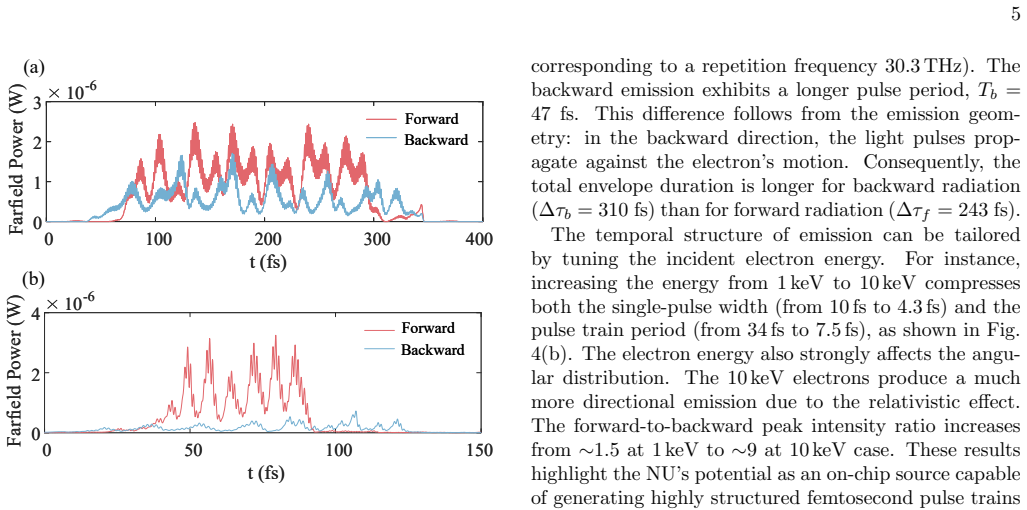
- The radiated field forms a train of femtosecond pulses—10 fs pulses every 34 fs at 1 keV, and 4.3 fs pulses every 7.5 fs at 10 keV—so the same structure serves as a femtosecond pulse-train source with electron-energy-tuned repetition rate.
- The transverse near-field interaction imprints a two-part structure in the electron energy-loss spectrum (ponderomotive sidebands plus a squeezing-induced dynamical phase), which is distinct from longitudinal-field interactions and can be used to characterize the shaping.
- Coherent squeezing suppresses wavepacket dispersion, so longer interaction lengths—and therefore stronger radiation—become possible without delocalizing the electron, addressing the main obstacle to compact free-electron light sources.
- Simultaneous interaction with forward-, backward-, and non-propagating field components yields three spectral lines per direction, so the measured multi-peak spectrum is a direct fingerprint of the mechanism.
Reading between the lines
- The same transverse-squeezing mechanism should work in other periodic near-field geometries—not just coupled nanowires—wherever a strong gap mode has a cosh-like transverse profile; comparing such structures would be a direct test of how general the effect is.
- The paper's lossless, single-mode model leaves open how material losses and nonlinearities at the required ~10^10 V/m field in a 10 nm gap modify the squeezing threshold; a natural next step is to include dispersion and heating in the calculation.
- Because the emission modes are computed as coherent states, the emitted light should carry a phase imprint from the electron's squeezing dynamics; this may enable transfer of quantum information from free electrons to light, though the paper does not develop that direction.
Editorial analysis
A structured set of objections, weighed in public.
Referee Report
Summary. The manuscript proposes a coupled nanowire pair (CNP) as a 'nanoscale undulator.' A pump laser excites a spatially periodic transverse gap mode; a free electron propagating in the 10 nm gap is driven transversely and, according to the analytic model, quantum-squeezed. The resulting oscillating, squeezed wave packet emits tunable femtosecond radiation. The authors support this with FDTD field maps, a relativistically corrected time-dependent Schrödinger equation (RC-TDSE) simulation, and a QED current-based radiation calculation. The main quantitative predictions are spectral peaks near 1.3–1.8 eV and femtosecond pulse trains; the far-field power is reported at the level of 10^-6 W for a single electron.
Significance. The idea of using a purely transverse evanescent near field both to undulate and to squeeze a free-electron wavepacket is novel and distinct from the longitudinal-field PINEM mechanism. If the quantitative claims are correct, this would be a compact on-chip source with control over wavelength, pulse spacing, and direction. The analytical formulas in Eqs. (2) and (3) are closed form, and the spectral peak positions follow from k_p = 1.3 k₀ and the electron velocity with no fitting to the output spectra, which is a strength. The RC-TDSE and FDTD simulations provide first-principles numerical support. The principal weaknesses are the absence of a benchmark for the radiation power calculation and the under-specification of the squeezing parameters in the main text.
major comments (3)
- [§4, Fig. 4; Eqs. (5)–(6)] The reported far-field power for a single 1 keV electron, ~2×10^-6 W, is not benchmarked. From Eq. (2) with E₀≈1×10^10 V/m, Ω≈345 THz, and ω_p≈2.36×10^15 rad/s, the transverse amplitude is x_c≈0.35 nm; in free space the Larmor power is about 1×10^-11 W, roughly five orders of magnitude smaller. If the Maxwell solver includes the CNP dielectric and the enhancement is physical, this must be stated explicitly and justified; if not, the normalization of the quantum current in Eq. (5)–(6) is suspect. Please add (i) a benchmark against the free-space Larmor/point-charge limit and (ii) an energy-conservation check equating the integrated radiated energy to the net EELS loss. These checks are essential because Fig. 4 underpins the claimed on-chip coherent source.
- [§2, Eq. (3)] The squeezing mechanism is central to the paper, but Eq. (3) never defines the effective harmonic frequency ω or the threshold field E_th in the main text; β and σ_x0 are not given. The assertion that E₀≈1×10^10 V/m 'significantly exceeds' E_th for 1–30 keV cannot be verified from the information provided. Please state explicit formulas for ω(E₀,β) and E_th, and give the numerical values of β, σ_x0, and the squeezing parameter M used in the RC-TDSE runs. Without these, the mechanism cannot be reproduced or quantitatively checked.
- [§1–§2, Eq. (2) and Fig. 1(b)] The analytic model assumes a single lossless mode E_x = E₀ cos(k_p z − ω_p t) cosh(βx) with k_p = 1.3 k₀. The FDTD maps show a gap-to-background intensity ratio of only about 10 and non-negligible end-facet fields, yet the RC-TDSE validation is described only as 'excellent agreement.' Please provide a quantitative comparison between the simulated wave-packet centroid and width and the predictions of Eqs. (2)–(3), including the time evolution of x_c and σ_x. This would establish that the idealized cosh(βx) mode captures the physics used to predict the spectra and pulse trains.
minor comments (4)
- [Title and text] Please correct minor typos and style issues: 'free electron Wavefunction' in the title should have consistent capitalization; 'transverses' should be 'traverses'; 'Farfield Power' should be 'Far-field power'; and in the sentence 'repetition frequency 30.3 THz)' there is an unmatched parenthesis.
- [§2, Eq. (3)] The definition of M is given in the text, but the notation t′ is not clearly defined. Please specify that t′ is the interaction duration measured in the electron's rest frame or laboratory frame, as appropriate.
- [§4, Eq. (7)] The formula for T_f is helpful, but the symbol c_g for the group velocity of the radiated pulse inside the CNP is not defined. Please provide its value or its relation to the mode dispersion.
- [References] Reference [23] is a preprint; if a peer-reviewed version exists, please cite it. Also, the supplemental material reference [49] is self-referential and should be formatted consistently with journal style.
Circularity Check
No circularity: radiation peaks follow from the input gap-mode parameters and electron velocity, with no fitted target-data reduction.
full rationale
The derivation chain is self-contained rather than circular. The FDTD simulation independently fixes the gap-mode parameters (kp=1.3k0, E0≈1×10^10 V/m), and these are used as inputs to the minimal-coupling Hamiltonian, giving the transverse centroid (Eq. 2) and width (Eq. 3). The RC-TDSE calculation then solves the Schrödinger equation in those same near fields; that is a numerical consistency test of the analytical model, not a fitting of the target results. The three radiation peaks are determined by the effective oscillation frequencies Ω_ICS, Ω_CS, Ω_NP, which are computed from kp, ωp, and ve through the Doppler formula ω_r(θ)=Ω/(1−v_e cosθ/c); there is no adjustment of these frequencies to match the computed spectra. The squeezing threshold E_th is derived algebraically from the same model parameters. The only self-citation ([20]) appears in a general list of PINEM-inspired wavefunction-shaping references and carries no load in the derivation. The reported far-field power is a potential normalization/validity concern, but it is not a case of an output being equal to an input by construction, so it does not constitute circularity.
Assumptions & free parameters
free parameters (5)
- Gap-mode wavevector kp = 1.3 k0 =
1.3 k0
- Gap field amplitude E0 ~ 1e10 V/m =
~1x10^10 V/m
- Evanescent decay constant beta =
not stated
- Effective harmonic squeezing frequency omega =
not stated
- Initial transverse width sigma_x0 =
not stated
assumptions (6)
- standard math Coulomb-gauge minimal-coupling Hamiltonian with relativistic corrections (Eq. 1)
- domain assumption The gap field is dominated by a single transverse harmonic mode of the form Ex = E0 cos(kp z - wave_p t) cosh(beta x); Ey and Ez are negligible on the electron path except near facets
- standard math Gaussian wavepacket dynamics in a harmonic potential (Eq. 3)
- domain assumption Quantum recoil from emitted photons is negligible
- domain assumption Lossless nanowires with refractive index 2 and no damage or ionization at E0 ~ 1e10 V/m
- domain assumption The near field decomposes into forward, backward, and non-propagating spatial components that set the three spectral peaks
Cite this review
Pith. "Pith review of Nanoscale Femtosecond Coherent Radiation and Spatiotemporally Shaped free electron Wavefunction." pith.science (2026). https://pith.science/paper/DL2KLQEL
@misc{pith2026251110931,
  author       = {Pith},
  title        = {Pith review of: Nanoscale Femtosecond Coherent Radiation and Spatiotemporally Shaped free electron Wavefunction},
  year         = {2026},
  howpublished = {\url{https://pith.science/paper/DL2KLQEL}},
  note         = {Machine review of arXiv:2511.10931}
}
read the original abstract
We study tunable nanoscale femtosecond coherent radiation based on a coupled nanowire pair (CNP) structure that is excited by a strong laser. The structure functions as a nanoscale undulator (NU): the electrons moving through the nanogap are driven by a spatially periodic, transverse optical near-field. We show that the transverse near-field can actively shape the electron wavefunction by inducing both a periodic oscillation and a quantum squeezing of its width. We then validate this theoretical framework by numerically solving the relativistically corrected time-dependent Schr\"odinger equation (RC-TDSE). The generated femtosecond pulse trains can be spectrally, temporally, and spatially controlled. This framework establishes the transverse optical near-field interaction as a novel mechanism to spatiotemporally shape electron wavefunctions, which illuminates a path to versatile platform for on-chip femtosecond coherent light source and the application in free-electron quantum optics.
Figures


Figures from the paper (1 more)
Reference graph
Works this paper leans on
-
[1]
wiggling
reveals that the excitation primarily produces a strong transverse electric-field component,E x, within the gap. The simulation further shows that theE x varies peri- odically alongzwith propagation constantk p = 1.3k 0 (wherek 0 is the pump’s free-space wavevector), realiz- ing the NU’s periodic deflecting field. As shown in Fig. 1(b), the simulated peak...
-
[2]
F. J. Garc ´ ıa de Abajo and V. Di Giulio, ACS Photonics 8, 945 (2021)
2021
-
[3]
F. J. Garc ´ ıa De Abajo, Reviews of Modern Physics82, 209 (2010)
2010
-
[4]
Talebi, S
N. Talebi, S. Meuret, S. Guo, M. Hentschel, A. Polman, H. Giessen, and P. A. van Aken, Nature Communications 10, 599 (2019)
2019
-
[5]
Chlouba, R
T. Chlouba, R. Shiloh, S. Kraus, L. Br¨ uckner, J. Litzel, and P. Hommelhoff, Nature622, 476 (2023)
2023
-
[6]
L. J. Wong, I. Kaminer, O. Ilic, J. D. Joannopoulos, and M. Soljaˇ ci´ c, Nature Photonics10, 46 (2016)
2016
-
[7]
Zhang, Y
D. Zhang, Y. Zeng, Y. Bai, Z. Li, Y. Tian, and R. Li, Nature611, 55 (2022). 6
2022
-
[8]
Taleb, M
M. Taleb, M. Hentschel, K. Rossnagel, H. Giessen, and N. Talebi, Nature Physics19, 869 (2023)
2023
Show all 56 references
-
[9]
Taleb, P
M. Taleb, P. H. Bittorf, M. Black, M. Hentschel, W. Sigle, B. Haas, C. Koch, P. A. van Aken, H. Giessen, and N. Talebi, Nature Communications16, 2326 (2025)
2025
-
[10]
Y. Yang, C. Roques-Carmes, S. E. Kooi, H. Tang, J. Beroz, E. Mazur, I. Kaminer, J. D. Joannopoulos, and M. Soljaˇ ci´ c, Nature613, 42 (2023)
2023
-
[11]
X. Lin, H. Hu, S. Easo, Y. Yang, Y. Shen, K. Yin, M. P. Blago, I. Kaminer, B. Zhang, H. Chen, J. Joannopoulos, M. Soljaˇ ci´ c, and Y. Luo, Nature Communications12, 5554 (2021)
2021
-
[12]
J. Chen, R. Chen, F. Tay, Z. Gong, H. Hu, Y. Yang, X. Zhang, C. Wang, I. Kaminer, H. Chen, B. Zhang, and X. Lin, Physical Review Letters131, 113002 (2023)
2023
-
[13]
Gahlmann, S
A. Gahlmann, S. Tae Park, and A. H. Zewail, Physical Chemistry Chemical Physics10, 2894 (2008)
2008
-
[14]
D.-S. Yang, O. F. Mohammed, and A. H. Zewail, Pro- ceedings of the National Academy of Sciences107, 14993 (2010)
2010
-
[15]
A. H. Zewail, Science328, 187 (2010)
2010
-
[16]
Barwick, D
B. Barwick, D. J. Flannigan, and A. H. Zewail, Nature 462, 902 (2009)
2009
-
[17]
S. T. Park, M. Lin, and A. H. Zewail, New Journal of Physics12, 123028 (2010)
2010
-
[18]
Feist, K
A. Feist, K. E. Echternkamp, J. Schauss, S. V. Yalunin, S. Sch¨ afer, and C. Ropers, Nature521, 200 (2015)
2015
-
[19]
Talebi, New Journal of Physics18, 123006 (2016)
N. Talebi, New Journal of Physics18, 123006 (2016)
2016
-
[20]
Ebel and N
S. Ebel and N. Talebi, Communications Physics6, 1 (2023)
2023
-
[21]
J. Li, Y. Fang, and Y. Liu, Phys. Rev. Lett.132, 073801 (2024)
2024
-
[22]
Kurman, R
Y. Kurman, R. Dahan, H. H. Sheinfux, K. Wang, M. Yan- nai, Y. Adiv, O. Reinhardt, L. H. G. Tizei, S. Y. Woo, J. Li, J. H. Edgar, M. Kociak, F. H. L. Koppens, and I. Kaminer, Science372, 1181 (2021)
2021
-
[23]
Khalaf and I
M. Khalaf and I. Kaminer, Science Advances9, eade0932 (2023)
2023
-
[24]
H. Dang, J. Gao, H. Wu, X. Guo, and L. Tong, Deep-sub- cycle ultrafast optical pulses (2024), arXiv:2408.07306 [physics]
2024 arXiv
-
[25]
F. R. Elder, A. M. Gurewitsch, R. V. Langmuir, and H. C. Pollock, Physical Review71, 829 (1947)
1947
-
[26]
L. R. Elias, W. M. Fairbank, J. M. J. Madey, H. A. Schwettman, and T. I. Smith, Physical Review Letters 36, 717 (1976)
1976
-
[27]
Pellegrini, A
C. Pellegrini, A. Marinelli, and S. Reiche, Reviews of Modern Physics88, 015006 (2016)
2016
-
[28]
Kumakhov, Physics Letters A57, 17 (1976)
M. Kumakhov, Physics Letters A57, 17 (1976)
1976
-
[29]
Halbach, Nuclear Instruments and Methods169, 1 (1980)
K. Halbach, Nuclear Instruments and Methods169, 1 (1980)
1980
-
[30]
T. N. Wistisen, K. K. Andersen, S. Yilmaz, R. Mikkelsen, J. L. Hansen, U. I. Uggerhøj, W. Lauth, and H. Backe, Physical Review Letters112, 254801 (2014)
2014
-
[31]
Bellucci, V
S. Bellucci, V. M. Biryukov, G. I. Britvich, Yu. A. Chesnokov, C. Balasubramanian, G. Giannini, V. Guidi, Yu. M. Ivanov, V. I. Kotov, V. A. Maisheev, C. Malagu, G. Martinelli, A. A. Petrunin, V. A. Pikalov, A. Raco, L. Silvi, V. V. Skorobogatov, M. Stefancich, F. Tombolini, an...
2004
-
[32]
R. H. Milburn, Physical Review Letters10, 75 (1963)
1963
-
[33]
Plettner and R
T. Plettner and R. L. Byer, Physical Review Special Top- ics - Accelerators and Beams11, 030704 (2008)
2008
-
[34]
S. A. Schmid and U. Niedermayer, Physical Review Ac- celerators and Beams25, 091301 (2022)
2022
-
[35]
Rivera and I
N. Rivera and I. Kaminer, Nature Reviews Physics2, 538 (2020)
2020
-
[36]
A. V. Akimov, A. Mukherjee, C. L. Yu, D. E. Chang, A. S. Zibrov, P. R. Hemmer, H. Park, and M. D. Lukin, Nature450, 402 (2007)
2007
-
[37]
Z. Fang, L. Fan, C. Lin, D. Zhang, A. J. Meixner, and X. Zhu, Nano Letters11, 1676 (2011)
2011
-
[38]
H. Xu, J. B. Wright, T.-S. Luk, J. J. Figiel, K. Cross, L. F. Lester, G. Balakrishnan, G. T. Wang, I. Brener, and Q. Li, Applied Physics Letters101, 113106 (2012)
2012
-
[39]
Huang, S
K. Huang, S. Yang, and L. Tong, Applied Optics46, 1429 (2007)
2007
-
[40]
R. Yan, P. Pausauskie, J. Huang, and P. Yang, Proceed- ings of the National Academy of Sciences106, 21045 (2009)
2009
-
[41]
Talebi, Physical Review Letters125, 080401 (2020)
N. Talebi, Physical Review Letters125, 080401 (2020)
2020
-
[42]
F. J. Garc ´ ıa De Abajo and A. Koneˇ cn´ a, Physical Review Letters126, 123901 (2021)
2021
-
[43]
Koz´ ak, ACS Photonics8, 431 (2021)
M. Koz´ ak, ACS Photonics8, 431 (2021)
2021
-
[44]
Tsesses, R
S. Tsesses, R. Dahan, K. Wang, T. Bucher, K. Cohen, O. Reinhardt, G. Bartal, and I. Kaminer, Nature Mate- rials22, 345 (2023)
2023
-
[45]
Koz´ ak, T
M. Koz´ ak, T. Eckstein, N. Sch¨ onenberger, and P. Hom- melhoff, Nature Physics14, 121 (2018)
2018
-
[46]
Madan, V
I. Madan, V. Leccese, A. Mazur, F. Barantani, T. La- Grange, A. Sapozhnik, P. M. Tengdin, S. Gargiulo, E. Rotunno, J.-C. Olaya, I. Kaminer, V. Grillo, F. J. G. de Abajo, F. Carbone, and G. M. Vanacore, ACS Pho- tonics9, 3215 (2022)
2022
-
[47]
Adamo, K
G. Adamo, K. F. MacDonald, Y. H. Fu, C.-M. Wang, D. P. Tsai, F. J. Garc ´ ıa de Abajo, and N. I. Zheludev, Physical Review Letters103, 113901 (2009)
2009
-
[48]
Z. Wang, A. Abbasi, U. Dave, A. De Groote, S. Ku- mari, B. Kunert, C. Merckling, M. Pantouvaki, Y. Shi, B. Tian, K. Van Gasse, J. Verbist, R. Wang, W. Xie, J. Zhang, Y. Zhu, J. Bauwelinck, X. Yin, Z. Hens, J. Van Campenhout, B. Kuyken, R. Baets, G. Morthier, D. Van Thourhout, ...
2017
-
[49]
H. Wu, L. Yang, P. Xu, J. Gong, X. Guo, P. Wang, and L. Tong, Physical Review Letters129, 013902 (2022)
2022
-
[50]
Y. L. Wu Wen, Jing Li (2025), see Supplemental Material for Section I. quantum description of electron motion in CNP, Section II QED description of the radiation, Sec- tion III. Numerical Method, and Supplemental Material movies for the time evolutions of the 1, 10, and 30 keV...
2025
-
[51]
Eldar, Z
M. Eldar, Z. Chen, Y. Pan, and M. Kr¨ uger, Physical Review Letters132, 035001 (2024)
2024
-
[52]
J. D. Jackson,Classical electrodynamics, 3rd ed. (Wiley, New York, NY, 1999)
1999
-
[53]
Zhang, Y
D. Zhang, Y. Zeng, Y. Tian, and R. Li, Photonics Insights 2, R07 (2023)
2023
-
[54]
Y. Tian, J. Liu, Y. Bai, S. Zhou, H. Sun, W. Liu, J. Zhao, R. Li, and Z. Xu, Nature Photonics11, 242 (2017)
2017
-
[55]
Kruit, R
P. Kruit, R. Hobbs, C.-S. Kim, Y. Yang, V. Man- frinato, J. Hammer, S. Thomas, P. Weber, B. Klopfer, C. Kohstall, T. Juffmann, M. Kasevich, P. Hommelhoff, and K. Berggren, Ultramicroscopy164, 31 (2016)
2016
-
[56]
K. E. Priebe, C. Rathje, S. V. Yalunin, T. Hohage, A. Feist, S. Sch¨ afer, and C. Ropers, Nature Photonics 11, 793 (2017)
2017
Reviewed August 3, 2026 · model on record in the stance chip above.
Discussion (0). Sign in to comment.