A Geometry Map-Based Site-Specific Propagation Channel Model for Urban Scenarios
Pith reviewed 2026-05-17 22:15 UTC · model grok-4.3
The pith
A geometry map-based model extracts building details from 3D urban maps and applies recursive diffraction theory to predict site-specific radio path loss and Doppler shifts more accurately than conventional methods.
A machine-rendered reading of the paper's core claim, the machinery that carries it, and where it could break.
Core claim
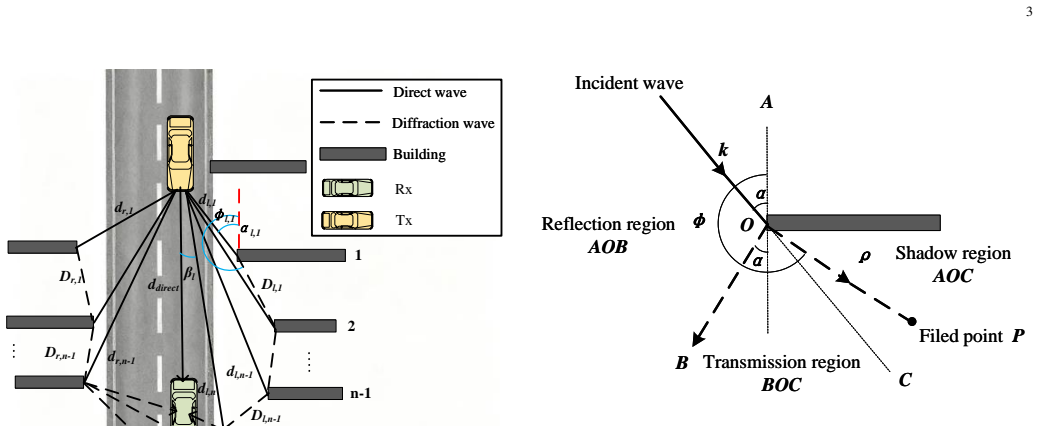
The proposed geometry map-based propagation channel model directly extracts key parameters from a 3D geometry map and incorporates the Uniform Theory of Diffraction (UTD) to recursively compute multiple diffraction fields, thereby enabling accurate prediction of site-specific large-scale path loss and time-varying Doppler characteristics in urban scenarios. A well-designed identification algorithm is developed to efficiently detect buildings that significantly affect signal propagation. The model is validated using urban measurement data, showing excellent agreement of path loss in both LOS and NLOS conditions and outperforming the 3GPP and simplified models in NLOS scenarios with complex 3D
What carries the argument
The identification algorithm that selects relevant buildings from the 3D geometry map together with recursive UTD computation of successive diffraction fields to determine propagation effects.
If this is right
- The model delivers lower root-mean-square error for path loss in NLOS urban settings with complex diffractions than either the 3GPP model or simplified alternatives.
- It reproduces measured time-varying Doppler characteristics that arise from motion in city environments.
- The identification algorithm keeps computation feasible while preserving accuracy across varied urban layouts.
- Results support more precise network planning and system design for 5G and 6G deployments where site-specific effects dominate.
Where Pith is reading between the lines
- Real-time map updates could allow the model to track changing urban environments such as new construction or temporary obstacles.
- The same map-plus-recursive-diffraction structure might transfer to acoustic or optical wave modeling inside cities.
- Adding stochastic elements for moving vehicles could extend the Doppler predictions to fully dynamic scenarios.
- Comparison against full ray-tracing simulations on the same maps would quantify the accuracy-compute tradeoff.
Load-bearing premise
The 3D geometry map must accurately capture all relevant urban features and the identification algorithm must correctly pick only the buildings that matter for propagation so that the UTD recursion produces reliable results.
What would settle it
Collect fresh path-loss measurements along a known NLOS route with multiple building diffractions in a different city, run the model and the 3GPP model on the same map, and check whether the new model's RMSE stays at least 7 dB lower; comparable or worse error would falsify the accuracy claim.
Figures


read the original abstract
With the rapid deployments of 5G and 6G networks, accurate modeling of urban radio propagation has become critical for system design and network planning. However, conventional statistical or empirical models fail to fully capture the influence of detailed geometric features on site-specific channel variances in dense urban environments. In this paper, we propose a geometry map-based propagation channel model that directly extracts key parameters from a 3D geometry map and incorporates the Uniform Theory of Diffraction (UTD) to recursively compute multiple diffraction fields, thereby enabling accurate prediction of site-specific large-scale path loss and time-varying Doppler characteristics in urban scenarios. A well-designed identification algorithm is developed to efficiently detect buildings that significantly affect signal propagation. The proposed model is validated using urban measurement data, showing excellent agreement of path loss in both line-of-sight (LOS) and nonline-of-sight (NLOS) conditions. In particular, for NLOS scenarios with complex diffractions, it outperforms the 3GPP and simplified models, reducing the RMSE by 7.1 dB and 3.18 dB, respectively. Doppler analysis further demonstrates its accuracy in capturing time-varying propagation characteristics, confirming the scalability and generalization of the model in urban environments.
Editorial analysis
A structured set of objections, weighed in public.
Referee Report
Summary. The paper proposes a geometry map-based site-specific propagation channel model for urban scenarios that extracts key parameters directly from a 3D geometry map and applies recursive Uniform Theory of Diffraction (UTD) computations for multiple diffractions. It introduces a building identification algorithm to select structures significantly affecting propagation and validates the model against urban measurement data, reporting good path-loss agreement in both LOS and NLOS conditions with specific RMSE reductions of 7.1 dB versus 3GPP and 3.18 dB versus simplified models in complex-diffraction NLOS cases, plus accurate time-varying Doppler characteristics.
Significance. If the validation holds after addressing the identification step, the work offers a practical advance in site-specific urban channel modeling for 5G/6G by combining detailed geometry with established UTD recursion, potentially yielding more accurate large-scale path loss and Doppler predictions than purely statistical models. The approach is scalable in principle and directly addresses limitations of conventional empirical models in dense environments.
major comments (2)
- [Abstract and validation results] Abstract and validation results: The reported 7.1 dB RMSE reduction versus 3GPP in NLOS scenarios with complex diffractions is load-bearing on the claim that the building identification algorithm correctly isolates only those buildings whose edges contribute meaningfully to the recursive UTD field. No quantitative evidence (e.g., precision/recall against exhaustive enumeration or expert labeling of diffracting edges) is supplied to confirm the algorithm's reliability across measured routes, so the measured agreement could be an artifact of the selection rather than a general property of the geometry-map + UTD method.
- [Measurement validation] Measurement validation: The abstract states validation using urban measurement data but provides no details on data selection criteria, number of independent routes or scenarios, statistical error bars or confidence intervals on the RMSE figures, or safeguards against post-hoc tuning of the identification algorithm or UTD parameters. These omissions leave the central performance claims only partially supported.
minor comments (2)
- [Identification algorithm description] Clarify the exact criteria and thresholds used in the building identification algorithm (e.g., distance, height, or visibility metrics) so that the method can be reproduced.
- [Figures in validation section] Ensure all figures showing path-loss comparisons include the number of samples or routes per condition and any shaded error regions.
Simulated Author's Rebuttal
We thank the referee for the constructive and detailed comments. We address each major comment point by point below, indicating where revisions to the manuscript will be made to strengthen the presentation of the validation results.
read point-by-point responses
-
Referee: [Abstract and validation results] Abstract and validation results: The reported 7.1 dB RMSE reduction versus 3GPP in NLOS scenarios with complex diffractions is load-bearing on the claim that the building identification algorithm correctly isolates only those buildings whose edges contribute meaningfully to the recursive UTD field. No quantitative evidence (e.g., precision/recall against exhaustive enumeration or expert labeling of diffracting edges) is supplied to confirm the algorithm's reliability across measured routes, so the measured agreement could be an artifact of the selection rather than a general property of the geometry-map + UTD method.
Authors: We agree that quantitative validation of the building identification algorithm is essential to substantiate that the reported RMSE reductions arise from the geometry-map + UTD approach rather than from the selection step. The current manuscript describes the algorithm and its use but does not supply precision/recall metrics or comparisons against exhaustive enumeration. In the revised manuscript we will add a dedicated subsection (or appendix) that evaluates the algorithm on the measured routes by reporting precision and recall against exhaustive enumeration of all candidate diffracting buildings in the 3D map. Where feasible we will also include a comparison to manually labeled significant edges. These additions will directly address the concern and support the validity of the 7.1 dB improvement figure. revision: yes
-
Referee: [Measurement validation] Measurement validation: The abstract states validation using urban measurement data but provides no details on data selection criteria, number of independent routes or scenarios, statistical error bars or confidence intervals on the RMSE figures, or safeguards against post-hoc tuning of the identification algorithm or UTD parameters. These omissions leave the central performance claims only partially supported.
Authors: We acknowledge that the validation section would benefit from greater transparency. The manuscript currently states that urban measurement data were used but omits the requested specifics. In the revision we will expand the validation section to report: (i) explicit data-selection criteria and the urban scenarios considered, (ii) the number of independent routes and total measurement points, (iii) statistical error bars or bootstrap-derived confidence intervals on the RMSE values, and (iv) a clear statement that the building-identification thresholds and UTD parameters were fixed from geometric considerations alone, with no post-hoc adjustment to the measurement outcomes. These additions will make the performance claims more fully supported. revision: yes
Circularity Check
No circularity: derivation applies established UTD to geometry inputs with external measurement validation
full rationale
The paper extracts geometric parameters from a 3D map, applies a building identification algorithm, and recursively computes diffraction fields via established Uniform Theory of Diffraction (UTD). Path loss and Doppler predictions are then compared against independent urban measurement data, yielding reported RMSE reductions versus 3GPP and simplified models. This structure keeps the claimed outputs independent of the inputs: the measurements serve as an external benchmark rather than a fitted target that defines the model by construction. No self-definitional equations, fitted-input predictions, load-bearing self-citations, or ansatz smuggling appear in the abstract or described chain. The identification algorithm is presented as a design choice whose reliability is assumed for the model but is not shown to be tuned to the reported performance metrics.
Axiom & Free-Parameter Ledger
axioms (1)
- domain assumption Uniform Theory of Diffraction accurately computes multiple diffraction fields around urban buildings
Lean theorems connected to this paper
-
IndisputableMonolith/Foundation/RealityFromDistinction.leanreality_from_one_distinction unclear?
unclearRelation between the paper passage and the cited Recognition theorem.
We propose a geometry map-based propagation channel model that directly extracts key parameters from a 3D geometry map and incorporates the Uniform Theory of Diffraction (UTD) to recursively compute multiple diffraction fields
-
IndisputableMonolith/Foundation/AlexanderDuality.leanalexander_duality_circle_linking unclear?
unclearRelation between the paper passage and the cited Recognition theorem.
A well-designed identification algorithm is developed to efficiently detect buildings that significantly affect signal propagation
What do these tags mean?
- matches
- The paper's claim is directly supported by a theorem in the formal canon.
- supports
- The theorem supports part of the paper's argument, but the paper may add assumptions or extra steps.
- extends
- The paper goes beyond the formal theorem; the theorem is a base layer rather than the whole result.
- uses
- The paper appears to rely on the theorem as machinery.
- contradicts
- The paper's claim conflicts with a theorem or certificate in the canon.
- unclear
- Pith found a possible connection, but the passage is too broad, indirect, or ambiguous to say the theorem truly supports the claim.
Reference graph
Works this paper leans on
-
[1]
C. Huang, R. He, B. Ai, A. F. Molisch, B. K. Lau, K. Haneda, B. Liu, C. Wang, M. Yang, C. Oestgeset al., “Artificial intelligence enabled ra- dio propagation for communications—part ii: Scenario identification and channel modeling,”IEEE Transactions on Antennas and Propagation, vol. 70, no. 6, pp. 3955–3969, 2022
work page 2022
-
[2]
R. He, C. Schneider, B. Ai, G. Wang, Z. Zhong, D. A. Dupleich, R. S. Thomae, M. Boban, J. Luo, and Y . Zhang, “Propagation channels of 5G millimeter-wave vehicle-to-vehicle communications: Recent advances and future challenges,”IEEE vehicular technology magazine, vol. 15, no. 1, pp. 16–26, 2019
work page 2019
-
[3]
Z. Zhang, R. He, B. Ai, M. Yang, X. Zhang, Z. Qi, and Z. Zhong, “Channel semantic characterization for integrated sensing and commu- nication scenarios: From measurements to modeling,”arXiv preprint arXiv:2503.01383, 2025
-
[4]
Aber performance evaluation of RIS-Aided millimeter wave massive MIMO system under 3GPP 5G channels,
V . Vardhan Gudla, V . Babu Kumaravelu, B. Anjana, P. Selvaprabhu, N. Baskar, H. Sheeba John Kennedy, S. Nath Sur, W. Montlouis, A. Lucky Imoize, and A. Murugadass, “Aber performance evaluation of RIS-Aided millimeter wave massive MIMO system under 3GPP 5G channels,”Massive MIMO for Future Wireless Communication Systems: Technology and Applications, pp. 3...
work page 2025
-
[5]
Analytical channel modeling: From MIMO to extra large-scale MIMO,
J. Tian, Y . Han, S. Jin, J. Zhang, and J. Wang, “Analytical channel modeling: From MIMO to extra large-scale MIMO,”Chinese Journal of Electronics, vol. 34, no. 1, pp. 1–15, 2025
work page 2025
-
[6]
Characterization of quasi-stationarity regions for vehicle- to-vehicle radio channels,
R. He, O. Renaudin, V . Kolmonen, K. Haneda, Z. Zhong, B. Ai, and C. Oestges, “Characterization of quasi-stationarity regions for vehicle- to-vehicle radio channels,”IEEE Transactions on Antennas and Propa- gation, vol. 63, no. 5, pp. 2237–2251, 2015
work page 2015
-
[7]
Non-stationarity characteristics in dynamic vehicular isac channels at 28 GHz,
Z. Zhang, R. He, M. Yang, X. Zhang, Z. Qi, H. Mi, G. Sun, J. Yang, and B. Ai, “Non-stationarity characteristics in dynamic vehicular isac channels at 28 GHz,”Chinese Journal of Electronics, vol. 34, no. 1, pp. 73–81, 2025
work page 2025
-
[8]
Characterizing urban vehicle-to-vehicle communications for reliable safety applications,
F. Lyu, H. Zhu, N. Cheng, H. Zhou, W. Xu, M. Li, and X. Shen, “Characterizing urban vehicle-to-vehicle communications for reliable safety applications,”IEEE Transactions on Intelligent Transportation Systems, vol. 21, no. 6, pp. 2586–2602, 2019
work page 2019
-
[9]
Vehicle-to-vehicle propagation models with large vehicle obstructions,
R. He, A. F. Molisch, F. Tufvesson, Z. Zhong, B. Ai, and T. Zhang, “Vehicle-to-vehicle propagation models with large vehicle obstructions,” IEEE Transactions on Intelligent Transportation Systems, vol. 15, no. 5, pp. 2237–2248, 2014
work page 2014
-
[10]
Site-specific radio channel representation for 5G and 6G,
T. Zemen, J. Gomez-Ponce, A. Chandra, M. Walter, E. Aksoy, R. He, D. Matolak, M. Kim, J.-I. Takada, S. Salous, R. Valenzuela, and A. F. Molisch, “Site-specific radio channel representation for 5G and 6G,” IEEE Communications Magazine, vol. 63, no. 6, pp. 106–113, 2025
work page 2025
-
[11]
Q. Zhu, C. X. Wang, B. Hua, K. Mao, S. Jiang, and M. Yao, “3GPP TR 38.901 channel model,” inthe wiley 5G Ref: the essential 5G reference online. Wiley Press, 2021, pp. 1–35
work page 2021
-
[12]
L. Raschkowski, P. Ky ¨osti, K. Kusume, T. J ¨ams¨a, V . Nurmela, A. Kart- tunen, A. Roivainen, T. Imai, J. J ¨arvel¨ainen, J. Medbo, J. Vihri ¨al¨a, J. Meinil ¨a, K. Haneda, V . Hovinen, J. Ylitalo, N. Omaki, A. Hekkala, R. Weiler, and M. Peter, “METIS Channel Models (D1.4),” 07 2015
work page 2015
-
[13]
P. Kyosti, “WINNER II channel models,”IST, Tech. Rep. IST-4-027756 WINNER II D1. 1.2 V1. 2, 2007
work page 2007
-
[14]
Cost ca20120 interact framework of artificial intelligence-based channel modeling,
R. He, N. D. Cicco, B. Ai, M. Yang, Y . Miao, and M. Boban, “Cost ca20120 interact framework of artificial intelligence-based channel modeling,”IEEE Wireless Communications, vol. 32, no. 4, pp. 200–207, 2025
work page 2025
- [15]
-
[16]
Map-based channel model for evaluation of 5G wireless communication systems,
P. Ky ¨osti, J. Lehtom ¨aki, J. Medbo, and M. Latva-aho, “Map-based channel model for evaluation of 5G wireless communication systems,” IEEE Transactions on Antennas and Propagation, vol. 65, no. 12, pp. 6491–6504, 2017
work page 2017
-
[17]
S. Priebe, M. Jacob, and T. K ¨urner, “Calibrated broadband ray tracing for the simulation of wave propagation in mm and sub-mm wave indoor communication channels,” inEuropean Wireless 2012; 18th European Wireless Conference 2012. VDE, 2012, pp. 1–10. 12
work page 2012
-
[18]
O. Kanhere and T. S. Rappaport, “Calibration of nyuray, a 3D mmwave and sub-THz ray tracer using indoor, outdoor, and factory channel measurements,” inICC 2023-IEEE International Conference on Com- munications. IEEE, 2023, pp. 5054–5059
work page 2023
-
[19]
A hybrid ray and graph model for simulating vehicle-to-vehicle channels in tunnels,
M. Gan, G. Steinb ¨ock, Z. Xu, T. Pedersen, and T. Zemen, “A hybrid ray and graph model for simulating vehicle-to-vehicle channels in tunnels,” IEEE Transactions on Vehicular Technology, vol. 67, no. 9, pp. 7955– 7968, 2018
work page 2018
-
[20]
Wireless channel simulation using geometrical models extrated from point clouds,
J. Pascual-Garcia, J.-M. Molina-Garcia-Pardo, M.-T. Martinez-Ingles, J.-V . Rodriguez, and L. Juan-Llacer, “Wireless channel simulation using geometrical models extrated from point clouds,” in2018 IEEE International Symposium on Antennas and Propagation & USNC/URSI National Radio Science Meeting. IEEE, 2018, pp. 83–84
work page 2018
-
[21]
Validation of 5G METIS map-based channel model at mmwave bands in indoor scenar- ios,
I. Carton, W. Fan, P. Ky ¨osti, and G. F. Pedersen, “Validation of 5G METIS map-based channel model at mmwave bands in indoor scenar- ios,” in2016 10th European Conference on Antennas and Propagation (EuCAP). IEEE, 2016, pp. 1–5
work page 2016
-
[22]
Channel measurements and modeling for dynamic vehicular ISAC scenarios at 28 GHz,
Z. Zhang, R. He, B. Ai, M. Yang, X. Zhang, Z. Qi, and Y . Yuan, “Channel measurements and modeling for dynamic vehicular ISAC scenarios at 28 GHz,”IEEE Transactions on Communications, vol. 73, no. 8, pp. 6884–6897, 2025
work page 2025
-
[23]
Ray-tracing-based indoor channel prediction using point cloud geometrical modeling,
Y .-J. Wang, L.-X. Guo, Z.-Y . Liu, and X.-J. Li, “Ray-tracing-based indoor channel prediction using point cloud geometrical modeling,” in 2021 13th International Symposium on Antennas, Propagation and EM Theory (ISAPE). IEEE, 2021, pp. 1–3
work page 2021
-
[24]
M. Ying, D. Shakya, P. Ma, G. Qian, and T. S. Rappaport, “Site-specific location calibration and validation of ray-tracing simulator nyuray at upper mid-band frequencies,”arXiv preprint arXiv:2507.22027, 2025
-
[25]
Map-based Millimeter-Wave Channel Models: An Overview, Hybrid Modeling, Data, and Learning
Y .-G. Lim, Y . J. Cho, M. Sim, Y . Kim, C.-B. Chae, and R. A. Valenzuela, “Map-based millimeter-wave channel models: An overview, hybrid modeling, data, and learning,”arXiv preprint arXiv:1711.09052, 2017
work page internal anchor Pith review Pith/arXiv arXiv 2017
-
[26]
A novel 3D non-stationary wireless MIMO channel simulator and hardware emulator,
Q. Zhu, H. Li, Y . Fu, C.-X. Wang, Y . Tan, X. Chen, and Q. Wu, “A novel 3D non-stationary wireless MIMO channel simulator and hardware emulator,”IEEE Transactions on Communications, vol. 66, no. 9, pp. 3865–3878, 2018
work page 2018
-
[27]
Map-based channel modeling and generation for U2V mmwave com- munication,
Q. Zhu, K. Mao, M. Song, X. Chen, B. Hua, W. Zhong, and X. Ye, “Map-based channel modeling and generation for U2V mmwave com- munication,”IEEE Transactions on Vehicular Technology, vol. 71, no. 8, pp. 8004–8015, 2022
work page 2022
-
[28]
A Hybrid Channel Model based on WINNER for Vehicle-to-X Application
P. Große, C. Schneider, G. Sommerkorn, and R. Thom ¨a, “A hybrid channel model based on winner for vehicle-to-x application,”arXiv preprint arXiv:1601.05929, 2016
work page internal anchor Pith review Pith/arXiv arXiv 2016
-
[29]
DeepMIMO: A Generic Deep Learning Dataset for Millimeter Wave and Massive MIMO Applications
A. Alkhateeb, “DeepMIMO: A generic deep learning dataset for millimeter wave and massive mimo applications,”arXiv preprint arXiv:1902.06435, 2019
work page internal anchor Pith review Pith/arXiv arXiv 1902
-
[30]
Deep learning for mmwave beam and blockage prediction using sub-6 GHz channels,
M. Alrabeiah and A. Alkhateeb, “Deep learning for mmwave beam and blockage prediction using sub-6 GHz channels,”IEEE Transactions on Communications, vol. 68, no. 9, pp. 5504–5518, 2020
work page 2020
-
[31]
DeepSense 6G: A large-scale real-world multi-modal sensing and communication dataset,
A. Alkhateeb, G. Charan, T. Osman, A. Hredzak, J. Morais, U. Demirhan, and N. Srinivas, “DeepSense 6G: A large-scale real-world multi-modal sensing and communication dataset,”IEEE Communica- tions Magazine, vol. 61, no. 9, pp. 122–128, 2023
work page 2023
-
[32]
Nerf2: Neural radio-frequency radiance fields,
X. Zhao, Z. An, Q. Pan, and L. Yang, “Nerf2: Neural radio-frequency radiance fields,” inProceedings of the 29th Annual International Con- ference on Mobile Computing and Networking, 2023, pp. 1–15
work page 2023
-
[33]
EM DeepRay: An expedient, generalizable, and realistic data-driven indoor propagation model,
S. Bakirtzis, J. Chen, K. Qiu, J. Zhang, and I. Wassell, “EM DeepRay: An expedient, generalizable, and realistic data-driven indoor propagation model,”IEEE Transactions on Antennas and Propagation, vol. 70, no. 6, pp. 4140–4154, 2022
work page 2022
-
[34]
Sionna RT: Differentiable ray tracing for radio propagation modeling,
J. Hoydis, F. A ¨ıt Aoudia, S. Cammerer, M. Nimier-David, N. Binder, G. Marcus, and A. Keller, “Sionna RT: Differentiable ray tracing for radio propagation modeling,” in2023 IEEE Globecom Workshops (GC Wkshps). IEEE, 2023, pp. 317–321
work page 2023
-
[35]
Y . Zhang, R. He, B. Ai, M. Yang, R. Chen, C. Wang, Z. Zhang, and Z. Zhong, “Generative adversarial networks based digital twin channel modeling for intelligent communication networks,”China Communica- tions, vol. 20, no. 8, pp. 32–43, 2023
work page 2023
-
[36]
Raypronet: A neural point field framework for radio propagation modeling in 3D environments,
G. Cao and Z. Peng, “Raypronet: A neural point field framework for radio propagation modeling in 3D environments,”IEEE Journal on Multiscale and Multiphysics Computational Techniques, 2024
work page 2024
-
[37]
Pseudo ray- tracing: Deep leaning assisted outdoor mm-wave path loss prediction,
K. Qiu, S. Bakirtzis, H. Song, J. Zhang, and I. Wassell, “Pseudo ray- tracing: Deep leaning assisted outdoor mm-wave path loss prediction,” IEEE Wireless Communications Letters, vol. 11, no. 8, pp. 1699–1702, 2022
work page 2022
-
[38]
Model- based learning for location-to-channel mapping,
B. Chatelier, L. Le Magoarou, V . Corlay, and M. Criissi `ere, “Model- based learning for location-to-channel mapping,” inICASSP 2024- 2024 IEEE International Conference on Acoustics, Speech and Signal Processing (ICASSP). IEEE, 2024, pp. 12 836–12 840
work page 2024
-
[39]
CKMDiff: A generative diffusion model for CKM construction via inverse problems with learned priors,
S. Fu, Y . Zeng, Z. Wu, D. Wu, S. Jin, C.-X. Wang, and X. Gao, “CKMDiff: A generative diffusion model for CKM construction via inverse problems with learned priors,”arXiv preprint arXiv:2504.17323, 2025
-
[40]
O. Kanhere, H. Poddar, and T. S. Rappaport, “Calibration of NYURay for ray tracing using 28, 73, and 142 GHz channel measurements conducted in indoor, outdoor, and factory scenarios,”IEEE Transactions on Antennas and Propagation, 2024
work page 2024
-
[41]
B. Rainer, M. Hofer, S. Zelenbaba, D. L ¨oschenbrand, T. Zemen, X. Ye, and P. Priller, “Scalable, resource and locality-aware selection of active scatterers in geometry-based stochastic channel models,” in2021 IEEE 32nd Annual International Symposium on Personal, Indoor and Mobile Radio Communications (PIMRC). IEEE, 2021, pp. 885–891
work page 2021
-
[42]
Electromagnetic waves and antennas,
S. J. Orfanidis, “Electromagnetic waves and antennas,” 2002
work page 2002
-
[43]
X. Du and J. Takada, “A uniform additional term using fock-type integral to unify edge diffraction creeping diffraction and reflection in lit and shadowed regions,”Prog. Electromagn. Res. B, vol. 101, no. 6, pp. 101– 117, 2023
work page 2023
-
[44]
E. Brugarolas-Ortiz, I. Rodr ´ıguez-Rodr´ıguez, J.-V . Rodr´ıguez, L. Juan- Ll´acer, and D. Pardo-Quiles, “Using the uniform theory of diffraction to analyze radio wave propagation along urban street canyons for device- to-device communication,”Electronics, vol. 12, no. 3, p. 593, 2023
work page 2023
-
[45]
MM-wave wideband propagation model for wireless communications in built-up environments,
A. Jarndal and K. Alnajjar, “MM-wave wideband propagation model for wireless communications in built-up environments,”Physical communi- cation, vol. 28, pp. 97–107, 2018
work page 2018
-
[46]
Channel measurement and modeling for 5G urban microcellular sce- narios,
M. Peter, R. J. Weiler, B. G ¨oktepe, W. Keusgen, and K. Sakaguchi, “Channel measurement and modeling for 5G urban microcellular sce- narios,”Sensors, vol. 16, no. 8, p. 1330, 2016
work page 2016
-
[47]
J. Lorente-L ´opez, J.-V . Rodr ´ıguez, M.-T. Mart ´ınez-Ingl´es, J.-M. M. Garcia-Pardo, I. Rodr ´ıguez-Rodr´ıguez, and L. Juan-Ll ´acer, “Analyzing radiowave multiple diffraction from a low transmitter in vegetated urban areas using a spherical-wave UTD–PO approach,”EURASIP Journal on Wireless Communications and Networking, vol. 2024, no. 1, p. 49, 2024
work page 2024
-
[48]
M. Bhatt, “A new solution based on UTD-PO method for multiple- diffraction by a series of buildings with irregular height and spacing,” International Journal of Wireless Information Networks, vol. 28, no. 2, pp. 217–229, 2021
work page 2021
-
[49]
X. Du and J.-i. Takada, “Equivalence of knife-edge diffraction model and uniform geometrical theory of diffraction applying fresnel approximation for an absorbing screen,”Electronics Letters, vol. 59, no. 22, p. e13014, 2023
work page 2023
-
[50]
A wide-band propagation model based on UTD for cellular mobile radio communications,
W. Zhang, “A wide-band propagation model based on UTD for cellular mobile radio communications,”IEEE Transactions on Antennas and Propagation, vol. 45, no. 11, pp. 1669–1678, 1997
work page 1997
discussion (0)
Sign in with ORCID, Apple, or X to comment. Anyone can read and Pith papers without signing in.