REVIEW 5 minor 21 references
Graphical view on linear extensions of finite posets
T0 review · 0 major / 5 minor · reviewed 2026-08-04 · deepseek-v4-flash
Pith's one-line read A non-empty set of total orders on a finite set equals the linear extensions of some partial order exactly when it is geodetically convex in the permutohedral graph.
desk verdict A clean, honestly-scoped re-proof of a known characterization (geodesic convexity = linear extensions) with a few useful refinements; worth refereeing despite modest novelty. read the letter →
The pith
A machine-rendered reading of the paper's core claim, the machinery that carries it, and where it could break.
The reading
What carries the argument
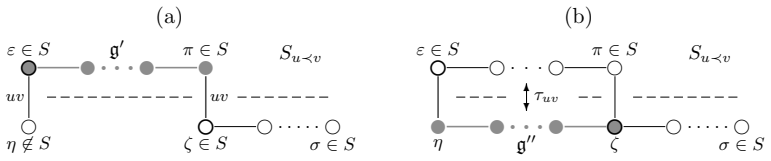
The permutohedral graph over N: vertices are enumerations of N (total orders), adjacency is an adjacent transposition. The paper labels each edge by the unordered pair of elements being swapped, and the pivotal Lemma 2 says that a walk between two enumerations is a geodesic if and only if no label is repeated; the labels along any geodesic are exactly the inversions between the endpoints. This label-repetition property makes the halfspaces S_{u≺v} = {orders in which u precedes v} geodetically convex, and the same property underpins the reflection argument in the sufficiency direction. The lattice-theoretic layer, built from Galois connections between subsets of enumerations and binary relati
What would settle it
Compute, for |N|=4, the full vertex set of the permutohedral graph and list every subset that is geodetically convex; compare this list to the collection of sets L(P) for all posets on N. If any non-empty geodetically convex set is not a linear-extension set, Theorem 3 is false. Alternatively, search for a geodesic between two permutations that repeats an edge label; such a walk would falsify Lemma 2(ii), the proof's keystone.
Extended reading notes
Core claim
Theorem 3 is the paper's central claim: for |N| ≥ 2, a subset S of the vertices of the permutohedral graph on N is the linear-extension set L(P) of some poset P if and only if S is geodetically convex. Geodetic convexity requires that whenever two total orders lie in S, every total order that appears on every shortest path between them also lies in S. The necessity follows from the observation that the coatoms of the poset-based lattice — the halfspaces S_{u≺v} in which a fixed element u precedes v — are geodetically convex, because a geodesic that swapped u and v twice could be shortened. The sufficiency reconstructs the poset from S by defining a covering relation Cov(S) from the edges tha
Load-bearing premise
The whole equivalence turns on the lemma that a shortest path between two total orders never swaps the same pair of elements twice; if any geodesic could repeat a pair, the proof that order-precedence halfspaces are convex and the reconstruction of the poset from the 'covering' edges would both break.
Editorial extensions
If this is right
- Finite posets become recognizable purely graphically: the set of linear extensions is convex in the permutohedral graph, and no extra data beyond the graph is needed to recover the poset.
- The lattice of geodetically convex sets is graded: the height of a non-empty convex set equals the number of different edge labels (inversions) appearing in its induced subgraph, which is also the number of incomparable pairs of the corresponding poset.
- The height and the graphical diameter of a convex set generally differ for ground sets with at least six elements; this failure is governed by the poset's dimension, so the height function encodes a finer invariant than diameter.
- Relative to any fixed reference total order, every poset is representable by an interval in a Boolean lattice of size 3^{n choose 2}, yielding an elementary upper bound on the number of posets on an n-element set.
- The description implies that the lattice of geodetically convex sets is anti-isomorphic to the lattice of all posets on N, so order-theoretic questions about posets can be translated into questions about convexity in the permutohedral graph.
Reading between the lines
- The paper's local trichotomy condition (each pair is either an inversion inside S, or ordered by the transitive closure of the covering relation, in one direction only) is conjectured to characterize convexity without checking all geodesics; if provable, it would give a fast way to test whether a given set of total orders comes from a poset, only requiring edge counts rather than all-pairs distanc
- Because geodetic convexity is a property of the whole graph, the result suggests that algorithms that generate linear extensions by Markov-chain walks could be constrained to stay inside convex 'poset-compatible' regions, potentially improving sampling or counting procedures.
- The equivalence between convex sets and linear-extension sets, combined with the braid-cone and topology translations, points toward a unified dictionary in which the same convexity criterion reappears as the normality of a fan of braid cones or the distributivity of a finite lattice; one could test this by translating a known non-poset convex set into the cone/topology language and checking which
Editorial analysis
A structured set of objections, weighed in public.
Referee Report
Summary. The paper develops a graphical characterization of sets of linear extensions of finite posets. The central result, Theorem 3, states that for a finite set N with |N|≥2, a subset S of the set Υ(N) of all total orders on N belongs to the Galois-closed family X° (i.e., S is either empty or the set L(P) of linear extensions of a unique poset P on N) if and only if S is geodetically convex in the permutohedral graph on Υ(N). The proof is built on a Galois-connection framework (Section 4) and on Lemma 2, which characterizes geodesics as walks using no repeated edge-label. The paper also shows that the lattice of such convex sets is graded, identifies the height function as the number of edge-colors inside the set, relates the height/diameter discrepancy to poset dimension, and sketches two further cryptomorphic views (braid cones and finite topologies).
Significance. The result, if correct, provides a purely graph-theoretic cryptomorph of finite posets. Although the equivalence is essentially contained in Tits's work as reformulated by Björner and Wachs [3], the present proof is elementary and self-contained, avoiding Coxeter-group machinery. The geodesic characterization (Lemma 2(ii)) is the load-bearing structural fact and is proved carefully; the Galois-connection lattice framework gives a clean derivation of the necessity and sufficiency of Theorem 3. The auxiliary results on height, diameter, and dimension, and the explicit 6-element counterexample, are valuable. The paper is clearly written and the main proof is internally consistent. I found no circularity: [18] is motivational only, and the alternative characterization in Section 5.5 is explicitly marked as beyond the paper's scope.
minor comments (5)
- [§4, Lemma 1(i)] In the sufficiency part, the extension of an enumeration of A to an enumeration of N is asserted without justification. One should add that transitivity of T rules out arrows from N\A into A, so A is an initial segment in every linear extension of G; hence the enumeration of A can simply be followed by any linear extension of the induced graph on N\A.
- [§5.4, Example 1] The decomposition of S into the four face-associated subsets and the diameter computation are stated without proof. The argument that diam(S)≤8 would be more transparent if the authors noted that every pair of elements of S lies in at least one of S\B, S\C, S\D, so that one of the three relations c≺f, b≺e, a≺d is shared; since the inversions inside S are among the 9 incomparable pairs, this bounds the distance by 8.
- [§5.5] The status of the rephrased [9, Theorem 9] should be clarified. As written, “it looks like the statement is indeed valid” is a conjecture, not a result of this paper. The authors should label it as a conjecture or an open problem, rather than leaving the reader uncertain about whether a theorem is being claimed.
- [§5.4, Corollary 6] The proof uses the nonstandard height convention |Inv(∅)|=−1. The sentence assigning the value C(n,2)−|P\∆| to S=L(P) may appear off by one from h_Y(N×N)=C(n,2)+1 unless the shift is made explicit. Please state that this is the standardized height shifted so that the empty set has height −1, which is consistent with the convention in the corollary.
- [Various] Minor typographical issues: “sandwiche principle” should be “sandwich principle”; “Appendum” should be “Addendum”. In Lemma 1(iv), the atomistic/coatomistic arguments are compressed; a sentence explaining that every closed set is the join/meet of the relevant atoms/coatoms would improve readability.
Circularity Check
No significant circularity: Theorem 3 is derived from first principles and the proof is self-contained.
full rationale
The paper's central claim (Theorem 3) is that a non-empty set S of enumerations equals L(P) for some poset P iff S is geodetically convex in the permutohedral graph. The derivation is not circular. The key structural fact, Lemma 2(ii), is proved directly from the inversion-distance formula Lemma 2(i), which is established by an independent induction argument using adjacent transpositions. Lemma 2(ii) is then used to prove both directions of Theorem 3: necessity via convexity of the halfspace coatoms S_{u≺v}, and sufficiency via the identity S = Cov(S)^⊲ for geodetically convex S. The objects Inv(S) and Cov(S) are defined purely graph-theoretically, not in terms of posets, and the poset interpretation is obtained as a consequence, not assumed. The paper's references to prior work are not load-bearing for the main theorem: [18] is used only as motivation and for the geometric interpretation of edge labels as parallel permutohedron edges, and [9] is explicitly described as having gaps and as merely inspiring the proof technique, with its sufficiency proof 'beyond the scope of the present paper.' The discussion of [3] reformulates known results as consequences of the independently proved Theorem 3. The height-function remark is also handled internally: the paper proves that the edge-labeling can be reconstructed from the graph itself, so the label-count description is not smuggled in as an unexplained input. No fitted parameter is called a prediction, and no argument reduces to a self-citation chain. Therefore no circular step is present, and an honest non-finding with score 0 is appropriate.
Assumptions & free parameters
assumptions (5)
- standard math Galois connections between power sets yield complete lattices and an anti-isomorphism of closed-set lattices (based on Birkhoff [2, §V.7])
- standard math Non-empty faces of the permutohedron Π(N) are in one-to-one correspondence with ordered partitions of N (cited from [1])
- standard math In the permutohedral graph, composing enumerations with a transposition of two elements is a graph automorphism (Section 3.7)
- standard math A finite poset's strict part is a transitive acyclic relation; the cover (Hasse) relations generate its transitive closure (Section 3.2–3.3)
- domain assumption Classical results on poset dimension: dim(P) ≤ floor(n/2) and tightness (Hiraguchi [10], Dushnik–Miller [6])
Cite this review
Pith. "Pith review of Graphical view on linear extensions of finite posets." pith.science (2026). https://pith.science/paper/CFDHAZRQ
@misc{pith2026251111785,
  author       = {Pith},
  title        = {Pith review of: Graphical view on linear extensions of finite posets},
  year         = {2026},
  howpublished = {\url{https://pith.science/paper/CFDHAZRQ}},
  note         = {Machine review of arXiv:2511.11785}
}
abstract
One of the possible cryptomorphic definitions of a partially ordered set (= a poset) $P$ on a non-empty finite ground set $N$ is in terms of the set ${\cal L}(P)$ of all its linear extensions, that is, in terms of the set of total orders on $N$ consistent with $P$. Any total order on $N$ can be interpreted as a node of a particular graph, called the permutohedral graph (over $N$), because it is indeed the graph of a certain polytope in $\mathbb{R}^{N}$, known as the permutohedron. It is shown in the paper that a non-empty set of total orders on $N$ equals to ${\cal L}(P)$ for some poset $P$ on $N$ if and only if it is a geodetically convex set in the permutohedral graph. This result means that a purely graphical concept of geodetical convexity in this graph is a cryptomorphic definition of a finite poset. In particular, the lattice of geodetically convex sets in this graph is graded and its height function is described in graphical terms. A counter-example, however, shows that the height function does not correspond to the usual graphical diameter, relating this matter to a combinatorial concept of the dimension of a poset. Two alternative cryptomorphic views on a poset $P$ on $N$ are also discussed. The geometric counterpart is its full-dimensional braid cone in $\mathbb{R}^{N}$, while a combinatorial alternative is a topology on $N$ distinguishing points, often referred as a (finite) distributive lattice.
Figures


Reference graph
Works this paper leans on
- [18]
-
[9]
Heath, A
L. Heath, A. Nema. The poset cover problem.Open Journal of Discrete Mathematics3 (2013) 101–111
2013
-
[3]
Bj¨ orner, M
A. Bj¨ orner, M. L. Wachs. Permutation statistics and linear extensions of posets.Journal of Combinatorial Theory A58 (1991) 85–114. 29
1991
-
[1]
L. J. Billera, A. Sarangarajan. The combinatorics of permutation polytopes. InFormal Power Series and Algebraic Combinatorics, DISMACS Series in Discrete Mathematics and Theoretical Computer Science 24, AMS, Providence 1996, pp. 1–23
1996
-
[2]
Birkhoff.Lattice Theory(Third edition)
G. Birkhoff.Lattice Theory(Third edition). AMS Colloquium Publications 25, AMS, Prov- idence 1995
1995
-
[4]
S. H. Chan, I. Pak. Linear extensions of finite posets. To appear inEMS Surveys in Math- ematical Sciences(2025), available onhttp://arxiv.org/abs/2311.02743
arXiv 2025
-
[5]
R. P. Dilworth. A decomposition theorem for partially ordered sets.Annals of Mathematics 51(1) (1950) 161–166
1950
-
[6]
Dushnik, E
B. Dushnik, E. W. Miller. Partially ordered sets.American Journal of Mathematics63(3) (1941) 600–610
1941
Show all 21 references
-
[7]
Fujishige.Submodular Functions and Optimization, North-Holland, 1991
S. Fujishige.Submodular Functions and Optimization, North-Holland, 1991
1991
-
[8]
Ganter, R
B. Ganter, R. Wille.Formal Concept Analysis - Mathematical Foundations, Springer, 1999
1999
-
[10]
Hiraguchi
T. Hiraguchi. On the dimension of partially ordered sets.The Science Reports Kanazawa University1(2) (1951) 77-94
1951
-
[11]
M. Massow. Linear extension graphs and linear extension diameter. Diploma thesis, TU Berlin, 2009
2009
-
[12]
Morton, L
J. Morton, L. Pachter, A. Shiu, B. Sturmfels, O. Wienand. Convex rank tests and semi- graphoids.SIAM Journal of Discrete Mathematics23(3) (2009) 1117–1134
2009
-
[13]
N. Naatz. The graph of linear extensions revisited.SIAM Journal of Discrete Mathematics 13 (2000) 354–369
2000
-
[14]
I. M. Pelayo.Geodesic Convexity in Graphs. Springer Briefs in Mathematics, Springer, 2013
2013
-
[15]
Postnikov, V
A. Postnikov, V. Reiner, L. Williams. Faces of generalized permutohedra.Documenta Math- ematica13 (2008) 207–273
2008
-
[16]
Pruesse, F
G. Pruesse, F. Ruskey. Generating linear extensions fast.SIAM Journal on Computing 23(2) (1994) 373–386
1994
-
[17]
R. P. Stanley.Enumerative Combinatorics, volume I.Cambridge Studies in Advanced Math- ematics 49, Cambridge University Press, 1997
1997
-
[19]
Tits.Buildings of Spherical Type and Finite BN-pairs
J. Tits.Buildings of Spherical Type and Finite BN-pairs. Lecture Notes in Mathematics 386, Springer, 1974
1974
-
[20]
Wiechert
V. Wiechert. Cover graphs and order dimension. Diploma thesis, TU Berlin, 2017
2017
-
[21]
G. M. Ziegler.Lectures on Polytopes. Graduate Texts in Mathematics 152, Springer, 1995. 30
1995
Reviewed August 4, 2026 · model on record in the stance chip above.
Discussion (0). Continue with ORCID to comment.