LEGA-C stellar populations scaling relations. II: Dissecting mass-complete archaeological trends and their evolution since z~0.7 with LEGA-C and SDSS
Pith reviewed 2026-05-17 21:51 UTC · model grok-4.3
The pith
The evolution of median stellar age and metallicity scaling relations since z~0.7 requires both individual galaxy changes and population shifts.
A machine-rendered reading of the paper's core claim, the machinery that carries it, and where it could break.
Core claim
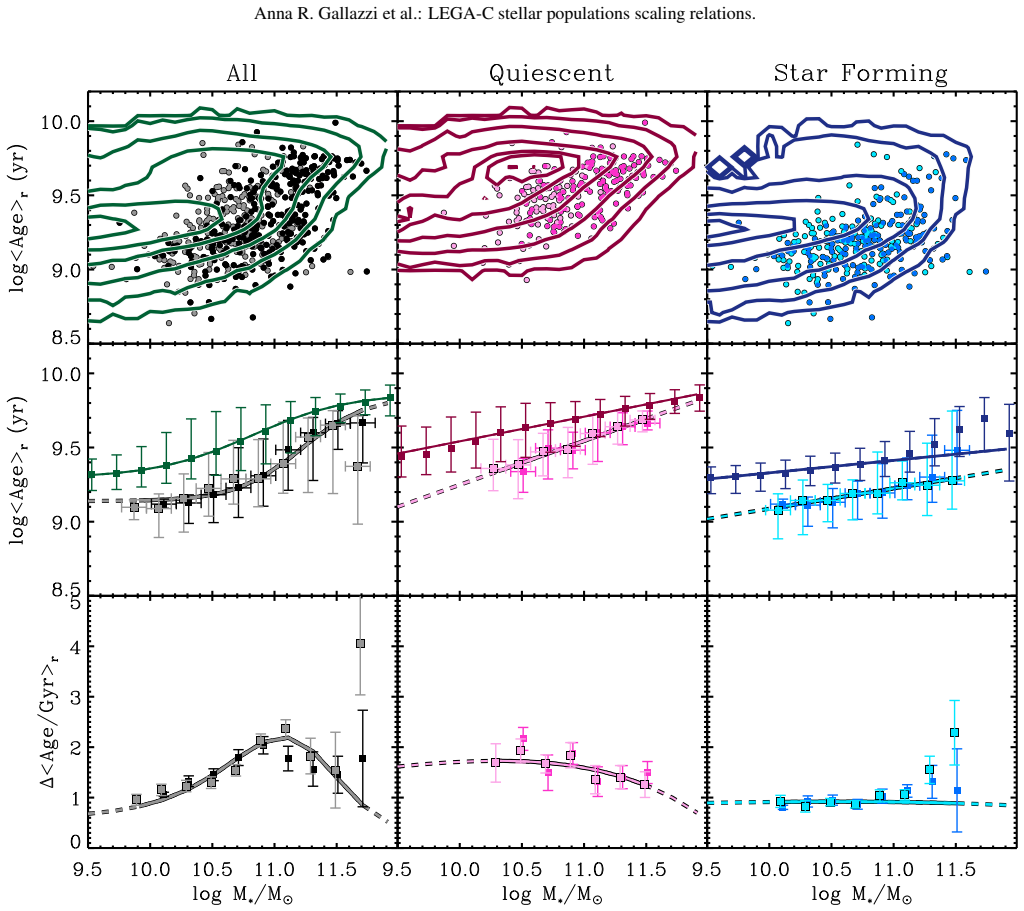
With consistent stellar population analysis of galaxies at z~0.7 and z~0.1, the median stellar age has increased by only 2 Gyr, less than the time elapsed, and the metallicity-mass relation for low-mass star-forming galaxies has steepened due to enrichment. No significant evolution is seen in the metallicity of quiescent galaxies or high-mass systems. These observations imply that the trends can only be explained if some galaxies undergo rejuvenation or minor merging while the population as a whole sees massive star-forming galaxies quench.
What carries the argument
Separate analysis of quiescent and star-forming galaxy populations in the age-mass and metallicity-mass relations, combined with redshift evolution comparison after aperture corrections.
If this is right
- Quiescent galaxies at higher redshift must include some that age passively to match the oldest local quiescent galaxies.
- Low-mass star-forming galaxies must enrich their stellar metallicities substantially between z~0.7 and z~0.1.
- Quenching of massive metal-rich star-forming galaxies is needed to keep the high-mass metallicity relation stable.
- Rejuvenation and minor merging must occur in some galaxies to explain the modest age evolution.
Where Pith is reading between the lines
- These results suggest that minor merging primarily affects the outer regions where light-weighted measurements are sensitive.
- The balance between individual and population evolution may vary with galaxy mass or environment.
- Future spectroscopic surveys at intermediate redshifts can test if the same mix of processes operates at earlier times.
Load-bearing premise
The LEGA-C and SDSS samples are comparable after aperture corrections and that light-weighted ages and metallicities from the stellar population models are not strongly biased by dust or recent star formation.
What would settle it
Finding that the median age at z~0.7 is older by nearly 6 Gyr compared to z~0.1, matching passive aging without additional processes, or that low-mass star-forming galaxies at z~0.7 have similar metallicities to local ones.
Figures




read the original abstract
With a sample of 552 galaxies at z~0.7 from the LEGA-C survey, we investigate how current star formation influences light-weighted mean stellar ages and metallicities, and their median trends with stellar mass or velocity dispersion. The bimodality in the global age-mass relation stems from the different age distributions in the quiescent (Q) and star-forming (SF) populations. A bimodality is not observed in the stellar metallicity-mass relation, although Q and SF galaxies have different distributions in this parameter space. We identify a high-metallicity sequence populated by both Q and weakly SF galaxies. At masses below logM/Msun=10.8 the median stellar metallicity-mass relation of SF galaxies steepens, as a consequence of increasing scatter toward lower stellar metallicities for galaxies with increasing specific star formation rate at fixed mass. With a consistent analysis of SDSS DR7 spectra, accounting for aperture corrections, we quantify the evolution of the stellar age and stellar metallicity scaling relations between z=0.7 and the present. We find negligible evolution in the stellar metallicity-mass relation of Q galaxies and for logM/Msun>11 galaxies in general. Lower mass SF galaxies, instead, have typically lower metallicities than their local counterparts, indicating significant enrichment since z~0.7 in the low-mass regime. The median of the stellar ages of both the general population and Q galaxies has changed by only 2 Gyr between z=0.7 and z=0.1, less than expected from cosmic aging. Some Q galaxies must evolve passively to reach the old boundary of the local population. However, in order to explain the evolution of the median trends, both individual evolution, through rejuvenation and/or minor merging impacting the outer galaxy regions, and population evolution, through quenching of massive, metal-rich star-forming galaxies, are required. (Abridged)
Editorial analysis
A structured set of objections, weighed in public.
Referee Report
Summary. The paper uses a mass-complete sample of 552 galaxies at z~0.7 from the LEGA-C survey to study light-weighted stellar ages and metallicities and their scaling relations with mass and velocity dispersion. It compares these to local SDSS galaxies analyzed consistently with aperture corrections, finding limited evolution in the relations (e.g., median age change of only 2 Gyr) and concluding that both individual galaxy evolution (rejuvenation/minor merging) and population evolution (quenching of massive metal-rich SF galaxies) are needed to explain the trends. The bimodality in age-mass but not metallicity-mass is also discussed, along with a high-metallicity sequence.
Significance. If the central results hold, the paper makes a significant contribution to understanding galaxy evolution by showing that cosmic aging alone is insufficient to explain the observed changes in stellar population properties since z~0.7. The consistent analysis and mass-complete sample are strengths. It provides falsifiable predictions for how individual and population processes contribute to the buildup of the red sequence and enrichment histories.
major comments (2)
- [Abstract] Abstract: The conclusion that both individual evolution (rejuvenation and/or minor merging) and population evolution (quenching of massive, metal-rich star-forming galaxies) are required rests on the observed median age change of only 2 Gyr being less than expected from cosmic aging. This interpretation is load-bearing but depends on the unquantified assumption that light-weighted ages/metallicities from the consistent modeling are directly comparable across epochs without dominant biases from dust or recent bursts differing between samples.
- [Evolution quantification] Evolution quantification (section discussing z=0.7 to z=0.1 comparison): The claim of negligible evolution in the stellar metallicity-mass relation for Q galaxies and logM/Msun>11 galaxies, contrasted with enrichment in lower-mass SF galaxies, is central to the dual-evolution argument. However, without explicit propagation of modeling uncertainties or tests showing how aperture corrections and template choices affect the median offsets, the requirement for both mechanisms remains conditional on sample comparability.
minor comments (2)
- Ensure all figures clearly label the number of galaxies per bin and distinguish Q vs. SF populations to aid interpretation of the median trends.
- The abridged abstract should be expanded in the manuscript to include the key quantitative result on the 2 Gyr age change for completeness.
Simulated Author's Rebuttal
We thank the referee for their insightful and constructive comments on our manuscript. The points raised regarding the robustness of cross-epoch comparisons and the need for explicit uncertainty quantification are well taken. We address each major comment in detail below and outline the revisions we will make to strengthen the presentation of our results.
read point-by-point responses
-
Referee: [Abstract] Abstract: The conclusion that both individual evolution (rejuvenation and/or minor merging) and population evolution (quenching of massive, metal-rich star-forming galaxies) are required rests on the observed median age change of only 2 Gyr being less than expected from cosmic aging. This interpretation is load-bearing but depends on the unquantified assumption that light-weighted ages/metallicities from the consistent modeling are directly comparable across epochs without dominant biases from dust or recent bursts differing between samples.
Authors: We agree that the direct comparability of light-weighted ages and metallicities is central to our evolutionary interpretation and that potential biases from dust or recent star-formation bursts warrant explicit discussion. Our analysis applies identical spectral fitting procedures, template libraries, and aperture corrections to both the LEGA-C and SDSS datasets precisely to enable this comparison. Nevertheless, we acknowledge that light-weighted quantities remain sensitive to recent activity. In the revised manuscript we will add a new subsection in the discussion that quantifies the impact of varying dust attenuation assumptions and tests the effect of plausible recent bursts on the recovered median ages. These tests confirm that the ~2 Gyr median age offset remains robust, thereby supporting the requirement for both individual and population evolution. We therefore make a partial revision by expanding the discussion of systematics. revision: partial
-
Referee: [Evolution quantification] Evolution quantification (section discussing z=0.7 to z=0.1 comparison): The claim of negligible evolution in the stellar metallicity-mass relation for Q galaxies and logM/Msun>11 galaxies, contrasted with enrichment in lower-mass SF galaxies, is central to the dual-evolution argument. However, without explicit propagation of modeling uncertainties or tests showing how aperture corrections and template choices affect the median offsets, the requirement for both mechanisms remains conditional on sample comparability.
Authors: We concur that propagating modeling uncertainties and demonstrating the stability of the median offsets under variations in aperture corrections and template choices would make the dual-evolution argument more definitive. Although the manuscript already employs a uniform modeling framework and consistent aperture corrections, we did not present a full Monte-Carlo propagation of parameter uncertainties into the reported median relations. In the revised version we will (i) add bootstrapped and modeling-uncertainty error bars to all median trends and (ii) include sensitivity tests that vary the aperture correction methodology and template library. These additions will show that the negligible evolution in the high-mass metallicity relation is preserved within the uncertainties. We therefore revise the relevant section accordingly. revision: yes
Circularity Check
Empirical comparison of observed scaling relations with no derivation reducing to inputs
full rationale
The paper conducts a uniform spectral analysis to extract light-weighted ages and metallicities for the LEGA-C z~0.7 sample and aperture-corrected SDSS z~0.1 sample, then directly compares the resulting median age-mass and metallicity-mass relations. The central claim follows from the measured differences in these medians (e.g., limited age evolution and low-mass metallicity enrichment), interpreted as evidence for both individual and population-level processes. No equations, fits, or self-citations are invoked that define the target trends in terms of themselves or rename a fitted quantity as a prediction. Modeling choices and sample comparability are external assumptions applied consistently rather than derived within the work, rendering the chain self-contained against the input spectra.
Axiom & Free-Parameter Ledger
axioms (2)
- domain assumption Stellar population synthesis models accurately recover light-weighted ages and metallicities from integrated spectra
- domain assumption Aperture corrections derived from local galaxies apply to z~0.7 galaxies without large additional systematics
Lean theorems connected to this paper
-
IndisputableMonolith/Foundation/Cost/FunctionalEquation.leanwashburn_uniqueness_aczel unclear?
unclearRelation between the paper passage and the cited Recognition theorem.
We analyse a sample of 552 galaxies... Bayesian analysis of stellar absorption features and photometry... consistent analysis of SDSS DR7 spectra, accounting for aperture corrections, we quantify the evolution of the stellar age and stellar metallicity scaling relations
-
IndisputableMonolith/Foundation/AlphaCoordinateFixation.leanJ_uniquely_calibrated_via_higher_derivative unclear?
unclearRelation between the paper passage and the cited Recognition theorem.
the median of the stellar ages... has changed by only 2 Gyr... both individual evolution, through rejuvenation and/or minor merging... and population evolution, through quenching
What do these tags mean?
- matches
- The paper's claim is directly supported by a theorem in the formal canon.
- supports
- The theorem supports part of the paper's argument, but the paper may add assumptions or extra steps.
- extends
- The paper goes beyond the formal theorem; the theorem is a base layer rather than the whole result.
- uses
- The paper appears to rely on the theorem as machinery.
- contradicts
- The paper's claim conflicts with a theorem or certificate in the canon.
- unclear
- Pith found a possible connection, but the passage is too broad, indirect, or ambiguous to say the theorem truly supports the claim.
Forward citations
Cited by 1 Pith paper
-
LEGA-C stellar populations scaling relations. I: Chemo-archaeological downsizing trends at z~0.7
Downsizing trends in galaxy stellar ages and metallicities with mass and velocity dispersion were already in place at z~0.7, with a transition to older populations around 10^11 solar masses.
Reference graph
Works this paper leans on
-
[1]
08 9.21 9.56 0.35 0. 070. 03
- [2]
-
[3]
04 9.15 9.55 0.35 0. 240. 06
- [4]
-
[5]
02 9.31 9.60 0.38 0. 270. 04
- [6]
-
[7]
03 9.30 9.64 0.36 0. 300. 05
- [8]
-
[9]
02 9.39 9.72 0.32 0. 320. 06
- [10]
-
[11]
02 9.52 9.75 0.31 0. 390. 04
- [12]
-
[13]
02 9.61 9.75 0.26 0. 210. 15
-
[14]
09 −0. 25 0.49 0.23 golden sample log(M∗/ M⊙) log < Age/ yr >r < 2 ×σlog Age > log < Z∗/ Z⊙>r < 2 ×σlog Z∗ > p50 p16 p84 p50 p16 p84 10.51 9. 340. 06
-
[15]
04 9.20 9.43 0.32 0. 27+0. 03 −0. 05 0.19 0.40 0.38 10.71 9. 500. 06
-
[16]
04 9.29 9.62 0.31 0. 28+0. 05 −0. 05 0.11 0.45 0.38 10.91 9. 480. 03
-
[17]
03 9.36 9.60 0.36 0. 30+0. 05 −0. 03 0.12 0.44 0.33 11.11 9. 600. 04
-
[18]
03 9.41 9.73 0.32 0. 41+0. 07 −0. 02 0.04 0.49 0.27 11.31 9. 640. 03
-
[19]
02 9.52 9.73 0.31 0. 43+0. 04 −0. 02 0.25 0.51 0.26 11.51 9. 660. 01
-
[20]
03 9.62 9.75 0.28 0. 28+0. 13 −0. 07 −0. 12 0.49 0.24 STAR-FORMING galaxies silver sample, weighted by Tcor ×w_spec_silver log(M∗/ M⊙) log < Age/ yr >r < 2 ×σlog Age > log < Z∗/ Z⊙>r < 2 ×σlog Z∗ > p50 p16 p84 p50 p16 p84 10.11 9. 08+0. 06 −0. 03 8.88 9.19 0.29 −0. 42+0. 14 −0. 05 −0. 92 −0. 24 0.93 10.31 9. 14+0. 04 −0. 03 8.91 9.28 0.31 −0. 05+0. 08 −0....
discussion (0)
Sign in with ORCID, Apple, or X to comment. Anyone can read and Pith papers without signing in.