Uniform Circular Arrays in Near-Field: Omnidirectional Coverage with Limited Capacity
Pith reviewed 2026-05-17 21:40 UTC · model grok-4.3
The pith
Uniform circular arrays extend near-field angular coverage but deliver only marginal capacity gains compared to linear arrays under fixed aperture constraints.
A machine-rendered reading of the paper's core claim, the machinery that carries it, and where it could break.
Core claim
Under a fixed antenna element count, uniform linear arrays achieve narrower beamdepth and a longer effective beamfocusing Rayleigh distance than uniform circular arrays, resulting in higher sum rates. Under a fixed aperture length, uniform circular arrays provide slightly narrower beamdepth and a marginally longer effective distance, with only marginal overall performance gains in spatial multiplexing.
What carries the argument
The effective beamfocusing Rayleigh distance (EBRD), an angle-dependent metric that bounds the spatial region where beamfocusing remains effective under spherical-wave channel models.
If this is right
- With fixed element count, ULAs yield narrower beamdepth, longer EBRD, and higher sum rates than UCAs.
- With fixed aperture length, UCAs achieve slightly narrower beamdepth and marginally longer EBRD.
- The omnidirectional coverage advantage of UCAs does not produce substantial multiplexing improvements beyond the marginal gains under aperture constraints.
Where Pith is reading between the lines
- Designers facing element-count limits may prefer linear arrays for better near-field rate performance.
- Aperture size appears more decisive than element density for realizing any circular-array benefits.
- The findings suggest testing other array geometries to locate better coverage-capacity balances in near-field systems.
Load-bearing premise
The introduced EBRD metric and closed-form beamdepth expressions accurately bound the effective near-field region under the spherical-wave models without major deviations from real propagation or hardware effects.
What would settle it
A controlled near-field measurement of sum rates and beam patterns for UCAs and ULAs using both equal element counts and equal physical aperture sizes to check whether the predicted performance ordering holds.
Figures




read the original abstract
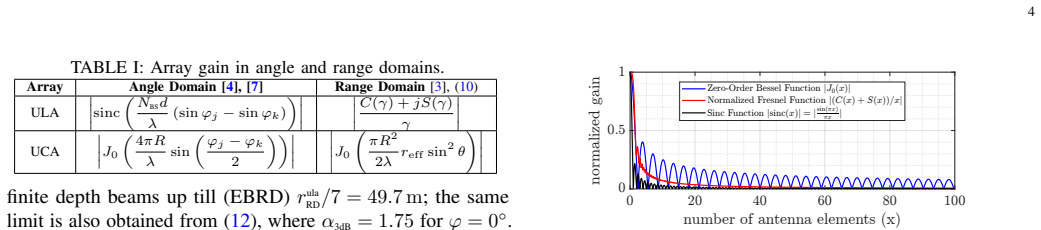
Recent studies suggest that uniform circular arrays (UCAs) can extend the angular coverage of the radiative near field region. This work investigates whether such enhanced angular coverage translates into improved spatial multiplexing performance when compared to uniform linear arrays (ULAs). To more accurately delineate the effective near field region, we introduce the effective beamfocusing Rayleigh distance (EBRD), an angle dependent metric that bounds the spatial region where beamfocusing remains effective. Closed form expressions for both beamdepth and EBRD are derived for UCAs. Our analysis shows that, under a fixed antenna element count, ULAs achieve narrower beamdepth and a longer EBRD than UCAs. Conversely, under a fixed aperture length, UCAs provide slightly narrower beamdepth and a marginally longer EBRD. Simulation results further confirm that ULAs achieve higher sum rate under the fixed element constraint, while UCAs offer marginal performance gain under the fixed aperture constraint.
Editorial analysis
A structured set of objections, weighed in public.
Referee Report
Summary. The manuscript compares uniform linear arrays (ULAs) and uniform circular arrays (UCAs) in the radiative near-field for spatial multiplexing. It introduces the angle-dependent effective beamfocusing Rayleigh distance (EBRD) to bound the region where beamfocusing is effective, derives closed-form expressions for beamdepth and EBRD of UCAs under spherical-wave assumptions, and analyzes performance under fixed-element-count and fixed-aperture constraints. The central claims are that fixed-element ULAs yield narrower beamdepth and longer EBRD (hence higher sum rates), while fixed-aperture UCAs yield slight advantages in these metrics and marginal sum-rate gains; simulations are presented to support the ordering.
Significance. If the EBRD metric and closed-form comparisons hold, the work clarifies geometry-dependent trade-offs between angular coverage and capacity in near-field regimes, showing that UCA omnidirectional benefits do not automatically improve multiplexing under all constraints. Credit is due for the parameter-free closed-form derivations of beamdepth and EBRD and for the independent simulation confirmation of the analytic ordering. Practical impact remains limited by the ideal propagation model.
major comments (2)
- [§3.2, Eq. (12)] §3.2, Eq. (12): The EBRD closed-form for UCAs is obtained under perfect spherical-wave propagation with no mutual coupling, element pattern variation, or scattering. Because the angle-dependent EBRD directly determines the reported beamdepth/EBRD ordering (and therefore the sum-rate conclusions) under both fixed-element and fixed-aperture constraints, any material deviation in real channels would undermine the central comparison.
- [§5] §5, simulation results: The sum-rate curves are shown without error bars, number of Monte-Carlo realizations, or sensitivity to channel parameters (e.g., scatterer density). This makes it impossible to judge whether the reported marginal UCA gain under fixed aperture is statistically reliable or robust to the ideal-model assumption.
minor comments (3)
- [Abstract] Abstract: The phrase 'simulation results further confirm' should briefly indicate the key simulation parameters (carrier frequency, array sizes, SNR range) so readers can immediately assess the scope of the validation.
- [Notation] Notation: The symbol for beamdepth is introduced in §2 and reused in §3; a single consolidated definition table would prevent minor ambiguity when comparing ULA and UCA expressions.
- [Figure 4] Figure 4: The EBRD-versus-angle plot for UCAs would be clearer if the corresponding ULA curve (or analytic bound) were overlaid for direct visual comparison of the two geometries.
Simulated Author's Rebuttal
We thank the referee for the constructive feedback on our manuscript comparing ULAs and UCAs in the near-field regime. We address each major comment point by point below, providing clarifications on the modeling assumptions and agreeing to strengthen the simulation presentation where appropriate.
read point-by-point responses
-
Referee: [§3.2, Eq. (12)] §3.2, Eq. (12): The EBRD closed-form for UCAs is obtained under perfect spherical-wave propagation with no mutual coupling, element pattern variation, or scattering. Because the angle-dependent EBRD directly determines the reported beamdepth/EBRD ordering (and therefore the sum-rate conclusions) under both fixed-element and fixed-aperture constraints, any material deviation in real channels would undermine the central comparison.
Authors: We agree that the closed-form expressions for EBRD and beamdepth in Section 3.2 are derived under the ideal spherical-wave model without mutual coupling, element pattern variations, or scattering. This assumption is standard in analytical geometry comparisons to isolate the effects of array shape on near-field metrics. The ordering between ULAs and UCAs holds rigorously within this framework, which is the intended scope of the work. To address the concern, we will add a dedicated paragraph in the discussion section (or conclusions) explicitly stating these ideal assumptions and noting that extensions to realistic channels with coupling or scattering would require separate numerical validation. This revision clarifies the applicability without changing the core derivations or conclusions. revision: partial
-
Referee: [§5] §5, simulation results: The sum-rate curves are shown without error bars, number of Monte-Carlo realizations, or sensitivity to channel parameters (e.g., scatterer density). This makes it impossible to judge whether the reported marginal UCA gain under fixed aperture is statistically reliable or robust to the ideal-model assumption.
Authors: We appreciate this suggestion for improving the simulation section. Our sum-rate results were generated by averaging over 1000 independent Monte Carlo channel realizations under the spherical-wave model. We omitted to report this number and the associated variability in the original figures. In the revision, we will update Section 5 to specify the number of realizations, include error bars on the sum-rate curves, and add a brief sensitivity study varying scatterer density to confirm that the marginal UCA advantage under fixed aperture remains consistent. These additions will make the statistical reliability and robustness explicit. revision: yes
Circularity Check
No significant circularity in EBRD or beamdepth derivations
full rationale
The paper introduces the EBRD metric and derives closed-form expressions for beamdepth and EBRD directly from array geometry and spherical-wave channel models. These steps do not reduce to fitted parameters, self-definitions, or self-citation chains. Comparisons of ULAs vs. UCAs under fixed-element and fixed-aperture constraints follow from the derived expressions, with simulations providing independent numerical confirmation. No load-bearing step in the provided claims exhibits the specific reduction required to flag circularity.
Axiom & Free-Parameter Ledger
axioms (1)
- domain assumption Spherical wavefront model governs the near-field channel response for both UCA and ULA geometries
Lean theorems connected to this paper
-
IndisputableMonolith/Cost/FunctionalEquation.leanwashburn_uniqueness_aczel unclear?
unclearRelation between the paper passage and the cited Recognition theorem.
Closed-form expressions for both beamdepth and EBRD are derived for UCAs... Guca ≈ |J0(ζ)| where ζ = π rucaRD / (16 reff sin²θ)
-
IndisputableMonolith/Foundation/RealityFromDistinction.leanreality_from_one_distinction unclear?
unclearRelation between the paper passage and the cited Recognition theorem.
The EBRD serves as a metric that defines the boundary of the near-field region where beamfocusing remains effective
What do these tags mean?
- matches
- The paper's claim is directly supported by a theorem in the formal canon.
- supports
- The theorem supports part of the paper's argument, but the paper may add assumptions or extra steps.
- extends
- The paper goes beyond the formal theorem; the theorem is a base layer rather than the whole result.
- uses
- The paper appears to rely on the theorem as machinery.
- contradicts
- The paper's claim conflicts with a theorem or certificate in the canon.
- unclear
- Pith found a possible connection, but the passage is too broad, indirect, or ambiguous to say the theorem truly supports the claim.
Reference graph
Works this paper leans on
-
[1]
The road towards 6G: A comprehensive survey,
W. Jiang, B. Han, M. A. Habibi, and H. D. Schotten, “The road towards 6G: A comprehensive survey,”IEEE Open J. Commun. Soc., vol. 2, pp. 334–366, Feb. 2021
work page 2021
-
[2]
A. Abdallah, A. Hussain, A. Celik, and A. M. Eltawil, “Exploring frontiers of polar-domain codebooks for near-field channel estimation and beam training: A comprehensive analysis, case studies, and implications for 6G,” IEEE Signal Process. Mag., vol. 42, no. 1, pp. 45–59, 2025
work page 2025
-
[3]
Redefining polar boundaries for near-field channel estimation for ultra-massive MIMO antenna array,
A. Hussain, A. Abdallah, and A. M. Eltawil, “Redefining polar boundaries for near-field channel estimation for ultra-massive MIMO antenna array,” IEEE Trans. Wireless Commun., pp. 1–1, 2025
work page 2025
-
[4]
Enabling more users to benefit from near-field communications: From linear to circular array,
Z. Wu, M. Cui, and L. Dai, “Enabling more users to benefit from near-field communications: From linear to circular array,”IEEE Trans. Wireless Commun., vol. 23, no. 4, pp. 3735–3748, 2024
work page 2024
-
[5]
Circular array beamforming using phase modes,
R. Mital, M. P. Parent, and A. Stumme, “Circular array beamforming using phase modes,”Naval Research Lab, Washington, DC, 2019
work page 2019
-
[6]
Millimeter wave communications with symmetric uniform circular antenna arrays,
P. Wang, Y . Li, and B. Vucetic, “Millimeter wave communications with symmetric uniform circular antenna arrays,”IEEE Commun. Lett., vol. 18, no. 8, pp. 1307–1310, 2014
work page 2014
-
[7]
Achievable sum-rate analysis for massive MIMO systems with different array configurations,
W. Tan, S. Jin, J. Wang, and Y . Huang, “Achievable sum-rate analysis for massive MIMO systems with different array configurations,” inIEEE Wireless Commun. Netw. Conf. (WCNC), 2015, pp. 316–321
work page 2015
-
[8]
The asymptotic expansion of bessel functions of large order,
F. W. Olver, “The asymptotic expansion of bessel functions of large order,” Philos. Trans. R. Soc. Lond. A, vol. 247, no. 930, pp. 328–368, 1954. APPENDIXA PROOF OFTHEOREM1 Utilizing (7) and (9), the array gain in the range domain for UCA is given by Guca = 1 NBS PNBS n=1 e j 2π λ R2 2 reff(1−sin2 θcos 2(φ−ψn)) , where reff = r−rF rrF . Defining ζ= π λ R2...
work page 1954
discussion (0)
Sign in with ORCID, Apple, or X to comment. Anyone can read and Pith papers without signing in.