Cutting a Pancake with an Exotic Knife
Pith reviewed 2026-05-17 20:08 UTC · model grok-4.3
The pith
Exotic knife shapes determine the exact maximum number of pieces obtainable from a pancake with n cuts in most cases.
A machine-rendered reading of the paper's core claim, the machinery that carries it, and where it could break.
Core claim
For each exotic knife shape the maximum number of pancake pieces with n cuts is found by positioning the rigid curves to produce the largest possible number of intersection points and crossings inside the disk, yielding explicit counts or tight bounds in all but two cases.
What carries the argument
The arrangement of n translated and rotated copies of a fixed curve or polyline inside a disk, maximized for the number of crossings and bounded regions.
Load-bearing premise
Each knife shape can be placed anywhere and in any orientation as a single rigid piece without self-overlap to reach the theoretical maximum intersections.
What would settle it
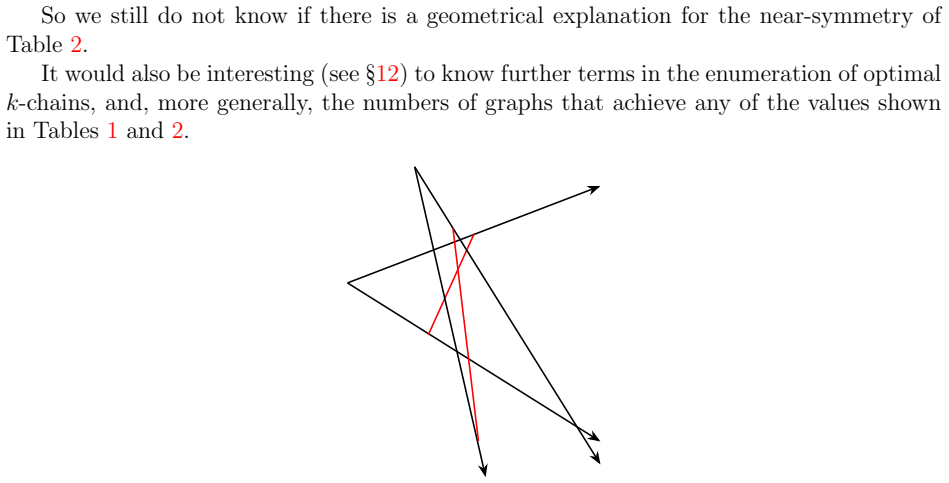
An explicit placement of three copies of a k-armed V that produces more regions than the paper's stated maximum for that shape and n would disprove the count.
Figures

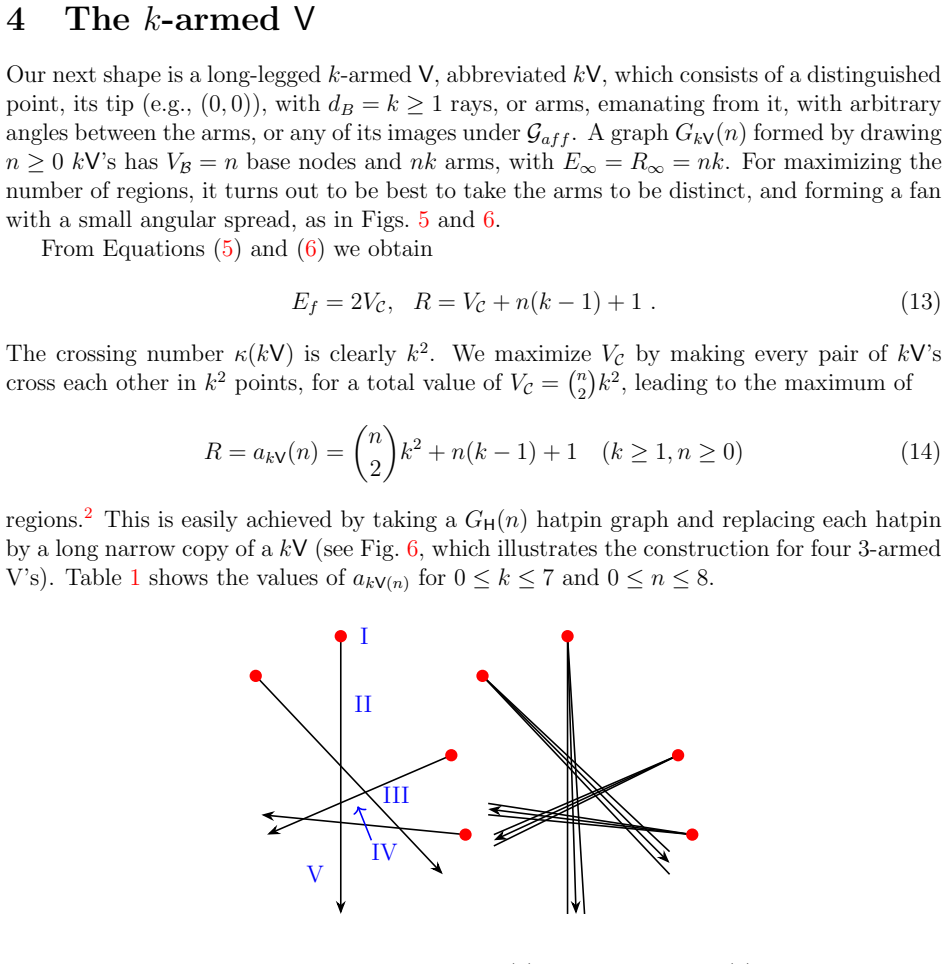
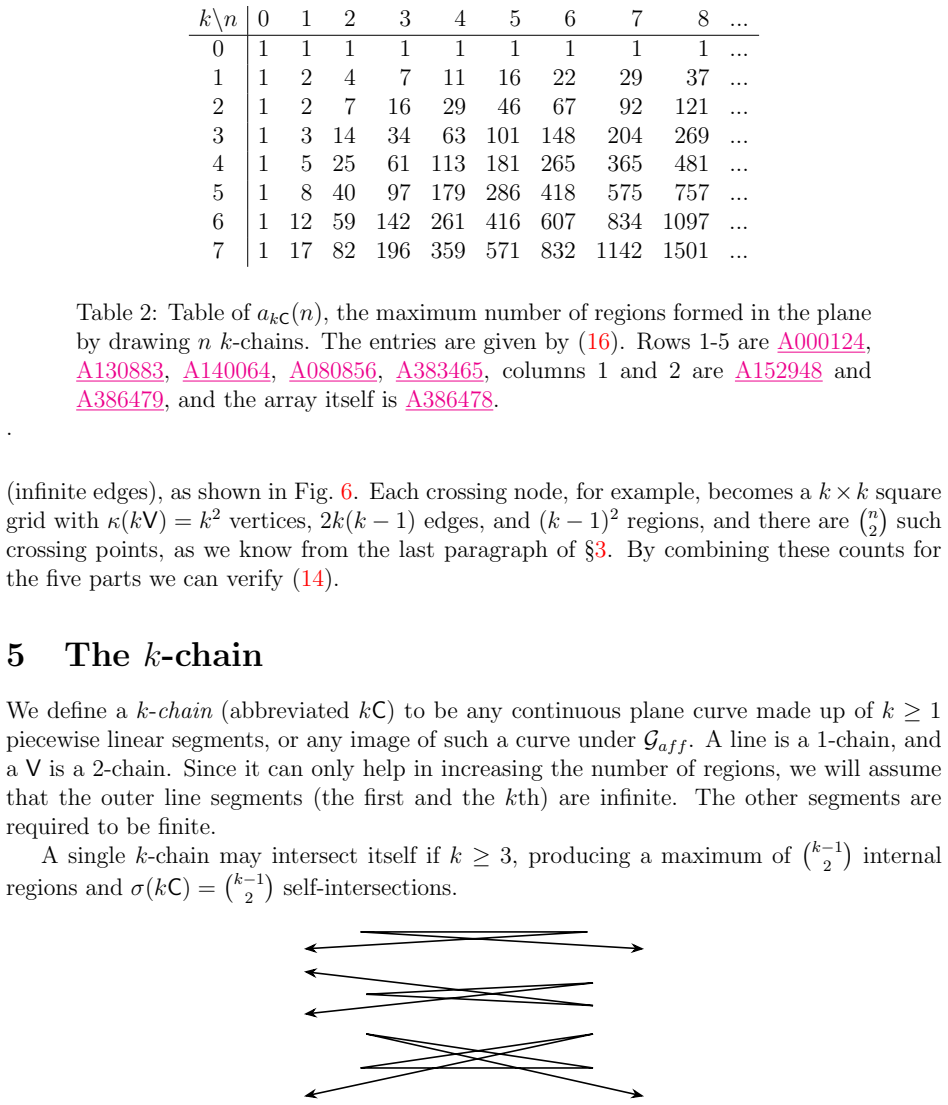
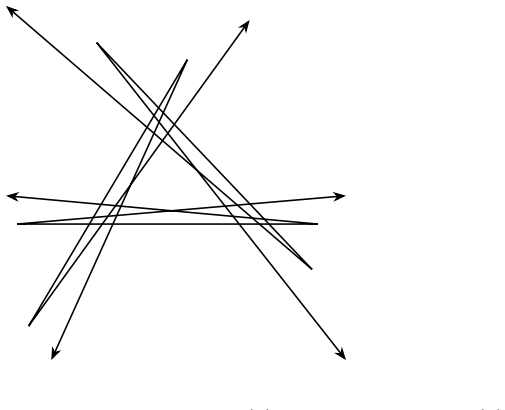
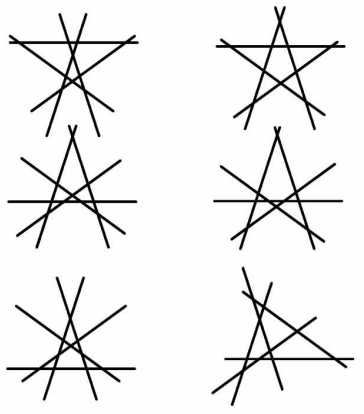
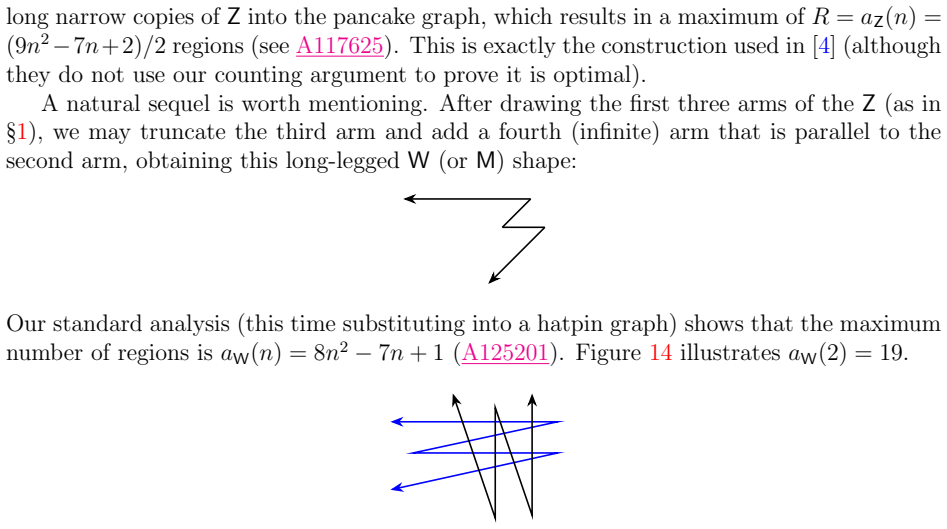
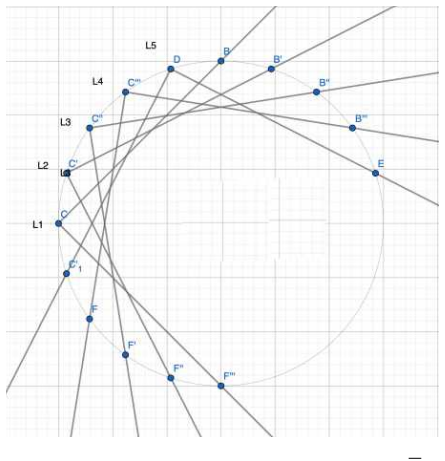
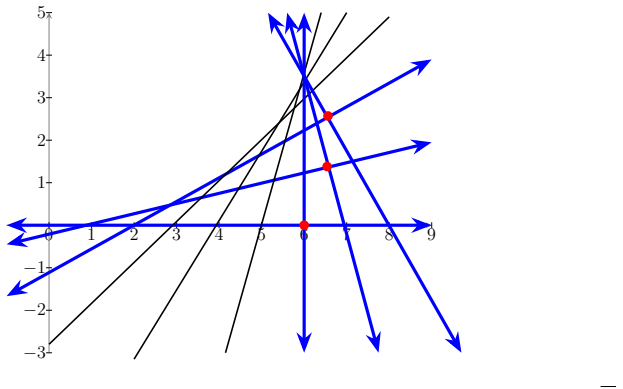
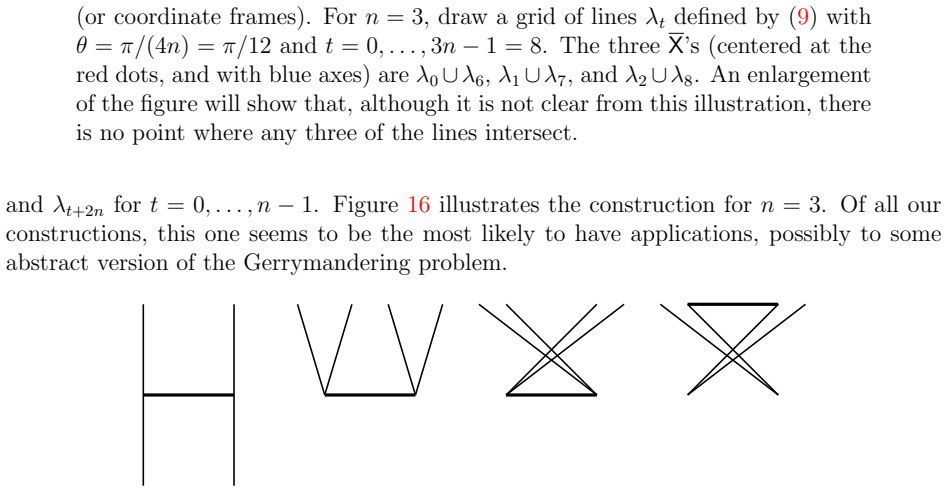
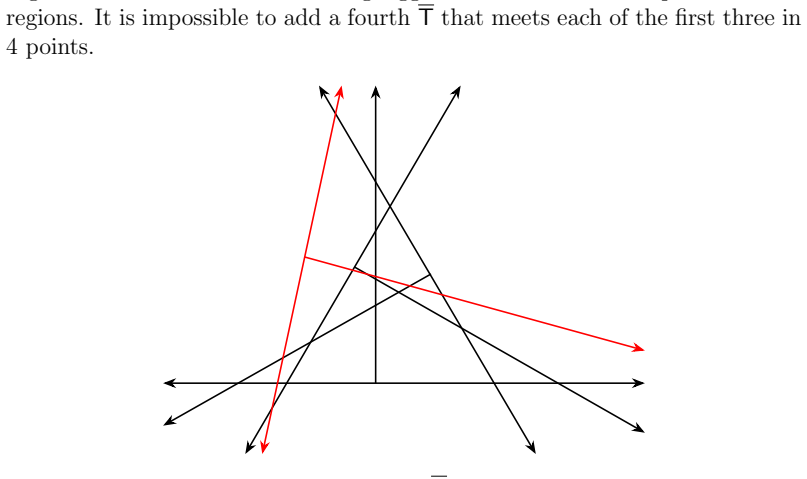
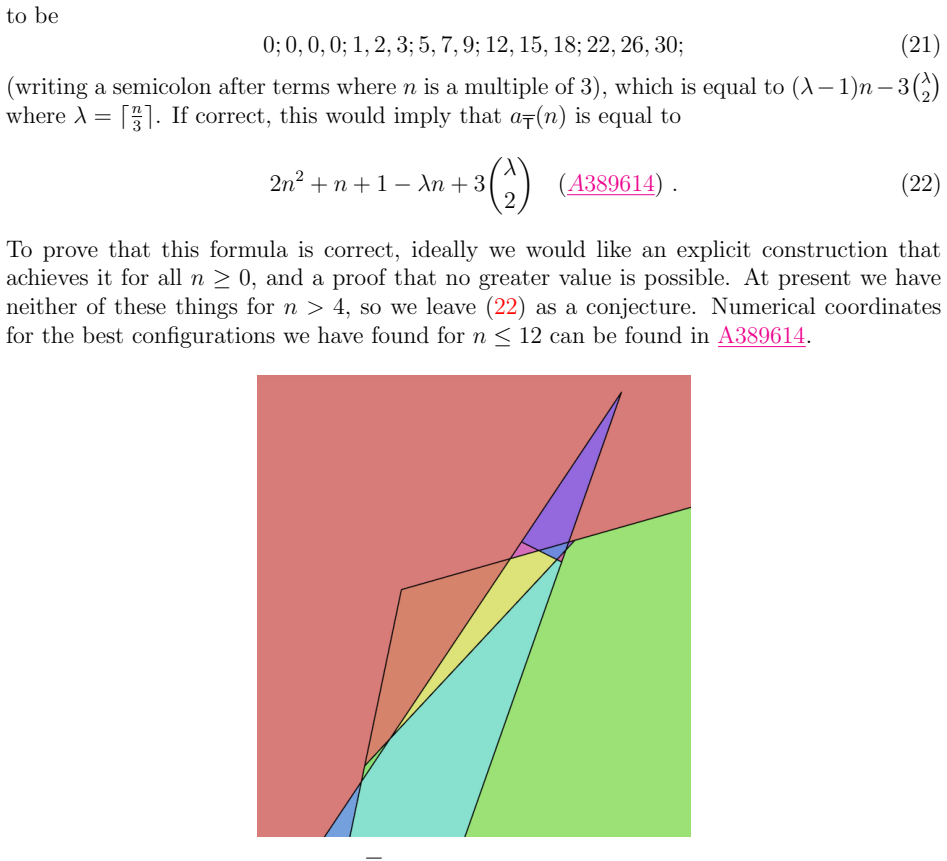
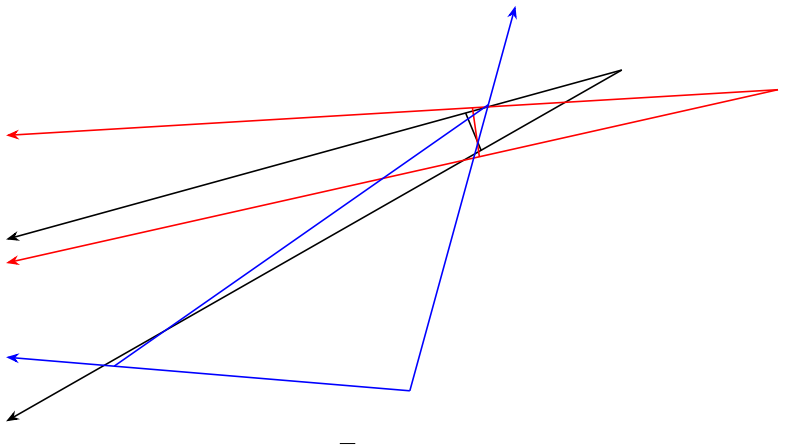
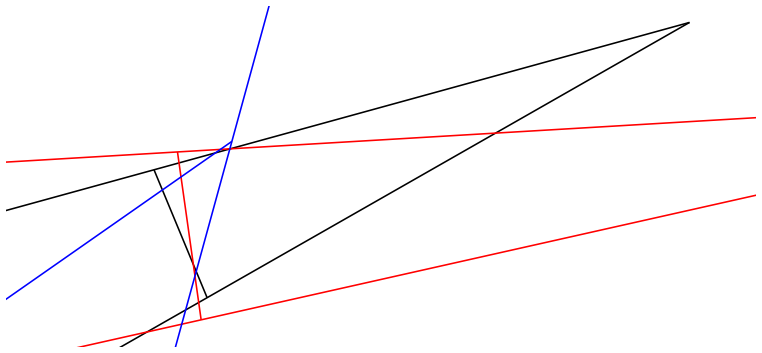
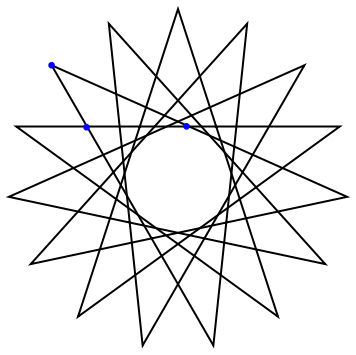
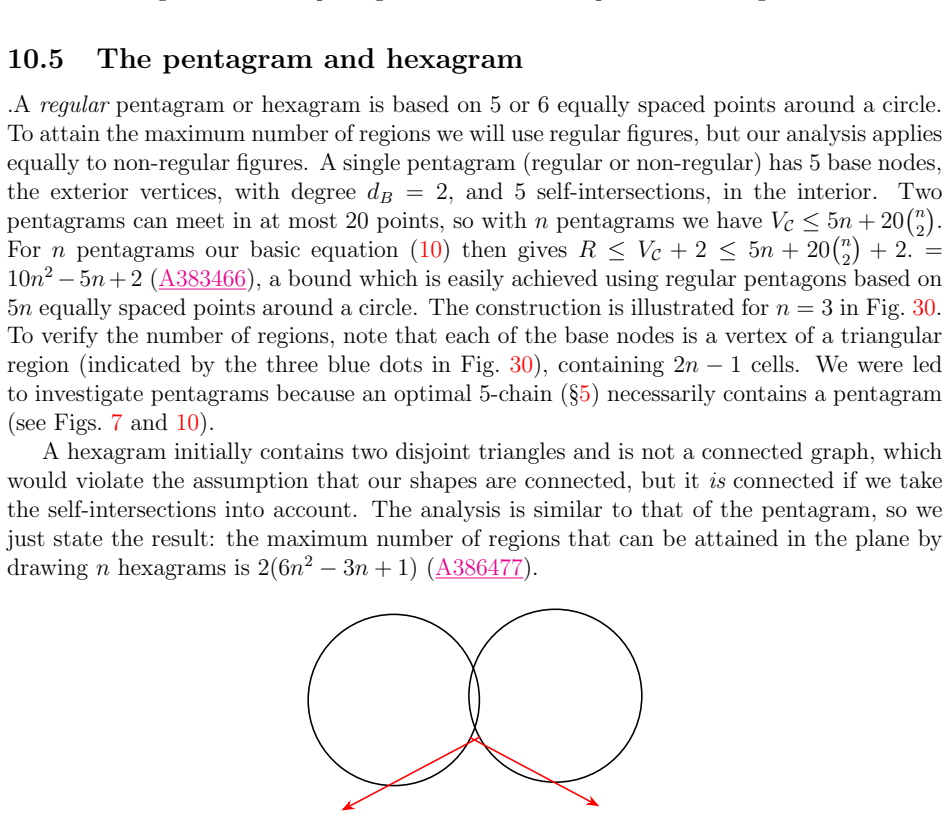
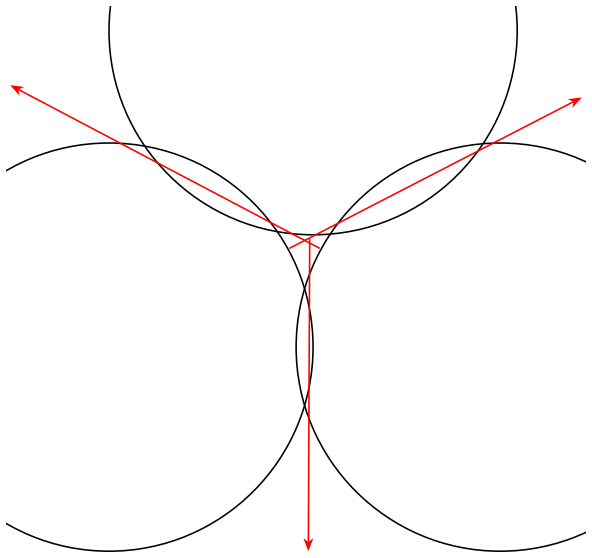
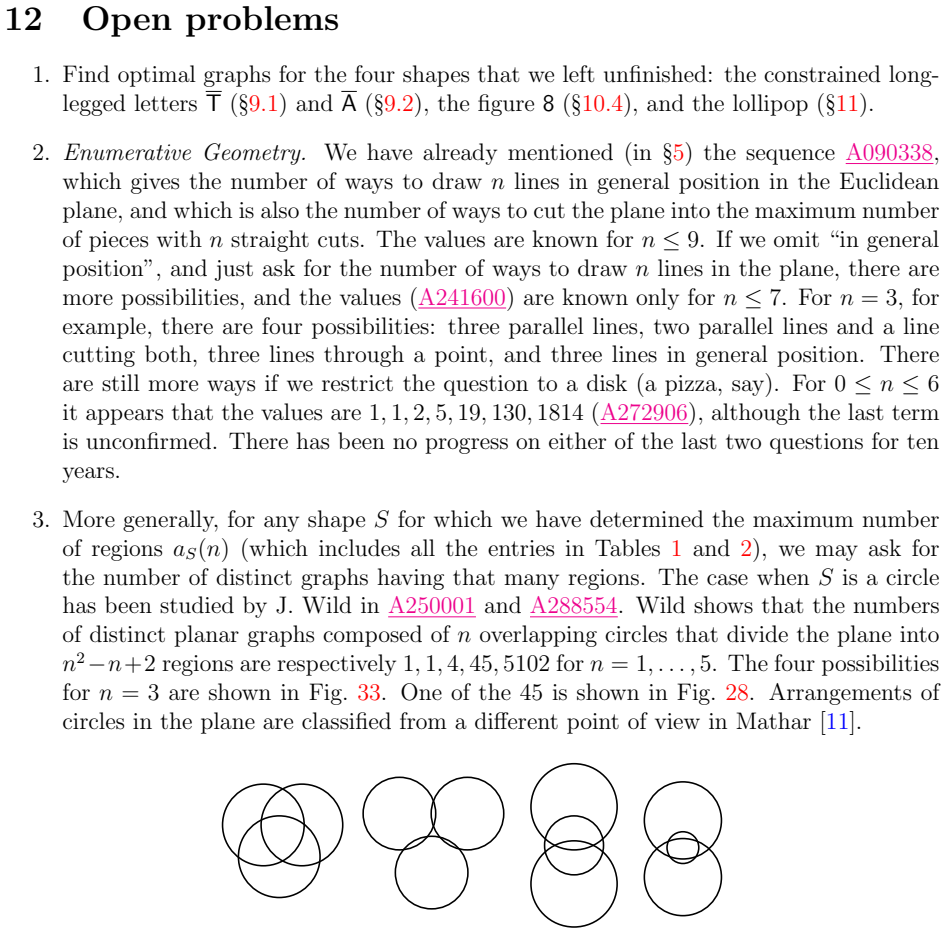
read the original abstract
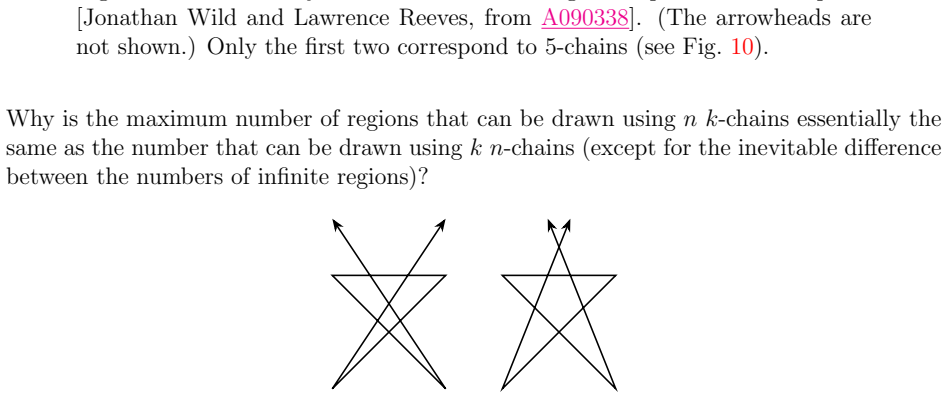
In the first chapter of their classic book "Concrete Mathematics", Graham, Knuth, and Patashnik consider the maximum number of pieces that can be obtained from a pancake by making n cuts with a knife blade that is straight, or bent into a V, or bent twice into a Z. We extend their work by considering knives, or "cookie-cutters", of even more exotic shapes, including a k-armed V, a chain of k connected line segments, long-legged versions of the letters A, E, H, L, M, T, W, or X, a convex polygon, a circle, a phi, a figure 8, a pentagram, a hexagram, or a lollipop (or qoppa). We also consider "constrained" versions of the long-legged letters A, H, L, T, and X. In most cases we are able to determine the maximum number of pieces, although for the constrained A and the lollipop we can only give bounds.
Editorial analysis
A structured set of objections, weighed in public.
Referee Report
Summary. The manuscript extends the classic pancake-cutting problem from Graham, Knuth, and Patashnik by determining the maximum number of pieces a disk can be divided into using a single rigid cut with exotic knife shapes. These include k-armed V shapes, chains of k line segments, long-legged versions of letters A/E/H/L/M/T/W/X, convex polygons, circles, phi, figure-8, pentagram, hexagram, and lollipop (qoppa), plus constrained variants of A/H/L/T/X. Explicit geometric placements achieve the stated maxima for most shapes; for the constrained A and lollipop the authors supply matching lower-bound constructions and upper bounds derived from intersection counting and the Euler characteristic.
Significance. If the constructions and counting arguments hold, the paper supplies a systematic extension of the GKP framework to a wide family of rigid, non-straight knives. Credit is due for the explicit, verifiable placements that realize the claimed maxima in the majority of cases and for the consistent use of elementary combinatorial topology (intersection counts plus Euler characteristic) to obtain tight bounds where exact values are not yet settled. The results are falsifiable by direct construction and therefore add concrete, checkable data to the literature on planar dissections.
minor comments (3)
- Abstract: the statement that 'in most cases we are able to determine the maximum number' would be more informative if the explicit formulas or the numerical bounds for the constrained A and lollipop were stated, even briefly.
- Introduction: a short tabular recap of the original GKP maxima for the straight, V, and Z knives would help readers immediately compare the new results with the baseline.
- Notation: the function p(S) denoting the maximum pieces for shape S is introduced informally; a single displayed definition early in the paper would eliminate repeated explanatory phrases across sections.
Simulated Author's Rebuttal
We thank the referee for the positive assessment of the manuscript, the recognition of our explicit constructions, and the recommendation for minor revision. No specific major comments were raised in the report.
Circularity Check
No significant circularity detected
full rationale
The paper derives maximum pancake piece counts via explicit geometric constructions that achieve lower bounds through specific knife placements and upper bounds via intersection counting plus Euler characteristic arguments. These steps are self-contained combinatorial geometry that do not reduce to fitted parameters, self-definitions, or load-bearing self-citations; the cited Concrete Mathematics reference is external and the derivations stand on direct verification of configurations for each shape class.
Axiom & Free-Parameter Ledger
axioms (2)
- domain assumption The pancake is modeled as a convex disk in the Euclidean plane.
- domain assumption Each exotic knife is a rigid, fixed-shape curve or polyline used in one continuous placement.
Lean theorems connected to this paper
-
IndisputableMonolith/Foundation/AlexanderDuality.leanalexander_duality_circle_linking unclear?
unclearRelation between the paper passage and the cited Recognition theorem.
We analyze these shapes by studying the planar graph formed by the union of the copies of the shape... R = V_C + 1/2 Σ d_v - V_B + 1/2 E_∞ + 1 (equation 6); to maximize regions it is necessary and sufficient to maximize crossings.
-
IndisputableMonolith/Foundation/ArithmeticFromLogic.leanreality_from_one_distinction unclear?
unclearRelation between the paper passage and the cited Recognition theorem.
The sequences... A000124 (line), A130883 (V), A140064 (3-armed V / A / 3-chain), A386480 (circle), ...
What do these tags mean?
- matches
- The paper's claim is directly supported by a theorem in the formal canon.
- supports
- The theorem supports part of the paper's argument, but the paper may add assumptions or extra steps.
- extends
- The paper goes beyond the formal theorem; the theorem is a base layer rather than the whole result.
- uses
- The paper appears to rely on the theorem as machinery.
- contradicts
- The paper's claim conflicts with a theorem or certificate in the canon.
- unclear
- Pith found a possible connection, but the passage is too broad, indirect, or ambiguous to say the theorem truly supports the claim.
Forward citations
Cited by 1 Pith paper
-
A Two-Graph Refinement of Paulsen's Lollipop Bounds
By recasting Paulsen's obstructions as two forbidden-subgraph graphs and analyzing near-extremal configurations while keeping the overlap term, the authors close all gaps and compute exact a_L(n) for n≤17 and n=19.
Reference graph
Works this paper leans on
-
[1]
Bollob´ as,Modern Graph Theory, Springer, 1998
B. Bollob´ as,Modern Graph Theory, Springer, 1998
work page 1998
-
[2]
Comtet,Advanced Combinatorics, Reidel, 1974
L. Comtet,Advanced Combinatorics, Reidel, 1974
work page 1974
-
[3]
Gardner,New Mathematical Diversions from Scientific American, Simon and Schus- ter, 1966
M. Gardner,New Mathematical Diversions from Scientific American, Simon and Schus- ter, 1966
work page 1966
-
[4]
R. L. Graham, D. E. Knuth, and O. Patashnik,Concrete Mathematics, Addison-Wesley, 2nd ed., 1994
work page 1994
-
[5]
Gr¨ unbaum, Venn diagrams and independent families of sets,Math
B. Gr¨ unbaum, Venn diagrams and independent families of sets,Math. Mag.,48(1975), 12–23
work page 1975
-
[6]
Gr¨ unbaum,Configurations of Points and Lines, Graduate Studies in Math.103, Amer
B. Gr¨ unbaum,Configurations of Points and Lines, Graduate Studies in Math.103, Amer. Math. Soc., 2009
work page 2009
-
[7]
D. Hilbert and S. Cohn-Vossen,Geometry and the Imagination, Chelsea, NY, 1952; 2nd ed., Springer, 1996. 30
work page 1952
-
[8]
D. Kinsella,Plane division by Lines AND Circles (Problem, Analysis and Solution), A Maths Puzzle Page, no date, but modified in 2009. This document is now appar- ently lost, although an incomplete copy was preserved by the Internet Archive’sWay- back Machineand can be seen here:https://web.archive.org/web/20210414225350 /http://www.90thkilmacudscouts.com/...
-
[9]
Lakatos,Proofs and Refutations: The Logic of Mathematical Discovery, Cambridge, 1976
I. Lakatos,Proofs and Refutations: The Logic of Mathematical Discovery, Cambridge, 1976
work page 1976
-
[10]
Levi,Geometrische Konfigurationen, Hirzel, 1929
F. Levi,Geometrische Konfigurationen, Hirzel, 1929
work page 1929
-
[11]
R. J. Mathar, Topologically distinct sets of non-intersecting circles in the plane, arXiv:1603.00077[math.CO], 2016(https://arxiv.org/abs/1603.00077)
work page internal anchor Pith review Pith/arXiv arXiv 2016
-
[12]
(2025),The On-Line Encyclopedia of Integer Sequences, https://oeis.org
OEIS Foundation Inc. (2025),The On-Line Encyclopedia of Integer Sequences, https://oeis.org
work page 2025
-
[13]
F. Ruskey and M. Weston, A survey of Venn diagrams,Electronic J. Combin., Dynamic Surveys5, 2005
work page 2005
-
[14]
A. M. Yaglom and I. M. Yaglom,Challenging Mathematical Problems with Elementary Solutions. Vol. I. Combinatorial Analysis and Probability Theory, Dover Publications, 1987
work page 1987
-
[15]
W. B. Yeats,The Collected Poems of W. B. Yeats, Macmillan, 1956. Keywords: pancake cutting, plane dissection, bent line, zig-zag, configuration, cookie cutter 2010 Mathematics Subject Classification: Primary 05C10, Secondary 05C63, 52C30 31
work page 1956
discussion (0)
Sign in with ORCID, Apple, or X to comment. Anyone can read and Pith papers without signing in.