Enabling Mobile Base Stations in 5G via Wireless Access Backhaul (WAB): A Multi-Band Experimental Study
Pith reviewed 2026-05-17 20:49 UTC · model grok-4.3
The pith
A multi-band wireless backhaul setup enables mobile 5G base stations and extends FR2 coverage while working with legacy user equipment.
A machine-rendered reading of the paper's core claim, the machinery that carries it, and where it could break.
Core claim
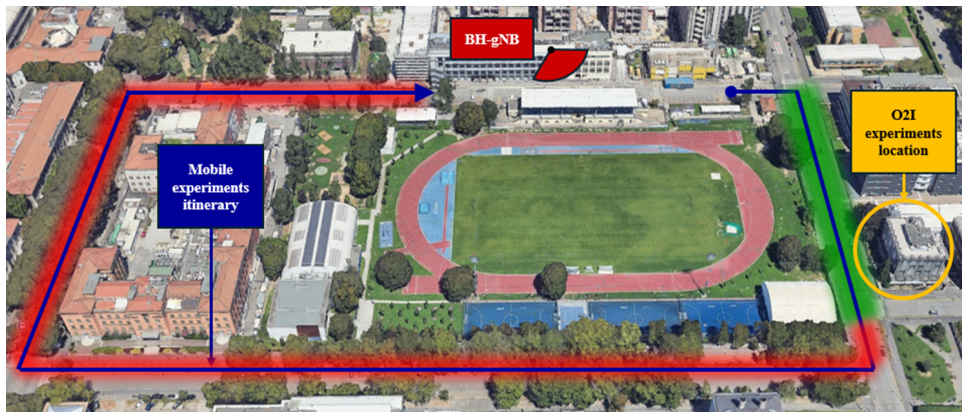
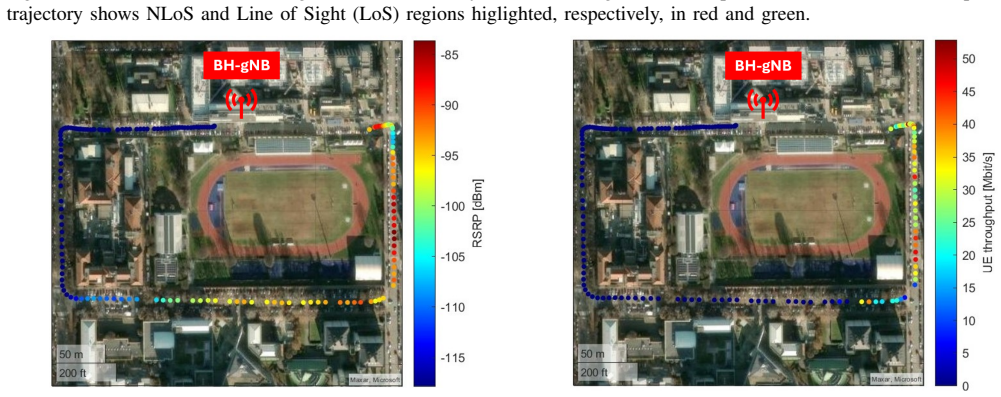
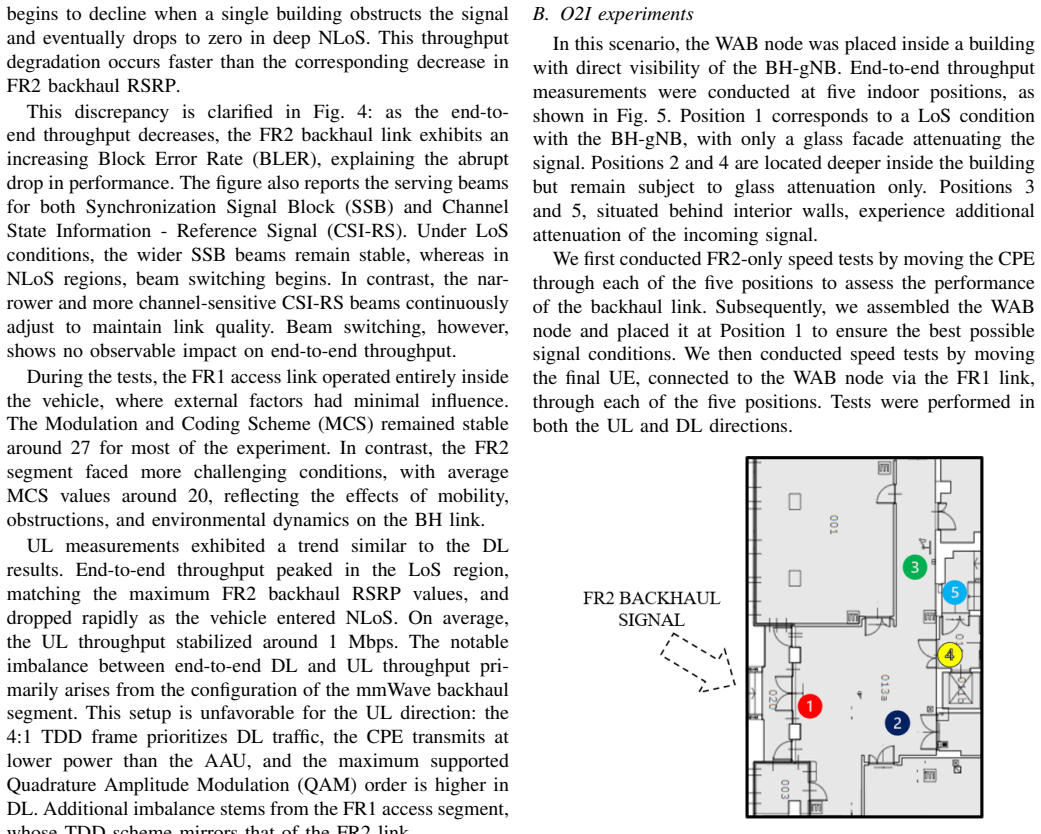
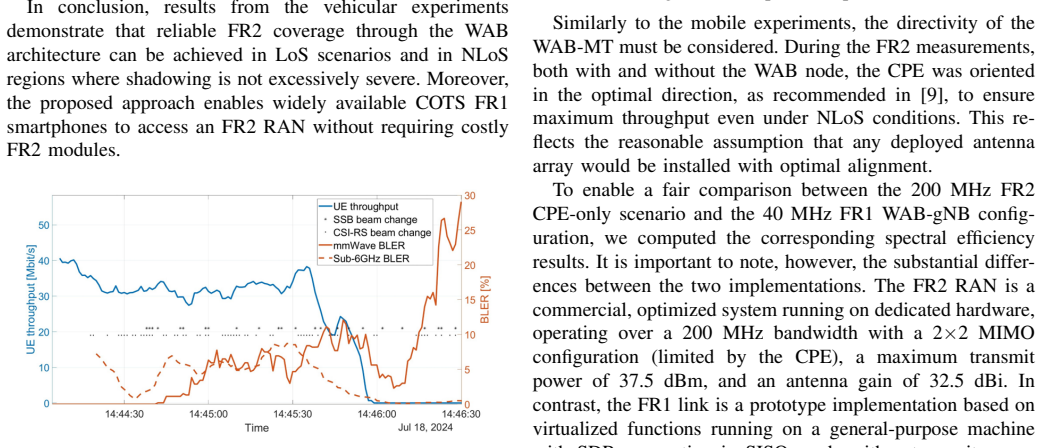
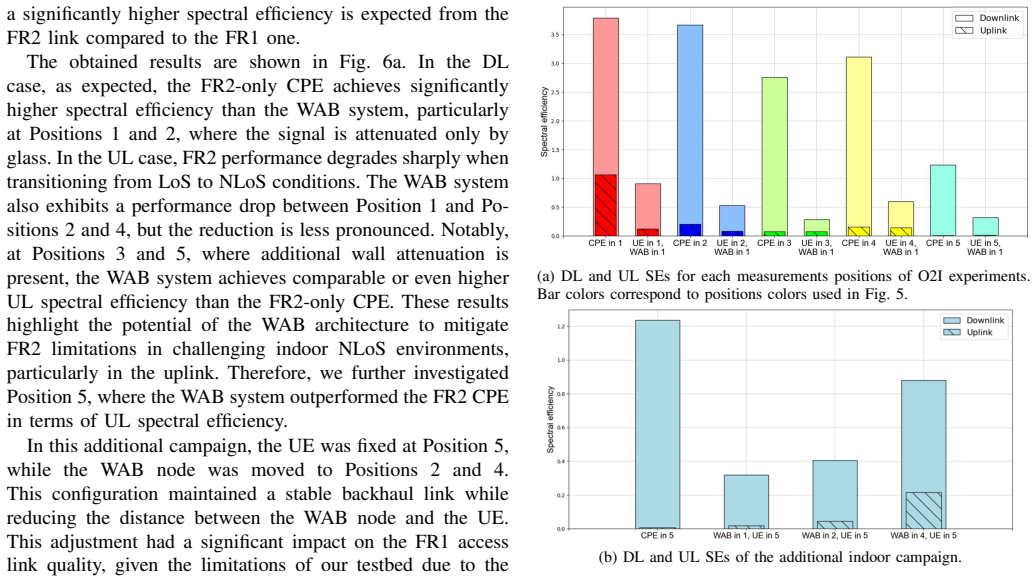
The authors deliver the first experimental multi-band WAB testbed that combines an FR2 backhaul with an FR1 access link. This validates full end-to-end operation under mobility and shows that FR2 coverage can be extended while remaining fully compatible with legacy FR1 user equipment. Tests in vehicular and outdoor-to-indoor scenarios confirm that WAB reduces the impact of FR2 limitations in uplink and non-line-of-sight conditions.
What carries the argument
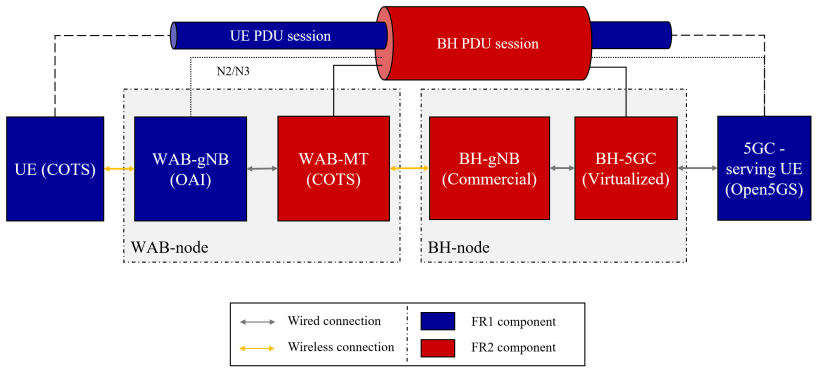
The Wireless Access Backhaul (WAB) architecture, which supports flexible modular wireless relay networks with native mobility handling and multi-technology backhaul links.
If this is right
- Mobile base stations become practical for covering areas with moving users such as highways or public transport routes.
- FR2 coverage gaps shrink without replacing existing FR1 user devices.
- Network densification for dynamic applications becomes cheaper by avoiding new wired backhaul installations.
- Uplink performance improves in conditions where direct high-frequency links normally struggle.
Where Pith is reading between the lines
- Operators could use WAB units for rapid temporary coverage at large events or after infrastructure damage.
- Interference between multiple moving WAB relays may require new coordination methods not tested here.
- The same multi-band relay idea could apply to future frequency ranges beyond current FR1 and FR2.
Load-bearing premise
That performance seen with specific commercial hardware and controlled small-scale mobility tests will continue in large real-world networks with variable interference and hardware differences.
What would settle it
A field trial with several mobile WAB base stations operating together in a dense urban area that shows repeated link failures or major uplink throughput loss during vehicle motion and non-line-of-sight segments.
Figures
read the original abstract
Highly dynamic and mobile applications, such as vehicular networks, require stable connectivity, which is often challenging to achieve. Network densification is a key approach to address this issue and can be achieved cost-effectively through mobile base stations and wireless relaying. However, existing solutions rely on rigid and complex architectures that hinder deployment in dynamic scenarios. The recently standardized Wireless Access Backhaul (WAB) architecture represents a key evolution, enabling flexible and modular wireless relay networks with native support for mobility and multi-technology wireless backhaul. This paper presents the first experimental realization of a multi-band WAB testbed, combining an FR2 backhaul and an FR1 access link using open-source software and commercial off-the-shelf components. The proposed framework validates end-to-end WAB operation under mobility and demonstrates the extension of FR2 coverage while maintaining compatibility with legacy FR1 user equipment. Experimental campaigns in vehicular and outdoor-to-indoor scenarios confirm that WAB effectively mitigates FR2 limitations, particularly in uplink and Non-Line-of-Sight conditions. These results highlight WAB as a practical and scalable approach for vehicular and next-generation wireless networks.
Editorial analysis
A structured set of objections, weighed in public.
Referee Report
Summary. The paper presents the first experimental realization of a multi-band Wireless Access Backhaul (WAB) testbed for 5G, combining an FR2 backhaul link with an FR1 access link using open-source software and commercial off-the-shelf (COTS) components. It claims to validate end-to-end WAB operation under mobility, demonstrate extension of FR2 coverage while maintaining compatibility with legacy FR1 user equipment, and show effective mitigation of FR2 limitations (particularly uplink and NLOS) through experimental campaigns in vehicular and outdoor-to-indoor scenarios.
Significance. If the reported experimental outcomes prove robust, the work would be significant for enabling cost-effective network densification via mobile base stations in dynamic environments such as vehicular networks. It offers practical evidence supporting the recently standardized WAB architecture as a flexible alternative to rigid relaying solutions, with the use of open-source software and COTS hardware noted as a strength for potential reproducibility and accessibility.
major comments (2)
- [Abstract and experimental campaigns] The abstract and experimental results description report positive outcomes for end-to-end WAB operation under mobility but provide no details on measurement methodology, number of trials, error bars, statistical tests, or data exclusion rules. This directly weakens support for the central claim that the campaigns confirm effective mitigation of FR2 limitations in uplink and NLOS conditions.
- [Discussion and conclusions] The claims that WAB represents a practical and scalable solution for vehicular networks rest on single-link controlled mobility tests with specific COTS hardware. No evidence is presented for multi-BS simultaneous operation, dense-deployment measurements, or robustness under co-channel interference and hardware variability, leaving the generalization to real-world multi-cell deployments unaddressed.
minor comments (1)
- [Abstract] The abstract would benefit from including at least one or two quantitative performance metrics (e.g., observed throughput or coverage extension values) to better summarize the experimental findings.
Simulated Author's Rebuttal
We thank the referee for the constructive and detailed review of our manuscript. We have carefully considered the major comments and provide point-by-point responses below, indicating the revisions we will incorporate.
read point-by-point responses
-
Referee: [Abstract and experimental campaigns] The abstract and experimental results description report positive outcomes for end-to-end WAB operation under mobility but provide no details on measurement methodology, number of trials, error bars, statistical tests, or data exclusion rules. This directly weakens support for the central claim that the campaigns confirm effective mitigation of FR2 limitations in uplink and NLOS conditions.
Authors: We agree that the manuscript would benefit from greater transparency in the experimental methodology. In the revised version, we will expand the relevant sections to include a detailed description of the measurement setup and procedures, the number of independent trials conducted in each scenario, error bars or confidence intervals for key metrics, the statistical tests employed, and any rules applied for data exclusion or outlier handling. These additions will draw directly from our existing experimental data and will strengthen the evidential basis for the reported mitigation of FR2 limitations under mobility, uplink, and NLOS conditions. revision: yes
-
Referee: [Discussion and conclusions] The claims that WAB represents a practical and scalable solution for vehicular networks rest on single-link controlled mobility tests with specific COTS hardware. No evidence is presented for multi-BS simultaneous operation, dense-deployment measurements, or robustness under co-channel interference and hardware variability, leaving the generalization to real-world multi-cell deployments unaddressed.
Authors: We acknowledge that the presented results are derived from single-link controlled mobility experiments with specific COTS hardware and do not include multi-BS operation, dense-deployment scenarios, or explicit measurements of co-channel interference and hardware variability. The manuscript frames this work as the first experimental demonstration of a multi-band WAB testbed rather than a comprehensive validation of large-scale deployments. We will revise the discussion and conclusions to explicitly delineate these scope limitations, avoid overgeneralization regarding scalability, and identify targeted directions for future multi-cell and interference studies. This will better contextualize the contributions while preserving the focus on the novel multi-band experimental validation. revision: partial
Circularity Check
No circularity: direct experimental measurements with no derivation chain
full rationale
The paper is an empirical experimental study that builds and measures a multi-band WAB testbed using COTS hardware and open-source software. All central claims (end-to-end operation under mobility, FR2 coverage extension, mitigation of uplink/NLoS limitations) rest on observed performance in vehicular and outdoor-to-indoor campaigns rather than any model, equation, fitted parameter, or prediction whose output is defined in terms of its own inputs. No self-citation load-bearing steps, uniqueness theorems, or ansatzes appear in the provided text. The work is therefore self-contained as experimental evidence and receives the default non-circularity finding.
Axiom & Free-Parameter Ledger
axioms (1)
- domain assumption The recently standardized WAB architecture natively supports mobility and multi-technology wireless backhaul.
Lean theorems connected to this paper
-
IndisputableMonolith/Foundation/RealityFromDistinction.leanreality_from_one_distinction unclear?
unclearRelation between the paper passage and the cited Recognition theorem.
The proposed framework validates end-to-end WAB operation under mobility and demonstrates the extension of FR2 coverage while maintaining compatibility with legacy FR1 user equipment.
-
IndisputableMonolith/Cost/FunctionalEquation.leanwashburn_uniqueness_aczel unclear?
unclearRelation between the paper passage and the cited Recognition theorem.
Experimental campaigns in vehicular and outdoor-to-indoor scenarios confirm that WAB effectively mitigates FR2 limitations
What do these tags mean?
- matches
- The paper's claim is directly supported by a theorem in the formal canon.
- supports
- The theorem supports part of the paper's argument, but the paper may add assumptions or extra steps.
- extends
- The paper goes beyond the formal theorem; the theorem is a base layer rather than the whole result.
- uses
- The paper appears to rely on the theorem as machinery.
- contradicts
- The paper's claim conflicts with a theorem or certificate in the canon.
- unclear
- Pith found a possible connection, but the passage is too broad, indirect, or ambiguous to say the theorem truly supports the claim.
Reference graph
Works this paper leans on
-
[1]
Millimeter-Wave Cellular Wireless Networks: Poten- tials and Challenges,
S. Ranganet al., “Millimeter-Wave Cellular Wireless Networks: Poten- tials and Challenges,”Proceedings of the IEEE, vol. 102, no. 3, pp. 366–385, 2014
work page 2014
-
[2]
Integrated Access and Backhaul in 5G mmWave Networks: Potential and Challenges,
M. Poleseet al., “Integrated Access and Backhaul in 5G mmWave Networks: Potential and Challenges,”IEEE Communications Magazine, vol. 58, no. 3, pp. 62–68, 2020
work page 2020
-
[3]
Paving the Way Toward Mobile IAB: Problems, Solutions and Challenges,
V . F. Monteiroet al., “Paving the Way Toward Mobile IAB: Problems, Solutions and Challenges,”IEEE Open Journal of the Communications Society, vol. 3, pp. 2347–2379, 2022
work page 2022
-
[4]
Field Trial on Millimeter Wave Integrated Access and Backhaul,
T. Tianet al., “Field Trial on Millimeter Wave Integrated Access and Backhaul,” in2019 IEEE 89th V ehicular Technology Conference (VTC2019-Spring), 2019, pp. 1–5
work page 2019
-
[5]
Integrated access and backhaul in 5g with aerial distributed unit using openairinterface,
R. Mundlamuriet al., “Integrated access and backhaul in 5g with aerial distributed unit using openairinterface,” 2023. [Online]. Available: https://arxiv.org/abs/2305.05983
-
[6]
The Bridge Toward 6G: 5G-Advanced Evolution in 3GPP Release 19,
X. Lin, “The Bridge Toward 6G: 5G-Advanced Evolution in 3GPP Release 19,” 2023. [Online]. Available: https://arxiv.org/abs/2312.15174
-
[7]
Study on additional topological enhancements for NR,
3GPP, “Study on additional topological enhancements for NR,” 3GPP, TR 38.799, version 19.0.0, 09 2024
work page 2024
-
[8]
Study on architecture enhancements for vehicle-mounted relays - Phase 2
3GPP, “Study on architecture enhancements for vehicle-mounted relays - Phase 2”,,” 3GPP, TR 23.700-06, version 19.0.0, 2024
work page 2024
-
[9]
Exploring Upper-6GHz and mmWave in Urban 5G Networks: A Direct on-Field Comparison,
M. Moriniet al., “Exploring Upper-6GHz and mmWave in Urban 5G Networks: A Direct on-Field Comparison,”IEEE Transactions on Mobile Computing, pp. 1–14, 2025
work page 2025
-
[10]
Openairinterface: Democratizing innovation in the 5g era,
F. Kaltenbergeret al., “Openairinterface: Democratizing innovation in the 5g era,”Computer Networks, vol. 176, p. 107284, 05 2020
work page 2020
-
[11]
[Online] Available: https://gist.github.com/nitred/ f16850ca48c48c79bf422e90ee5b9d95
discussion (0)
Sign in with ORCID, Apple, or X to comment. Anyone can read and Pith papers without signing in.