Probabilistic Analysis of the Random Spectral Radius for a Matrix Family
Pith reviewed 2026-05-17 20:44 UTC · model grok-4.3
The pith
The random spectral radius of products from diagonal and triangular matrix families satisfies a law of large numbers and central limit theorem with closed-form expressions.
A machine-rendered reading of the paper's core claim, the machinery that carries it, and where it could break.
Core claim
We establish a law of large numbers and a central limit theorem for the random spectral radius of length-n products sampled according to a probability measure on families of diagonal or commuting matrices, yielding the exact limit as the expected logarithm of the absolute value of the dominant eigenvalue and an explicit variance formula. The same holds for upper or lower triangular matrices and small perturbations thereof. When leading eigenvalues coalesce, the limit law is the maximum of a vector of correlated Gaussians with explicit covariance.
What carries the argument
Asymptotic analysis of the random spectral radius via the spectral radius of randomly selected matrix products in commuting and nearly commuting families.
If this is right
- If the claim holds, the typical growth rate in random switching systems can be predicted exactly without Monte Carlo simulation for these matrix classes.
- The explicit variance allows precise confidence intervals for finite-n approximations in applications.
- Phase transitions in growth rates are determined by eigenvalue coalescence, leading to non-Gaussian limits.
- Closed-form constants enable accurate numerical computations in control and stability analysis.
Where Pith is reading between the lines
- The approach might generalize to other matrix families if they can be approximated by diagonal ones.
- Similar probabilistic tools could apply to non-commuting cases by considering Lyapunov exponents.
- These results suggest testable predictions for the distribution of growth rates in simulated switching systems.
Load-bearing premise
The results require the matrices to be diagonal, triangular, or small perturbations of diagonal ones, with the probability measure satisfying suitable regularity conditions.
What would settle it
Generate many random products of length 1000 from a diagonal matrix family with known eigenvalues and verify if the sample mean and variance of log spectral radii match the paper's predicted values within statistical error.
Figures
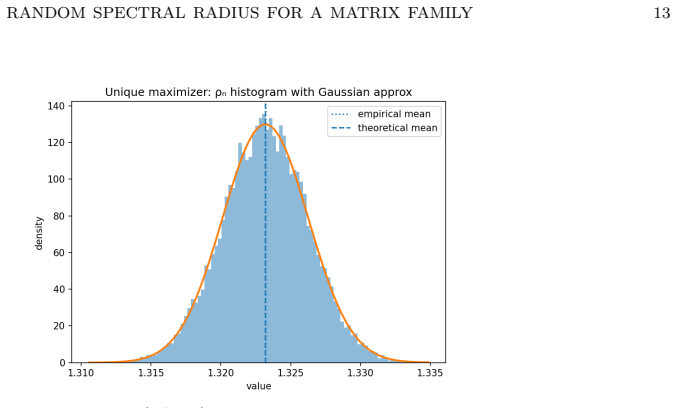


read the original abstract
We investigate joint spectral characteristics of a family of matrices $\mathcal F $, associated with products in the semigroup generated by $\mathcal F$. In the literature, extremal measures such as the well-known joint spectral radius and the lower spectral radius have been extensively studied. However, these measures fail to capture the typical growth rate of matrix products, focusing instead on the worst and best-case scenarios. Nevertheless, when examining, for instance, a switching dynamical system, a probabilistic rate of growth, which characterizes typical trajectories, emerges as a highly intriguing and significant measure. In this article, we study the random spectral radius, defined as the spectral radius of a length-$n$ product sampled at random from the semigroup according to a given probability measure. We establish asymptotic results, namely a Law of Large Numbers and a Central Limit Theorem, for diagonal (equivalently, commuting), upper- or lower-triangular, and small perturbations of diagonal matrices. Beyond recovering the correct scaling, we obtain exact closed-form expressions for the limiting value and variance, which may be useful in numerical applications requiring precise constants. In the coalescence regime, where the leading eigenvalues merge, the limiting distribution is non-Gaussian: it is given by the maximum of a correlated Gaussian vector with explicit covariance structure. This phenomenon governs phase transitions between distinct growth regimes in switching systems.
Editorial analysis
A structured set of objections, weighed in public.
Referee Report
Summary. The manuscript studies the random spectral radius of length-n products drawn randomly from a matrix family F according to a probability measure. It establishes a law of large numbers and central limit theorem for the logarithm of this radius, together with exact closed-form expressions for the limiting value and variance, in the cases of diagonal (commuting) matrices, upper- or lower-triangular matrices, and small perturbations of diagonal matrices. In the coalescence regime where leading eigenvalues merge, the limiting distribution is shown to be the maximum of a correlated Gaussian vector with explicit covariance structure. The results are motivated by applications to switching dynamical systems and typical growth rates.
Significance. If the derivations hold, the work supplies precise, usable constants for the typical asymptotic growth of random matrix products, which is a natural complement to the extremal joint spectral radius and lower spectral radius. The explicit closed forms and the non-Gaussian coalescence limit provide concrete tools for numerical analysis and for identifying phase transitions between growth regimes in switched systems.
major comments (1)
- [small-perturbation results] The section on small perturbations of diagonal matrices claims that the LLN and CLT, together with the exact closed-form limiting value and variance, transfer from the commuting diagonal case via eigenvalue perturbation theory. For this transfer to preserve the exact expressions, the perturbation norm must remain smaller than the gap between the largest and second-largest |eigenvalue| of the unperturbed length-n product. Because this gap is random and can be arbitrarily small with positive probability under any measure that places positive mass on distinct diagonal entries, a fixed perturbation size violates the required condition for large n on a set of positive measure. The manuscript must supply either an almost-sure quantitative lower bound on the gap or an explicit smallness condition (e.g., ||E|| < c · min-gap) that holds with probability 1; without it the claimed closed forms are,
minor comments (2)
- [Introduction and main results] Notation for the probability measure on the matrix family and the precise regularity conditions (moment assumptions, support restrictions) should be stated uniformly at the beginning of the main theorems rather than introduced piecemeal.
- [coalescence regime] The coalescence-regime covariance structure is described as “explicit,” but the explicit matrix entries or generating function are not displayed; adding a short displayed formula would improve readability.
Simulated Author's Rebuttal
We thank the referee for the careful reading, positive assessment of significance, and constructive major comment. We address the concern on small perturbations point by point below and will incorporate revisions to clarify the conditions under which the transfer of exact closed forms holds.
read point-by-point responses
-
Referee: [small-perturbation results] The section on small perturbations of diagonal matrices claims that the LLN and CLT, together with the exact closed-form limiting value and variance, transfer from the commuting diagonal case via eigenvalue perturbation theory. For this transfer to preserve the exact expressions, the perturbation norm must remain smaller than the gap between the largest and second-largest |eigenvalue| of the unperturbed length-n product. Because this gap is random and can be arbitrarily small with positive probability under any measure that places positive mass on distinct diagonal entries, a fixed perturbation size violates the required condition for large n on a set of positive measure. The manuscript must supply either an almost-sure quantitative lower bound on the gap or an explicit smallness condition (e.g., ||E|| < c · min-gap) that holds with probability 1; without it
Authors: We agree that a fixed perturbation size does not automatically satisfy the gap condition uniformly for all realizations and all large n. When the top Lyapunov exponent is strictly dominant (the regime treated in this section, distinct from the coalescence case handled separately), large-deviation estimates imply that the probability of the gap falling below any fixed positive threshold decays exponentially in n. Thus the perturbation condition holds with probability tending to 1. Moreover, on the almost-sure set where the empirical occupation measures converge to the maximizing measure, the gap grows exponentially almost surely. We will revise the manuscript to (i) explicitly assume strict dominance of the leading exponent, (ii) state the smallness condition in terms of the random gap, and (iii) add a remark that the closed-form expressions therefore hold in probability and almost surely under this assumption. This preserves the claimed transfer while making the probabilistic nature of the bound transparent. revision: yes
Circularity Check
No circularity detected; derivations apply standard limit theorems to explicit matrix classes
full rationale
The paper derives LLN and CLT for the random spectral radius on diagonal/commuting, triangular, and small-perturbation matrices by direct computation of the spectral radius for the first two classes (products reduce to entrywise products or maxima) followed by classical ergodic theorems and CLT for i.i.d. sums or maxima; closed-form limits and variances are obtained from explicit moment calculations on the eigenvalue logs rather than any fitted parameter or self-referential definition. The perturbation transfer invokes standard eigenvalue perturbation bounds but does not redefine the target quantity in terms of itself or rely on a self-citation chain for the core result. No load-bearing step reduces by construction to an input that is defined using the output, and the work remains self-contained against external benchmarks such as the Furstenberg-Kesten theorem and standard perturbation theory.
Axiom & Free-Parameter Ledger
axioms (1)
- standard math Standard law of large numbers and central limit theorem apply to the logarithm of the spectral radius of random matrix products under suitable moment conditions.
Lean theorems connected to this paper
-
IndisputableMonolith/Foundation/AbsoluteFloorClosure.leanreality_from_one_distinction unclear?
unclearRelation between the paper passage and the cited Recognition theorem.
We establish asymptotic results, namely a Law of Large Numbers and a Central Limit Theorem, for diagonal (equivalently, commuting), upper- or lower-triangular, and small perturbations of diagonal matrices. Beyond recovering the correct scaling, we obtain exact closed-form expressions for the limiting value and variance.
What do these tags mean?
- matches
- The paper's claim is directly supported by a theorem in the formal canon.
- supports
- The theorem supports part of the paper's argument, but the paper may add assumptions or extra steps.
- extends
- The paper goes beyond the formal theorem; the theorem is a base layer rather than the whole result.
- uses
- The paper appears to rely on the theorem as machinery.
- contradicts
- The paper's claim conflicts with a theorem or certificate in the canon.
- unclear
- Pith found a possible connection, but the passage is too broad, indirect, or ambiguous to say the theorem truly supports the claim.
Reference graph
Works this paper leans on
-
[1]
2 [3]P. Billingsley,Probability and Measure, Wiley Series in Probability and Mathematical Statistics, John Wiley & Sons, New York, 3rd ed., 1995. 9 [4]V. D. Blondel, R. Jungers, and V. Protasov,On the complexity of computing the capacity of codes that avoid forbidden difference patterns, IEEE Trans. Inform. Theory, 52 (2006), pp. 5122–5127. 2 [5]Y. Chitou...
work page 1995
-
[2]
9 [17]J. E. Kolassa,Series Approximation Methods in Statistics, vol. 88 of Lecture Notes in Statistics, Springer, New York, NY, 3 ed., 2006. 19 [18]D. Kruyswijk,On some well-known properties of the partition functionp(n)and Euler’s infinite product, Nieuw Arch. Wiskunde, 23 (1950), pp. 97–107. 2 [19]B. E. Moision, A. Orlitsky, and P. H. Siegel,On codes th...
work page 2006
-
[3]
2 Francesco Paolo Maiale Gran Sasso Science Institute Viale Rendina 26–28, L’Aquila, 67100, Italy Email address:francescopaolo.maiale@gssi.it Anastasiia Trofimova Gran Sasso Science Institute Viale Rendina 26–28, L’Aquila, 67100, Italy Email address:anastasiia.trofimova@gssi.it Nicola Guglielmi Gran Sasso Science Institute Viale Rendina 26–28, L’Aquila, 6...
discussion (0)
Sign in with ORCID, Apple, or X to comment. Anyone can read and Pith papers without signing in.