REVIEW 4 major objections 5 minor 53 references
Modeling memory in time-respecting paths on temporal networks
T0 review · 4 major / 5 minor · reviewed 2026-08-03 · deepseek-v4-flash
Pith's one-line read Time-respecting paths in human contact networks carry measurable memory, and increasing that memory slows diffusion.
desk verdict A useful, clean operationalization of memory in temporal paths, with solid MLE machinery and a good cross-dataset campaign, but the null models are too weak to fully support the claim of strong memory effects. read the letter →
The pith
A machine-rendered reading of the paper's core claim, the machinery that carries it, and where it could break.
The reading
What carries the argument
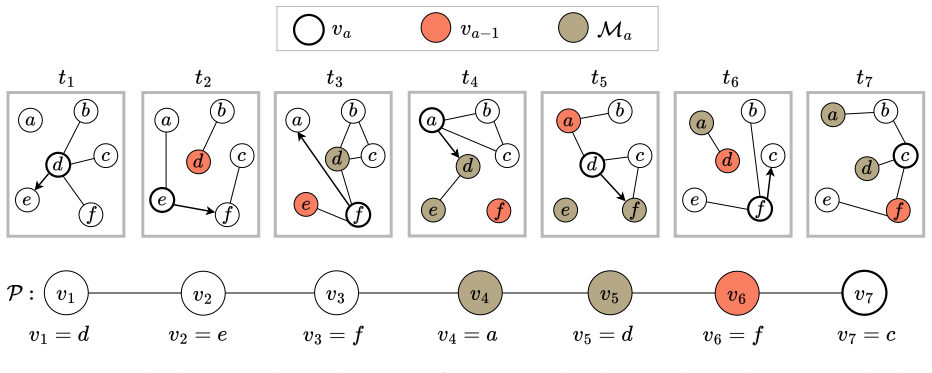
The analysis rests on non-backtracking time-respecting paths—sequences of node-time pairs in which a walker cannot step back to the previous node—and a memory set of nodes visited in the last m steps. The MEM model assigns probability p that the next node lies in that memory set and 1-p uniform otherwise; MEM+SBM generalizes the uniform term to community affinities. Maximum-likelihood estimators for p and the affinity matrix are solved by fixed-point iteration. A generative model with parameter α rewires edges toward pairs connected by recent time-respecting paths, letting the authors tune p and measure its effect on diffusion entropy.
What would settle it
Generate surrogate temporal graphs that preserve each snapshot's degree sequence and the empirical inter-event time distribution but randomize which nodes interact, then rerun the MEM/MEM+SBM inference; if the surrogate p matches the empirical p, the claimed memory effect is an artifact of those null-omitted features. Alternatively, find a human-contact dataset where inferred p is large yet diffusion entropy does not decrease with p in the generative model.
Extended reading notes
Core claim
The central claim is that the probability p that a non-backtracking time-respecting path returns to a previously visited node can be inferred from data and is large—much larger than in null models that preserve only snapshot density or density plus community labels. In all eight human-proximity datasets the inferred p exceeds the null baselines by a wide margin across memory horizons, and a stochastic-block-model extension beats the plain memory model by Bayesian information criterion, showing that part of the apparent memory in schools is homophily. The paper further claims p decreases with temporal aggregation and that synthetic networks with higher p show lower final entropy of a diffusiv
Load-bearing premise
The significance claim rests on comparing real networks to random ones that keep only each snapshot's density (plus group labels), not the real degree sequence, timing of interactions, or burstiness; if those omitted features alone make paths return often, the inferred memory p is inflated.
Editorial extensions
If this is right
- Memory in time-respecting paths is a measurable, single-parameter property of human contact networks, consistent across eight settings.
- Modeling spread without memory underestimates path recurrence; temporal-network generative models for epidemics or information flow should include it.
- Community-aware inference is needed to avoid mistaking homophily for memory, especially in schools.
- Memory weakens with coarser temporal aggregation, so temporal resolution choices directly change apparent diffusion constraints.
- Increasing memory slows diffusion speed in the controlled generative model, linking the measured p to a dynamical consequence.
Reading between the lines
- A direct test would replace the null models with degree-sequence- and burstiness-preserving surrogates; if inferred p collapses, part of the 'memory' is generated by non-Markovian timing rather than recurring social choices.
- The single parameter p could be promoted to a per-community or per-node memory value, which might separate context-driven memory from intrinsic individual behavior.
- The diffusion result suggests p could serve as a model-selection statistic for choosing temporal aggregation in epidemic simulations, though the paper does not test that application.
- Since memory decreases with aggregation, one could design adaptive aggregation that preserves p—a practical rule the authors leave implicit.
Editorial analysis
A structured set of objections, weighed in public.
Referee Report
Summary. The paper proposes a framework to quantify memory in non-backtracking time-respecting paths (TRPs) on temporal networks. Memory is defined as the probability p that a TRP returns to a previously visited node within a horizon m. Two models are introduced: MEM, which has a single memory parameter p, and MEM+SBM, which adds a community-affinity matrix C. The authors derive maximum-likelihood estimators, apply them to eight SocioPatterns human-proximity datasets, and report that empirical p values are much larger than those obtained from two memoryless null models (ER and SBM). They also propose a synthetic generative model with a memory weight α and use it to argue that higher memory slows diffusion. The paper claims strong, statistically significant memory effects robust across datasets and parameters.
Significance. If the empirical inference is valid, the paper offers a simple, single-parameter quantification of memory in temporal human-proximity networks, which is a useful addition to temporal-network modeling. The MLE derivations in Section 4.2 are internally consistent, the code and data are publicly available, and the comparison across eight empirical datasets is a strength. The diffusion experiment, while synthetic, illustrates a plausible mechanism connecting memory to spreading dynamics. However, the central empirical claim relies on the adequacy of the null models; the current nulls preserve only density or density plus community labels, leaving degree heterogeneity and burstiness uncontrolled.
major comments (4)
- [Section 2.2.2 / Figure 3] The null models preserve only per-snapshot density (ER) and density plus community labels (SBM); they do not preserve the empirical degree sequence or burstiness/inter-event time statistics. Because TRP generation (Algorithm 1) samples the next node with probability proportional to edge weight, high-degree nodes will be revisited more often even without memory. A configuration-model null that preserves the degree sequence is needed to separate memory from popularity. The paper's own observation that the SBM null yields non-zero p in schools indicates that the baseline absorbs structure; the degree-heterogeneity confound remains untested.
- [Eq. (1) / Section 4.2] The MEM model assigns uniform probability (1-p)/(n-2) to all nodes outside the memory set, independent of the temporal graph's adjacency structure. However, the observed TRPs are generated on a graph where the next node must be a neighbor of the current node at the given time (Algorithm 1). Therefore, p estimated via Eq. (4) conflates return-to-memory with the deviation between this uniform baseline and the actual neighborhood/topology-driven transition distribution. The non-memory baseline should be the empirical transition distribution (e.g., proportional to edge weight), or at least a degree-proportional null, rather than a uniform one.
- [Abstract / Section 2.2.2] The phrase 'statistically significant' is used prominently but no formal test is performed. Figure 3 reports null-model means and standard deviations over 50 realizations, but the empirical p is a point estimate without confidence intervals, and no p-value or likelihood-ratio test is given. A bootstrap over TRPs for the empirical p, and a formal comparison against the null distribution, are necessary to support the stated significance claim.
- [Section 4.2, Eqs. (6)-(7)] The MLEs are defined by implicit equations, but the paper does not address existence or uniqueness of solutions, nor does it prove that the iterative procedure converges to a global maximum. Given that mixture-model likelihoods are generally not concave, this is a technical gap. Additionally, when the memory set |M_a| is empty (early steps of a TRP), the term p * δ / |M_a| in Eq. (1) is undefined (0/0); the handling of such steps should be specified.
minor comments (5)
- [Eq. (6)] The expression for p is ambiguous: it should be written as p = 1 - |R_out| / ( sum_{r in R_in} [ ... ]^{-1} ), with the sum clearly in the denominator. The current typesetting could be misread as a product.
- [Section 4.1 / Figure 3] The values of the path length a and the number of TRPs R used in the experiments are not reported in the main text or appendix. These parameters are central to the estimation and should be stated for reproducibility.
- [Eq. (3)] The notation in the edge probability is ambiguous: 'd(1−α/n)' is unclear. It should be clarified whether the random-edge term is d(1−α)/n or d(1−α/n). The surrounding text suggests the former, but the formula should be explicit.
- [Figure 2 / BIC] The number of parameters in the MEM+SBM model (the C matrix of size k×k) should be explicitly stated for the BIC comparison. Also, the BIC values for different datasets use different scales; the caption notes this, but a brief remark in the text would help.
- [Appendix / Figures 5-6] The appendix reports p values at different aggregations and memory horizons as point values without uncertainties. While the main text shows null-model variability, the empirical p values are also estimates and should carry confidence intervals or at least a bootstrap standard deviation.
Circularity Check
No significant circularity: empirical p is fitted by maximum likelihood and compared against memoryless null models; the synthetic generator controls memory via α, but diffusion speed is a separately measured simulation outcome.
full rationale
No load-bearing circular reduction is present. The memory parameter p is introduced as a model probability in Eq. (1) and estimated from empirical TRPs via the maximum-likelihood expressions in Eqs. (4)–(6); the central empirical claim is that this fitted p exceeds the p obtained from memoryless null models (ER and SBM), which is a fit-versus-null comparison rather than a fitted parameter being renamed as a prediction. The null models preserve only density or density plus community labels, so concerns about degree heterogeneity or burstiness inflating p are correctness/robustness risks, not circularity. The synthetic generative model in Eq. (3) intentionally correlates new edges with recent TRPs, so the monotone increase of fitted p with α is by design and is acknowledged as such; however, the diffusion entropy in the right panel of Figure 4 is a measured response of the diffusion dynamics, not an equation-level consequence of the inference. Self-citations, such as [8], are contextual and do not carry the derivation. No uniqueness theorem or ansatz is imported from the authors' prior work to force the result.
Assumptions & free parameters
free parameters (8)
- p (memory parameter) =
0.2–0.94 depending on dataset, m, and t_res (Figs. 3, 5, 6)
- C (community affinity matrix) =
not tabulated; estimated from Eq. (7)
- m (memory horizon) =
5, 10, 15, 20; also duration versions in appendix
- t_res (temporal aggregation) =
20 s, 1 min, 5 min, 10 min, 15 min
- alpha (synthetic memory weight) =
swept 0 → 1
- d (expected degree in synthetic graphs) =
10, 25, 50
- beta (diffusion coefficient) =
0.03
- TRP sampling parameters (path length a, number of paths R) =
not stated in text
assumptions (4)
- domain assumption Algorithm 1's TRP sampling procedure is representative of information flow on the temporal network; the convention of transitioning at the end of an interaction and regenerating dead-end paths does not bias p.
- domain assumption The empirical temporal graphs are in a stationary regime, so a single time-independent p (and C) suffices.
- domain assumption The ER and SBM null models, preserving only per-snapshot density and (for SBM) community labels, are adequate memoryless baselines.
- domain assumption The discrete diffusion dynamics u_{t+1} = (I − β(D_t − A_t))u_t with final entropy as the speed measure captures propagation on temporal graphs.
Cite this review
Pith. "Pith review of Modeling memory in time-respecting paths on temporal networks." pith.science (2026). https://pith.science/paper/VRGB3CHA
@misc{pith2026251117108,
  author       = {Pith},
  title        = {Pith review of: Modeling memory in time-respecting paths on temporal networks},
  year         = {2026},
  howpublished = {\url{https://pith.science/paper/VRGB3CHA}},
  note         = {Machine review of arXiv:2511.17108}
}
read the original abstract
Human close-range proximity interactions are the key determinant for spreading processes like knowledge diffusion, norm adoption, and infectious disease transmission. These dynamical processes can be modeled with time-respecting paths on temporal networks. Here, we propose a framework to quantify memory in time-respecting paths and evaluate it on several empirical datasets encoding proximity between humans collected in different settings. Our results show strong memory effects, robust across settings, model parameters, and statistically significant when compared to memoryless null models. We further propose a generative model to create synthetic temporal graphs with memory and use it to show that memory in time-respecting paths decreases the diffusion speed, affecting the dynamics of spreading processes on temporal networks.
Figures


Figures from the paper (5 more)


Reference graph
Works this paper leans on
-
[1]
Dynamics on networks: competition of temporal and topological correlations.Scientific reports, 7(1):41627, 2017
Oriol Artime, Jos´ e J Ramasco, and Maxi San Miguel. Dynamics on networks: competition of temporal and topological correlations.Scientific reports, 7(1):41627, 2017
2017
-
[2]
Alain Barrat and Ciro Cattuto. Temporal networks of face-to-face human interactions.Temporal Net- works, Understanding Complex Systems. ISBN 978-3-642-36460-0. Springer-Verlag Berlin Heidelberg, 2013, p. 191, 05 2013. doi: 10.1007/978-3-642-36461-7 10
-
[3]
Burnham and D.R
K.P. Burnham and D.R. Anderson.Model selection and multimodel inference: a practical information- theoretic approach. Springer Verlag, 2002
2002
-
[4]
Ciro Cattuto, Wouter Van den Broeck, Alain Barrat, Vittoria Colizza, Jean-Fran¸ cois Pinton, and Alessandro Vespignani. Dynamics of person-to-person interactions from distributed rfid sensor net- works.PLoS ONE, 5(7):e11596, July 2010. ISSN 1932-6203. doi: 10.1371/journal.pone.0011596. URL http://dx.doi.org/10.1371/journal.pone.0011596
-
[5]
Digital proximity tracing on empirical contact networks for pandemic control.Nature communications, 12(1):1655, 2021
Giulia Cencetti, Gabriele Santin, Antonio Longa, Emanuele Pigani, Alain Barrat, Ciro Cattuto, Sune Lehmann, Marcel Salathe, and Bruno Lepri. Digital proximity tracing on empirical contact networks for pandemic control.Nature communications, 12(1):1655, 2021
2021
-
[6]
Screening and vaccination against covid-19 to minimise school closure: a modelling study.The Lancet Infectious Diseases, 22(7):977–989, 2022
Elisabetta Colosi, Giulia Bassignana, Diego Andr´ es Contreras, Canelle Poirier, Pierre-Yves Bo¨ elle, Simon Cauchemez, Yazdan Yazdanpanah, Bruno Lina, Arnaud Fontanet, Alain Barrat, et al. Screening and vaccination against covid-19 to minimise school closure: a modelling study.The Lancet Infectious Diseases, 22(7):977–989, 2022
2022
-
[7]
Interaction data are identifiable even across long periods of time.Nature Communications, 13(1):313, 2022
Ana-Maria Cret ¸u, Federico Monti, Stefano Marrone, Xiaowen Dong, Michael Bronstein, and Yves- Alexandre de Montjoye. Interaction data are identifiable even across long periods of time.Nature Communications, 13(1):313, 2022
2022
-
[8]
An embedding-based distance for temporal graphs
Lorenzo Dall’Amico, Alain Barrat, and Ciro Cattuto. An embedding-based distance for temporal graphs. Nature Communications, 15(1), November 2024. ISSN 2041-1723. doi: 10.1038/s41467-024-54280-4. URLhttp://dx.doi.org/10.1038/s41467-024-54280-4
Show all 53 references
-
[9]
Wagner, Cheryl Cohen, Stefano Tempia, and Ciro Cattuto
Lorenzo Dall’Amico, Jackie Kleynhans, Laetitia Gauvin, Michele Tizzoni, Laura Ozella, Mvuyo Makhasi, Nicole Wolter, Brigitte Language, Ryan G. Wagner, Cheryl Cohen, Stefano Tempia, and Ciro Cattuto. Estimating household contact matrices structure from easily collectable metada...
2024 doi
-
[10]
Contact patterns among high school students.PLoS ONE, 9(9):e107878, 9 2014
Julie Fournet and Alain Barrat. Contact patterns among high school students.PLoS ONE, 9(9):e107878, 9 2014. doi: 10.1371/journal.pone.0107878. URLhttps://doi.org/10.1371/journal.pone.0107878
2014 doi
-
[11]
Higher-order correlations reveal complex memory in temporal hypergraphs.Nature Communications, 15(1):4754, 2024
Luca Gallo, Lucas Lacasa, Vito Latora, and Federico Battiston. Higher-order correlations reveal complex memory in temporal hypergraphs.Nature Communications, 15(1):4754, 2024
2024
-
[12]
Vestergaard
Laetitia Gauvin, Mathieu G´ enois, M´ arton Karsai, Mikko Kivel¨ a, Taro Takaguchi, Eugenio Valdano, and Christian L. Vestergaard. Randomized reference models for temporal networks.SIAM Review, 64(4): 763–830, 2022. doi: 10.1137/19M1242252. URLhttps://doi.org/10.1137/19M1242252
2022 doi
-
[13]
Mitigation of infectious disease at school: targeted class closure vs school closure.BMC infectious diseases, 14(1):695, December 2014
Valerio Gemmetto, Alain Barrat, and Ciro Cattuto. Mitigation of infectious disease at school: targeted class closure vs school closure.BMC infectious diseases, 14(1):695, December 2014. ISSN 1471-2334. doi: 10.1186/PREACCEPT-6851518521414365. URLhttp://www.biomedcentral.com/14...
2014 doi
-
[14]
Can co-location be used as a proxy for face-to-face contacts?EPJ Data Science, 7(1):11, May 2018
Mathieu G´ enois and Alain Barrat. Can co-location be used as a proxy for face-to-face contacts?EPJ Data Science, 7(1):11, May 2018. ISSN 2193-1127. doi: 10.1140/epjds/s13688-018-0140-1. URLhttps: //doi.org/10.1140/epjds/s13688-018-0140-1. 11
2018 doi
-
[15]
Data on face-to-face contacts in an office building suggest a low-cost vaccination strategy based on community linkers.Network Science, 3(3):326–347, 2015
Mathieu G´ enois, Christian L Vestergaard, Julie Fournet, Andr´ e Panisson, Isabelle Bonmarin, and Alain Barrat. Data on face-to-face contacts in an office building suggest a low-cost vaccination strategy based on community linkers.Network Science, 3(3):326–347, 2015
2015
-
[16]
Community aware temporal network generation.arXiv preprint arXiv:2501.07327, 2025
Nicol` o Alessandro Girardini, Antonio Longa, Gaia Trebucchi, Giulia Cencetti, Andrea Passerini, and Bruno Lepri. Community aware temporal network generation.arXiv preprint arXiv:2501.07327, 2025
2025 arXiv
-
[17]
Community structure in social and biological networks.Pro- ceedings of the national academy of sciences, 99(12):7821–7826, 2002
Michelle Girvan and Mark EJ Newman. Community structure in social and biological networks.Pro- ceedings of the national academy of sciences, 99(12):7821–7826, 2002
2002
-
[18]
Household members do not contact each other at random: implications for infectious disease modelling.Proceedings of the Royal Society B, 285(1893):20182201, 2018
Nele Goeyvaerts, Eva Santermans, Gail Potter, Andrea Torneri, Kim Van Kerckhove, Lander Willem, Marc Aerts, Philippe Beutels, and Niel Hens. Household members do not contact each other at random: implications for infectious disease modelling.Proceedings of the Royal Society B,...
2018
-
[19]
Modeling temporal networks with bursty activity patterns of nodes and links.Physical Review Research, 2(2):023073, 2020
Takayuki Hiraoka, Naoki Masuda, Aming Li, and Hang-Hyun Jo. Modeling temporal networks with bursty activity patterns of nodes and links.Physical Review Research, 2(2):023073, 2020
2020
-
[20]
Stochastic blockmodels: First steps.Social networks, 5(2):109–137, 1983
Paul W Holland, Kathryn Blackmond Laskey, and Samuel Leinhardt. Stochastic blockmodels: First steps.Social networks, 5(2):109–137, 1983
1983
-
[21]
Temporal networks.Physics Reports, 519(3):97–125, October 2012
Petter Holme and Jari Saram¨ aki. Temporal networks.Physics Reports, 519(3):97–125, October 2012. ISSN 0370-1573. doi: 10.1016/j.physrep.2012.03.001. URLhttp://dx.doi.org/10.1016/j.physrep. 2012.03.001
2012 doi
-
[22]
What’s in a crowd? analysis of face-to-face behavioral networks.Journal of Theoretical Biology, 271(1):166–180, 2011
Lorenzo Isella, Juliette Stehl´ e, Alain Barrat, Ciro Cattuto, Jean-Fran¸ cois Pinton, and Wouter Van den Broeck. What’s in a crowd? analysis of face-to-face behavioral networks.Journal of Theoretical Biology, 271(1):166–180, 2011. ISSN 0022-5193. doi: DOI:10.1016/j.jtbi.2010....
2011 doi
-
[23]
Karsai, M
M. Karsai, M. Kivel¨ a, R. K. Pan, K. Kaski, J. Kert´ esz, A.-L. Barab´ asi, and J. Saram¨ aki. Small but slow world: How network topology and burstiness slow down spreading.Phys. Rev. E, 83:025102, 2 2011. doi: 10.1103/PhysRevE.83.025102. URLhttps://link.aps.org/doi/10.1103/P...
2011 doi
-
[24]
Time varying networks and the weakness of strong ties.Scientific Reports, 4(1), February 2014
M´ arton Karsai, Nicola Perra, and Alessandro Vespignani. Time varying networks and the weakness of strong ties.Scientific Reports, 4(1), February 2014. ISSN 2045-2322. doi: 10.1038/srep04001. URL http://dx.doi.org/10.1038/srep04001
2014 doi
-
[25]
Inter- personal distance during real-time social interaction: Insights from subjective experience, behavior, and physiology.Frontiers in psychiatry, 11:561, 2020
Leon OH Kroczek, Michael Pfaller, Bastian Lange, Mathias M¨ uller, and Andreas M¨ uhlberger. Inter- personal distance during real-time social interaction: Insights from subjective experience, behavior, and physiology.Frontiers in psychiatry, 11:561, 2020
2020
-
[26]
Modeling framework unifying contact and social networks.Physical Review E, 107(2):024301, 2023
Didier Le Bail, Mathieu G´ enois, and Alain Barrat. Modeling framework unifying contact and social networks.Physical Review E, 107(2):024301, 2023
2023
-
[27]
Generating fine-grained surrogate temporal networks.Communications Physics, 7(1):22, 2024
Antonio Longa, Giulia Cencetti, Sune Lehmann, Andrea Passerini, and Bruno Lepri. Generating fine-grained surrogate temporal networks.Communications Physics, 7(1):22, 2024. doi: 10.1038/ s42005-023-01517-1. URLhttps://doi.org/10.1038/s42005-023-01517-1
2024 doi
-
[28]
Simple crowd dynamics to generate complex temporal contact networks.arXiv preprint arXiv:2405.06508, 2024
Razieh Masoumi, Juliette Gambaudo, and Mathieu G´ enois. Simple crowd dynamics to generate complex temporal contact networks.arXiv preprint arXiv:2405.06508, 2024
2024 arXiv
-
[29]
Contact patterns in a high school: A comparison between data collected using wearable sensors, contact diaries and friendship surveys.PLoS ONE, 10 (9), 2015
Rossana Mastrandrea, Julie Fournet, and Alain Barrat. Contact patterns in a high school: A comparison between data collected using wearable sensors, contact diaries and friendship surveys.PLoS ONE, 10 (9), 2015. doi: 10.1371/journal.pone.0136497
2015 doi
-
[30]
Using wearable proximity sensors to characterize social contact patterns in a village of rural malawi.EPJ Data Science, 10(1):46, 2021
Laura Ozella, Daniela Paolotti, Guilherme Lichand, Jorge P Rodr ´ ıguez, Simon Haenni, John Phuka, Onicio B Leal-Neto, and Ciro Cattuto. Using wearable proximity sensors to characterize social contact patterns in a village of rural malawi.EPJ Data Science, 10(1):46, 2021. 12
2021
-
[31]
Path lengths, correlations, and centrality in temporal networks
Raj Kumar Pan and Jari Saram¨ aki. Path lengths, correlations, and centrality in temporal networks. Phys. Rev. E, 84:016105, July 2011. doi: 10.1103/PhysRevE.84.016105. URLhttps://link.aps.org/ doi/10.1103/PhysRevE.84.016105
2011 doi
-
[32]
Peixoto and Laetitia Gauvin
Tiago P. Peixoto and Laetitia Gauvin. Change points, memory and epidemic spreading in temporal networks.Scientific Reports, 8, 2017. URLhttps://api.semanticscholar.org/CorpusID:37320993
2017
-
[33]
Perra, B
N. Perra, B. Gon¸ calves, R. Pastor-Satorras, and A. Vespignani. Activity driven modeling of time varying networks.Scientific Reports, 2(1), June 2012. ISSN 2045-2322. doi: 10.1038/srep00469. URL http://dx.doi.org/10.1038/srep00469
2012 doi
-
[34]
Petrovi´ c, Anatol Eugen Wegner, and Ingo Scholtes
Luka V. Petrovi´ c, Anatol Eugen Wegner, and Ingo Scholtes. Higher-order patterns reveal causal tem- poral scales in time series network data. InThe First Learning on Graphs Conference, 2022. URL https://openreview.net/forum?id=aI0-qQsFCHV
2022
-
[35]
Petrovi´ c and Vincenzo Perri
Luka V. Petrovi´ c and Vincenzo Perri. Bayesian detection of mesoscale structures in pathway data on graphs. 2023. URLhttps://arxiv.org/abs/2301.11120
2023 arXiv
-
[36]
Simulated epidemics in an empirical spatiotemporal network of 50,185 sexual contacts.PLoS computational biology, 7(3):e1001109, 2011
Luis EC Rocha, Fredrik Liljeros, and Petter Holme. Simulated epidemics in an empirical spatiotemporal network of 50,185 sexual contacts.PLoS computational biology, 7(3):e1001109, 2011
2011
-
[37]
Privacy and uniqueness of neighborhoods in social networks.Scientific reports, 11(1):20104, 2021
Daniele Romanini, Sune Lehmann, and Mikko Kivel¨ a. Privacy and uniqueness of neighborhoods in social networks.Scientific reports, 11(1):20104, 2021
2021
-
[38]
Esquivel, Andrea Lancichinetti, Jevin D
Martin Rosvall, Alcides V. Esquivel, Andrea Lancichinetti, Jevin D. West, and Renaud Lambiotte. Memory in network flows and its effects on spreading dynamics and community detection.Nature Communications, 5(1), August 2014. ISSN 2041-1723. doi: 10.1038/ncomms5630. URLhttp://dx...
2014 doi
-
[39]
Feldman, and James H
Marcel Salath´ e, Maria Kazandjieva, Jung Woo Lee, Philip Levis, Marcus W. Feldman, and James H. Jones. A high-resolution human contact network for infectious disease transmission.Proceedings of the National Academy of Sciences, 107(51):22020–22025, 2010. doi: 10.1073/pnas.100...
2010 doi
-
[40]
Exploring temporal networks with greedy walks.The European Physical Journal B, 88:1–8, 2015
Jari Saram¨ aki and Petter Holme. Exploring temporal networks with greedy walks.The European Physical Journal B, 88:1–8, 2015
2015
-
[41]
Predicting partially observed processes on temporal networks by dynamics-aware node embeddings (dyane).EPJ Data Science, 10(1):22, 2021
Koya Sato, Mizuki Oka, Alain Barrat, and Ciro Cattuto. Predicting partially observed processes on temporal networks by dynamics-aware node embeddings (dyane).EPJ Data Science, 10(1):22, 2021
2021
-
[42]
Causality-driven slow-down and speed-up of diffusion in non-markovian temporal networks.Nature communications, 5:5024, 09 2014
Ingo Scholtes, Nicolas Wider, Ren´ e Pfitzner, Antonios Garas, Claudio Tessone, and Frank Schweitzer. Causality-driven slow-down and speed-up of diffusion in non-markovian temporal networks.Nature communications, 5:5024, 09 2014. doi: 10.1038/ncomms6024
2014 doi
-
[43]
Fundamental structures of dynamic social networks.Proceedings of the National Academy of Sciences, 113(36):9977–9982, 2016
Vedran Sekara, Arkadiusz Stopczynski, and Sune Lehmann. Fundamental structures of dynamic social networks.Proceedings of the National Academy of Sciences, 113(36):9977–9982, 2016. doi: 10.1073/ pnas.1602803113. URLhttps://www.pnas.org/doi/abs/10.1073/pnas.1602803113
2016 doi
-
[44]
Constructing temporal networks with bursty activity patterns.Nature Communications, 14, 11 2023
Anzhi Sheng, Qi Su, Aming Li, Long Wang, and Joshua Plotkin. Constructing temporal networks with bursty activity patterns.Nature Communications, 14, 11 2023. doi: 10.1038/s41467-023-42868-1
2023 doi
-
[45]
Modeling human dynamics of face-to-face interaction networks.Physical review letters, 110(16):168701, 2013
Michele Starnini, Andrea Baronchelli, and Romualdo Pastor-Satorras. Modeling human dynamics of face-to-face interaction networks.Physical review letters, 110(16):168701, 2013
2013
-
[46]
High- resolution measurements of face-to-face contact patterns in a primary school.PLoS ONE, 6(8):e23176, August 2011
Juliette Stehl´ e, Nicolas Voirin, Alain Barrat, Ciro Cattuto, Lorenzo Isella, Jean-Fran¸ cois Pinton, Marco Quaggiotto, Wouter Van den Broeck, Corinne R´ egis, Bruno Lina, and Philippe Vanhems. High- resolution measurements of face-to-face contact patterns in a primary school...
2011 doi
-
[47]
Epidemic spreading and aging in temporal networks with memory.Physical Review E, 98 (6), December 2018
Michele Tizzani, Simone Lenti, Enrico Ubaldi, Alessandro Vezzani, Claudio Castellano, and Raffaella Burioni. Epidemic spreading and aging in temporal networks with memory.Physical Review E, 98 (6), December 2018. ISSN 2470-0053. doi: 10.1103/physreve.98.062315. URLhttp://dx.do...
2018 doi
-
[48]
Burstiness and tie activation strategies in time-varying social networks.Scientific Reports, 7(1), April 2017
Enrico Ubaldi, Alessandro Vezzani, M´ arton Karsai, Nicola Perra, and Raffaella Burioni. Burstiness and tie activation strategies in time-varying social networks.Scientific Reports, 7(1), April 2017. ISSN 2045-2322. doi: 10.1038/srep46225. URLhttp://dx.doi.org/10.1038/srep46225
2017 doi
-
[49]
Estimating potential infection transmission routes in hospital wards using wearable proximity sensors.PLoS ONE, 8(9):e73970, 09 2013
Philippe Vanhems, Alain Barrat, Ciro Cattuto, Jean-Fran¸ cois Pinton, Nagham Khanafer, Corinne R´ egis, Byeul-a Kim, Brigitte Comte, and Nicolas Voirin. Estimating potential infection transmission routes in hospital wards using wearable proximity sensors.PLoS ONE, 8(9):e73970,...
2013
-
[50]
Vestergaard, Mathieu G´ enois, and Alain Barrat
Christian L. Vestergaard, Mathieu G´ enois, and Alain Barrat. How memory generates heterogeneous dynamics in temporal networks.Phys. Rev. E, 90:042805, 10 2014. doi: 10.1103/PhysRevE.90.042805. URLhttps://link.aps.org/doi/10.1103/PhysRevE.90.042805
2014 doi
-
[51]
Effects of memory on spreading processes in non- markovian temporal networks.New Journal of Physics, 21(4):043028, April 2019
Oliver E Williams, Fabrizio Lillo, and Vito Latora. Effects of memory on spreading processes in non- markovian temporal networks.New Journal of Physics, 21(4):043028, April 2019. ISSN 1367-2630. doi: 10.1088/1367-2630/ab13fb. URLhttp://dx.doi.org/10.1088/1367-2630/ab13fb
2019 doi
-
[52]
The shape of memory in temporal networks.Nature communications, 13(1):499, 2022
Oliver E Williams, Lucas Lacasa, Ana P Mill´ an, and Vito Latora. The shape of memory in temporal networks.Nature communications, 13(1):499, 2022
2022
-
[53]
MEM” (solid line with squares) is obtained from theMEMmodel of Equation (1) on the empirical data. The curve “MEM+SBM
Oliver E. Williams, Piero Mazzarisi, Fabrizio Lillo, and Vito Latora. Non-markovian temporal net- works with auto- and cross-correlated link dynamics.Phys. Rev. E, 105:034301, 3 2022. doi: 10.1103/PhysRevE.105.034301. URLhttps://link.aps.org/doi/10.1103/PhysRevE.105.034301. 14...
2022 doi
Reviewed August 3, 2026 · model on record in the stance chip above.
Discussion (0). Continue with ORCID to comment.