Effect of subgrid-scale anisotropy on wall-modeled large-eddy simulation of turbulent flow with smooth-body separation
Pith reviewed 2026-05-17 05:52 UTC · model grok-4.3
The pith
Anisotropic SGS stresses yield consistent separation bubble sizes in WMLES
A machine-rendered reading of the paper's core claim, the machinery that carries it, and where it could break.
Core claim
Eddy-viscosity SGS models produce non-monotonic separation bubble sizes under refinement in Gaussian bump WMLES, while anisotropic models are consistent. Anisotropy in the favorable pressure gradient region modifies SGS dissipation and diffusion, affecting Reynolds stresses. Improvement comes from normal stress terms, confirmed by a priori filtered DNS showing high anisotropy under FPG.
What carries the argument
Anisotropic SGS stress tensor that modifies SGS dissipation and diffusion in the Reynolds stress equation via normal components.
If this is right
- Separation predictions become consistent under grid refinement.
- Favorable pressure gradient region controls downstream separation.
- Normal SGS stresses are key to the improvement over eddy-viscosity models.
- Resolved Reynolds stresses dominate at finer grids while SGS fluctuations influence dissipation.
Where Pith is reading between the lines
- Anisotropic SGS modeling may benefit WMLES of other pressure-driven separated flows.
- Canonical flow a priori tests can inform SGS choices for complex geometries.
Load-bearing premise
The SGS anisotropy from filtered Couette-Poiseuille flow under FPG represents that in the Gaussian bump, and consistency comes from anisotropy rather than other model aspects.
What would settle it
Non-monotonic separation bubble variation in WMLES even with anisotropic SGS models would falsify the claim that anisotropy ensures consistency.
Figures




read the original abstract
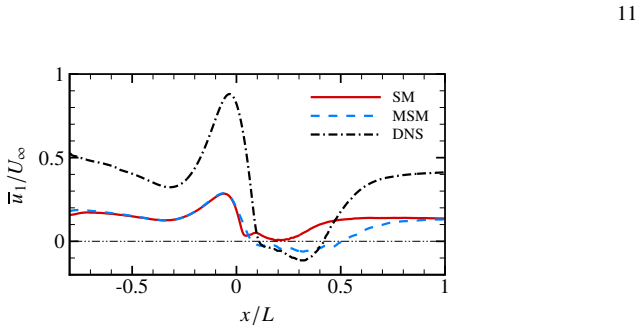
We examine the role of anisotropic subgrid-scale (SGS) stress in wall-modeled large-eddy simulation (WMLES) of flow over a spanwise-uniform Gaussian-shaped bump, with emphasis on predicting flow separation. The simulations show that eddy-viscosity-based SGS models often yield non-monotonic predictions of the mean separation bubble size on the leeward side under grid refinement, whereas models incorporating anisotropic SGS stress produce more consistent results. To identify where SGS anisotropy is most critical, we introduce anisotropic SGS stress in selected regions of the domain. The results reveal that the windward side, where a strong favorable pressure gradient (FPG) occurs, is crucial in determining downstream separation. Analysis of the Reynolds stress transport equation shows that fluctuations of anisotropic SGS stress modify SGS dissipation and diffusion in this region, thereby altering the Reynolds stress and the onset of separation. Examination of the mean streamwise momentum equation indicates that at coarse resolutions, the mean SGS shear stress dominates, and the differences between the eddy-viscosity-based and anisotropic models remain minor. With grid refinement, resolved Reynolds stresses increasingly govern the near-wall momentum transport, and the influence of SGS stress fluctuations grows as they determine the SGS dissipation and diffusion of Reynolds stresses. Component-wise analysis of the SGS stress tensor further shows that the improvement arises mainly from including significant normal stress contributions. An a priori study using filtered direct numerical simulation of turbulent Couette-Poiseuille flow confirms that wall-bounded turbulence under FPG is highly anisotropic and that anisotropic SGS models provide a more realistic SGS stress representation than eddy-viscosity-based models.
Editorial analysis
A structured set of objections, weighed in public.
Referee Report
Summary. The manuscript examines the role of anisotropic subgrid-scale (SGS) stress in wall-modeled large-eddy simulation (WMLES) of turbulent flow over a spanwise-uniform Gaussian bump. It reports that eddy-viscosity SGS models produce non-monotonic separation-bubble sizes under grid refinement, while anisotropic models yield more consistent results. Regional insertion of anisotropic stress identifies the windward favorable-pressure-gradient (FPG) region as critical; Reynolds-stress transport analysis links anisotropic SGS fluctuations to changes in SGS dissipation/diffusion and downstream separation; component-wise decomposition attributes the improvement mainly to normal-stress contributions. An a priori filtered-DNS study on Couette-Poiseuille flow under FPG is used to confirm that wall-bounded turbulence in FPG is highly anisotropic and that anisotropic models better represent the SGS stress.
Significance. If the central claim holds, the work would be significant for WMLES of separated flows: it supplies concrete numerical evidence that SGS anisotropy, particularly normal-stress components in FPG regions, can remove non-monotonic grid dependence in separation predictions. The regional-activation experiments and Reynolds-stress transport analysis are useful diagnostic tools that could be adopted more broadly. The a priori filtered-DNS check, while limited in scope, provides a falsifiable test of SGS anisotropy under FPG.
major comments (2)
- [a priori filtered DNS study] The a priori filtered-DNS study is performed on Couette-Poiseuille flow under FPG; this configuration lacks the bump curvature, adverse-pressure-gradient separation, and WMLES wall treatment of the target Gaussian-bump case. Consequently, the reported SGS anisotropy may not be representative of the anisotropy actually present in the WMLES, weakening the link between the a priori evidence and the main simulation results (abstract and a priori study section).
- [regional SGS insertion experiments] The regional SGS insertion experiments and the comparison between eddy-viscosity and anisotropic models do not explicitly state that all other model constants, numerical dissipation settings, and wall-model/SGS coupling parameters are identical. Without such controls, the observed monotonicity in separation-bubble size cannot be attributed unambiguously to the anisotropic stress tensor itself rather than to confounding differences in model formulation or dissipation (regional insertion experiments and grid-refinement studies).
minor comments (2)
- [grid-refinement studies] Quantitative error bars or uncertainty estimates on the reported separation-bubble lengths are not provided, making it difficult to judge the statistical significance of the monotonicity claim under refinement.
- [numerical methods] The manuscript would benefit from a short table summarizing the SGS model constants, filter widths, and wall-model parameters used for each simulation set to facilitate reproducibility.
Simulated Author's Rebuttal
We thank the referee for the constructive comments on our manuscript. We address each major comment below and indicate where revisions will be made to improve clarity and strengthen the presentation.
read point-by-point responses
-
Referee: [a priori filtered DNS study] The a priori filtered-DNS study is performed on Couette-Poiseuille flow under FPG; this configuration lacks the bump curvature, adverse-pressure-gradient separation, and WMLES wall treatment of the target Gaussian-bump case. Consequently, the reported SGS anisotropy may not be representative of the anisotropy actually present in the WMLES, weakening the link between the a priori evidence and the main simulation results (abstract and a priori study section).
Authors: We appreciate this point. The Couette-Poiseuille configuration was deliberately selected as a simplified, canonical wall-bounded flow that isolates the influence of a strong favorable pressure gradient on SGS anisotropy without the additional complexities of surface curvature or separation. While we acknowledge that this setup does not replicate the full bump geometry, adverse-pressure-gradient region, or wall-model implementation, it provides a controlled demonstration that wall-bounded turbulence under FPG is markedly anisotropic and that eddy-viscosity models under-represent the normal stress components. We will revise the a priori study section and abstract to explicitly state the rationale for this choice, note the differences from the target configuration, and clarify that the a priori results serve as supporting evidence rather than a direct replica of the WMLES conditions. revision: partial
-
Referee: [regional SGS insertion experiments] The regional SGS insertion experiments and the comparison between eddy-viscosity and anisotropic models do not explicitly state that all other model constants, numerical dissipation settings, and wall-model/SGS coupling parameters are identical. Without such controls, the observed monotonicity in separation-bubble size cannot be attributed unambiguously to the anisotropic stress tensor itself rather than to confounding differences in model formulation or dissipation (regional insertion experiments and grid-refinement studies).
Authors: We confirm that all regional insertion experiments and grid-refinement comparisons were performed with identical model constants, numerical dissipation settings, and wall-model/SGS coupling parameters; the sole difference was the form of the SGS stress tensor (eddy-viscosity versus anisotropic) within the designated regions. We regret that this was not stated explicitly and will add a dedicated paragraph in the methods section of the revised manuscript detailing these controls to remove any ambiguity. revision: yes
Circularity Check
No significant circularity detected; claims rest on independent numerical experiments and transport analysis
full rationale
The paper's derivation chain consists of WMLES runs with eddy-viscosity versus anisotropic SGS models, selective regional activation of anisotropy, direct analysis of the Reynolds-stress transport equation, mean-momentum balance, and a separate a priori filtered-DNS study on Couette-Poiseuille flow under FPG. None of these steps reduce by construction to fitted parameters, self-definitions, or self-citation chains; the reported consistency under refinement and the localization to normal-stress contributions are outcomes of the simulations themselves rather than tautological re-statements of the model inputs. The a priori confirmation is performed on an independent configuration and therefore supplies external evidence rather than circular support.
Axiom & Free-Parameter Ledger
axioms (2)
- standard math Filter commutes with derivatives in the LES equations
- domain assumption The filtered DNS of Couette-Poiseuille flow under FPG is representative of SGS anisotropy in the bump flow
Lean theorems connected to this paper
-
IndisputableMonolith/Cost/FunctionalEquation.leanwashburn_uniqueness_aczel unclear?
unclearRelation between the paper passage and the cited Recognition theorem.
models incorporating anisotropic SGS stress produce more consistent results... improvement arises mainly from including significant normal stress contributions
-
IndisputableMonolith/Foundation/AlexanderDuality.leanalexander_duality_circle_linking unclear?
unclearRelation between the paper passage and the cited Recognition theorem.
a priori study using filtered DNS of turbulent Couette-Poiseuille flow confirms... wall-bounded turbulence under FPG is highly anisotropic
What do these tags mean?
- matches
- The paper's claim is directly supported by a theorem in the formal canon.
- supports
- The theorem supports part of the paper's argument, but the paper may add assumptions or extra steps.
- extends
- The paper goes beyond the formal theorem; the theorem is a base layer rather than the whole result.
- uses
- The paper appears to rely on the theorem as machinery.
- contradicts
- The paper's claim conflicts with a theorem or certificate in the canon.
- unclear
- Pith found a possible connection, but the passage is too broad, indirect, or ambiguous to say the theorem truly supports the claim.
Reference graph
Works this paper leans on
-
[1]
, " * write output.state after.block = add.period write newline
ENTRY address author booktitle chapter edition editor howpublished institution journal key month note number organization pages publisher school series title type volume year eprint label extra.label sort.label short.list INTEGERS output.state before.all mid.sentence after.sentence after.block FUNCTION init.state.consts #0 'before.all := #1 'mid.sentence ...
-
[2]
" write newline "" before.all 'output.state := FUNCTION n.dashify 't := "" t empty not t #1 #1 substring "-" = t #1 #2 substring "--" = not "--" * t #2 global.max substring 't := t #1 #1 substring "-" = "-" * t #2 global.max substring 't := while if t #1 #1 substring * t #2 global.max substring 't := if while FUNCTION word.in bbl.in capitalize " " * FUNCT...
-
[3]
Abe, K. 2013 An improved anisotropy-resolving subgrid-scale model with the aid of a scale-similarity modeling concept . Int. J. Heat Fluid Flow 39 , 42--52
work page 2013
-
[4]
2014 An investigation of SGS stress anisotropy modeling in complex turbulent flow fields
Abe, K. 2014 An investigation of SGS stress anisotropy modeling in complex turbulent flow fields . Flow Turbul. Combust. 92 (1), 503--525
work page 2014
-
[5]
Abe, K. 2019 Notable effect of the subgrid-scale stress anisotropy on mean-velocity prediction through budget of the grid-scale Reynolds -shear stress . Phys. Fluids 31 (10), 105103
work page 2019
- [6]
-
[7]
Agrawal, R. , Whitmore, M. P. , Griffin, K. P. , Bose, S. T. & Moin, P. 2022 Non- B oussinesq subgrid-scale model with dynamic tensorial coefficients . Phys. Rev. Fluids 7 (7), 074602
work page 2022
- [8]
- [9]
-
[10]
Bae, H. J. , Lozano-Dur \'a n, A. , Bose, S. T. & Moin, P. 2018 Turbulence intensities in large-eddy simulation of wall-bounded flows . Phys. Rev. Fluids 3 (1), 014610
work page 2018
-
[11]
Bae, H. J. , Lozano-Dur \'a n, A. , Bose, S. T. & Moin, P. 2019 Dynamic slip wall model for large-eddy simulation . J. Fluid Mech. 859 , 400--432
work page 2019
-
[12]
Balin, R. & Jansen, K. E. 2021 Direct numerical simulation of a turbulent boundary layer over a bump with strong pressure gradients . J. Fluid Mech. 918 , A14
work page 2021
-
[13]
Bardina, J. 1983 Improved turbulence models based on large eddy simulation of homogeneous, incompressible turbulent flows\/ . Stanford University
work page 1983
-
[14]
Bhushan, S. & Warsi, Z. U. A. 2005 Large eddy simulation of turbulent channel flow using an algebraic model . Int. J. Numer. Methods Fluids 49 (5), 489--519
work page 2005
-
[15]
Bhushan, S. , Warsi, Z. U. A. & Walters, D. K. 2006 Modeling of energy backscatter via an algebraic subgrid-stress model . AIAA J. 44 (4), 837--847
work page 2006
-
[16]
Bose, S. T. & Moin, P. 2014 A dynamic slip boundary condition for wall-modeled large-eddy simulation . Phys. Fluids 26 (1), 015104
work page 2014
-
[17]
Bose, S. T. & Park, G. I. 2018 Wall-modeled large-eddy simulation for complex turbulent flows . Annu. Rev. Fluid Mech. 50 , 535--561
work page 2018
- [18]
- [19]
-
[20]
Cimarelli, A. , Leonforte, A. , De Angelis, E. , Crivellini, A. & Angeli, D. 2019 Resolved dynamics and subgrid stresses in separating and reattaching flows . Phys. Fluids 31 (9), 095101
work page 2019
-
[21]
Clark, R. A. , Ferziger, J. H. & Reynolds, W. C. 1979 Evaluation of subgrid-scale models using an accurately simulated turbulent flow . J. Fluid Mech. 91 (1), 1--16
work page 1979
-
[22]
Domaradzki, J. A. & Saiki, E. M. 1997 A subgrid-scale model based on the estimation of unresolved scales of turbulence . Phys. Fluids 9 (7), 2148--2164
work page 1997
-
[23]
Duraisamy, K. 2021 Perspectives on machine learning-augmented Reynolds -averaged and large eddy simulation models of turbulence . Phys. Rev. Fluids 6 (5), 050504
work page 2021
-
[24]
Gatski, T. B. & Jongen, T. 2000 Nonlinear eddy viscosity and algebraic stress models for solving complex turbulent flows . Prog. Aerosp. Sci. 36 (8), 655--682
work page 2000
- [25]
-
[26]
Goc, K. A. , Lehmkuhl, O. , Park, G. I. , Bose, S. T. & Moin, P. 2021 Large eddy simulation of aircraft at affordable cost: a milestone in computational fluid dynamics . Flow 1 , E14
work page 2021
-
[27]
Goc, K. A. , Moin, P. , Bose, S. T. & Clark, A. M. 2024 Wind tunnel and grid resolution effects in large-eddy simulations of the high-lift common research model . J. Aircr. 61 (1), 267--279
work page 2024
-
[28]
Gray, P. D. , Gluzman, I. , Thomas, F. O. & Corke, T. C. 2022 a\/ Experimental characterization of smooth body flow separation over wall-mounted G aussian bump. In AIAA Scitech 2022 Forum\/ , p. 1209
work page 2022
-
[29]
Gray, P. D. , Gluzman, I. , Thomas, F. O. , Corke, T. C. , Lakebrink, M. T. & Mejia, K. 2021 A new validation experiment for smooth-body separation. In AIAA Aviation 2021 Forum\/ , p. 2810
work page 2021
-
[30]
Gray, P. D. , Gluzman, I. , Thomas, F. O. , Corke, T. C. , Lakebrink, M. T. & Mejia, K. 2022 b\/ Benchmark characterization of separated flow over smooth G aussian bump. In AIAA Aviation 2022 Forum\/ , p. 3342
work page 2022
-
[31]
Haering, S. W. , Lee, M. & Moser, R. D. 2019 Resolution-induced anisotropy in large-eddy simulations . Phys. Rev. Fluids 4 (11), 114605
work page 2019
-
[32]
1997 A new dynamic two-parameter mixed model for large-eddy simulation
Horiuti, K. 1997 A new dynamic two-parameter mixed model for large-eddy simulation . Phys. Fluids 9 (11), 3443--3464
work page 1997
-
[33]
Horiuti, K. 2003 Roles of non-aligned eigenvectors of strain-rate and subgrid-scale stress tensors in turbulence generation . J. Fluid Mech. 491 , 65--100
work page 2003
-
[34]
Inagaki, K. & Kobayashi, H. 2020 Role of various scale-similarity models in stabilized mixed subgrid-scale model . Phys. Fluids 32 (7)
work page 2020
-
[35]
Inagaki, K. & Kobayashi, H. 2023 Analysis of anisotropic subgrid-scale stress for coarse large-eddy simulation . Phys. Rev. Fluids 8 (10), 104603
work page 2023
-
[36]
Iyer, P. S. & Malik, M. R. 2022 Wall-modeled LES of turbulent flow over a two dimensional G aussian bump. In Eleventh International Conference on Computational Fluid Dynamics\/ , p. 0204
work page 2022
-
[37]
Iyer, P. S. & Malik, M. R. 2024 Efficient dynamic mixed subgrid-scale model . Phys. Rev. Fluids 9 (9), L092601
work page 2024
-
[38]
Iyer, P. S. & Malik, M. R. 2025 Insights from targeted grid refinement for WMLES of turbulent smooth-body separation . Flow Turbul. Combust. 115 (4), 1435--1443
work page 2025
-
[39]
Jimenez, J. & Moser, R. D. 2000 Large-eddy simulations: where are we and what can we expect? AIAA J. 38 (4), 605--612
work page 2000
-
[40]
Kawai, S. & Larsson, J. 2013 Dynamic non-equilibrium wall-modeling for large eddy simulation at high R eynolds numbers . Phys. Fluids 25 (1), 015105
work page 2013
-
[41]
Kerr, R. M. , Domaradzki, J. A. & Barbier, G. 1996 Small-scale properties of nonlinear interactions and subgrid-scale energy transfer in isotropic turbulence . Phys. Fluids 8 (1), 197--208
work page 1996
-
[42]
Kobayashi, H. 2018 Improvement of the SGS model by using a scale-similarity model based on the analysis of SGS force and SGS energy transfer . Int. J. Heat Fluid Flow 72 , 329--336
work page 2018
-
[43]
Kobayashi, H. & Shimomura, Y. 2001 The performance of dynamic subgrid-scale models in the large eddy simulation of rotating homogeneous turbulence . Phys. Fluids 13 (8), 2350--2360
work page 2001
-
[44]
Larsson, J. , Kawai, S. , Bodart, J. & Bermejo-Moreno, I. 2016 Large eddy simulation with modeled wall-stress: recent progress and future directions . Mech. Eng. Rev. 3 (1), 15--00418
work page 2016
- [45]
-
[46]
Li, Y. & Meneveau, C. 2004 Analysis of mean momentum flux in subgrid models of turbulence . Phys. Fluids 16 (9), 3483--3486
work page 2004
-
[47]
Ling, Y. , Arranz, G. , Williams, E. , Goc, K. , Griffin, K. & Lozano-Dur \'a n, A. 2022 Wall-modeled large-eddy simulation based on building-block flows. In Proceedings of the 2022 Center for Turbulence Research Summer Program\/ , pp. 5--14
work page 2022
-
[48]
Liu, S. , Meneveau, C. & Katz, J. 1994 On the properties of similarity subgrid-scale models as deduced from measurements in a turbulent jet . J. Fluid Mech. 275 , 83--119
work page 1994
- [49]
-
[50]
Lund, T. S. & Novikov, E. A. 1992 Parameterization of subgrid-scale stress by the velocity gradient tensor. In Center for Turbulence Research Annual Research Briefs\/ , pp. 27--43
work page 1992
-
[51]
Lund, T. S. , Wu, X. & Squires, K. D. 1998 Generation of turbulent inflow data for spatially-developing boundary layer simulations . J. Comput. Phys. 140 (2), 233--258
work page 1998
-
[52]
Marstorp, L. , Brethouwer, G. , Grundestam, O. & Johansson, A. V. 2009 Explicit algebraic subgrid stress models with application to rotating channel flow . J. Fluid Mech. 639 , 403--432
work page 2009
-
[53]
1994 Statistics of turbulence subgrid-scale stresses: Necessary conditions and experimental tests
Meneveau, C. 1994 Statistics of turbulence subgrid-scale stresses: Necessary conditions and experimental tests . Phys. Fluids 6 (2), 815--833
work page 1994
- [54]
-
[55]
Montecchia, M. , Brethouwer, G. , Johansson, A. V. & Wallin, S. 2017 Taking large-eddy simulation of wall-bounded flows to higher R eynolds numbers by use of anisotropy-resolving subgrid models . Phys. Rev. Fluids 2 (3), 034601
work page 2017
-
[56]
Moser, R. D. , Haering, S. W. & Yalla, G. R. 2021 Statistical properties of subgrid-scale turbulence models . Annu. Rev. Fluid Mech. 53 (1), 255--286
work page 2021
-
[57]
Park, G. I. 2017 Wall-modeled large-eddy simulation of a high R eynolds number separating and reattaching flow . AIAA J. 55 (11), 3709--3721
work page 2017
-
[58]
Park, G. I. & Moin, P. 2014 An improved dynamic non-equilibrium wall-model for large eddy simulation . Phys. Fluids 26 (1), 015108
work page 2014
- [59]
-
[60]
Prakash, A. , Balin, R. , Evans, J. A. & Jansen, K. E. 2024 A streamline coordinate analysis of a turbulent boundary layer subject to pressure gradients and curvature on the windward side of a bump . J. Fluid Mech. 984 , A23
work page 2024
-
[61]
Rasam, A. , Wallin, S. , Brethouwer, G. & Johansson, A. V. 2017 Improving separated-flow predictions using an anisotropy-capturing subgrid-scale model . Int. J. Heat Fluid Flow 65 , 246--251
work page 2017
-
[62]
Rezaeiravesh, S. , Mukha, T. & Liefvendahl, M. 2019 Systematic study of accuracy of wall-modeled large eddy simulation using uncertainty quantification techniques . Comput. Fluids 185 , 34--58
work page 2019
-
[63]
Sarghini, F. , Piomelli, U. & Balaras, E. 1999 Scale-similar models for large-eddy simulations . Phys. Fluids 11 (6), 1596--1607
work page 1999
-
[64]
Silvis, M. H. & Verstappen, R. 2019 Nonlinear subgrid-scale models for large-eddy simulation of rotating turbulent flows . In Direct and large-eddy simulation XI\/ , pp. 129--134 . Springer
work page 2019
-
[65]
Slotnick, J. P. 2019 Integrated CFD validation experiments for prediction of turbulent separated flows for subsonic transport aircraft. In Separated Flow: Prediction, Measurement and Assessment for Air and Sea Vehicles, STO Publication STO-MP-AVT-307-06\/
work page 2019
-
[66]
1963 General circulation experiments with the primitive equations: I
Smagorinsky, J. 1963 General circulation experiments with the primitive equations: I. the basic experiment . Mon. Weather Rev. 91 (3), 99--164
work page 1963
-
[67]
Spalart, P. , Jansen, K. & Coleman, G. 2024 Direct numerical simulation of two boundary layers with the same pressure distribution but different surface curvatures . arXiv preprint arXiv:2409.00555
-
[68]
Uzun, A. & Malik, M. R. 2022 High-fidelity simulation of turbulent flow past G aussian bump . AIAA J. 60 (4), 2130--2149
work page 2022
-
[69]
Uzun, A. & Malik, M. R. 2025 Application of a new nonlinear subgrid-scale model to a G aussian bump flow . AIAA J. 63 (1), 354--360
work page 2025
-
[70]
Vollant, A. , Balarac, G. & Corre, C. 2016 A dynamic regularized gradient model of the subgrid-scale stress tensor for large-eddy simulation . Phys. Fluids 28 (2), 025114
work page 2016
-
[71]
Van der Vorst, H. A. 1992 B i - CGSTAB : A fast and smoothly converging variant of B i - CG for the solution of nonsymmetric linear systems . SIAM J. Sci. Comput. 13 (2), 631--644
work page 1992
-
[72]
Vreman, B. , Geurts, B. & Kuerten, H. 1994 On the formulation of the dynamic mixed subgrid-scale model . Phys. Fluids 6 (12), 4057--4059
work page 1994
-
[73]
Vreman, B. , Geurts, B. & Kuerten, H. 1997 Large-eddy simulation of the turbulent mixing layer . J. Fluid Mech. 339 , 357--390
work page 1997
-
[74]
Wang, B. & Bergstrom, D. J. 2005 A dynamic nonlinear subgrid-scale stress model . Phys. Fluids 17 (3), 035109
work page 2005
- [75]
-
[76]
Whitmore, M. P. , Griffin, K. P. , Bose, S. T. & Moin, P. 2021 Large-eddy simulation of a G aussian bump with slip-wall boundary conditions. In Center for Turbulence Research Annual Research Briefs\/ , pp. 45--58
work page 2021
-
[77]
Whitmore, M. P. , Lozano-Dur \'a n, A. & Moin, P. 2020 Requirements and sensitivity analysis of RANS -free wall-modeled LES . In Center for Turbulence Research Annual Research Briefs\/ , pp. 97--108
work page 2020
-
[78]
Williams, O. , Samuell, M. , Sarwas, E. S. , Robbins, M. & Ferrante, A. 2020 Experimental study of a CFD validation test case for turbulent separated flows. In AIAA Scitech 2020 Forum\/ , p. 0092
work page 2020
-
[79]
Xu, N. & Bermejo-Moreno, I. 2024 Wall-modeled large-eddy simulations of the flow over a G aussian-shaped bump with a sensor-based blended wall model . Phys. Rev. Fluids 9 (11), 114605
work page 2024
- [80]
discussion (0)
Sign in with ORCID, Apple, or X to comment. Anyone can read and Pith papers without signing in.