Robust Algorithms for Finding Cliques in Random Intersection Graphs via Sum-of-Squares
Pith reviewed 2026-05-17 04:52 UTC · model grok-4.3
The pith
Sum-of-squares algorithms recover exact and approximate community structure in random intersection graphs with overlapping planted cliques when k greatly exceeds the square root of n log n, and they tolerate noise and edge corruptions.
A machine-rendered reading of the paper's core claim, the machinery that carries it, and where it could break.
Core claim
The central claim is that the sum-of-squares hierarchy yields the first efficient algorithms for recovering the community structure of random intersection graphs, delivering both exact and approximate recovery. These algorithms remain robust to noise, monotone adversaries, and an optimal number of edge corruptions, and they succeed whenever k ≫ √(n log n). The approach follows the proofs-to-algorithms framework by using an appropriate degree of the hierarchy to certify the planted structure under the model's density and overlap conditions.
What carries the argument
The sum-of-squares hierarchy of appropriate degree, used through the proofs-to-algorithms paradigm to produce a semidefinite program that certifies the identities of the planted overlapping cliques inside the random intersection graph.
If this is right
- Exact recovery of every planted clique becomes possible once the size condition is met.
- Approximate recovery of the overlapping community structure succeeds under the same density regime.
- The algorithms continue to work correctly after a bounded number of arbitrary edge corruptions.
- Robustness carries over to monotone adversaries that may add edges in any way that preserves the planted structure.
Where Pith is reading between the lines
- The same certification technique might transfer to other random graph models that feature overlapping dense subgraphs rather than strict cliques.
- The appearance of the square-root-of-n-log-n threshold hints at a possible information-theoretic barrier that could be confirmed by constructing matching lower bounds.
- Practical implementations could test the method on synthetic networks that mimic social or biological data with known overlapping groups.
Load-bearing premise
The generative model plants the cliques independently with each vertex included according to probability δ, and the sum-of-squares program of suitable degree can be solved efficiently while still certifying the planted communities despite overlaps.
What would settle it
Generating random instances with k set near the square root of n log n and checking whether the sum-of-squares relaxation fails to output the correct communities or fails to certify them would directly test whether the claimed recovery threshold holds.
Figures

read the original abstract
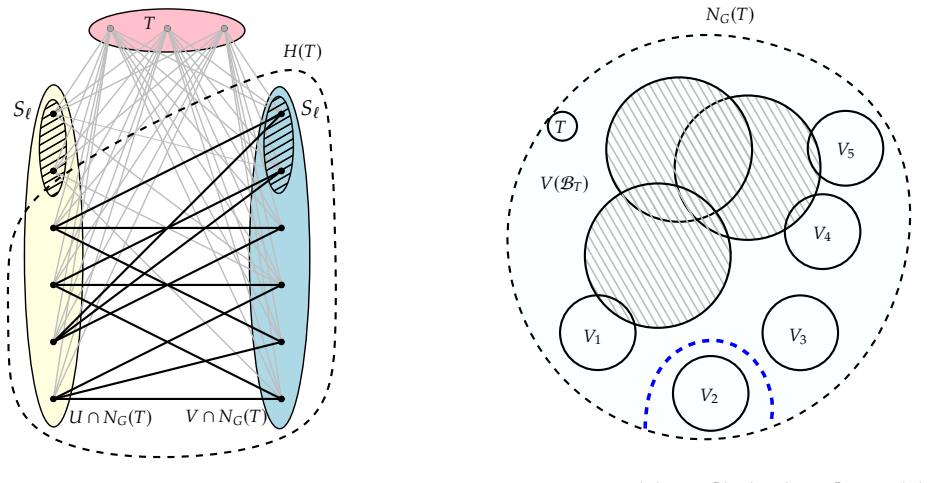
We study efficient algorithms for recovering cliques in dense random intersection graphs (RIGs). In this model, $d = n^{\Omega(1)}$ cliques of size approximately $k$ are randomly planted by choosing the vertices to participate in each clique independently with probability $\delta$. While there has been extensive work on recovering one, or multiple disjointly planted cliques in random graphs, the natural extension of this question to recovering overlapping cliques has been, surprisingly, largely unexplored. Moreover, because every vertex can be part of polynomially many cliques, this task is significantly more challenging than in case of disjointly planted cliques (as recently studied by Kothari, Vempala, Wein and Xu [COLT'23]). In this work we obtain the first efficient algorithms for recovering the community structure of RIGs both from the perspective of exact and approximate recovery. Our algorithms are further robust to noise, monotone adversaries, and a certain, optimal number of edge corruptions. They work whenever $k \gg \sqrt{n \log(n)}$. Our techniques follow the proofs-to-algorithms framework utilizing the sum-of-squares hierarchy.
Editorial analysis
A structured set of objections, weighed in public.
Referee Report
Summary. The manuscript develops the first efficient algorithms for recovering overlapping planted cliques in dense random intersection graphs (RIGs), where d = n^Ω(1) cliques of size ~k are planted independently with vertex-inclusion probability δ. Using the sum-of-squares hierarchy, the algorithms achieve both exact and approximate recovery of the community structure and remain robust to noise, monotone adversaries, and an optimal number of edge corruptions, succeeding whenever k ≫ √(n log n).
Significance. If the central claims hold, the work extends the proofs-to-algorithms paradigm from disjoint to overlapping cliques in RIGs, addressing a previously unexplored regime. The robustness guarantees and the threshold k ≫ √(n log n) align with known SOS thresholds in related community-recovery settings, potentially strengthening the toolkit for intersection-graph models.
minor comments (2)
- [Abstract] Abstract and §1: the phrase 'a certain, optimal number of edge corruptions' is used without stating the precise corruption fraction or the corresponding theorem; adding an explicit bound (e.g., o(k^2 / n) or similar) would clarify the robustness claim.
- Theorem statements (presumably §3–4): the degree of the SOS relaxation is not stated explicitly in the main recovery guarantees. Because runtime and sample complexity depend on this degree, it should appear in the theorem hypotheses.
Simulated Author's Rebuttal
We thank the referee for their positive summary of our work and for recommending minor revision. The report does not list any specific major comments to address.
Circularity Check
No significant circularity identified
full rationale
The derivation follows the standard proofs-to-algorithms paradigm by applying the sum-of-squares hierarchy to recover overlapping planted cliques in the RIG model. The paper introduces new analysis for the overlapping case, robustness to monotone adversaries and edge corruptions, and the regime k ≫ √(n log n), without reducing any target guarantee to a fitted parameter, self-defined quantity, or load-bearing self-citation. The cited prior work on disjoint cliques is by different authors and serves as contrast rather than foundational input. The central claims remain independent of the paper's own fitted values or renamings.
Axiom & Free-Parameter Ledger
axioms (2)
- domain assumption Cliques are planted independently by including each vertex with probability δ
- domain assumption The sum-of-squares hierarchy of suitable degree can be solved in polynomial time and certifies the planted structure
Reference graph
Works this paper leans on
-
[1]
Community detection and stochastic block models.arXiv preprint arXiv:1703.10146, 2017
Emmanuel Abbe. Community detection and stochastic block models.arXiv preprint arXiv:1703.10146, 2017. 15
-
[2]
Emmanuel Abbe and Colin Sandon. Community detection in general stochastic block models: Fundamental limits and efficient algorithms for recovery. In2015 IEEE 56th annual symposium on foundations of computer science, pages 670–688. IEEE, 2015. 15
work page 2015
-
[3]
Hamzeh Agahi, Yao Ouyang, Radko Mesiar, Endre Pap, and Mirjana Štrboja. Hölder and minkowski type inequalities for pseudo-integral.Applied Mathematics and Computation, 217(21):8630–8639, 2011. 30
work page 2011
-
[4]
Noga Alon, Michael Krivelevich, and Benny Sudakov. Finding a large hidden clique in a random graph.Random Structures & Algorithms, 13(3-4):457–466, 1998. 1, 7 71
work page 1998
-
[5]
BrendanP.W.AmesandStephenAVavasis. Nuclearnormminimizationfortheplantedclique and biclique problems.Mathematical programming, 129(1):69–89, 2011. 1
work page 2011
-
[6]
Arash A. Amini and Elizaveta Levina. On semidefinite relaxations for the block model.The Annals of Statistics, 46(1):149 – 179, 2018.doi:10.1214/17-AOS1545. 15
-
[7]
Atensorspectralapproach to learning mixed membership community models
AnimashreeAnandkumar,RongGe,DanielHsu,andShamKakade. Atensorspectralapproach to learning mixed membership community models. InProceedings of the 26th Annual Conference on Learning Theory, page 867–881. PMLR, 2013. URL:https://proceedings.mlr.press/v30/ Anandkumar13.html. 5, 15, 16, 17
work page 2013
-
[8]
Samuel Baguley, Andreas Göbel, Marcus Pappik, and Leon Schiller. Testing thresholds and spectral properties of high-dimensional random toroidal graphs via edgeworth-style expansions. InProceedings of Thirty Eighth Conference on Learning Theory, page 200–201. PMLR,
-
[9]
URL:https://proceedings.mlr.press/v291/baguley25a.html. 7
-
[10]
Ainesh Bakshi, Ilias Diakonikolas, Samuel B. Hopkins, Daniel Kane, Sushrut Karmalkar, and Pravesh K. Kothari. Outlier-Robust Clustering of Gaussians and Other Non- Spherical Mixtures . In2020 IEEE 61st Annual Symposium on Foundations of Computer Science (FOCS), pages 149–159, Los Alamitos, CA, USA, November 2020. IEEE Computer Society. URL: https://doi.ie...
-
[11]
Kiril Bangachev and Guy Bresler. On the fourier coefficients of high-dimensional random geometricgraphs.InProceedingsofthe56thAnnualACMSymposiumonTheoryofComputing,STOC 2024, page 549–560, New York, NY, USA, 2024. Association for Computing Machinery. URL: https://dl.acm.org/doi/10.1145/3618260.3649676,doi:10.1145/3618260.3649676. 7
-
[12]
Kothari, Ankur Moitra, and Aaron Potechin
Boaz Barak, Samuel Hopkins, Jonathan Kelner, Pravesh K. Kothari, Ankur Moitra, and Aaron Potechin. A nearly tight sum-of-squares lower bound for the planted clique problem.SIAM Journal on Computing, 48(2):687–735, January 2019.doi:10.1137/17M1138236. 1, 14
-
[13]
2019.09.018,doi:10.1016/J.TCS.2019.09.018
Michael Behrisch and Anusch Taraz. Efficiently covering complex networks with cliques of similar vertices.Theoretical Computer Science, 355(1):37–47, April 2006.doi:10.1016/j.tcs. 2005.12.005. 2, 3, 81
-
[14]
Michael Behrisch, Anusch Taraz, and Michael Ueckerdt. Coloring random intersection graphs and complex networks.SIAM Journal on Discrete Mathematics, 23(1):288–299, 2009. 2, 3
work page 2009
-
[15]
Semirandom planted clique and the restricted isometry property
Jarosław Błasiok, Rares-Darius Buhai, Pravesh K Kothari, and David Steurer. Semirandom planted clique and the restricted isometry property. In2024 IEEE 65th Annual Symposium on Foundations of Computer Science (FOCS), pages 959–969. IEEE, 2024. 1, 2
work page 2024
-
[16]
Non-backtracking spectrum of random graphs: community detection and non-regular ramanujan graphs
Charles Bordenave, Marc Lelarge, and Laurent Massoulié. Non-backtracking spectrum of random graphs: community detection and non-regular ramanujan graphs. In2015 IEEE 56th Annual Symposium on Foundations of Computer Science, pages 1347–1357. IEEE, 2015. 15
work page 2015
-
[17]
Reducibilityandstatistical-computationalgapsfromsecret leakage
MatthewBrennanandGuyBresler. Reducibilityandstatistical-computationalgapsfromsecret leakage. InConference on Learning Theory, pages 648–847. PMLR, 2020. 1 72
work page 2020
-
[18]
Reducibility and computational lower bounds for problems with planted sparse structure
Matthew Brennan, Guy Bresler, and Wasim Huleihel. Reducibility and computational lower bounds for problems with planted sparse structure. InConference On Learning Theory, pages 48–166. PMLR, 2018. 1
work page 2018
-
[19]
Matthew Brennan, Guy Bresler, and Dheeraj Nagaraj. Phase transitions for detecting latent geometry in random graphs.Probability Theory and Related Fields, 178(3):1215–1289, December 2020.doi:10.1007/s00440-020-00998-3. 5
-
[20]
Algorithmic decorrelation and planted clique in dependent random graphs: the case of extra triangles
Guy Bresler, Chenghao Guo, and Yury Polyanskiy. Algorithmic decorrelation and planted clique in dependent random graphs: the case of extra triangles. In2023 IEEE 64th Annual Symposium on Foundations of Computer Science (FOCS), pages 2149–2158. IEEE, 2023. 1
work page 2023
-
[21]
Thresholds for reconstruction of random hypergraphsfromgraphprojections
Guy Bresler, Chenghao Guo, and Yury Polyanskiy. Thresholds for reconstruction of random hypergraphsfromgraphprojections. InTheThirtySeventhAnnualConferenceonLearningTheory, pages 632–647. PMLR, 2024. 5, 6
work page 2024
-
[22]
Guy Bresler, Chenghao Guo, Yury Polyanskiy, and Andrew Yao. Partial and exact recovery of a random hypergraph from its graph projection.arXiv preprint arXiv:2502.14988, 2025. 3, 5, 6
-
[23]
Rares-Darius Buhai, Pravesh K. Kothari, and David Steurer. Algorithms approaching the thresholdforsemi-randomplantedclique. InSTOC’23,2023. doi:10.1145/3564246.3585184. 1, 2, 8, 9, 19, 31, 32, 33, 45, 47
-
[24]
Improved robust estimation for erdős-rényi graphs: The sparse regime and optimal breakdown point
Hongjie Chen, Jingqiu Ding, Yiding Hua, and Stefan Tiegel. Improved robust estimation for erdős-rényi graphs: The sparse regime and optimal breakdown point. (arXiv:2503.03923), March2025. arXiv:2503.03923[cs]. URL:http://arxiv.org/abs/2503.03923, doi:10.48550/ arXiv.2503.03923. 7
-
[25]
Yudong Chen and Jiaming Xu. Statistical-computational tradeoffs in planted problems and submatrix localization with a growing number of clusters and submatrices.Journal of Machine Learning Research, 17(27):1–57, 2016. 1
work page 2016
-
[26]
Filippos Christodoulou, Sotiris Nikoletseas, Christoforos Raptopoulos, and Paul G. Spirakis. A spectral algorithm for finding maximum cliques in dense random intersection graphs. In Leszek Gąsieniec, editor,SOFSEM 2023: Theory and Practice of Computer Science, page 18–32, Cham, 2023. Springer International Publishing.doi:10.1007/978-3-031-23101-8_2. 2, 3
-
[27]
Amin Coja-Oghlan. Graph partitioning via adaptive spectral techniques.Combinatorics, Probability and Computing, 19(2):227–284, 2010. 15
work page 2010
-
[28]
Yael Dekel, Ori Gurel-Gurevich, and Yuval Peres. Finding hidden cliques in linear time with high probability.Combinatorics, Probability and Computing, 23(1):29–49, 2014. 1
work page 2014
-
[29]
Yash Deshpande and Andrea Montanari. Finding hidden cliques of size n/e in nearly linear time.Foundations of Computational Mathematics, 15(4):1069–1128, 2015. 1
work page 2015
-
[30]
Improved sum-of-squares lower bounds for hidden cliqueandhiddensubmatrixproblems
Yash Deshpande and Andrea Montanari. Improved sum-of-squares lower bounds for hidden cliqueandhiddensubmatrixproblems. InConferenceonLearningTheory,pages523–562.PMLR,
-
[31]
[JS21] Wenyu Jin and Xiaorui Sun
JingqiuDing,TommasoD’Orsi,RajaiNasser,andDavidSteurer. Robustrecoveryforstochastic block models. page 387–394. IEEE Computer Society, February 2022. URL:https://www. computer.org/csdl/proceedings-article/focs/2022/205500a387/1BtfG9j304g, doi:10. 1109/FOCS52979.2021.00046. 17
-
[32]
Uriel Feige and Vadim Grinberg. How to hide a clique?Theory of Computing Systems, 68(4):773–813, August 2024.doi:10.1007/s00224-024-10167-x. 2, 80
-
[33]
Uriel Feige and Joe Kilian. Heuristics for semirandom graph problems.Journal of Computer and System Sciences, 63(4):639–671, 2001. 3
work page 2001
-
[34]
Uriel Feige and Robert Krauthgamer. Finding and certifying a large hidden clique in a semirandom graph.Random Structures and Algorithms, 16(2):195–208, 2000. 1
work page 2000
-
[35]
Uriel Feige and Dorit Ron. Finding hidden cliques in linear time.Discrete Mathematics & Theoretical Computer Science, (Proceedings), 2010. 1
work page 2010
-
[36]
Vitaly Feldman, Elena Grigorescu, Lev Reyzin, Santosh S Vempala, and Ying Xiao. Statistical algorithms and a lower bound for detecting planted cliques.Journal of the ACM (JACM), 64(2):1–37, 2017. 1
work page 2017
-
[37]
Noah Fleming, Pravesh Kothari, and Toniann Pitassi. Semialgebraic proofs and efficient algorithm design.Foundations and Trends®in Theoretical Computer Science, 14(1–2):1–221, December 2019.doi:10.1561/0400000086. 6, 29
-
[38]
Olivier Guédon and Roman Vershynin. Community detection in sparse networks via grothendieck’s inequality.Probability Theory and Related Fields, 165(3):1025–1049, 2016. 15
work page 2016
-
[39]
Computational lower bounds for community detection on random graphs
Bruce Hajek, Yihong Wu, and Jiaming Xu. Computational lower bounds for community detection on random graphs. InConference on Learning Theory, pages 899–928. PMLR, 2015. 1
work page 2015
-
[40]
Johan Høastad. Clique is hard to approximate within n1tildeeps.Acta Mathematica, 182(1):105–142, January 1999.doi:10.1007/BF02392825. 1
-
[41]
Samuel B Hopkins, Pravesh Kothari, Aaron Henry Potechin, Prasad Raghavendra, and Tselil Schramm. On the integrality gap of degree-4 sum of squares for planted clique.ACM Transactions on Algorithms (TALG), 14(3):1–31, 2018. 1
work page 2018
-
[42]
Samuel B. Hopkins and David Steurer. Efficient bayesian estimation from few sam- ples: Community detection and related problems. page 379–390. IEEE Computer Society, October 2017. URL:https://www.computer.org/csdl/proceedings-article/focs/2017/ 3464a379/12OmNxWLTst,doi:10.1109/FOCS.2017.42. 5, 15, 16, 17
-
[43]
Large cliques elude the metropolis process.Random Structures & Algorithms, 3(4):347–359, 1992
Mark Jerrum. Large cliques elude the metropolis process.Random Structures & Algorithms, 3(4):347–359, 1992. 1
work page 1992
-
[44]
On the computational complexity of combinatorial problems.Networks, 5(1):45–68, 1975
Richard M Karp. On the computational complexity of combinatorial problems.Networks, 5(1):45–68, 1975. 1 74
work page 1975
-
[45]
Achim Klenke.Probability theory: a comprehensive course. Springer, 2008. 76
work page 2008
-
[46]
Pravesh Kothari, Santosh S Vempala, Alexander S Wein, and Jeff Xu. Is planted coloring easier than planted clique? InThe Thirty Sixth Annual Conference on Learning Theory, pages 5343–5372. PMLR, 2023. 1, 2, 5, 78
work page 2023
-
[47]
PraveshKothari,SantoshS.Vempala,AlexanderS.Wein,andJeffXu. Isplantedcoloringeasier thanplantedclique? InProceedingsofThirtySixthConferenceonLearningTheory,page5343–5372. PMLR, 2023. URL:https://proceedings.mlr.press/v195/kothari23a.html. 14
work page 2023
-
[48]
FlorentKrzakala,CristopherMoore,ElchananMossel,JoeNeeman,AllanSly,LenkaZdeborová, and Pan Zhang. Spectral redemption in clustering sparse networks.Proceedings of the National Academy of Sciences, 110(52):20935–20940, 2013. 15
work page 2013
-
[49]
Luděk Kučera. Expected complexity of graph partitioning problems.Discrete Applied Mathe- matics, 57(2-3):193–212, 1995. 1
work page 1995
-
[50]
New positive semidefinite relaxations for nonconvex quadratic programs
Jean B Lasserre. New positive semidefinite relaxations for nonconvex quadratic programs. In Advances in Convex Analysis and Global Optimization: Honoring the Memory of C. Caratheodory (1873–1950), pages 319–331. Springer, 2001. 30, 51
work page 1950
-
[51]
Can M. Le. Estimating community structure in networks by spectral methods. 2016. URL: https://hdl.handle.net/2027.42/133258. 7
work page 2016
-
[52]
The fundamental limits of recovering planted subgraphs.arXiv preprint arXiv:2503.15723, 2025
Daniel Lee, Francisco Pernice, Amit Rajaraman, and Ilias Zadik. The fundamental limits of recovering planted subgraphs.arXiv preprint arXiv:2503.15723, 2025. 1
-
[53]
Spectral clustering in the gaussian mixture block model
Shuangping Li and Tselil Schramm. Spectral clustering in the gaussian mixture block model. (arXiv:2305.00979), April 2024. arXiv:2305.00979 [stat]. URL:http://arxiv.org/abs/2305. 00979,doi:10.48550/arXiv.2305.00979. 7
-
[54]
Perfect recovery for random geometric graph matching with shallow graph neural networks
Suqi Liu and Morgane Austern. Perfect recovery for random geometric graph matching with shallow graph neural networks. InProceedings of The 28th International Conference on Artificial Intelligence and Statistics, page 910–918. PMLR, April 2025. URL:https://proceedings.mlr. press/v258/liu25c.html. 5
work page 2025
-
[55]
Xueyu Mao, Purnamrita Sarkar, and Deepayan Chakrabarti. Estimating mixed mem- berships with sharp eigenvector deviations.Journal of the American Statistical Associa- tion, 116(536):1928–1940, 2021.arXiv:https://doi.org/10.1080/01621459.2020.1751645, doi:10.1080/01621459.2020.1751645. 15
-
[56]
Spectral partitioning of random graphs
Frank McSherry. Spectral partitioning of random graphs. InProceedings 42nd IEEE Symposium on Foundations of Computer Science, pages 529–537. IEEE, 2001. 1
work page 2001
-
[57]
Sum-of-squares lower bounds for planted clique
Raghu Meka, Aaron Potechin, and Avi Wigderson. Sum-of-squares lower bounds for planted clique. InProceedings of the forty-seventh annual ACM symposium on Theory of computing, pages 87–96, 2015. 1 75
work page 2015
-
[58]
Sidhanth Mohanty, Prasad Raghavendra, and David X. Wu. Robust recovery for stochastic block models, simplified and generalized. InProceedings of the 56th Annual ACM Symposium on Theory of Computing, STOC 2024, page 367–374, New York, NY, USA, 2024. Association forComputingMachinery. URL: https://dl.acm.org/doi/10.1145/3618260.3649761, doi: 10.1145/3618260...
-
[59]
AnkurMoitra,WilliamPerry,andAlexanderS.Wein. Howrobustarereconstructionthresholds for community detection? InProceedings of the forty-eighth annual ACM symposium on Theory of Computing, STOC ’16, page 828–841, New York, NY, USA, 2016. Association for Computing Machinery.doi:10.1145/2897518.2897573. 2, 71
-
[60]
Semidefinite programs on sparse random graphs and their application to community detection
Andrea Montanari and Subhabrata Sen. Semidefinite programs on sparse random graphs and their application to community detection. InProceedings of the forty-eighth annual ACM symposium on Theory of Computing, pages 814–827, 2016. 15
work page 2016
-
[61]
Elchanan Mossel, Joe Neeman, and Allan Sly. Reconstruction and estimation in the planted partition model.Probability Theory and Related Fields, 162(3):431–461, 2015. 15
work page 2015
-
[62]
Squared functional systems and optimization problems
Yurii Nesterov. Squared functional systems and optimization problems. InHigh performance optimization, pages 405–440. Springer, 2000. 30, 51
work page 2000
-
[63]
Sotiris E. Nikoletseas, Christoforos L. Raptopoulos, and Paul G. Spirakis. Maximum cliques in graphs with small intersection number and random intersection graphs. InMFCS’12, 2012. doi:10.1007/978-3-642-32589-2\_63. 4, 6, 7, 14, 38
-
[64]
Sotiris E Nikoletseas, Christoforos L Raptopoulos, and Paul G Spirakis. Maximum cliques in graphs with small intersection number and random intersection graphs.Computer Science Review, 39:100353, 2021. 2, 3, 4, 7
work page 2021
-
[65]
California Institute of Technology, 2000
Pablo A Parrilo.Structured semidefinite programs and semialgebraic geometry methods in robustness and optimization. California Institute of Technology, 2000. 30, 51
work page 2000
-
[66]
Tselil Schramm and Alexander S Wein. Computational barriers to estimation from low-degree polynomials.The Annals of Statistics, 50(3):1833–1858, 2022. 1
work page 2022
-
[67]
Se-Young Yun and Alexandre Proutiere. Optimal cluster recovery in the labeled stochastic block model.Advances in Neural Information Processing Systems, 29, 2016. 15
work page 2016
-
[68]
David Zuckerman. Linear degree extractors and the inapproximability of max clique and chromatic number. InProceedings of the thirty-eighth annual ACM symposium on Theory of computing, pages 681–690, 2006. 1 A Lower bound on the spectral gap of RIGs In this section we prove the lower-bound on the spectral norm of the centered adjacency matrix of a random i...
work page 2006
discussion (0)
Sign in with ORCID, Apple, or X to comment. Anyone can read and Pith papers without signing in.