LatencyScope: A System-Level Mathematical Framework for 5G RAN Latency
Pith reviewed 2026-05-21 19:22 UTC · model grok-4.3
The pith
LatencyScope computes accurate 5G RAN latencies by modeling all major delay sources across the protocol stack and their dependencies.
A machine-rendered reading of the paper's core claim, the machinery that carries it, and where it could break.
Core claim
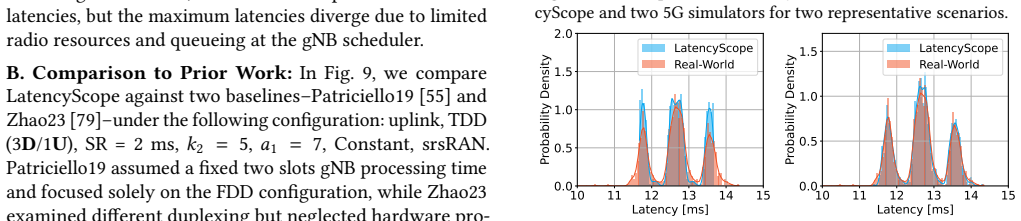
LatencyScope models latency sources across the 5G protocol stack, including radio interfaces, scheduling decisions, processing delays, frame structures, and hardware and software constraints, while capturing dependencies among configuration parameters and stochastic sources of delay. The framework computes one-way uplink and downlink latencies for diverse system configurations and includes a configuration analyzer that identifies settings satisfying latency-reliability targets. When validated on two open-source 5G RAN testbeds and measurements from a public commercial network, it closely matches empirical latency distributions, captures observed bounds, and outperforms prior models and simul
What carries the argument
LatencyScope, the mathematical model integrating latency contributions from across the protocol stack with their interdependencies and stochastic elements to enable precise latency calculation and configuration search.
Load-bearing premise
The modeled latency sources across the protocol stack plus their dependencies and stochastic elements are sufficient to reproduce real-world latency behavior without significant unmodeled effects.
What would settle it
A test where measured latency distributions in a 5G network fall outside the bounds predicted by LatencyScope or show systematic deviations not accounted for by the stochastic models in the framework.
Figures




read the original abstract
This paper presents LatencyScope, a mathematical framework for computing one-way uplink and downlink latency in fifth-generation radio access networks across diverse system configurations. LatencyScope models latency sources across the protocol stack, including radio interfaces, scheduling decisions, processing delays, frame structures, and hardware and software constraints, while capturing dependencies among configuration parameters and stochastic sources of delay. The framework also includes a configuration analyzer that uses these models to search billions of candidate settings and identify those that satisfy latency-reliability targets under user-specified constraints. We validate LatencyScope on two open-source fifth-generation radio access network testbeds, as well as on measurements from a public commercial fifth-generation network. The results show that LatencyScope closely matches empirical latency distributions, captures observed lower and upper latency bounds, and substantially outperforms prior analytical models and widely used fifth-generation network simulators. LatencyScope can determine whether ultra-reliable low-latency communication targets are feasible for a given deployment and, when they are feasible, efficiently find satisfying configurations, helping network operators reason about latency modeling, configuration analysis, and system-level bottlenecks.
Editorial analysis
A structured set of objections, weighed in public.
Referee Report
Summary. The paper presents LatencyScope, a mathematical framework for computing one-way uplink and downlink latency in 5G radio access networks. It models latency sources including radio interfaces, scheduling, processing delays, frame structures, and hardware/software constraints, along with their dependencies and stochastic elements. The framework includes a configuration analyzer to search for settings satisfying latency-reliability targets. Validation on two open-source 5G RAN testbeds and commercial network measurements shows close matches to empirical latency distributions, capture of bounds, and outperformance over prior analytical models and simulators.
Significance. If the validation demonstrates that the modeled latency sources are sufficient and parameters are not tuned to the validation data, LatencyScope could be a significant contribution for network operators and researchers in assessing and optimizing 5G configurations for ultra-reliable low-latency communication (URLLC) targets. It provides a system-level approach that goes beyond component-wise analysis and could reduce reliance on full-scale simulations.
major comments (2)
- [Validation results] Validation section: The central claim that LatencyScope closely matches empirical latency distributions, captures observed bounds, and substantially outperforms prior models rests on comparisons to measurements from two open-source testbeds and a commercial network. The manuscript does not clarify whether parameters (e.g., processing delay distributions, scheduling probabilities, or hardware constraints) are derived exclusively from 3GPP specifications and first principles or adjusted using the same empirical data. If any calibration to validation measurements occurred, the reported match would be consistent with in-sample fitting rather than an independent test of whether unmodeled effects are negligible.
- [Mathematical framework] Model formulation: The framework claims to capture dependencies among configuration parameters and stochastic delay sources. The description does not specify the exact mathematical structure used to combine these (e.g., whether total latency is expressed as a sum of independent random variables, a joint distribution, or a queueing model with explicit conditioning), which is load-bearing for the claimed ability to reproduce lower and upper latency bounds.
minor comments (2)
- [Abstract] The abstract states outperformance versus 'prior analytical models and widely used fifth-generation network simulators' without naming the specific baselines (e.g., which simulators or which prior latency models). Adding these names would improve context.
- [Throughout] Notation for latency components and configuration parameters should be introduced once with a clear table or list of symbols to avoid ambiguity when the analyzer searches billions of candidate settings.
Simulated Author's Rebuttal
We thank the referee for the constructive comments. We address each major point below with clarifications and note revisions that will be incorporated in the revised manuscript.
read point-by-point responses
-
Referee: [Validation results] Validation section: The central claim that LatencyScope closely matches empirical latency distributions, captures observed bounds, and substantially outperforms prior models rests on comparisons to measurements from two open-source testbeds and a commercial network. The manuscript does not clarify whether parameters (e.g., processing delay distributions, scheduling probabilities, or hardware constraints) are derived exclusively from 3GPP specifications and first principles or adjusted using the same empirical data. If any calibration to validation measurements occurred, the reported match would be consistent with in-sample fitting rather than an independent test of whether unmodeled effects are negligible.
Authors: We agree that explicit clarification on parameter sources is necessary to establish the validation as an independent test. All parameters in LatencyScope—including processing delay distributions, scheduling probabilities, and hardware constraints—are derived exclusively from 3GPP specifications, publicly available vendor documentation, and first-principles derivations. No parameters were fitted or calibrated to the validation measurements from the testbeds or commercial network; those data were used only for post-specification comparison. We will revise the validation section to add a dedicated paragraph (and table) listing the source of every parameter and confirming the absence of any tuning to the reported datasets. revision: yes
-
Referee: [Mathematical framework] Model formulation: The framework claims to capture dependencies among configuration parameters and stochastic delay sources. The description does not specify the exact mathematical structure used to combine these (e.g., whether total latency is expressed as a sum of independent random variables, a joint distribution, or a queueing model with explicit conditioning), which is load-bearing for the claimed ability to reproduce lower and upper latency bounds.
Authors: We acknowledge that the precise composition method must be stated explicitly. LatencyScope expresses one-way latency as the sum of random variables for each delay source, with dependencies among configuration parameters and stochastic elements captured via conditional distributions and joint probability models (rather than assuming full independence or using a classical queueing formulation). Lower and upper bounds follow directly from the support of the resulting distribution after convolution of independent components and conditioning on dependent ones. We will expand the model formulation section with the explicit mathematical definitions, including the conditioning structure and how bounds are obtained. revision: yes
Circularity Check
No significant circularity in LatencyScope derivation chain
full rationale
The paper constructs LatencyScope from explicit models of radio interfaces, scheduling, processing delays, frame structures, hardware/software constraints and their stochastic dependencies, drawing on protocol specifications. The configuration analyzer then searches over these models to identify feasible settings. Validation against separate open-source testbed and commercial network measurements is presented as an independent check rather than a fitted input. No equations, self-citations, or steps are quoted that reduce a claimed prediction or first-principles result to the validation data by construction, nor is any uniqueness theorem or ansatz smuggled in via prior self-work. The central claim therefore remains self-contained against external benchmarks.
Axiom & Free-Parameter Ledger
axioms (1)
- domain assumption Latency contributions from radio interfaces, scheduling, processing, frame structures, and hardware/software constraints can be expressed as interdependent mathematical expressions that include stochastic terms.
Lean theorems connected to this paper
-
IndisputableMonolith/Cost/FunctionalEquation.leanwashburn_uniqueness_aczel unclear?
unclearRelation between the paper passage and the cited Recognition theorem.
Total UL Latency = w1 + w3 + w5 + w6 + w7; w1 derived from SR periodicity/offset and TDD pattern via GCD and Euler totient (Lemma 4.1)
What do these tags mean?
- matches
- The paper's claim is directly supported by a theorem in the formal canon.
- supports
- The theorem supports part of the paper's argument, but the paper may add assumptions or extra steps.
- extends
- The paper goes beyond the formal theorem; the theorem is a base layer rather than the whole result.
- uses
- The paper appears to rely on the theorem as machinery.
- contradicts
- The paper's claim conflicts with a theorem or certificate in the canon.
- unclear
- Pith found a possible connection, but the passage is too broad, indirect, or ambiguous to say the theorem truly supports the claim.
Reference graph
Works this paper leans on
-
[1]
2017.NR; NR and NG-RAN Overall description; Stage-2
3GPP. 2017.NR; NR and NG-RAN Overall description; Stage-2. Technical Report 3GPP TS 38.300 version 1.1.1 Release 15. 3GPP. https://www. 3gpp.org/ftp/Specs/archive/38_series/38.300/38300-111.zip
work page 2017
-
[2]
2019.Study on physical layer enhancements for NR ultra-reliable and low latency case (URLLC)
3GPP. 2019.Study on physical layer enhancements for NR ultra-reliable and low latency case (URLLC). Technical Report 3GPP TR 38.824 version 16.0.0 Release 16. 3GPP. https://www.3gpp.org/ftp//Specs/archive/38_ series/38.824/38824-g00.zip
work page 2019
-
[3]
2020.Physical layer procedures for data
3GPP. 2020.Physical layer procedures for data. Technical Report 3GPP TS 38.214 16.2.0 Release 16. 3GPP. https://www.etsi.org/deliver/etsi_ ts/138200_138299/138214/16.02.00_60/ts_138214v160200p.pdf
work page 2020
-
[4]
2022.5G; NR; User Equipment (UE) radio transmission and recep- tion; Part 1: Range 1 Standalone
3GPP. 2022.5G; NR; User Equipment (UE) radio transmission and recep- tion; Part 1: Range 1 Standalone. Technical Report 3GPP TS 38.101-1 version 17.5.0 Release 17. 3GPP. https://www.etsi.org/deliver/etsi_ts/ 138100_138199/13810101/17.05.00_60/ts_13810101v170500p.pdf
work page 2022
-
[5]
2023.User Equipment (UE) radio transmission and reception; Part 1: Range 1 Standalone
3GPP. 2023.User Equipment (UE) radio transmission and reception; Part 1: Range 1 Standalone. Technical Report 3GPP TS 38.101-1 version 17.8.0 Release 17. 3GPP. https://www.etsi.org/deliver/etsi_ts/138100_ 138199/13810101/17.08.00_60/ts_13810101v170800p.pdf
work page 2023
-
[6]
2024.5G; NR; Physical channels and modulation
3GPP. 2024.5G; NR; Physical channels and modulation. Tech- nical Report 3GPP TS 38.211 version 18.2.0 Release 18. 3GPP. https://www.etsi.org/deliver/etsi_ts/138200_138299/138211/18.02.00_ 60/ts_138211v180200p.pdf
work page 2024
-
[7]
2024.5G; NR; Radio Resource Control (RRC); Protocol specifi- cation
3GPP. 2024.5G; NR; Radio Resource Control (RRC); Protocol specifi- cation. Technical Report 3GPP TS 38.331 version 18.2.0 Release 18. 3GPP. https://www.etsi.org/deliver/etsi_ts/138300_138399/138331/18. 02.00_60/ts_138331v180200p.pdf
work page 2024
-
[8]
2024.5G; Study on scenarios and requirements for next generation access technologies
3GPP. 2024.5G; Study on scenarios and requirements for next generation access technologies. Technical Report 3GPP TR 38.913 version 18.0.0 Release 18. 3GPP. https://www.etsi.org/deliver/etsi_tr/138900_138999/ 138913/18.00.00_60/tr_138913v180000p.pdf
work page 2024
-
[9]
Aaron Turner. 1999. tcpreplay. https://tcpreplay.appneta.com/. [On- line; Last accessed: 19-Jan-2025]
work page 1999
-
[10]
Renato Barbosa Abreu. 2019. Uplink Grant-free Access for Ultra- Reliable Low-Latency Communications in 5G: Radio Access and Re- source Management Solutions. PhD supervisor: Prof. Preben Mo- gensen, Aalborg University Assistant PhD supervisors: Assoc. Prof. Gilberto Berardinelli, Aalborg University Prof. Klaus Pedersen, Aal- borg University
work page 2019
-
[11]
Rashid Ali, Yousaf Bin Zikria, Ali Kashif Bashir, Sahil Garg, and Hyung Seok Kim. 2021. URLLC for 5G and Beyond: Requirements, En- abling Incumbent Technologies and Network Intelligence.IEEE Access 9 (2021), 67064–67095. https://doi.org/10.1109/ACCESS.2021.3073806
-
[12]
Arjun Anand, Gustavo de Veciana, and Sanjay Shakkottai. 2020. Joint Scheduling of URLLC and eMBB Traffic in 5G Wireless Networks. IEEE/ACM Transactions on Networking28, 2 (2020), 477–490. https: //doi.org/10.1109/TNET.2020.2968373
-
[13]
Nihel Benzaoui. 2020. Deterministic Latency Networks for 5G Applica- tions. In2020 European Conference on Optical Communications (ECOC). Institute of Electrical and Electronics Engineers (IEEE), Brussels, Bel- gium, 1–4. https://doi.org/10.1109/ECOC48923.2020.9333411
-
[14]
Gabriel Brown, P Analyst, and H Reading. 2018. Ultra-reliable low-latency 5G for industrial automation.Technol. Rep. Qualcomm2 (2018), 52065394. https://www.qualcomm.com/content/dam/qcomm- martech/dm-assets/documents/ultra-reliable-low-latency-5g-for- industrial-automation.pdf
work page 2018
-
[15]
Marwa Chafii, Lina Bariah, Sami Muhaidat, and Merouane Debbah
-
[16]
Surveys Tuts.25, 2 (apr 2023), 868–904
Twelve Scientific Challenges for 6G: Rethinking the Foundations of Communications Theory.Commun. Surveys Tuts.25, 2 (apr 2023), 868–904. https://doi.org/10.1109/COMST.2023.3243918
-
[17]
Baldomero Coll-Perales, M. Carmen Lucas-Estañ, Takayuki Shimizu, Javier Gozalvez, Takamasa Higuchi, Sergei Avedisov, Onur Altintas, and Miguel Sepulcre. 2023. End-to-End V2X Latency Modeling and Analysis in 5G Networks.IEEE Transactions on Vehicular Technology 72, 4 (2023), 5094–5109. https://doi.org/10.1109/TVT.2022.3224614
-
[18]
2009.Euler’s theorem and function
Underwood Dudley. 2009.Euler’s theorem and function. Mathematical Association of America, Washington, DC, 37–40. https://doi.org/10. 5948/UPO9780883859186
work page 2009
-
[19]
2017.5G Techniques for Ultra Reliable Low Latency Commu- nication
Ericsson. 2017.5G Techniques for Ultra Reliable Low Latency Commu- nication. Ericsson. https://wp-files.comsoc.org/cscn-2017/files/2017/ 08/Janne_Peisa_Ericsson_CSCN2017.pdf
work page 2017
-
[20]
2019.You Need to See Our Dancing Hexapod Demo from MWC
Ericsson. 2019.You Need to See Our Dancing Hexapod Demo from MWC. Ericsson. https://www.ericsson.com/en/blog/2019/3/dancing- hexapod-demo-a-success-at-mwc
work page 2019
-
[21]
Daquan Feng, Lifeng Lai, Jingjing Luo, Yi Zhong, Canjian Zheng, and Kai Ying. 2021. Ultra-reliable and low-latency communications: ap- plications, opportunities and challenges.Science China Information Sciences64, 2 (20 Jan 2021), 120301. https://doi.org/10.1007/s11432- 020-2852-1
-
[22]
Daquan Feng, Changyang She, Kai Ying, Lifeng Lai, Zhanwei Hou, Tony Q. S. Quek, Yonghui Li, and Branka Vucetic. 2019. Toward Ul- trareliable Low-Latency Communications: Typical Scenarios, Possible Solutions, and Open Issues.IEEE Vehicular Technology Magazine14, 2 (2019), 94–102. https://doi.org/10.1109/MVT.2019.2903657
-
[23]
Rostand A. K. Fezeu, Eman Ramadan, Wei Ye, Benjamin Minneci, Jack Xie, Arvind Narayanan, Ahmad Hassan, Feng Qian, Zhi-Li Zhang, Jaideep Chandrashekar, and Myungjin Lee. 2023. An In-Depth Mea- surement Analysis of 5G mmWave PHY Latency and Its Impact on End- to-End Delay. InPassive and Active Measurement: 24th International Conference, PAM 2023, Virtual Ev...
work page 2023
-
[24]
Changhan Ge, Zihui Ge, Xuan Liu, Ajay Mahimkar, Yusef Shaqalle, Yu Xiang, and Shomik Pathak. 2023. Chroma: Learning and Using Net- work Contexts to Reinforce Performance Improving Configurations. InProceedings of the 29th Annual International Conference on Mobile Computing and Networking(Madrid, Spain)(ACM MobiCom ’23). As- sociation for Computing Machine...
-
[25]
Aoyu Gong, Arman Maghsoudnia, Raphael Cannatà, Eduard Vlad, Néstor Lomba Lomba, Dan Mihai Dumitriu, and Haitham Hassanieh
-
[26]
Towards URLLC with Open-Source 5G Software. InProceedings of the 1st Workshop on Open Research Infrastructures and Toolkits for 6G(Coimbra, Portugal)(OpenRIT6G ’25). Association for Computing Machinery, New York, NY, USA, 7–14. https://doi.org/10.1145/3750718. 3750743
-
[27]
Andres J Gonzalez, Min Xie, Per Hjalmar Lehne, and Pål Grønsund
-
[28]
Achieving high throughput and low latency with 5g: A real implementation experience.IEEE Communications Magazine59, 10 (2021), 84–90
work page 2021
-
[29]
Rajesh Gupta, Dakshita Reebadiya, and Sudeep Tanwar. 2021. 6G- enabled Edge Intelligence for Ultra -Reliable Low Latency Applications: Vision and Mission.Computer Standards & Interfaces77 (2021), 103521. https://doi.org/10.1016/j.csi.2021.103521
-
[30]
Saqib Hakak, Thippa Reddy Gadekallu, Praveen Kumar Reddy Mad- dikunta, Swarna Priya Ramu, Parimala M, Chamitha De Alwis, and Madhusanka Liyanage. 2023. Autonomous vehicles in 5G and be- yond: A survey.Vehicular Communications39 (2023), 100551. https: //doi.org/10.1016/j.vehcom.2022.100551
-
[31]
Emdadul Haque, Faisal Tariq, Muhammad R
Md. Emdadul Haque, Faisal Tariq, Muhammad R. A. Khandaker, Kai- Kit Wong, and Yangyang Zhang. 2023. A Survey of Scheduling in 5G URLLC and Outlook for Emerging 6G Systems.IEEE Access11 (2023), 34372–34396. https://doi.org/10.1109/ACCESS.2023.3264592 13 , Maghsoudnia et al
-
[32]
Ananya Hazarika and Mehdi Rahmati. 2023. Towards an Evolved Immersive Experience: Exploring 5G- and Beyond-Enabled Ultra-Low- Latency Communications for Augmented and Virtual Reality.Sensors 23, 7 (2023), 25 pages. https://doi.org/10.3390/s23073682
-
[33]
Thomas R Henderson, Mathieu Lacage, and George F Riley. 2008. Net- work simulations with the ns-3 simulator. InProceedings of the ACM SIGCOMM 2008 Conference on Data Communication(Seattle, WA, USA) (SIGCOMM ’08). Association for Computing Machinery, New York, NY, USA, 527. https://conferences.sigcomm.org/sigcomm/2008/papers/ p527-hendersonA.pdf
work page 2008
-
[34]
Hongxun Hui, Yi Ding, Qingxin Shi, Fangxing Li, Yonghua Song, and Jinyue Yan. 2020. 5G network-based Internet of Things for demand response in smart grid: A survey on application potential.Applied Energy257 (2020), 113972. https://doi.org/10.1016/j.apenergy.2019. 113972
- [35]
-
[36]
2025.5G Toolbox version: R2025a
The MathWorks Inc. 2025.5G Toolbox version: R2025a. MATLAB, Natick, MA, USA. https://www.mathworks.com/products/5g.html
work page 2025
-
[37]
Hyoungju Ji, Sunho Park, Jeongho Yeo, Younsun Kim, Juho Lee, and By- onghyo Shim. 2018. Ultra-Reliable and Low-Latency Communications in 5G Downlink: Physical Layer Aspects.IEEE Wireless Communica- tions25, 3 (2018), 124–130. https://doi.org/10.1109/MWC.2018.1700294
-
[38]
Niklas A. Johansson, Y.-P. Eric Wang, Erik Eriksson, and Martin Hessler. 2015. Radio access for ultra-reliable and low-latency 5G communications. In2015 IEEE International Conference on Commu- nication Workshop (ICCW). IEEE, London, UK, 1184–1189. https: //doi.org/10.1109/ICCW.2015.7247338
-
[39]
Leonid V Kantorovich. 1960. Mathematical methods of organizing and planning production.Management science6, 4 (1960), 366–422
work page 1960
-
[40]
Benish Sharfeen Khan, Sobia Jangsher, Ashfaq Ahmed, and Arafat Al-Dweik. 2022. URLLC and eMBB in 5G industrial IoT: A survey. IEEE Open Journal of the Communications Society3 (2022), 1134–1163
work page 2022
-
[41]
Thorge Lackner, Julian Hermann, Fabian Dietrich, Christian Kuhn, Mario Angos, Johannes L Jooste, and Daniel Palm. 2022. Measurement and comparison of data rate and time delay of end-devices in licensed sub-6 GHz 5G standalone non-public networks.Procedia CIRP107 (2022), 1132–1137
work page 2022
-
[42]
Jingya Li, Keerthi Kumar Nagalapur, Erik Stare, Satyam Dwivedi, She- hzad Ali Ashraf, Per-Erik Eriksson, Ulrika Engström, Woong-Hee Lee, and Thorsten Lohmar. 2022. 5G New Radio for Public Safety Mission Critical Communications.IEEE Communications Standards Magazine 6, 4 (2022), 48–55. https://doi.org/10.1109/MCOMSTD.0002.2100036
- [43]
-
[44]
Arman Maghsoudnia, Eduard Vlad, Aoyu Gong, Dan Mihai Dumitriu, and Haitham Hassanieh. 2024. Ultra-Reliable Low-Latency in 5G: A Close Reality or a Distant Goal?. InProceedings of the 23rd ACM Workshop on Hot Topics in Networks(Irvine, CA, USA)(HotNets ’24). Association for Computing Machinery, New York, NY, USA, 111–120. https://doi.org/10.1145/3696348.3696862
-
[45]
Ajay Mahimkar, Ashiwan Sivakumar, Zihui Ge, Shomik Pathak, and Karunasish Biswas. 2021. Auric: using data-driven recommendation to automatically generate cellular configuration. InProceedings of the 2021 ACM SIGCOMM 2021 Conference(Virtual Event, USA)(SIGCOMM ’21). Association for Computing Machinery, New York, NY, USA, 807–820. https://doi.org/10.1145/34...
-
[46]
Colin L Mallows. 1972. A note on asymptotic joint normality.The Annals of Mathematical Statistics43, 2 (1972), 508–515
work page 1972
-
[47]
Mike Muuss. 1983. Ping. https://github.com/iputils/iputils/tree/master/ ping. [Online; Last accessed: 19-Jan-2025]
work page 1983
-
[48]
Andrea Moglia, Konstantinos Georgiou, Blagoi Marinov, Evangelos Georgiou, Raffaella Nice Berchiolli, Richard M. Satava, and Alfred Cuschieri. 2022. 5G in Healthcare: From COVID-19 to Future Chal- lenges.IEEE Journal of Biomedical and Health Informatics26, 8 (2022), 4187–4196. https://doi.org/10.1109/JBHI.2022.3181205
-
[49]
Samie Mostafavi, Marius Tillner, Gourav Prateek Sharma, and James Gross. 2024. EDAF: An End-to-End Delay Analytics Framework for 5G-and-Beyond Networks. InIEEE INFOCOM 2024 - IEEE Conference on Computer Communications Workshops (INFOCOM WKSHPS). Institute of Electrical and Electronics Engineers (IEEE), Vancouver, BC, Canada, 1–6. https://doi.org/10.1109/I...
-
[50]
Marina, Saravana Manickam, Alex Dawson, Raymond Knopp, and Christian Bonnet
Navid Nikaein, Mahesh K. Marina, Saravana Manickam, Alex Dawson, Raymond Knopp, and Christian Bonnet. 2014. OpenAirInterface: A Flexible Platform for 5G Research.SIGCOMM Comput. Commun. Rev. 44, 5 (oct 2014), 33–38. https://doi.org/10.1145/2677046.2677053
-
[51]
2020.Low Latency 5G for Profes- sional Audio Transmission
Nokia and Sennheiser. 2020.Low Latency 5G for Profes- sional Audio Transmission. Nokia and Sennheiser. https: //d1p0gxnqcu0lvz.cloudfront.net/documents/Nokia_Low_Latency_ 5G_for_Professional_Audio_Transmission_White_Paper_EN.pdf Accessed on November 27, 2025
work page 2020
-
[52]
Europian 5G Observatory. 2018. Commercial 5G launches – 5G Obser- vatory. https://5gobservatory.eu/overview-5g-commercial-launches/ Accessed on November 27, 2025
work page 2018
-
[53]
Open5GS. 2017. Open5GS Project: Open source 5G core network. https://open5gs.org/. [Online; Last accessed: 17-Jan-2025]
work page 2017
-
[54]
Victor M Panaretos and Yoav Zemel. 2019. Statistical aspects of Wasser- stein distances.Annual review of statistics and its application6, 1 (2019), 405–431
work page 2019
-
[55]
Imtiaz Parvez, Ali Rahmati, Ismail Guvenc, Arif I. Sarwat, and Huaiyu Dai. 2018. A Survey on Low Latency Towards 5G: RAN, Core Network and Caching Solutions.IEEE Communications Surveys & Tutorials20, 4 (2018), 3098–3130. https://doi.org/10.1109/COMST.2018.2841349
-
[56]
Natale Patriciello, Sandra Lagen, Biljana Bojovic, and Lorenza Giup- poni. 2019. An E2E simulator for 5G NR networks.Simulation Mod- elling Practice and Theory96 (2019), 101933. https://doi.org/10.1016/j. simpat.2019.101933
work page doi:10.1016/j 2019
-
[57]
Natale Patriciello, Sandra Lagen, Lorenza Giupponi, and Biljana Bo- jovic. 2018. 5G New Radio Numerologies and their Impact on the End-To-End Latency. In2018 IEEE 23rd International Workshop on Com- puter Aided Modeling and Design of Communication Links and Networks (CAMAD). Institute of Electrical and Electronics Engineers (IEEE), Barcelona, Spain, 1–6. ...
-
[58]
Natale Patriciello, Sandra Lagen, Lorenza Giupponi, and Biljana Bo- jovic. 2019. The Impact of NR Scheduling Timings on End-to-End De- lay for Uplink Traffic. In2019 IEEE Global Communications Conference (GLOBECOM). Institute of Electrical and Electronics Engineers (IEEE), Waikoloa, HI, USA, 1–6. https://doi.org/10.1109/GLOBECOM38437. 2019.9013231
-
[59]
Nielsen, Cedomir Stefanovic, Elisabeth de Carvalho, Erik Strom, Kasper F
Petar Popovski, Jimmy J. Nielsen, Cedomir Stefanovic, Elisabeth de Carvalho, Erik Strom, Kasper F. Trillingsgaard, Alexandru-Sabin Bana, Dong Min Kim, Radoslaw Kotaba, Jihong Park, and Rene B. Sorensen
-
[60]
https://doi.org/10.1109/MNET.2018.1700258
Wireless Access for Ultra-Reliable Low-Latency Communication: Principles and Building Blocks.IEEE Network32, 2 (2018), 16–23. https://doi.org/10.1109/MNET.2018.1700258
-
[61]
Yerra Prathyusha and Tsang-Ling Sheu. 2022. Coordinated Resource Allocations for eMBB and URLLC in 5G Communication Networks. IEEE Transactions on Vehicular Technology71, 8 (2022), 8717–8728. https://doi.org/10.1109/TVT.2022.3176018
-
[62]
Qualcomm. 2020.Making 5G NR a Reality. Technical Report. Qualcomm. https://www.qualcomm.com/content/dam/qcomm- 14 LatencyScope : A System-Level Mathematical Framework for 5G RAN Latency , martech/dm-assets/documents/powerpoint_presentation_- _making_5g_nr_a_reality_february_2020_web.pdf
work page 2020
-
[63]
Qualcomm. 2021. Qualcomm Snapdragon X65 5G Modem-RF Sys- tem. https://www.qualcomm.com/products/snapdragon-x65-5g- modem-rf-system [Online; Last accessed: 31-Jan-2025]
work page 2021
-
[64]
Justus Rischke, Peter Sossalla, Sebastian Itting, Frank HP Fitzek, and Martin Reisslein. 2021. 5G campus networks: A first measurement study.IEEE Access9 (2021), 121786–121803
work page 2021
-
[65]
Justus Rischke, Christian Vielhaus, Peter Sossalla, Sebastian Itting, Giang T. Nguyen, and Frank H. P. Fitzek. 2022. Empirical Study of 5G Downlink & Uplink Scheduling and its Effects on Latency. In2022 IEEE 23rd International Symposium on a World of Wireless, Mobile and Multimedia Networks (WoWMoM). Institute of Electrical and Electronics Engineers (IEEE...
-
[66]
Roland Schemers. 1992. fping. https://fping.org/. [Online; Last accessed: 19-Jan-2025]
work page 1992
-
[67]
Brighten Godfrey, Haitham Hassanieh, and Bruce Maggs
William Sentosa, Balakrishnan Chandrasekaran, P. Brighten Godfrey, Haitham Hassanieh, and Bruce Maggs. 2023. DChannel: Accelerating Mobile Applications With Parallel High-bandwidth and Low-latency Channels. In20th USENIX Symposium on Networked Systems Design and Implementation (NSDI 23). USENIX Association, Boston, MA, 419–436. https://www.usenix.org/conf...
work page 2023
-
[68]
Changyang She and Yonghui Li. 2024.Ultra-Reliable and Low-Latency Communications in 6G: Challenges, Solutions, and Future Directions. Springer International Publishing, Cham, 27. https://doi.org/10.1007/ 978-3-031-37920-8_24
work page 2024
-
[69]
Marco Skocaj, Francesca Conserva, Nicol Sarcone Grande, Andrea Orsi, Davide Micheli, Giorgio Ghinamo, Simone Bizzarri, and Roberto Verdone. 2023. Data-driven Predictive Latency for 5G: A Theo- retical and Experimental Analysis Using Network Measurements. In2023 IEEE 34th Annual International Symposium on Personal, In- door and Mobile Radio Communications ...
-
[70]
Software Radio Systems. 2022. srsRAN Project: Open source RAN. https://www.srsran.com/. [Online; Last accessed: 17-Jan-2025]
work page 2022
-
[71]
Sohaib, Oluwakayode Onireti, Yusuf Sambo, Rafiq Swash, Shuja Ansari, and Muhammad A
Rana M. Sohaib, Oluwakayode Onireti, Yusuf Sambo, Rafiq Swash, Shuja Ansari, and Muhammad A. Imran. 2023. Intelligent Resource Management for eMBB and URLLC in 5G and Beyond Wireless Net- works.IEEE Access11 (2023), 65205–65221. https://doi.org/10.1109/ ACCESS.2023.3288698
-
[72]
Sutton, Jie Zeng, Ren Ping Liu, Wei Ni, Diep N
Gordon J. Sutton, Jie Zeng, Ren Ping Liu, Wei Ni, Diep N. Nguyen, Bee- shanga A. Jayawickrama, Xiaojing Huang, Mehran Abolhasan, Zhang Zhang, Eryk Dutkiewicz, and Tiejun Lv. 2019. Enabling Technologies for Ultra-Reliable and Low Latency Communications: From PHY and MAC Layer Perspectives.IEEE Communications Surveys & Tutorials 21, 3 (2019), 2488–2524. htt...
-
[73]
Michal Sybis, Krzysztof Wesolowski, Keeth Jayasinghe, Venkatkumar Venkatasubramanian, and Vladimir Vukadinovic. 2016. Channel Cod- ing for Ultra-Reliable Low-Latency Communication in 5G Systems. In 2016 IEEE 84th Vehicular Technology Conference (VTC-Fall). IEEE, Mon- treal, QC, Canada, 1–5. https://doi.org/10.1109/VTCFall.2016.7880930
-
[74]
Talal Touseef, William Sentosa, Milind Kumar Vaddiraju, Debopam Bhattacherjee, Bala Chandrasekaran, P. Brighten Godfrey, and Shub- ham Tiwari. 2023. Boosting Application Performance using Heteroge- neous Virtual Channels: Challenges and Opportunities. In22nd ACM Workshop on Hot Topics in Networks (HotNets). ACM, Cambridge MA USA, 139 – 146. https://doi.or...
-
[75]
Mikko Uitto and Antti Heikkinen. 2021. Evaluation of live video streaming performance for low latency use cases in 5g. In2021 Joint European Conference on Networks and Communications & 6G Summit (EuCNC/6G Summit). IEEE, IEEE, Porto, Portugal, 431–436
work page 2021
-
[76]
Sutharshun Varatharaajan, Marcus Grossmann, and Giovanni Del Galdo. 2022. 5G New Radio Physical Downlink Control Chan- nel Reliability Enhancements for Multiple Transmission-Reception- Point Communications.IEEE Access10 (2022), 97394–97407. https: //doi.org/10.1109/ACCESS.2022.3206027
-
[77]
Leonid Nisonovich Vaserstein. 1969. Markov processes over denu- merable products of spaces, describing large systems of automata. Problemy Peredachi Informatsii5, 3 (1969), 64–72
work page 1969
-
[78]
Mojca Volk and Janez Sterle. 2021. 5G Experimentation for Public Safety: Technologies, Facilities and Use Cases.IEEE Access9 (2021), 41184–41217. https://doi.org/10.1109/ACCESS.2021.3064405
-
[79]
Thomas Wirth, Matthias Mehlhose, Jens Pilz, Bernd Holfeld, and Den- nis Wieruch. 2016. 5G new radio and ultra low latency applications: A PHY implementation perspective. In2016 50th Asilomar Confer- ence on Signals, Systems and Computers. IEEE, Pacific Grove, CA, USA, 1409–1413. https://doi.org/10.1109/ACSSC.2016.7869608
-
[80]
Fan Yi, Haoran Wan, Kyle Jamieson, Jennifer Rexford, Yaxiong Xie, and Oliver Michel. 2024. Athena: Seeing and Mitigating Wireless Impact on Video Conferencing and Beyond. InProceedings of the 23rd ACM Workshop on Hot Topics in Networks(Irvine, CA, USA)(HotNets ’24). Association for Computing Machinery, New York, NY, USA, 103–110. https://doi.org/10.1145/3...
discussion (0)
Sign in with ORCID, Apple, or X to comment. Anyone can read and Pith papers without signing in.