Data-Driven Reduction of Fault Location Errors in Onshore Wind Farm Collectors
Pith reviewed 2026-05-25 07:42 UTC · model grok-4.3
The pith
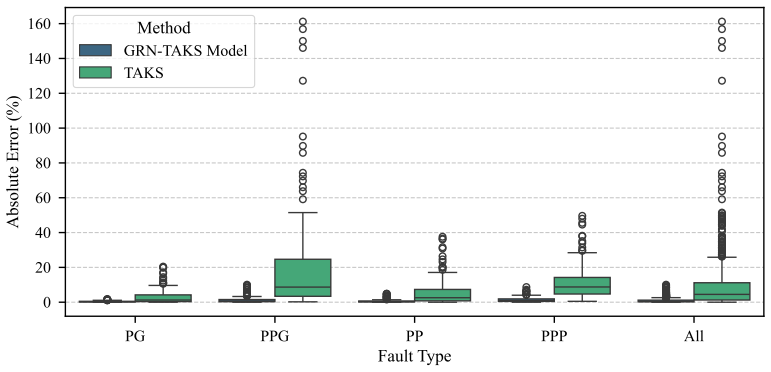
A Gated Residual Network correction reduces fault location errors in wind farm collectors by 76%.
A machine-rendered reading of the paper's core claim, the machinery that carries it, and where it could break.
Core claim
The authors establish that a Gated Residual Network trained on a diverse set of PSCAD-simulated fault scenarios can be added as a correction stage to a deterministic fault distance estimator, producing a 76% overall reduction in fault location error while retaining scalability and adaptability to topological and operational variations in the wind farm.
What carries the argument
Gated Residual Network correction model that takes engineered features from measured currents and voltages to adjust the output of a base deterministic fault locator.
If this is right
- Faster restoration times follow directly from smaller location errors in collector networks.
- The same trained model can be applied after changes in network topology or generation mix without full retraining.
- Protection systems become more effective against the altered fault signatures produced by high inverter penetration.
Where Pith is reading between the lines
- The correction approach could be tested on recorded field data from other renewable plants to check transferability.
- Combining the model with online topology detection might allow automatic updates when the wind farm layout changes.
- Similar residual-correction networks could be explored for fault location on transmission lines feeding the collector system.
Load-bearing premise
The simulated fault scenarios in the real-world wind farm model represent actual fault behavior well enough for the trained network to generalize to new topologies and conditions without major overfitting.
What would settle it
Record actual fault events on an operating wind farm, feed the measured waveforms into the trained correction model, and check whether the 76% error reduction is observed on those real cases.
Figures


read the original abstract
Accurate fault location is essential for operational reliability and fast restoration in wind farm collector networks. However, the growing integration of inverter-based resources changes the current and voltage behavior during faults, challenging the effectiveness of traditional phasor-based diagnostic methods. In this context, the present paper introduces an advanced machine-learning solution that enhances a deterministic fault distance estimator by incorporating a correction model driven by a Gated Residual Network, specifically designed to minimize residual fault location errors. Through comprehensive feature engineering and selection processes, an improved predictor was developed and trained on a diverse set of fault scenarios simulated in a PSCAD-based real-world wind farm model, including variations in fault type, resistance, location, inception angle, and generation penetration. Hyperparameter optimization was performed using the Optuna framework, and the robustness of the method was statistically validated. Results show a significant improvement in accuracy, with a 76% overall decrease in fault location error compared to state-of-the-art approaches. The proposed method demonstrates strong scalability and adaptability to topological and operational changes. This approach advances the deployment of data-driven fault location frameworks for modern power systems.
Editorial analysis
A structured set of objections, weighed in public.
Referee Report
Summary. The manuscript introduces a hybrid fault-location method for onshore wind-farm collector networks that augments a deterministic distance estimator with a residual-error correction model implemented by a Gated Residual Network (GRN). The GRN is trained on a large set of PSCAD-simulated fault scenarios that vary fault type, resistance, location, inception angle and generation penetration; hyperparameters are tuned with Optuna. The central empirical claim is a 76 % reduction in fault-location error relative to state-of-the-art approaches, together with asserted scalability and adaptability to topological and operational changes.
Significance. If the reported accuracy gain were shown to hold under real recorded waveforms and explicit out-of-distribution topological shifts, the work would offer a practical route to improving fault location in inverter-dominated collector systems. The combination of a physics-based estimator with a learned residual corrector is a reasonable design choice and the use of Optuna for hyper-parameter search is a positive methodological detail. However, because all quantitative results derive from a single simulated network without real-data validation or hold-out topology tests, the immediate deployment significance remains limited.
major comments (2)
- [Abstract] Abstract: the 76 % overall decrease in fault-location error is stated without any definition of the error metric (e.g., MAE in km or pu), the precise state-of-the-art baselines employed for comparison, the data-exclusion rules, or the cross-validation procedure. These omissions leave the central empirical claim unsupported by visible evidence.
- [Abstract] Abstract / Results: the claim of 'strong scalability and adaptability to topological and operational changes' rests on training and testing performed inside a single PSCAD model. No independent collector topologies, no real recorded waveforms, and no explicit hold-out topology or operating-point shift are described, so the statistical validation cannot rule out overfitting to the simulator's inverter models.
Simulated Author's Rebuttal
We thank the referee for the thoughtful and constructive comments. We address each major comment below and indicate the revisions we will make to improve clarity and accuracy of the claims.
read point-by-point responses
-
Referee: [Abstract] Abstract: the 76 % overall decrease in fault-location error is stated without any definition of the error metric (e.g., MAE in km or pu), the precise state-of-the-art baselines employed for comparison, the data-exclusion rules, or the cross-validation procedure. These omissions leave the central empirical claim unsupported by visible evidence.
Authors: We agree the abstract should be more self-contained. The full manuscript defines the error metric as mean absolute error (MAE) in per-unit distance, compares against impedance-based and recent ML regression baselines, applies an 80/20 train-test split with 5-fold cross-validation on the training portion, and uses Optuna for hyperparameter search (detailed in Sections III and IV). We will revise the abstract to include concise statements of the metric, baselines, and validation procedure. revision: yes
-
Referee: [Abstract] Abstract / Results: the claim of 'strong scalability and adaptability to topological and operational changes' rests on training and testing performed inside a single PSCAD model. No independent collector topologies, no real recorded waveforms, and no explicit hold-out topology or operating-point shift are described, so the statistical validation cannot rule out overfitting to the simulator's inverter models.
Authors: The referee is correct that all quantitative results derive from a single simulated collector network. While the extensive parametric sweeps (fault type, resistance, location, inception angle, and generation penetration) provide evidence of robustness to operational variations within that network, we did not perform explicit hold-out tests on independent topologies or real waveforms. We will revise the abstract and results/discussion sections to moderate the language to 'demonstrates adaptability to operational changes within the studied network' and add an explicit limitations paragraph acknowledging the single-topology scope and the value of future multi-topology and field-data validation. revision: partial
Circularity Check
No significant circularity; empirical ML performance on simulated data
full rationale
The paper trains a Gated Residual Network on PSCAD-simulated fault scenarios (varying type, resistance, location, angle, penetration) to correct a deterministic fault distance estimator, then reports a 76% error reduction on held-out simulations. This is a standard empirical ML result with no load-bearing equations, no fitted parameters renamed as predictions, and no self-citation chains or uniqueness theorems invoked to force the outcome. The derivation chain consists of feature engineering, Optuna hyperparameter tuning, and statistical validation—all external to any self-referential definition. The result does not reduce to its inputs by construction.
Axiom & Free-Parameter Ledger
free parameters (1)
- GRN hyperparameters
axioms (1)
- domain assumption PSCAD simulation of the real-world wind farm model produces fault signatures representative of field conditions.
Lean theorems connected to this paper
-
IndisputableMonolith/Cost/FunctionalEquation.leanwashburn_uniqueness_aczel unclear?
unclearRelation between the paper passage and the cited Recognition theorem.
The proposed correction model is a deep neural network based on the Gated Residual Network (GRN) architecture... trained on a diverse set of fault scenarios simulated in a PSCAD-based real-world wind farm model
-
IndisputableMonolith/Foundation/BranchSelection.leanbranch_selection unclear?
unclearRelation between the paper passage and the cited Recognition theorem.
Feature selection... Mutual Information (MI) and Pearson correlation analysis... final feature set that is highly informative, non-redundant
What do these tags mean?
- matches
- The paper's claim is directly supported by a theorem in the formal canon.
- supports
- The theorem supports part of the paper's argument, but the paper may add assumptions or extra steps.
- extends
- The paper goes beyond the formal theorem; the theorem is a base layer rather than the whole result.
- uses
- The paper appears to rely on the theorem as machinery.
- contradicts
- The paper's claim conflicts with a theorem or certificate in the canon.
- unclear
- Pith found a possible connection, but the passage is too broad, indirect, or ambiguous to say the theorem truly supports the claim.
Reference graph
Works this paper leans on
-
[1]
K. Jones, et al., Impact of inverter based generation on bulk power system dynamics and short-circuit performance, IEEE Power & Energy 31 Society technical report (07 2018)
work page 2018
-
[2]
S. Das, S. Santoso, A. Gaikwad, M. Patel, Impedance-based fault loca- tion in transmission networks: theory and application, IEEE Access 2 (2014) 537–557. doi:10.1109/ACCESS.2014.2323353
-
[3]
G. Ziegler, Numerical Distance Protection: Principles and Applications, 4th Ed., Germany: Publicis Publishing, Erlangen, 2011
work page 2011
-
[4]
A. Çapar, A. Basa Arsoy, Evaluating accuracy of fault location algorithms based on terminal current and voltage data, Interna- tional Journal of Electronics and Electrical Engineering 3 (01 2014). doi:10.12720/ijeee.3.3.202-206
-
[5]
T. Takagi, Y. . Yamakoshi, M. Yamaura, R. Kondow, T. Matsushima, Development of a new type fault locator using the one-terminal voltage and current data, IEEE Transactions on Power Apparatus and Systems PAS-101 (8) (1982) 2892–2898. doi:10.1109/TPAS.1982.317615
-
[6]
SEL, Advanced line differential protection, automation, and control sys- tem, Schweitzer Engineering Laboratories (2018)
work page 2018
-
[7]
A. Girgis, D. Hart, W. Peterson, A new fault location technique for two- and three-terminal lines, IEEE Transactions on Power Delivery 7 (1) (1992) 98–107. doi:10.1109/61.108895
-
[8]
A. T. Johns, S. Jamali, Accurate fault location technique for power transmission lines, IEEE Proc. 137 (6) (1990) 395–402. doi:10.1049/ip- c.1990.0054. 32
work page doi:10.1049/ip- 1990
-
[9]
G. Preston, Z. M. Radojevic, C. H. Kim, V. Terzija, New settings-free fault location algorithm based on synchronised sampling, IEEE Proc. 5 (3) (2011) 376–383. doi:10.1049/iet-gtd.2010.0053
-
[10]
Z. He, R. Mai, W. He, Q. Qian, Phasor-measurement-unit-based trans- mission line fault location estimator under dynamic conditions, GTD IET 5 (2011) 1183–1191. doi:10.1049/iet-gtd.2011.0081
-
[11]
R. C. Matthews, S. Hossain-McKenzie, M. J. Reno, Fault current cor- rection strategies for effective fault location in inverter-based systems, in: 2019 IEEE 46th Photovoltaic Specialists Conference (PVSC), 2019, pp. 3124–3131. doi:10.1109/PVSC40753.2019.8980536
-
[12]
F. Chang, H. Sun, S. Kawano, D. Nikovski, S. Kitamura, W. Su, A fault detection and location technique for inverter-dominated islanding micro- grids, in: 2022 IEEE 5th International Electrical and Energy Conference (CIEEC), 2022, pp. 2041–2046. doi:10.1109/CIEEC54735.2022.9846567
-
[13]
K. D. Khattak, M. Choudhry, A. Feliachi, Fault classificaton and location in power distribution networks using 1d cnn with resid- ual learning, in: 2024 IEEE Power & Energy Society Innova- tive Smart Grid Technologies Conference (ISGT), 2024, pp. 1–5. doi:10.1109/ISGT59692.2024.10454243
-
[14]
M. Davi, M. Oleskovicz, F. V. Lopes, An impedance-multi- method-based fault location methodology for transmission lines connected to inverter-based resources, International Jour- 33 nal of Electrical Power & Energy Systems 154 (2023) 109466. doi:https://doi.org/10.1016/j.ijepes.2023.109466
-
[15]
M. Davi, R. Iscuissati, M. Oleskovicz, F. V. Lopes, Investi- gating the potential of machine learning for fault location on inverter-based resource interconnection lines: Insights and recom- mendations, Electric Power Systems Research 231 (2024) 110366. doi:https://doi.org/10.1016/j.epsr.2024.110366
-
[16]
M. Davi, A. Júnior, C. Grilo, T. Cunha, L. Lessa, M. Oleskovicz, D. Coury, An improved methodology to locate faults in onshore wind farm collector systems, Energies 18 (3) (2025). doi:10.3390/en18030693. URLhttps://www.mdpi.com/1996-1073/18/3/693
-
[17]
A. Kraskov, H. Stögbauer, P. Grassberger, Estimating mu- tual information, Physical Review E 69 (6) (Jun. 2004). doi:10.1103/physreve.69.066138. URLhttp://dx.doi.org/10.1103/PhysRevE.69.066138
-
[18]
T.Hastie, R.Tibshirani, J.Friedman, TheElementsofStatisticalLearn- ing: Data Mining, Inference, and Prediction, 2nd Edition, Springer, New York, NY, 2009
work page 2009
-
[19]
P. H. P. Savarese, L. O. Mazza, D. R. Figueiredo, Learning identity mappings with residual gates (2016). arXiv:1611.01260
work page internal anchor Pith review Pith/arXiv arXiv 2016
-
[20]
Y. N. Dauphin, A. Fan, M. Auli, D. Grangier, Language modeling with gated convolutional networks (2017). arXiv:1612.08083. 34
work page internal anchor Pith review Pith/arXiv arXiv 2017
-
[21]
J. Qi, J. Du, S. M. Siniscalchi, X. Ma, C.-H. Lee, On mean absolute error for deep neural network based vector-to-vector regression, IEEE Signal Processing Letters 27 (2020) 1485–1489. doi:10.1109/lsp.2020.3016837
-
[22]
Decoupled Weight Decay Regularization
I. Loshchilov, F. Hutter, Decoupled weight decay regularization (2019). arXiv:1711.05101
work page internal anchor Pith review Pith/arXiv arXiv 2019
-
[23]
S. Watanabe, Tree-structured parzen estimator: Understanding its al- gorithm components and their roles for better empirical performance (2023). arXiv:2304.11127. URLhttps://arxiv.org/abs/2304.11127
-
[24]
E. Muljadi, et al., Method of equivalencing for a large wind power plant with multiple turbine representation, in: 2008 IEEE Power and Energy Society General Meeting, 2008, pp. 1–9. doi:10.1109/PES.2008.4596055. 35
discussion (0)
Sign in with ORCID, Apple, or X to comment. Anyone can read and Pith papers without signing in.