Enabling Full-Duplex LEO Satellite Systems with Non-Reciprocal BD-RIS-Assisted Beamforming
Pith reviewed 2026-05-17 04:45 UTC · model grok-4.3
The pith
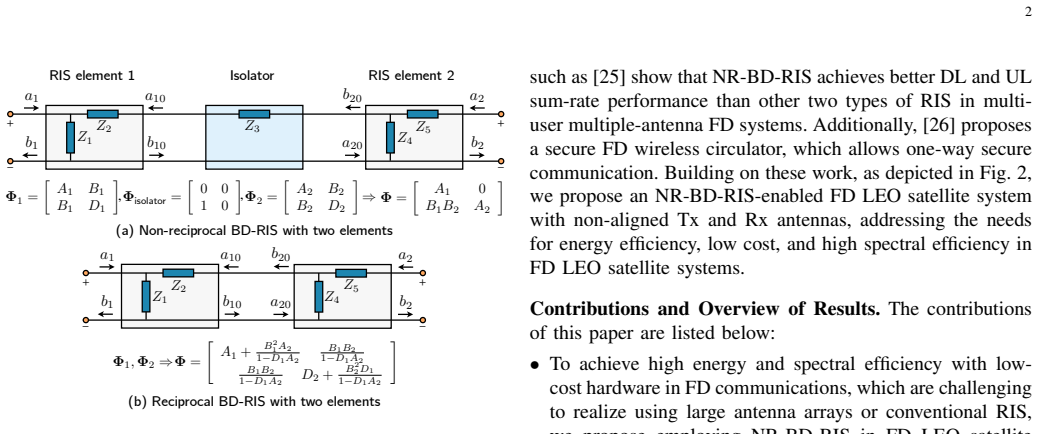
Non-reciprocal components in BD-RIS break channel reciprocity on LEO satellites to enable simultaneous multi-beam full-duplex operation.
A machine-rendered reading of the paper's core claim, the machinery that carries it, and where it could break.
Core claim
Incorporating non-reciprocal components into the impedance network of a beyond-diagonal RIS breaks channel reciprocity, allowing the surface to simultaneously support multiple beam directions for downlink and uplink signals in a full-duplex LEO satellite equipped with multiple transmit and receive antennas; combined with a time-sharing scheduling framework that maximizes weighted sum-rate over the scheduling period, this yields superior sum-rate performance and reduced reconfiguration frequency compared with standard BD-RIS and diagonal RIS designs.
What carries the argument
Non-reciprocal beyond-diagonal reconfigurable intelligent surface (NR-BD-RIS) that incorporates non-reciprocal components into the impedance network to break channel reciprocity and support multiple independent beam directions.
If this is right
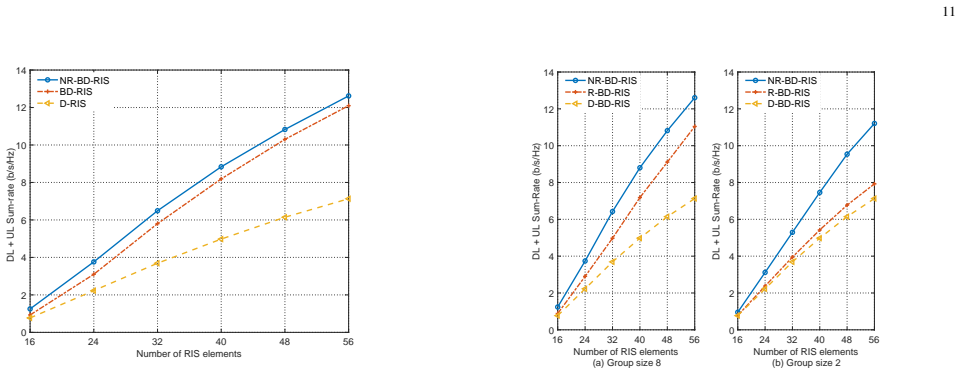
- NR-BD-RIS achieves higher downlink and uplink sum rates than both BD-RIS and diagonal RIS under single-user and multi-user scenarios.
- The NR-BD-RIS requires less frequent reconfiguration than conventional RIS types, improving practicality for LEO platforms.
- The time-sharing framework enables wide coverage by simultaneously serving multiple downlink and uplink ground devices within each slot.
- Flexible resource allocation between downlink and uplink is supported to handle traffic imbalance.
Where Pith is reading between the lines
- The reciprocity-breaking mechanism could be adapted to other non-terrestrial platforms such as high-altitude platforms or mega-constellations facing similar duplex constraints.
- Lower reconfiguration rates may reduce control signaling overhead and energy use in rapidly moving LEO orbits.
- Hybrid active-passive beamforming architectures on satellites might combine NR-BD-RIS with a small number of active elements for further performance gains.
Load-bearing premise
Non-reciprocal components can be integrated into the BD-RIS impedance network on an LEO satellite without prohibitive insertion loss, power consumption, or calibration overhead while preserving beamforming flexibility.
What would settle it
A hardware prototype or measurement showing that non-reciprocal components cause insertion losses or power draws large enough to erase the claimed sum-rate gains or violate satellite power budgets would falsify the practicality of the NR-BD-RIS approach.
Figures




read the original abstract
Low Earth orbit (LEO) satellites are a promising technology for providing low-latency, high-data-rate, and wide-coverage communication services. However, with growing demand for data transmission, future non-terrestrial networks (NTNs) require high spectral efficiency especially with low-gain antennas at the ground devices. This motivates the adoption of in-band full-duplex (FD) systems. In addition, the potential imbalance between downlink (DL) and uplink (UL) transmissions necessitates flexibility in resource allocation. To overcome these challenges, we propose an FD LEO satellite system, where the non-reciprocal beyond-diagonal reconfigurable intelligent surfaces (NR-BD-RIS) and multiple transmit and receive antennas are attached to the LEO satellite. NR-BD-RIS reflects the DL and UL signals by passive beamforming. By incorporating non-reciprocal components into the impedance network of RIS, the NR-BD-RIS breaks channel reciprocity, facilitating simultaneous support for multiple beam directions. To cover a wide coverage, we propose a time-sharing scheduling framework in which the NR-BD-RIS simultaneously serves multiple DL and multiple UL ground devices within each time slot. An optimization problem is defined to maximize the weighted sum-rate over the entire scheduling period. Numerical results demonstrate that the proposed NR-BD-RIS significantly performs better than both conventional BD-RIS and diagonal RIS (D-RIS) with respect to DL and UL sum-rate performance under both single-user (SU) and multiple-user (MU) cases. Additionally, NR-BD-RIS requires less frequent reconfiguration compared to the other two types of RIS, making it more practical for implementation.
Editorial analysis
A structured set of objections, weighed in public.
Referee Report
Summary. The manuscript proposes a full-duplex LEO satellite system assisted by non-reciprocal beyond-diagonal RIS (NR-BD-RIS) to support simultaneous DL and UL transmissions. Non-reciprocal components in the impedance network break channel reciprocity, enabling multiple independent beam directions. A time-sharing scheduling framework serves multiple ground devices per slot, and the weighted sum-rate is maximized subject to passive beamforming constraints. Numerical results claim higher DL/UL sum-rates than conventional BD-RIS and D-RIS in both SU and MU scenarios, plus reduced reconfiguration frequency.
Significance. If the idealized non-reciprocal model holds under hardware constraints, the approach could improve spectral efficiency and scheduling flexibility in NTNs with low-gain terminals. The core idea of using non-reciprocity for simultaneous multi-beam FD operation is technically interesting and addresses a real imbalance between DL and UL traffic.
major comments (2)
- [Numerical Results] Abstract and Numerical Results section: The headline claim that NR-BD-RIS yields higher weighted sum-rate and requires less frequent reconfiguration rests on treating non-reciprocal elements as ideal lossless phase shifters with perfect control. No term for insertion loss, noise figure, DC power draw, or calibration overhead under LEO thermal/vibration conditions appears in the model; any realistic degradation directly reduces effective aperture gain and therefore the reported advantage over BD-RIS and D-RIS.
- [System Model] System Model and Problem Formulation: Channel models, optimization algorithm (e.g., whether alternating optimization, semidefinite relaxation, or gradient-based), convergence criteria, and simulation parameters (noise power, path-loss exponents, satellite altitude, antenna gains, error bars) are not detailed enough to reproduce or stress-test the sum-rate curves. This leaves open whether post-hoc tuning or overly favorable assumptions drive the gains.
minor comments (2)
- Clarify the exact definition of the non-reciprocal impedance matrix and how it is realized with passive components; the current description is high-level.
- Add a table or plot quantifying reconfiguration frequency (e.g., coherence time vs. update interval) for the three RIS types under the same mobility model.
Simulated Author's Rebuttal
We thank the referee for the constructive comments, which help improve the clarity and rigor of our work on NR-BD-RIS-assisted full-duplex LEO systems. We respond to each major comment below and indicate planned revisions.
read point-by-point responses
-
Referee: [Numerical Results] Abstract and Numerical Results section: The headline claim that NR-BD-RIS yields higher weighted sum-rate and requires less frequent reconfiguration rests on treating non-reciprocal elements as ideal lossless phase shifters with perfect control. No term for insertion loss, noise figure, DC power draw, or calibration overhead under LEO thermal/vibration conditions appears in the model; any realistic degradation directly reduces effective aperture gain and therefore the reported advantage over BD-RIS and D-RIS.
Authors: We acknowledge that the model treats non-reciprocal elements as ideal to isolate the benefit of breaking reciprocity for simultaneous independent DL/UL beams. This is a standard theoretical starting point. In revision we will add a dedicated discussion subsection on hardware impairments (insertion loss, noise figure, DC power, and LEO environmental effects) and note that the reported gains represent an upper bound. The core advantage of non-reciprocity enabling multi-beam FD operation without frequent reconfiguration should persist qualitatively even after moderate degradation, as the impedance network still decouples the effective channels. revision: partial
-
Referee: [System Model] System Model and Problem Formulation: Channel models, optimization algorithm (e.g., whether alternating optimization, semidefinite relaxation, or gradient-based), convergence criteria, and simulation parameters (noise power, path-loss exponents, satellite altitude, antenna gains, error bars) are not detailed enough to reproduce or stress-test the sum-rate curves. This leaves open whether post-hoc tuning or overly favorable assumptions drive the gains.
Authors: We agree that additional detail is required for reproducibility. In the revised manuscript we will expand the System Model section to explicitly state the LEO channel model (including altitude-dependent path loss and Rician fading), describe the optimization procedure (alternating optimization between scheduling variables and passive beamforming solved via semidefinite relaxation), provide the convergence criterion (relative objective change below 10^{-4}), and tabulate all simulation parameters (noise power, path-loss exponents, satellite altitude, antenna gains). We will also add error bars to the sum-rate figures based on multiple Monte-Carlo runs. revision: yes
Circularity Check
No circularity: optimization objective and numerical results are independent of fitted inputs or self-citations.
full rationale
The paper states an optimization problem to maximize the weighted sum-rate subject to passive beamforming constraints derived from the non-reciprocal impedance matrix. Numerical results compare NR-BD-RIS against BD-RIS and D-RIS under this model. No equations reduce a claimed prediction to a fitted parameter by construction, no load-bearing self-citation chain justifies the central premise, and the weighted-sum-rate objective is formulated independently of the reported outcomes. The derivation chain is self-contained against the stated assumptions and simulations.
Axiom & Free-Parameter Ledger
free parameters (1)
- Weights in weighted sum-rate objective
axioms (1)
- domain assumption Standard far-field channel models for LEO satellite to ground links with RIS reflection
invented entities (1)
-
Non-reciprocal beyond-diagonal RIS (NR-BD-RIS)
no independent evidence
Reference graph
Works this paper leans on
-
[1]
RIS-empowered LEO satellite networks for 6G: Promising usage scenarios and future directions,
M. Toka, B. Lee, J. Seonget al., “RIS-empowered LEO satellite networks for 6G: Promising usage scenarios and future directions,”IEEE Commun. Mag., vol. 62, no. 11, pp. 128–135, 2024
work page 2024
-
[2]
Energy-efficient RIS- assisted satellites for IoT networks,
K. Tekbıyık, G. K. Kurt, and H. Yanikomeroglu, “Energy-efficient RIS- assisted satellites for IoT networks,”IEEE Internet Things J., vol. 9, no. 16, pp. 14 891–14 899, Aug. 2022
work page 2022
-
[3]
Full- duplex techniques for satellite communications: Feasibility analysis and roadmap,
E. Lagunas, T. Ramirez-Parracho, J. A. Vasquez-Peralvoet al., “Full- duplex techniques for satellite communications: Feasibility analysis and roadmap,”IEEE Open J. of the Comm. Society., 2025
work page 2025
-
[4]
Reconfigurable intelligent surfaces for energy efficiency in wireless communication,
C. Huang, A. Zappone, G. C. Alexandropouloset al., “Reconfigurable intelligent surfaces for energy efficiency in wireless communication,” IEEE Trans. Wireless Commun., vol. 18, no. 8, pp. 4157–4170, 2019
work page 2019
-
[5]
S. Sekimori, Y . Kawamoto, N. Katoet al., “Frequency prism in delay adjustable intelligent reflecting surfaces for long distance communica- tions in LEO satellite networks,” inProc. IEEE Int. Conf. Commun. (ICC), Denver, USA, 2024, pp. 3470–3475
work page 2024
-
[6]
S. Shen, B. Clerckx, and R. Murch, “Modeling and architecture design of reconfigurable intelligent surfaces using scattering parameter network analysis,”IEEE Trans. Wireless Commun., vol. 21, no. 2, pp. 1229–1243, Feb. 2022
work page 2022
-
[7]
Reconfigurable intelligent surfaces 2.0: Beyond diagonal phase shift matrices,
H. Li, S. Shen, M. Neriniet al., “Reconfigurable intelligent surfaces 2.0: Beyond diagonal phase shift matrices,”IEEE Commun. Mag., vol. 62, no. 3, pp. 102–108, Mar. 2024
work page 2024
-
[8]
H. Li, M. Nerini, S. Shenet al., “A tutorial on beyond-diagonal reconfig- urable intelligent surfaces: Modeling, architectures, system design and optimization, and applications,”arXiv preprint arXiv:2505.16504, 2025
-
[9]
Enhancing ISAC network throughput using beyond diagonal RIS,
Z. Liu, Y . Liu, S. Shenet al., “Enhancing ISAC network throughput using beyond diagonal RIS,”IEEE Wireless Commun. Lett., vol. 13, no. 6, pp. 1670–1674, 2024
work page 2024
-
[10]
M. Nerini, S. Shen, H. Liet al., “Beyond diagonal reconfigurable intelligent surfaces utilizing graph theory: Modeling, architecture design, and optimization,”IEEE Trans. Wireless Commun., 2024
work page 2024
-
[11]
A novel Q-stem connected architecture for beyond-diagonal reconfigurable intelligent surfaces,
X. Zhou, T. Fang, and Y . Mao, “A novel Q-stem connected architecture for beyond-diagonal reconfigurable intelligent surfaces,” inProc. IEEE Int. Conf. Commun. (ICC), Montreal, Canada, 2025, pp. 6880–6885
work page 2025
-
[12]
Z. Wu and B. Clerckx, “Beyond diagonal RIS in multiuser MIMO: Graph theoretic modeling and optimal architectures with low complex- ity,”arXiv preprint arXiv:2502.16509, 2025
-
[13]
H. Li and B. Clerckx, “Non-reciprocal beyond diagonal RIS: Multiport network models and performance benefits in full-duplex systems,”IEEE Trans. Commun., 2025
work page 2025
-
[14]
D. M. Pozar,Microwave engineering: Theory and techniques. Hoboken, NJ, USA: Wiley, 2009
work page 2009
-
[15]
Non-reciprocal reconfigurable intelligent surfaces,
J. Xu, H. Wang, R. Liuet al., “Non-reciprocal reconfigurable intelligent surfaces,”IEEE Wireless Commun. Lett., 2025
work page 2025
-
[16]
Reconfigurable intelligent surfaces relying on non-diagonal phase shift matrices,
Q. Li, M. El-Hajjar, I. Hemadehet al., “Reconfigurable intelligent surfaces relying on non-diagonal phase shift matrices,”IEEE Trans. Veh. Technol., vol. 71, no. 6, pp. 6367–6383, Jun. 2022
work page 2022
-
[17]
RF MEMS switches and switch circuits,
G. M. Rebeiz and J. B. Muldavin, “RF MEMS switches and switch circuits,”IEEE Microw. Mag., vol. 2, no. 4, pp. 59–71, 2001
work page 2001
-
[18]
Breaking reciprocity with space-time-coding digital metasurfaces,
L. Zhang, X. Q. Chen, R. W. Shaoet al., “Breaking reciprocity with space-time-coding digital metasurfaces,”Advanced Materials, vol. 31, no. 41, p. 1904069, 2019
work page 2019
-
[19]
Space-time-coding digital meta- surfaces,
L. Zhang, X. Q. Chen, S. Liuet al., “Space-time-coding digital meta- surfaces,”Nature communications, vol. 9, no. 1, p. 4334, 2018
work page 2018
-
[20]
Metasurfaces and their applica- tions,
A. Li, S. Singh, and D. Sievenpiper, “Metasurfaces and their applica- tions,”Nanophotonics, vol. 7, no. 6, pp. 989–1011, 2018
work page 2018
-
[21]
The internet of metamaterial things and their software enablers,
C. Liaskos, G. G. Pyrialakos, A. Pitilakiset al., “The internet of metamaterial things and their software enablers,”Int. Telecommun. Union J, vol. 1, no. 1, pp. 55–77, 2020
work page 2020
-
[22]
Spatially selective reconfig- urable intelligent surfaces through element permutation,
F. Rusek, J. Flordelis, E. Bengtssonet al., “Spatially selective reconfig- urable intelligent surfaces through element permutation,” inProc. IEEE Int. Conf. Commun. (ICC), Denver, USA, 2024, pp. 5540–5545
work page 2024
-
[23]
Full-duplex enabled intelligent reflecting surface systems: Opportunities and challenges,
G. Pan, J. Ye, J. Anet al., “Full-duplex enabled intelligent reflecting surface systems: Opportunities and challenges,”IEEE Wireless Commun., vol. 28, no. 3, pp. 122–129, Jun. 2021
work page 2021
-
[24]
Channel reciprocity attacks using intelligent surfaces with non-diagonal phase shifts,
H. Wang, Z. Han, and A. L. Swindlehurst, “Channel reciprocity attacks using intelligent surfaces with non-diagonal phase shifts,”IEEE Open J. of the Comm. Society., 2024
work page 2024
-
[25]
Non-reciprocal BD-RIS in full- duplex communications: A perspective on sum-rate maximization,
Z. Liu, H. Li, and B. Clerckx, “Non-reciprocal BD-RIS in full- duplex communications: A perspective on sum-rate maximization,” arXiv preprint arXiv:2411.18523, 2024
-
[26]
A secure full-duplex wireless circula- tor enabled by non-reciprocal beyond-diagonal RIS,
Z. Liu and B. Clerckx, “A secure full-duplex wireless circula- tor enabled by non-reciprocal beyond-diagonal RIS,”arXiv preprint arXiv:2507.23381, 2025
-
[27]
W. Tang, M. Z. Chen, X. Chenet al., “Wireless communications with reconfigurable intelligent surface: Path loss modeling and experimental measurement,”IEEE Trans. Wireless Commun., vol. 20, no. 1, pp. 421– 439, Jan. 2021
work page 2021
-
[28]
Deconstructing multiantenna fading channels,
A. Sayeed, “Deconstructing multiantenna fading channels,”IEEE Trans. Sig. Proc., vol. 50, no. 10, pp. 2563–2579, Oct. 2002
work page 2002
-
[29]
Near-field channel reconstruction in sensing RIS-assisted wireless communication systems,
J. Tian, Y . Han, S. Jinet al., “Near-field channel reconstruction in sensing RIS-assisted wireless communication systems,”IEEE Trans. Wireless Commun., vol. 23, no. 9, pp. 12 223–12 238, Sep. 2024
work page 2024
-
[30]
A new wireless com- munication paradigm through software-controlled metasurfaces,
C. Liaskos, S. Nie, A. Tsioliaridouet al., “A new wireless com- munication paradigm through software-controlled metasurfaces,”IEEE Commun. Mag., vol. 56, no. 9, pp. 162–169, 2018
work page 2018
-
[31]
Beam focusing for near-field multiuser MIMO communications,
H. Zhang, N. Shlezinger, F. Guidiet al., “Beam focusing for near-field multiuser MIMO communications,”IEEE Trans. Wireless Commun., vol. 21, no. 9, pp. 7476–7490, 2022
work page 2022
-
[32]
W. L. Stutzman and G. A. Thiele,Antenna theory and design. John Wiley & Sons, 2012
work page 2012
-
[33]
Int. Telecommun. Union, “Propagation data and prediction methods required for the design of Earth-space telecommunication systems,” International Telecommunication Union, Geneva, Switzerland, ITU- Recommendation P.618-13, Dec. 2017
work page 2017
-
[34]
Specific attenuation model for rain for use in prediction meth- ods,
——, “Specific attenuation model for rain for use in prediction meth- ods,” International Telecommunication Union, Geneva, Switzerland, ITU-Recommendation P.838-3, Mar. 2005
work page 2005
-
[35]
Full-duplex beyond self- interference: The unlimited sensing way,
Z. Liu, A. Bhandari, and B. Clerckx, “Full-duplex beyond self- interference: The unlimited sensing way,”IEEE Commun. Lett., 2024
work page 2024
-
[36]
Fractional programming for communication systems—Part I: Power control and beamforming,
K. Shen and W. Yu, “Fractional programming for communication systems—Part I: Power control and beamforming,”IEEE Trans. Sig. Proc., vol. 66, no. 10, pp. 2616–2630, 2018
work page 2018
-
[37]
Optimization algorithms exploiting unitary constraints,
J. H. Manton, “Optimization algorithms exploiting unitary constraints,” IEEE Trans. Sig. Proc., vol. 50, no. 3, pp. 635–650, 2002
work page 2002
-
[38]
Q. Shi and M. Hong, “Penalty dual decomposition method for non- smooth nonconvex optimization—Part I: Algorithms and convergence analysis,”IEEE Trans. Sig. Proc., vol. 68, pp. 4108–4122, 2020
work page 2020
-
[39]
SoftNull: Many-antenna full-duplex wireless via digital beamforming,
E. Everett, C. Shepard, L. Zhonget al., “SoftNull: Many-antenna full-duplex wireless via digital beamforming,”IEEE Trans. Wireless Commun., vol. 15, no. 12, pp. 8077–8092, 2016
work page 2016
discussion (0)
Sign in with ORCID, Apple, or X to comment. Anyone can read and Pith papers without signing in.