Industrial overcapacity can enable seasonal flexibility in electricity use
Pith reviewed 2026-05-17 04:39 UTC · model grok-4.3
The pith
Retaining overcapacity lets aluminum smelters run seasonally and cut China's decarbonized power system costs by 23-32 billion CNY a year.
A machine-rendered reading of the paper's core claim, the machinery that carries it, and where it could break.
Core claim
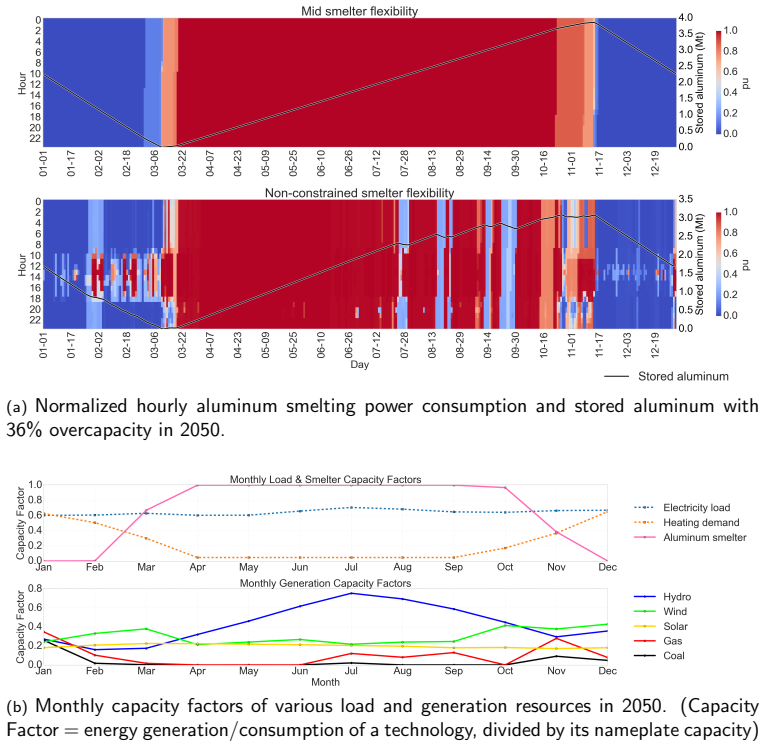
The central discovery is that industrial overcapacity in aluminum smelting can enable a seasonal operation paradigm. Smelters cease production during winter load peaks caused by heating electrification and renewable seasonality. This approach reduces the investment and operational costs of China's decarbonized electricity system by 23-32 billion CNY/year, equivalent to 11-15% of the industry's product value. The savings suffice to offset added smelter maintenance and product storage costs. It may also create labor complementarities between the aluminum and thermal power sectors.
What carries the argument
The seasonal operation paradigm of aluminum smelters, made possible by overcapacity, which allows halting production to avoid winter electricity peaks.
If this is right
- The electricity system requires less investment in peak power capacity.
- Operational costs decrease due to reduced need for expensive winter generation.
- Extra maintenance and storage costs for smelters are covered by the system savings.
- Labor needs in aluminum production can complement those in thermal power generation during off-seasons.
Where Pith is reading between the lines
- Other energy-intensive industries such as steel and cement might adopt similar seasonal flexibility strategies.
- Energy planners could view industrial overcapacity as a low-cost source of demand response in renewable-heavy systems.
- International contexts with similar seasonal demand patterns could explore this approach for their decarbonization pathways.
Load-bearing premise
Shifting aluminum smelters to seasonal operation is technically feasible and does not introduce significant unmodeled costs or disruptions to product supply.
What would settle it
If operating smelters seasonally leads to aluminum shortages, higher than expected maintenance costs, or actual system savings below 23 billion CNY per year, the proposed benefits would not hold.
Figures




read the original abstract
In many countries, declining demand in energy-intensive industries (EIIs) such as cement, steel, and aluminum is leading to industrial overcapacity. Although industrial overcapacity is traditionally envisioned as problematic and resource-wasteful, it could unlock EIIs' flexibility in electricity use. Here, using China's aluminum smelting industry as a case study, we evaluate the system-level cost-benefit of retaining EII overcapacity for flexible electricity use in decarbonized energy systems. We find that overcapacity can enable aluminum smelters to adopt a seasonal operation paradigm, ceasing production during winter load peaks that are exacerbated by heating electrification and renewable seasonality. This seasonal operation paradigm could reduce the investment and operational costs of China's decarbonized electricity system by 23-32 billion CNY/year (11-15% of the aluminum smelting industry's product value), sufficient to offset the increased smelter maintenance and product storage costs associated with overcapacity. It may also create labor complementarities between the aluminum and thermal power sectors.
Editorial analysis
A structured set of objections, weighed in public.
Referee Report
Summary. The paper uses China's aluminum smelting industry as a case study to argue that retaining industrial overcapacity enables a seasonal operation paradigm in which smelters cease production during winter electricity peaks driven by heating electrification and renewable seasonality. This flexibility is claimed to reduce decarbonized electricity-system investment and operational costs by 23-32 billion CNY/year (11-15% of industry product value), sufficient to offset added maintenance and storage costs while also generating labor complementarities with the thermal power sector.
Significance. If the quantitative results and feasibility assumptions hold, the work identifies a potentially important mechanism for leveraging existing overcapacity to lower decarbonization costs in systems with high renewable penetration and seasonal demand. The system-level cost-benefit framing and the specific CNY savings estimate provide a concrete, policy-relevant illustration that could extend to other energy-intensive industries.
major comments (2)
- [Methods] Methods: The system model that produces the headline 23-32 billion CNY/year net savings is described at a high level only; key parameters for smelter shutdown feasibility, maintenance/storage costs, and the valuation of avoided winter peaks are not fully specified or validated against operational data. Because the central claim is that these savings exceed incremental overcapacity costs, insufficient documentation of the model structure and data sources undermines verifiability of the net-benefit result.
- [Results] Results: The reported cost savings are presented as the difference between electricity-system cost reduction and incremental overcapacity costs, yet no sensitivity analysis is shown for plausible increases in unmodeled disruption or supply-chain costs. If these parameters are optimistic, the 11-15% savings figure relative to product value would not be robust.
minor comments (2)
- [Abstract] Abstract and introduction: The phrase 'sufficient to offset' should be qualified with the base-case versus sensitivity range to avoid implying the result is parameter-free.
- [Discussion] Discussion: Adding a short comparison table to prior studies on industrial demand response (e.g., in steel or cement) would help situate the seasonal-shutdown approach.
Simulated Author's Rebuttal
We thank the referee for the constructive comments, which help clarify the presentation of our modeling approach and the robustness of our quantitative findings. We respond to each major comment below and indicate the revisions we will undertake.
read point-by-point responses
-
Referee: [Methods] The system model that produces the headline 23-32 billion CNY/year net savings is described at a high level only; key parameters for smelter shutdown feasibility, maintenance/storage costs, and the valuation of avoided winter peaks are not fully specified or validated against operational data. Because the central claim is that these savings exceed incremental overcapacity costs, insufficient documentation of the model structure and data sources undermines verifiability of the net-benefit result.
Authors: We agree that the main-text description of the electricity-system optimization model is high-level. In the revised manuscript we will expand the Methods section to include a summary of the model structure (linear optimization of generation, transmission, and storage under seasonal demand and renewable profiles), explicit parameter values for smelter shutdown feasibility (technical minimum downtime and restart constraints), maintenance and storage costs (drawn from published Chinese aluminum-industry benchmarks), and the valuation of avoided winter peaks (marginal cost of additional peaking capacity). We will also add a brief discussion of data sources and note that, while feasibility assumptions are informed by historical smelter responses to price and demand signals, large-scale seasonal shutdowns remain a proposed paradigm whose operational validation would benefit from future empirical studies. revision: yes
-
Referee: [Results] The reported cost savings are presented as the difference between electricity-system cost reduction and incremental overcapacity costs, yet no sensitivity analysis is shown for plausible increases in unmodeled disruption or supply-chain costs. If these parameters are optimistic, the 11-15% savings figure relative to product value would not be robust.
Authors: We accept that the absence of sensitivity analysis on unmodeled disruption and supply-chain costs limits the demonstrated robustness of the net-benefit result. We will add a dedicated sensitivity subsection to the Results, testing increases of 30 % and 50 % in these costs relative to our central estimates. The revised analysis will show that the 23–32 billion CNY annual net savings remain positive across the tested range and continue to represent 8–12 % of industry product value under the more conservative assumptions, thereby addressing the concern about optimism in the headline figures. revision: yes
Circularity Check
No significant circularity; derivation self-contained in system model outputs
full rationale
The paper derives its central cost savings estimate (23-32 billion CNY/year) from a system-level optimization model comparing scenarios with and without seasonal smelter operation. No equations or steps reduce by construction to fitted inputs, self-definitions, or load-bearing self-citations; the feasibility assumptions and cost offsets are stated as modeling choices whose validity is external to the derivation itself. The result is presented as an output of the model rather than a renaming or tautology, making the chain independent of its own inputs.
Axiom & Free-Parameter Ledger
Lean theorems connected to this paper
-
IndisputableMonolith/Cost/FunctionalEquation.leanwashburn_uniqueness_aczel unclear?
unclearRelation between the paper passage and the cited Recognition theorem.
We developed a comprehensive framework that co-optimizes power system capacity expansion planning with detailed smelter operations, capturing key technical constraints such as temperature limits, restart costs, and operational limitations.
-
IndisputableMonolith/Foundation/DimensionForcing.leanalexander_duality_circle_linking unclear?
unclearRelation between the paper passage and the cited Recognition theorem.
The averaged optimal overcapacity rate of 30% roughly corresponds to the proportion of winter time in a year
What do these tags mean?
- matches
- The paper's claim is directly supported by a theorem in the formal canon.
- supports
- The theorem supports part of the paper's argument, but the paper may add assumptions or extra steps.
- extends
- The paper goes beyond the formal theorem; the theorem is a base layer rather than the whole result.
- uses
- The paper appears to rely on the theorem as machinery.
- contradicts
- The paper's claim conflicts with a theorem or certificate in the canon.
- unclear
- Pith found a possible connection, but the passage is too broad, indirect, or ambiguous to say the theorem truly supports the claim.
Reference graph
Works this paper leans on
-
[1]
L. Tan, Z. Yang, M. Irfan, C. J. Ding, M. Hu, J. Hu, Toward low-carbon sustainable development: Exploring the impact of digital economy devel- opment and industrial restructuring, Bus. Strategy Environ. 33 (2024) 2159–2172
work page 2024
-
[2]
B. Xie, C. Yang, W. Song, L. Song, H. Wang, The impact of envi- ronmental regulation on capacity utilization of china’s manufacturing 22 industry: An empirical research based on the sector level, Ecol. Indic. 148 (2023) 110085
work page 2023
-
[3]
Y. Li, Q. Yue, J. He, F. Zhao, H. Wang, When will the arrival of China’s secondary aluminum era?, Resour. Policy 65 (2020) 101573
work page 2020
-
[4]
B. Yu, C. Shen, Environmental regulation and industrial capacity uti- lization: An empirical study of china, J. Clean. Prod. 246 (2020) 118986
work page 2020
-
[5]
J. Guo, H. Dong, H. Farzaneh, Y. Geng, C. L. Reddington, Uncovering the overcapacity feature of china’s industry and the environmental & health co-benefits from de-capacity, J. Environ. Manage. 308 (2022) 114645
work page 2022
-
[6]
W. J. Cole, D. Greer, P. Denholm, A. W. Frazier, S. Machen, T. Mai, N. Vincent, S. F. Baldwin, Quantifying the challenge of reaching a 100% renewable energy power system for the United States, Joule 5 (2021) 1732–1748
work page 2021
-
[7]
J. D. Jenkins, N. A. Sepulveda, Long-duration energy storage: A blueprint for research and innovation, Joule 5 (2021) 2241–2246
work page 2021
-
[8]
H. Wei, M. Ma, H. Jiang, T. Capuder, F. Teng, G. Strbac, J. Zhang, N. Zhang, C. Kang, Generation and transmission expansion planning in- corporating economically feasible heterogeneous demand-side resources, Appl. Energy 381 (2025) 125067
work page 2025
-
[9]
Golmohamadi, Demand-side management in industrial sector: A review of heavy industries, Renew
H. Golmohamadi, Demand-side management in industrial sector: A review of heavy industries, Renew. Sustain. Energy Rev. 156 (2022) 111963
work page 2022
-
[10]
N. A. Sepulveda, J. D. Jenkins, F. J. De Sisternes, R. K. Lester, The Role of Firm Low-Carbon Electricity Resources in Deep Decarbonization of Power Generation, Joule 2 (2018) 2403–2420
work page 2018
-
[11]
R. Van Heerden, O. Y. Edelenbosch, V. Daioglou, T. Le Gallic, L. B. Baptista, A. Di Bella, F. P. Colelli, J. Emmerling, P. Fragkos, R. Hasse, J. Hoppe, P. Kishimoto, F. Leblanc, J. Lef` evre, G. Lud- erer, G. Marangoni, A. Mastrucci, H. Pettifor, R. Pietzcker, P. Rochedo, 23 B. Van Ruijven, R. Schaeffer, C. Wilson, S. Yeh, E. Zisarou, D. Van Vu- uren, Dem...
work page 2050
-
[12]
J. Bistline, Variability in deeply decarbonized electricity systems, En- vironmental Science & Technology 55 (2021) 5629–5635
work page 2021
-
[13]
Aluminum Corporation of China Limited, 2020 Annual Report, Tech- nical Report, Chinalco Finance and Asset Department (Board of Direc- tors Office), 2021. URL: https://www.chalco.com.cn/tzzgx/yjbg/ndbg/ 202104/P020210420669662364743.pdf, accessed: 2025-09-10
work page 2020
-
[14]
L. Song, S. Van Ewijk, E. Masanet, T. Watari, F. Meng, J. M. Cullen, Z. Cao, W.-Q. Chen, China’s bulk material loops can be closed but deep decarbonization requires demand reduction, Nat. Clim. Chang. 13 (2023) 1136–1143
work page 2023
-
[15]
D. Eheliyagoda, J. Li, Y. Geng, X. Zeng, The role of china’s aluminum recycling on sustainable resource and emission pathways, Resour. Policy 76 (2022) 102552
work page 2022
-
[16]
D. Todd, M. Caufield, B. Helms, A. P. Generating, I. M. Starke, B. Kirby, J. Kueck, Providing reliability services through demand re- sponse: A preliminary evaluation of the demand response capabilities of alcoa inc, ORNL/TM 233 (2008) 1–52
work page 2008
-
[17]
C.-J. Wong, J. Bao, M. Skyllas-Kazacos, B. Welch, M. Mahmoud, A. Arkhipov, N. Ahli, Studies on Power Modulation of Aluminum Smelt- ing Cells Based on a Discretized Mass and Thermal Dynamic Model, Metall. Mater. Trans. B 54 (2023) 562–577
work page 2023
-
[18]
A. T. Tabereaux, Loss in Cathode Life Resulting from the Shutdown and Restart of Potlines at Aluminum Smelters, in: G. Bearne, M. Dupuis, G. Tarcy (Eds.), Essential Readings in Light Metals: Volume 2 Alu- minum Reduction Technology, Cham, 2016, pp. 723–728
work page 2016
-
[19]
K. J. Driscoll, The Economics of Shutting and Restarting Primary Alu- minium Smelting Capacity, in: G. Bearne, M. Dupuis, G. Tarcy (Eds.), Essential Readings in Light Metals: Volume 2 Aluminum Reduction Technology, Cham, 2016, pp. 699–706. 24
work page 2016
-
[20]
Y. Shen, R. Lyu, H. Guo, C. Kang, An Improved Modeling Method for Electrolyte Aluminum Loads Considering Thermal Balance and Flexible Regulation Cost, in: 2025 IEEE International Conference on Power Systems and Smart Grid Technologies (PSSGT), 2025, pp. 331–337
work page 2025
-
[21]
R. Lyu, H. Guo, G. Strbac, C. Kang, Data-Driven Dimension Reduction for Industrial Load Modeling Using Inverse Optimization, IEEE Trans. Smart Grid 16 (2025) 2695–2698
work page 2025
- [22]
-
[23]
Lazzaro, High costs challenge smelter responses to alu- minum oversupply: Alcoa, 2020
N. Lazzaro, High costs challenge smelter responses to alu- minum oversupply: Alcoa, 2020. URL: https://www.spglobal. com/commodity-insights/en/news-research/latest-news/metals/ 051420-high-costs-challenge-smelter-responses-to-aluminum-oversupply-alcoa
work page 2020
-
[24]
Coyne, Alcoa to restart 268,000 mt/year of aluminum smelting capacity in Brazil: company, 2021
J. Coyne, Alcoa to restart 268,000 mt/year of aluminum smelting capacity in Brazil: company, 2021. URL: https://www.spglobal. com/commodity-insights/en/news-research/latest-news/metals/ 092021-alcoa-to-restart-268000-mtyear-of-aluminum-smelting-capacity-in-brazil-company
work page 2021
-
[25]
China Nonferrous Metals News, China’s Recycled Aluminium Output Exceeds 10 Million Tons in 2024, 2025. URL: https://www.foundry.com. cn/lists/detail/a id/2158/cate id/2158/nav id/1.html, accessed: 2025- 09-10
work page 2024
-
[26]
X. Zhou, K. Strunz, T. Brown, H. Sun, F. Neumann, Multi-energy sys- tem horizon planning: Early decarbonisation in China avoids stranded assets, Energy Internet 1 (2024) 81–98
work page 2024
-
[27]
S. Li, T. Zhang, L. Niu, Q. Yue, Analysis of the development scenarios and greenhouse gas (GHG) emissions in China’s aluminum industry till 2030, J. Clean. Prod. 290 (2021) 125859
work page 2030
-
[28]
T. Peng, L. Ren, E. Du, X. Ou, X. Yan, Life Cycle Energy Consump- tion and Greenhouse Gas Emissions Analysis of Primary and Recycled Aluminum in China, Processes 10 (2022) 2299. 25
work page 2022
-
[29]
The Aluminum Association, Key Sustainability Performance Indica- tors for the Aluminum Can, Technical Report, The Aluminum As- sociation, 2024. URL: https://www.aluminum.org/sites/default/files/ 2024-12/FINAL-2024 Aluminum-Can-KPI-Report.pdf, accessed: 2025- 09-10
work page 2024
-
[30]
H. Hatayama, I. Daigo, Y. Matsuno, Y. Adachi, Evolution of aluminum recycling initiated by the introduction of next-generation vehicles and scrap sorting technology, Resources, Conservation and Recycling 66 (2012) 8–14
work page 2012
-
[31]
C. Tan, X. Yu, D. Li, T. Lei, Q. Hao, D. Guan, Different technology packages for aluminium smelters worldwide to deliver the 1.5°C target, Nat. Clim. Chang. 15 (2025) 51–58
work page 2025
- [32]
-
[33]
L. Song, P. Wang, M. Hao, M. Dai, K. Xiang, N. Li, W.-Q. Chen, Mapping provincial steel stocks and flows in China: 1978-2050, J. Clean. Prod. 262 (2020) 121393
work page 1978
-
[34]
S. Li, Z. Wang, Q. Yue, T. Zhang, Analysis of the quantity and spatial characterization of aluminum in-use stocks in China, Resour. Policy 79 (2022) 102979
work page 2022
- [35]
-
[36]
E. Larson, Net-zero America: Potential pathways, infrastructure, and impacts, Princeton University, 2020
work page 2020
- [37]
-
[38]
Y. Chen, F. Guo, J. Wang, W. Cai, C. Wang, K. Wang, Provincial and gridded population projection for China under shared socioeconomic pathways from 2010 to 2100, Sci. Data 7 (2020) 83
work page 2010
-
[39]
H. A. Øye, M. Sørlie, Power failure, restart and repair, Alum. Int. Today (2011)
work page 2011
-
[40]
H. A. Øye, POWER FAILURE, TEMPORARY POT SHUT-DOWN, RESTART AND REPAIR, 27th Int. Alum. Conf. (2011)
work page 2011
-
[41]
R. K. SMITH, Analysis of hourly generation patterns at large coal-fired units and implications of transitioning from baseload to load-following electricity supplier, J. Mod. Power Syst. Clean Energy 7 (2019) 468–474
work page 2019
-
[42]
Colliers, Map of Logistics and Warehouse Market Rental Prices in China for the Second Half of 2023, Colliers official website, 2024. Published: March 11, 2024. Retrieved from https://www.colliers.com.cn/zh-cn/ research/20240312logisticsrental. Accessed: 2025-09-10
-
[43]
F. Yang, X. Yang, X. Li, China’s diverse energy transition pathways toward carbon neutrality by 2060, Sustain. Prod. Consum. 47 (2024) 236–250
work page 2060
-
[44]
J. Liu, T. Wang, Y. Wang, X. Lin, R. Zhou, K. Wang, China’s 1+N policy system supports an earlier peak in carbon emissions, Renew. Sustain. Energy Rev. 215 (2025) 115626
work page 2025
-
[45]
PyPSA: Python for Power System Analysis
T. Brown, J. H¨ orsch, D. Schlachtberger, PyPSA: Python for Power System Analysis, J. Open Res. Softw. 6 (2018).arXiv:1707.09913
work page internal anchor Pith review Pith/arXiv arXiv 2018
-
[46]
Lennon, The aluminium demand risk of terawatt photovoltaics for net zero emissions by 2050, Nat
A. Lennon, The aluminium demand risk of terawatt photovoltaics for net zero emissions by 2050, Nat. Sustain. 5 (2022)
work page 2050
-
[47]
Y. Yang, H. Zhang, L. Wu, M. Wang, Supply potential, carbon emission reduction, energy conservation, and sustainable pathways for aluminum recycling in China, Sustain. Prod. Consum. 50 (2024) 239–252
work page 2024
-
[48]
A. Shen, J. Zhang, Technologies for CO2 emission reduction and low- carbon development in primary aluminum industry in China: A review, Renew. Sustain. Energy Rev. 189 (2024) 113965. 27
work page 2024
-
[49]
International Aluminium Institute, Primary Aluminium Smelting Power Consumption, Technical Report, International Aluminium Institute,
-
[50]
Accessed: 2025-09-10
work page 2025
-
[51]
A. Hasanbeigi, C. Springer, How Clean Is the U.S. Steel Industry?, 2019. URL: http://www.globalefficiencyintel.com/ us-steel-industry-benchmarking-energy-co2intensities, accessed: 2025- 09-10. Acknowledgment The authors would like to thank Eric Larson for reviewing the paper, Jiaxiang Zhang, Xicheng Cha, Jiarui Li, and Yingrui Zhang for their assis- tance...
work page 2019
discussion (0)
Sign in with ORCID, Apple, or X to comment. Anyone can read and Pith papers without signing in.