Measurements of electroweak production of a photon in association with two jets in proton-proton collisions at sqrt{s} = 13 TeV
Pith reviewed 2026-05-21 18:52 UTC · model grok-4.3
The pith
The CMS experiment observes electroweak production of a photon with two jets for the first time.
A machine-rendered reading of the paper's core claim, the machinery that carries it, and where it could break.
Core claim
The central claim is the observation of electroweak photon plus two jets production, with a measured cross section of 202^{+36}_{-32} fb that matches the standard model expectation of 177^{+13}_{-12} fb at greater than five sigma significance, along with differential measurements and constraints on dimension-six operators in the Warsaw basis.
What carries the argument
The vector boson fusion enriched selection requiring a photon with transverse momentum above 200 GeV and two forward jets, which isolates the electroweak signal for cross section extraction.
Load-bearing premise
Background processes and detector efficiencies are modeled with sufficient accuracy in the vector boson fusion enriched region to allow reliable signal extraction and significance calculation.
What would settle it
An independent analysis using different background estimation methods or additional data that finds the excess over background to be less than five standard deviations in the signal region would falsify the observation.
Figures


read the original abstract
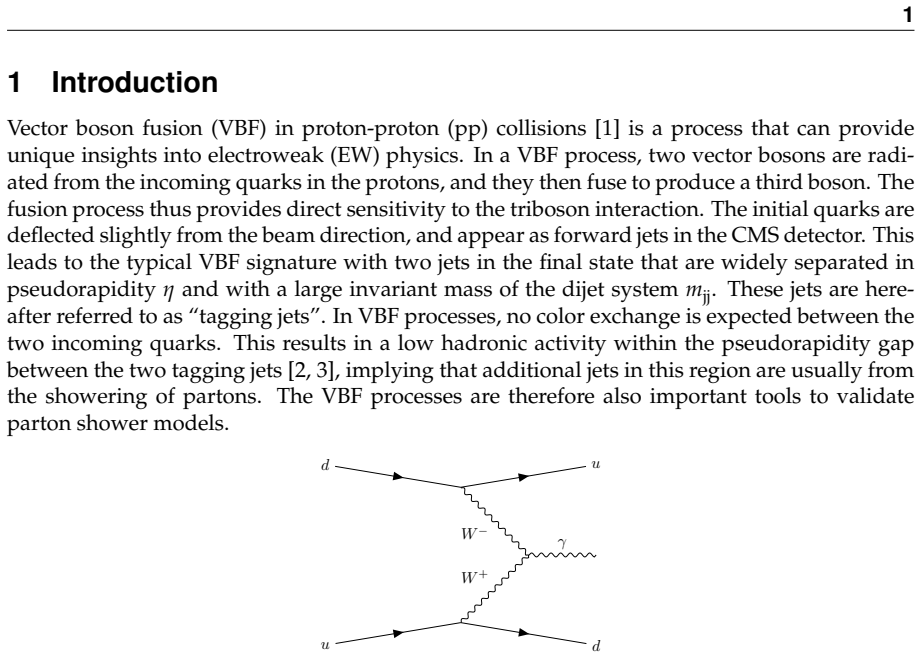
The first observation of electroweak production of a photon in association with two forward jets in proton-proton collisions is presented. The measurement uses data recorded by the CMS experiment at the LHC during 2016$-$2018 at a center-of-mass energy of 13 TeV, corresponding to an integrated luminosity of 138 fb$^{-1}$. The analysis is performed in a region enriched in photon production via vector boson fusion, with a requirement on the transverse momentum of the photon to exceed 200 GeV. The cross section is measured to be 202 $^{+36}_{-32}$ fb, at a significance with respect to the null hypothesis that exceeds five standard deviations. This is in agreement with the standard model prediction of 177 $^{+13}_{-12}$ fb. Differential cross sections are measured as a function of various observables. Limits are set on dimension-6 effective field theory operators that contribute to the WW$\gamma$ interaction. The observed 95% confidence intervals for the corresponding Warsaw basis Wilson coefficients $c_\mathrm{W}$ and $c_\mathrm{HWB}$ are [$-$0.11, 0.16] and [$-$1.6, 1.5], respectively.
Editorial analysis
A structured set of objections, weighed in public.
Referee Report
Summary. The manuscript reports the first observation of electroweak production of a photon in association with two forward jets in proton-proton collisions at 13 TeV using 138 fb^{-1} of CMS data from 2016-2018. The analysis selects a vector-boson-fusion enriched region requiring photon p_T > 200 GeV and measures the fiducial cross section as 202^{+36}_{-32} fb with a significance exceeding five standard deviations relative to the background-only hypothesis. This is stated to be consistent with the Standard Model prediction of 177^{+13}_{-12} fb. Differential cross sections are presented as functions of several observables, and 95% CL limits are set on the Warsaw-basis Wilson coefficients c_W and c_HWB for dimension-6 operators affecting the WWγ vertex.
Significance. If the background modeling and systematic uncertainties in the VBF-enriched high-p_T photon region are shown to be under control, the result would represent a meaningful first observation of this electroweak process. It provides a direct test of the Standard Model at high energies and yields competitive constraints on anomalous triple-gauge couplings. The inclusion of differential distributions and EFT limits adds value beyond the inclusive cross-section measurement.
major comments (2)
- [Analysis and background estimation sections] The >5σ significance and the extracted signal yield of 202^{+36}_{-32} fb both rest on the accuracy of the background prediction (primarily QCD γ+jet) inside the signal region after VBF cuts. The manuscript should explicitly detail the template or fit method used for background extraction, including any data-driven validation of the dijet-mass or other discriminant shapes at photon p_T > 200 GeV, and quantify the impact of possible mismodeling on the p-value.
- [Results section] The quoted uncertainties on the measured cross section and on the SM prediction appear to be dominated by different sources; a breakdown table showing the separate contributions from statistical, experimental systematic, and theoretical uncertainties for both the data and the prediction would allow a clearer assessment of the agreement.
minor comments (2)
- [Abstract and Introduction] The abstract and introduction use the phrase 'first observation' without a brief statement of the previous search limits or the integrated luminosity of earlier datasets; adding one sentence would improve context.
- [Figures] Figure captions for the differential distributions should explicitly state the bin-by-bin statistical and systematic uncertainties shown in the ratio panels.
Simulated Author's Rebuttal
We thank the referee for the careful reading of the manuscript and for the constructive comments, which have helped improve the clarity of the presentation. We address each major comment below and have revised the manuscript to incorporate additional details where appropriate.
read point-by-point responses
-
Referee: [Analysis and background estimation sections] The >5σ significance and the extracted signal yield of 202^{+36}_{-32} fb both rest on the accuracy of the background prediction (primarily QCD γ+jet) inside the signal region after VBF cuts. The manuscript should explicitly detail the template or fit method used for background extraction, including any data-driven validation of the dijet-mass or other discriminant shapes at photon p_T > 200 GeV, and quantify the impact of possible mismodeling on the p-value.
Authors: We appreciate the referee's focus on the robustness of the background modeling. The background extraction is performed via a template fit to the dijet invariant mass distribution in the VBF signal region, as described in Section 5 of the manuscript. The QCD γ+jet template is derived from a data-driven control region with inverted photon isolation and validated in multiple orthogonal sidebands at lower photon p_T. In response to this comment, we have expanded the text in the revised manuscript to include an explicit discussion of the shape validation and extrapolation to the p_T > 200 GeV regime, along with a dedicated study showing that a 10% variation in the background shape alters the observed significance by less than 0.2σ. We believe these additions address the request without altering the core analysis. revision: partial
-
Referee: [Results section] The quoted uncertainties on the measured cross section and on the SM prediction appear to be dominated by different sources; a breakdown table showing the separate contributions from statistical, experimental systematic, and theoretical uncertainties for both the data and the prediction would allow a clearer assessment of the agreement.
Authors: We agree that a tabulated uncertainty breakdown improves the transparency of the comparison between measurement and prediction. We have added a new table (Table 3) in the revised manuscript that separates the contributions for the measured cross section (statistical uncertainty 12%, experimental systematic 15%, luminosity 2%) and for the SM prediction (theoretical scale and PDF uncertainties totaling 7%). This table confirms that the measured value of 202 fb remains consistent with the SM expectation of 177 fb within the combined uncertainties. revision: yes
Circularity Check
No circularity: direct experimental measurement from data
full rationale
The paper reports a cross-section measurement extracted from 138 fb^{-1} of CMS collision data in a VBF-enriched region with pT(gamma) > 200 GeV. The value 202^{+36}_{-32} fb is obtained by fitting or subtracting backgrounds (primarily QCD photon+jet) from observed yields and comparing the excess to the independent SM prediction of 177^{+13}_{-12} fb. No equations, self-citations, or ansatze reduce this extracted yield to a parameter fitted from the same observable by construction; background modeling and efficiency corrections are external inputs validated against control regions or simulation, not self-referential. The >5 sigma significance follows from the data excess over the background-only hypothesis and does not rely on any load-bearing self-citation chain or uniqueness theorem imported from prior author work. The result is therefore self-contained against external benchmarks.
Axiom & Free-Parameter Ledger
axioms (1)
- domain assumption Background processes and detector efficiencies can be modeled accurately enough to extract the signal with the quoted precision.
Lean theorems connected to this paper
-
IndisputableMonolith/Foundation/AbsoluteFloorClosure.leanreality_from_one_distinction unclear?
unclearRelation between the paper passage and the cited Recognition theorem.
The cross section is measured to be 202^{+36}_{-32} fb... in agreement with the standard model prediction of 177^{+13}_{-12} fb. ... Limits are set on dimension-6 effective field theory operators...
-
IndisputableMonolith/Foundation/AlexanderDuality.leanalexander_duality_circle_linking unclear?
unclearRelation between the paper passage and the cited Recognition theorem.
The analysis is performed in a region enriched in photon production via vector boson fusion...
What do these tags mean?
- matches
- The paper's claim is directly supported by a theorem in the formal canon.
- supports
- The theorem supports part of the paper's argument, but the paper may add assumptions or extra steps.
- extends
- The paper goes beyond the formal theorem; the theorem is a base layer rather than the whole result.
- uses
- The paper appears to rely on the theorem as machinery.
- contradicts
- The paper's claim conflicts with a theorem or certificate in the canon.
- unclear
- Pith found a possible connection, but the passage is too broad, indirect, or ambiguous to say the theorem truly supports the claim.
Reference graph
Works this paper leans on
-
[1]
Vector-Boson Fusion and Vector-Boson Scattering
M. Rauch, “Vector-boson fusion and vector-boson scattering”, 2016. arXiv:1610.08420
work page internal anchor Pith review Pith/arXiv arXiv 2016
-
[2]
Rapidity gaps and jets as a new-physics signature in very-high-energy hadron-hadron collisions
J. D. Bjorken, “Rapidity gaps and jets as a new-physics signature in very-high-energy hadron-hadron collisions”,Phys. Rev. D47(1993) 101, doi:10.1103/PhysRevD.47.101
-
[3]
Jets separated by a large pseudorapidity gap at the Tevatron and at the LHC
C. Baldenegro et al., “Jets separated by a large pseudorapidity gap at the Tevatron and at the LHC”,J. High Energy Phys.2022(2022), no. 08, 250, doi:10.1007/JHEP08(2022)250
-
[4]
High Energy Phys.2013(2013), no
CMS Collaboration, “Measurement of the hadronic activity in events with a Z and two jets and extraction of the cross section for the electroweak production of a Z with two jets inppcollisions at √s= 7 TeV”,J. High Energy Phys.2013(2013), no. 10, 062, doi:10.1007/JHEP10(2013)062
-
[5]
ATLAS Collaboration, “Measurement of the electroweak production of dijets in association with a Z-boson and distributions sensitive to vector boson fusion in proton-proton collisions at √s=8 TeV using the ATLAS detector”,J. High Energy Phys. 2014(2014), no. 04, 031,doi:10.1007/JHEP04(2014)031
-
[6]
CMS Collaboration, “Measurement of electroweak production of two jets in association with a Z boson in proton-proton collisions at √s=8 TeV”,Eur. Phys. J. C75(2015) 66, doi:10.1140/epjc/s10052-014-3232-5
-
[7]
CMS Collaboration, “Electroweak production of two jets in association with a Z boson in proton–proton collisions at √s=13 TeV”,Eur. Phys. J. C78(2018) 589, doi:10.1140/epjc/s10052-018-6049-9
-
[8]
ATLAS Collaboration, “Measurement of the cross-section for electroweak production of dijets in association with a Z boson in pp collisions at √s= 13 TeV with the ATLAS detector”,Phys. Lett. B775(2017) 206,doi:10.1016/j.physletb.2017.10.040
-
[9]
CMS Collaboration, “Measurement of electroweak production of a W boson and two forward jets in proton-proton collisions at √s=8 TeV”,J. High Energy Phys.2016(2016), no. 11, 147,doi:10.1007/JHEP11(2016)147
-
[10]
ATLAS Collaboration, “Measurements of electroweak Wjj production and constraints on anomalous gauge couplings with the ATLAS detector”,Eur. Phys. J. C77(2017) 474, doi:10.1140/epjc/s10052-017-5007-2. 18
-
[11]
CMS Collaboration, “Measurement of electroweak production of a W boson in association with two jets in proton–proton collisions at √s=13 TeV”,Eur. Phys. J. C80 (2020) 43,doi:10.1140/epjc/s10052-019-7585-7
-
[12]
ATLAS Collaboration, “Measurement of isolated-photon plus two-jet production inpp collisions at √s=13 TeV with the ATLAS detector”,J. High Energy Phys.2020(2020), no. 03, 179,doi:10.1007/JHEP03(2020)179
-
[13]
Observation and measurement of Higgs boson decays toWW ∗ with the ATLAS detector
ATLAS Collaboration, “Observation and measurement of Higgs boson decays toWW ∗ with the ATLAS detector”,Phys. Rev. D92(2014) 012006, doi:10.1103/PhysRevD.92.012006
-
[14]
Probing color–singlet exchange in Z + 2–jet events at the CERN LHC
D. L. Rainwater, R. Szalapski, and D. Zeppenfeld, “Probing color–singlet exchange in Z + 2–jet events at the CERN LHC”,Phys. Rev. D54(1996) 6680, doi:10.1103/PhysRevD.54.6680
-
[15]
Dimension-six terms in the standard model Lagrangian
B. Grzadkowski, M. Iskrzynski, M. Misiak, and J. Rosiek, “Dimension-six terms in the standard model Lagrangian”,J. High Energy Phys.2010(2010), no. 10, 085, doi:10.1007/JHEP10(2010)085
-
[16]
SMEFT constraints on new physics beyond the standard model
J. Ellis, “SMEFT constraints on new physics beyond the standard model”, inProceedings of the BSM-2021 Conference: Beyond Standard Model: From Theory to Experiment. 2021. doi:10.31526/ACP.BSM-2021.16
-
[17]
HEPData record for this analysis
“HEPData record for this analysis”, 2025.doi:10.17182/hepdata.167074
-
[18]
The CMS experiment at the CERN LHC
CMS Collaboration, “The CMS experiment at the CERN LHC”,J. Instrum.3(2008) S08004,doi:10.1088/1748-0221/3/08/S08004
-
[19]
Development of the CMS detector for the CERN LHC Run 3
CMS Collaboration, “Development of the CMS detector for the CERN LHC Run 3”,J. Instrum.19(2024) P05064,doi:10.1088/1748-0221/19/05/P05064
-
[20]
CMS Collaboration, “The CMS trigger system”,J. Instrum.12(2017) P01020, doi:10.1088/1748-0221/12/01/P01020
-
[21]
Performance of the CMS high-level trigger during LHC Run 2
CMS Collaboration, “Performance of the CMS high-level trigger during LHC run 2”,J. Instrum.19(2024) P11021,doi:10.1088/1748-0221/19/11/P11021
-
[22]
J. Alwall et al., “The automated computation of tree-level and next-to-leading order differential cross sections, and their matching to parton shower simulations”,J. High Energy Phys.2014(2014), no. 07, 079,doi:10.1007/JHEP07(2014)079
-
[23]
Isolated photons in perturbative QCD
S. Frixione, “Isolated photons in perturbative QCD”,Phys. Lett. B429(1998) 369, doi:10.1016/S0370-2693(98)00454-7
-
[24]
Event Generation with Sherpa 2.2
E. Bothmann et al., “Event generation with Sherpa 2.2”,SciPost Phys.7(2019) 034, doi:10.21468/SciPostPhys.7.3.034
-
[25]
: An introduction to PYTHIA 8.2
T. Sjostrand et al., “An introduction to PYTHIA 8.2”,Comput. Phys. Commun.191(2015) 159,doi:10.1016/j.cpc.2015.01.024
-
[26]
Event generator tunes obtained from underlying event and multiparton scattering measurements
CMS Collaboration, “Event generator tunes obtained from underlying event and multiparton scattering measurements”,Eur. Phys. J. C76(2016) 155, doi:10.1140/epjc/s10052-016-3988-x. References 19
-
[27]
Parton-shower effects in Higgs production via vector-boson fusion,
B. J ¨ager et al., “Parton-shower effects in Higgs production via vector-boson fusion”,Eur. Phys. J. C80(2020) 756,doi:10.1140/epjc/s10052-020-8326-7
-
[28]
Parton distributions from high-precision collider data
NNPDF Collaboration, “Parton distributions from high-precision collider data”,Eur. Phys. J. C77(2017) 663,doi:10.1140/epjc/s10052-017-5199-5
work page internal anchor Pith review doi:10.1140/epjc/s10052-017-5199-5 2017
-
[29]
GEANT4 Collaboration, “GEANT4–A simulation toolkit”,Nucl. Instrum. Meth. A506 (2003) 250,doi:10.1016/S0168-9002(03)01368-8
-
[30]
Particle-flow reconstruction and global event description with the CMS detector
CMS Collaboration, “Particle-flow reconstruction and global event description with the CMS detector”,J. Instrum.12(2017) P10003, doi:10.1088/1748-0221/12/10/P10003
work page internal anchor Pith review doi:10.1088/1748-0221/12/10/p10003 2017
-
[31]
Technical proposal for the Phase-II upgrade of the Compact Muon Solenoid
CMS Collaboration, “Technical proposal for the Phase-II upgrade of the Compact Muon Solenoid”, CMS Technical Proposal CERN-LHCC-2015-010, CMS-TDR-15-02, 2015
work page 2015
-
[32]
Electron and photon reconstruction and identification with the CMS experiment at the CERN LHC
CMS Collaboration, “Electron and photon reconstruction and identification with the CMS experiment at the CERN LHC”,J. Instrum.16(2021) P05014, doi:10.1088/1748-0221/16/05/P05014
-
[33]
CMS Collaboration, “Performance of the CMS muon detector and muon reconstruction with proton-proton collisions at √s=13 TeV”,J. Instrum.13(2018) P06015, doi:10.1088/1748-0221/13/06/P06015
work page internal anchor Pith review doi:10.1088/1748-0221/13/06/p06015 2018
-
[34]
CMS electron and photon performance at 13 TeV
J. Rembser on behalf of the CMS Collaboration, “CMS electron and photon performance at 13 TeV”,J. Phys. Conf. Ser.1162(2019) 012008, doi:10.1088/1742-6596/1162/1/012008
-
[35]
The anti-kT jet clustering algorithm
M. Cacciari, G. P . Salam, and G. Soyez, “The anti-kT jet clustering algorithm”,J. High Energy Phys.2008(2008), no. 04, 063,doi:10.1088/1126-6708/2008/04/063
-
[36]
M. Cacciari, G. P . Salam, and G. Soyez, “FastJet user manual”,Eur. Phys. J. C72(2012) 1896,doi:10.1140/epjc/s10052-012-1896-2
-
[37]
Jet energy scale and resolution in the CMS experiment in pp collisions at 8 TeV
CMS Collaboration, “Jet energy scale and resolution in the CMS experiment in pp collisions at 8 TeV”,J. Instrum.12(2017) P02014, doi:10.1088/1748-0221/12/02/P02014
-
[38]
Jet algorithms performance in 13 TeV data
CMS Collaboration, “Jet algorithms performance in 13 TeV data”, Technical Report CMS-PAS-JME-16-003, CERN, Geneva, 2017
work page 2017
-
[39]
ATLAS Collaboration, “Measurement of the inclusive isolated prompt photon cross section in pp collisions at √s=8 TeV with the ATLAS detector”,J. High Energy Phys. 2016(2016), no. 08, 5,doi:10.1007/JHEP08(2016)005
-
[40]
T. Chen and C. Guestrin, “XGBoost: a scalable tree boosting system”, inProceedings of the 22nd ACM SIGKDD International Conference on Knowledge Discovery and Data Mining, p. 785. 2016.doi:10.1145/2939672.2939785
-
[41]
The CMS statistical analysis and combination tool: Combine
CMS Collaboration, “The CMS statistical analysis and combination tool: COMBINE”, Comput. Softw. Big Sci.8(2024) 19,doi:10.1007/s41781-024-00121-4
-
[42]
PDF4LHC recommendations for LHC Run II
J. Butterworth et al., “PDF4LHC recommendations for LHC Run II”,J. Phys. G43(2016) 023001,doi:10.1088/0954-3899/43/2/023001. 20
-
[43]
Performance of the CMS electromagnetic calorimeter in pp collisions at √s=13 TeV
CMS Collaboration, “Performance of the CMS electromagnetic calorimeter in pp collisions at √s= 13 TeV”,J. Instrum.19(2024) P09004, doi:10.1088/1748-0221/19/09/P09004
-
[44]
Precision luminosity measurement in proton-proton collisions at√s = 13 TeV in 2015 and 2016 at CMS
CMS Collaboration, “Precision luminosity measurement in proton-proton collisions at√s=13 TeV in 2015 and 2016 at CMS”,Eur. Phys. J. C81(2021) 800, doi:10.1140/epjc/s10052-021-09538-2
-
[45]
CMS luminosity measurement for the 2017 data-taking period at√s=13 TeV
CMS Collaboration, “CMS luminosity measurement for the 2017 data-taking period at√s=13 TeV”, Technical Report CMS-PAS-LUM-17-004, CERN, Geneva, 2018
work page 2017
-
[46]
CMS luminosity measurement for the 2018 data-taking period at√s=13 TeV
CMS Collaboration, “CMS luminosity measurement for the 2018 data-taking period at√s=13 TeV”, Technical Report CMS-PAS-LUM-18-002, CERN, Geneva, 2019
work page 2018
-
[47]
Measurement of the inelastic proton-proton cross section at √s=13 TeV
CMS Collaboration, “Measurement of the inelastic proton-proton cross section at √s=13 TeV”,J. High Energy Phys.2018(2018), no. 07, 161,doi:10.1007/JHEP07(2018)161
-
[48]
Fitting using finite Monte Carlo samples
R. J. Barlow and C. Beeston, “Fitting using finite Monte Carlo samples”,Comput. Phys. Commun.77(1993) 219,doi:10.1016/0010-4655(93)90005-W
-
[49]
The standard model as an effective field theory
I. Brivio and M. Trott, “The standard model as an effective field theory”,Phys. Rept.793 (2019) 1,doi:10.1016/j.physrep.2018.11.002
-
[50]
SMEFTsim 3.0 — a practical guide
I. Brivio, “SMEFTsim 3.0 — a practical guide”,J. High Energy Phys.2021(2021), no. 04, 073,doi:10.1007/JHEP04(2021)073
-
[51]
Chollet et al., “Keras”.https://keras.io, 2015
F. Chollet et al., “Keras”.https://keras.io, 2015
work page 2015
-
[52]
TENSORFLOW: Large-scale machine learning on heterogeneous systems
M. Abadi et al., “TENSORFLOW: large-scale machine learning on heterogeneous systems”, 2015. Software available fromhttp://tensorflow.org. doi:10.5281/zenodo.4724125
-
[53]
ATLAS Collaboration, “Differential cross-section measurements for the electroweak production of dijets in association with a Z boson in proton–proton collisions at ATLAS”, Eur, Phys, J. C81(2021) 163,doi:10.1140/epjc/s10052-020-08734-w
-
[54]
CMS Collaboration, “Search for anomalous triple gauge couplings in WW and WZ production in lepton + jet events in proton-proton collisions at √s=13 TeV”,J. High Energy Phys.2019(2019), no. 12, 062,doi:10.1007/JHEP12(2019)062. 21 A The CMS Collaboration Yerevan Physics Institute, Yerevan, Armenia A. Hayrapetyan, V . Makarenko , A. Tumasyan1 Institut f ¨ ur...
discussion (0)
Sign in with ORCID, Apple, or X to comment. Anyone can read and Pith papers without signing in.