Computing the Bottleneck Distance between Persistent Homology Transforms
Pith reviewed 2026-05-17 03:24 UTC · model grok-4.3
The pith
Algorithms compute the bottleneck distance between persistent homology transforms in Õ(n^5) time for the integral and Õ(n^3) or Õ(n^5) for the maximum.
A machine-rendered reading of the paper's core claim, the machinery that carries it, and where it could break.
Core claim
By maintaining a kinetic data structure over critical directions where the optimal matching between persistence diagrams changes, the integral of the bottleneck distance can be computed exactly in Õ(n^5) time while the maximum distance over directions can be found in Õ(n^3) time in R^2 and Õ(n^5) time in R^3.
What carries the argument
Kinetic data structure that enumerates and processes the finite sequence of directions at which the bottleneck matching between persistence diagrams changes.
If this is right
- Exact comparison of shapes becomes feasible without relying on direction sampling.
- Collections of three-dimensional objects can be compared using the maximum objective at reduced cost.
- The same event-tracking technique may extend the integral computation to additional shape classes.
Where Pith is reading between the lines
- The kinetic approach could be adapted to other diagram distances such as Wasserstein.
- Practical implementations might benefit from early termination when the running maximum already exceeds a user threshold.
- The bounds suggest that higher-dimensional cases remain computationally heavy but still polynomial.
Load-bearing premise
Changes in the optimal bottleneck matching occur only at a finite, enumerable set of directions that the kinetic structure can locate without missing any transitions.
What would settle it
Run the new algorithm on two simple polyhedra whose persistence diagrams are known explicitly, then compare the output integral against a high-resolution numerical quadrature of the distance function sampled at millions of directions.
Figures

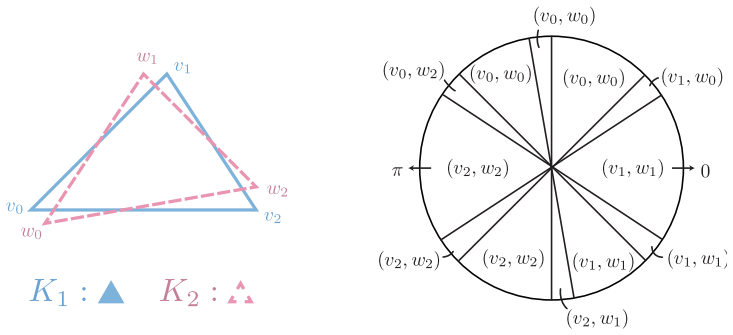
read the original abstract
The Persistent Homology Transform (PHT) summarizes a shape in $\mathbb{R}^m$ by collecting persistence diagrams obtained from linear height filtrations in all directions on $\mathbb{S}^{m-1}$. It enjoys strong theoretical guarantees, including continuity, stability, and injectivity on broad classes of shapes. A natural way to compare two PHTs is to use the bottleneck distance between their diagrams as the direction varies. Prior work has either compared PHTs by sampling directions or, in 2D, computed the exact \textit{integral} of bottleneck distance over all angles via a kinetic data structure. We improve the integral objective to $\tilde O(n^5)$ in place of earlier $\tilde O(n^6)$ bound. For the \textit{max} objective, we give a $\tilde O(n^3)$ algorithm in $\mathbb{R}^2$ and a $\tilde O(n^5)$ algorithm in $\mathbb{R}^3$.
Editorial analysis
A structured set of objections, weighed in public.
Referee Report
Summary. The manuscript presents algorithms for computing the bottleneck distance between Persistent Homology Transforms (PHTs) of two shapes in R^m. It improves the integral objective to Õ(n^5) time (from prior Õ(n^6)), and for the max objective gives an Õ(n^3) algorithm in R^2 and an Õ(n^5) algorithm in R^3, relying on kinetic data structures that maintain the current bottleneck matching as the direction varies continuously on S^{m-1}.
Significance. If the central claims hold, the work advances exact, non-sampling comparison of PHTs, which are known to be continuous, stable, and injective on broad shape classes. The kinetic maintenance of bottleneck matchings and the improved asymptotics for both integral and max objectives represent a concrete algorithmic contribution in computational geometry and topological data analysis. No machine-checked proofs or reproducible code are mentioned, but the parameter-free derivation of the event-based accumulation between critical directions is a positive feature if fully substantiated.
major comments (2)
- [Kinetic data structure for integral objective] Kinetic data structure construction (integral objective): the Õ(n^5) bound rests on the assumption that all changes to the optimal bottleneck matching occur at finitely many algebraically computable critical directions (birth/death swaps and equal-length matching swaps) that can be predicted from the current diagram without exhaustive search or missed transitions. For general simplicial complexes the persistence coordinates are roots of polynomials whose degree grows with the filtration; the manuscript must bound this algebraic degree and prove that the kinetic certificate never misses a crossing, as this is load-bearing for the claimed improvement over the prior Õ(n^6) bound.
- [Max objective in R^3] Max-objective algorithm in R^3: the Õ(n^5) claim similarly depends on enumerating and tracking events on S^2 without hidden logarithmic factors or post-hoc degeneracy assumptions. A concrete complexity analysis of event prediction and interval-cost accumulation is required to confirm the bound.
minor comments (2)
- [Abstract] The abstract and introduction should explicitly define the Õ notation and reference the prior Õ(n^6) result being improved upon.
- [Introduction] Notation for the sphere S^{m-1} and the height filtrations could be introduced with a short preliminary paragraph for readers outside computational geometry.
Simulated Author's Rebuttal
We thank the referee for their careful reading and constructive comments on the manuscript. We address each major comment below, clarifying the underlying assumptions and indicating the revisions we will make to strengthen the rigor of the analysis.
read point-by-point responses
-
Referee: [Kinetic data structure for integral objective] Kinetic data structure construction (integral objective): the Õ(n^5) bound rests on the assumption that all changes to the optimal bottleneck matching occur at finitely many algebraically computable critical directions (birth/death swaps and equal-length matching swaps) that can be predicted from the current diagram without exhaustive search or missed transitions. For general simplicial complexes the persistence coordinates are roots of polynomials whose degree grows with the filtration; the manuscript must bound this algebraic degree and prove that the kinetic certificate never misses a crossing, as this is load-bearing for the claimed improvement over the prior Õ(n^6) bound.
Authors: We agree that an explicit bound on algebraic degree and a proof of completeness for the kinetic certificate are necessary to fully substantiate the Õ(n^5) bound. In the manuscript we model shapes as simplicial complexes whose height filtrations assign to each simplex the maximum vertex height; consequently birth and death times are linear functions of the direction. Critical directions arise from equating bottleneck costs of adjacent matchings, yielding polynomial equations of bounded degree (at most 4). We will add a dedicated subsection that states this degree bound, enumerates the O(n^5) candidate events, and proves that the certificate maintained by the kinetic data structure detects every crossing without omission. This revision will make the improvement over the prior Õ(n^6) bound rigorous. revision: yes
-
Referee: [Max objective in R^3] Max-objective algorithm in R^3: the Õ(n^5) claim similarly depends on enumerating and tracking events on S^2 without hidden logarithmic factors or post-hoc degeneracy assumptions. A concrete complexity analysis of event prediction and interval-cost accumulation is required to confirm the bound.
Authors: We concur that a concrete complexity analysis for the spherical case is required. The R^3 algorithm lifts the 2D kinetic maintenance to S^2 by tracking events where the current bottleneck matching ceases to be optimal. Candidate events are generated by solving low-degree polynomial systems on the sphere; under general position these are processed with a priority queue in amortized constant time per event. We will insert a new subsection that counts the total number of events, shows that interval-cost accumulation for the max objective incurs no extra logarithmic factors, and explains how symbolic perturbation resolves degeneracies without changing the Õ(n^5) asymptotic. This will confirm the claimed bound. revision: yes
Circularity Check
No significant circularity; algorithmic improvements are independent constructions
full rationale
The paper derives improved time bounds (Õ(n^5) integral, Õ(n^3)/Õ(n^5) max) for bottleneck distance on PHTs by extending kinetic data structures to track critical events on the sphere. These steps rely on standard computational geometry primitives (event prediction, certificate maintenance) whose validity is external to the present work and not reduced to self-definition, fitted parameters renamed as predictions, or load-bearing self-citations. The derivation chain remains self-contained against external benchmarks in kinetic algorithms and persistent homology.
Axiom & Free-Parameter Ledger
axioms (2)
- domain assumption Persistence diagrams obtained from linear height filtrations are stable and can be compared via bottleneck distance.
- domain assumption The set of directions where the bottleneck matching changes is finite and can be tracked combinatorially.
Reference graph
Works this paper leans on
-
[1]
Havard Bakke Bjerkevik and Michael Kerber. Asymptotic improvements on the ex- act matching distance for 2-parameter persistence.Journal of Computational Geometry, 14(1):309–342, Dec. 2023
work page 2023
-
[2]
Geometric Matching and Bottleneck Problems
Sergio Cabello, Siu-Wing Cheng, Otfried Cheong, and Christian Knauer. Geometric Matching and Bottleneck Problems. In Wolfgang Mulzer and Jeff M. Phillips, editors, 40th International Symposium on Computational Geometry (SoCG 2024), volume 293 of Leibniz International Proceedings in Informatics (LIPIcs), pages 31:1–31:15, Dagstuhl, Germany, 2024. Schloss D...
work page 2024
-
[3]
Perslay: A neural network layer for persistence diagrams and new graph topo- logical signatures
Mathieu Carri` ere, Frederic Chazal, Yuichi Ike, Theo Lacombe, Martin Royer, and Yuhei Umeda. Perslay: A neural network layer for persistence diagrams and new graph topo- logical signatures. In Silvia Chiappa and Roberto Calandra, editors,Proceedings of the Twenty Third International Conference on Artificial Intelligence and Statistics, volume 108 ofProce...
work page 2020
-
[4]
Vines and vineyards by updating persistence in linear time
David Cohen-Steiner, Herbert Edelsbrunner, and Dmitriy Morozov. Vines and vineyards by updating persistence in linear time. InProceedings of the Twenty-Second Annual Sym- posium on Computational Geometry, SCG ’06, page 119–126, New York, NY, USA, 2006. Association for Computing Machinery
work page 2006
-
[5]
Justin Curry, Sayan Mukherjee, and Katharine Turner. How many directions determine a shape and other sufficiency results for two topological transforms.Transactions of the American Mathematical Society, Series B, 2018
work page 2018
-
[6]
Tamal K. Dey and Cheng Xin. Computing Bottleneck Distance for 2-D Interval Decom- posable Modules. In Bettina Speckmann and Csaba D. T´ oth, editors,34th International Symposium on Computational Geometry (SoCG 2018), volume 99 ofLeibniz International Proceedings in Informatics (LIPIcs), pages 32:1–32:15, Dagstuhl, Germany, 2018. Schloss Dagstuhl – Leibniz...
work page 2018
-
[7]
Cam- bridge University Press, 1 edition, 2017
Tamal Krishna Dey and Yusu Wang.Computational Topology for Data Analysis. Cam- bridge University Press, 1 edition, 2017
work page 2017
-
[8]
Herbert Edelsbrunner and John Harer.Computational Topology - an Introduction.Amer- ican Mathematical Society, 2010
work page 2010
-
[9]
Merge trees of periodic filtrations, 2024
Herbert Edelsbrunner and Teresa Heiss. Merge trees of periodic filtrations, 2024
work page 2024
-
[10]
Alon Efrat, Alon Itai, and Matthew J. Katz. Geometry helps in bottleneck matching and related problems.Algorithmica, 31(1):1–28, Sep 2001
work page 2001
-
[11]
Robert Ghrist, Rachel Levanger, and Huy Mai. Persistent homology and Euler integral transforms.Journal of Applied and Computational Topology, 2(1):55–60, Oct 2018
work page 2018
-
[12]
Chad Giusti, Eva Pastalkova, Carina Curto, and Vladimir Itskov. Clique topology reveals intrinsic geometric structure in neural correlations.Proceedings of the National Academy of Sciences, 112(44):13455–13460, 2015
work page 2015
-
[13]
Felix Hensel, Michael Moor, and Bastian Rieck. A survey of topological machine learning methods.Frontiers in Artificial Intelligence, Volume 4 - 2021, 2021
work page 2021
-
[14]
Escolar, Kaname Mat- sue, and Yasumasa Nishiura
Yasuaki Hiraoka, Takenobu Nakamura, Akihiko Hirata, Emerson G. Escolar, Kaname Mat- sue, and Yasumasa Nishiura. Hierarchical structures of amorphous solids characterized by persistent homology.Proceedings of the National Academy of Sciences, 113(26):7035–7040, 2016
work page 2016
-
[15]
John E. Hopcroft and Richard M. Karp. Ann 5/2 algorithm for maximum matchings in bipartite graphs.SIAM J. Comput., 2(4):225–231, Dec 1973. 15
work page 1973
-
[16]
Geometry helps to compare persistence diagrams.ACM J
Michael Kerber, Dmitriy Morozov, and Arnur Nigmetov. Geometry helps to compare persistence diagrams.ACM J. Exp. Algorithmics, 22, sep 2017
work page 2017
-
[17]
Knuth.The Art of Computer Programming, Volume 3: Sorting and Searching
Donald E. Knuth.The Art of Computer Programming, Volume 3: Sorting and Searching. Addison-Wesley, 2nd edition, 1998. Section 5.1.1
work page 1998
-
[18]
The kinetic hourglass data struc- ture for computing the bottleneck distance of dynamic data, 2025
Elizabeth Munch, Elena Xinyi Wang, and Carola Wenk. The kinetic hourglass data struc- ture for computing the bottleneck distance of dynamic data, 2025
work page 2025
-
[19]
Michael W. Reimann, Max Nolte, Martina Scolamiero, Katharine Turner, Rodrigo Perin, Giuseppe Chindemi, Pawe l D lotko, Ran Levi, Kathryn Hess, and Henry Markram. Cliques of neurons bound into cavities provide a missing link between structure and function. Frontiers in Computational Neuroscience, Volume 11 - 2017, 2017
work page 2017
-
[20]
Katharine Turner, Sayan Mukherjee, and Doug M. Boyer. Persistent homology transform for modeling shapes and surfaces.Information and Inference: A Journal of the IMA, 3(4):310–344, 12 2014. A Properties of difference curves A.1 Local maxima Lemma A.1.LetK, K ′ ⊂R 2 be simplicial complexes, and let∆ α,σ(ω)be a difference curve for simplicesα∈Kandσ∈K ′ withω...
work page 2014
-
[21]
Insertion overlaps: WhenI α =I β over some region
-
[22]
Difference overlaps: When ∆ α,σ = ∆β,τ over some region due to shared active vertices 17 B.2 Why Overlaps Don’t Affect the Algorithm Despite these geometric coincidences, our algorithm remains correct because: Lemma B.1.Each difference curve∆ α,σ maintains a unique combinatorial identity determined by the ordered pair(α, σ), independent of geometric overl...
-
[23]
Great circle arcs map to circles and lines in the plane
-
[24]
Disjoint arc families remain disjoint after projection
-
[25]
Each projected curve can be decomposed intoO(1)x-monotone arcs. Proof.Stereographic projection from the north pole (0,0,1) maps a point (θ, ϕ) onS 2 to (x, y) = sinϕcosθ 1−cosϕ , sinϕsinθ 1−cosϕ Great circles onS 2 are intersections with planes through the origin. Under stereographic projection, these map to circles in the plane (or lines if the plane pas...
discussion (0)
Sign in with ORCID, Apple, or X to comment. Anyone can read and Pith papers without signing in.