Analysis and reformulation of the k--ω turbulence model for buoyancy-driven thermal convection
Pith reviewed 2026-05-17 03:28 UTC · model grok-4.3
The pith
Two algebraic functions added to the k-ω model restore the observed heat transfer scaling with Prandtl number in buoyancy-driven convection.
A machine-rendered reading of the paper's core claim, the machinery that carries it, and where it could break.
Core claim
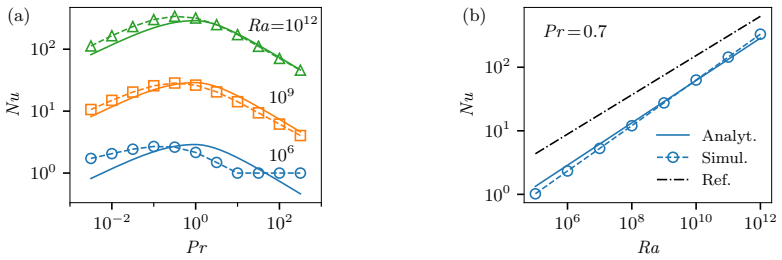
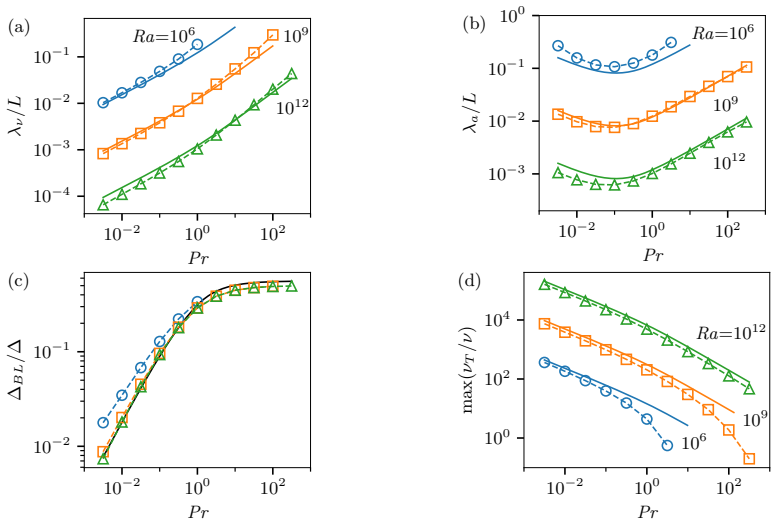
Analysis of the standard k-ω equations for pure-buoyancy Rayleigh-Bénard convection in an infinite layer produces the scalings Nu ∼ Ra^{1/3} Pr^{1/3} for Pr ≪ 1 and Nu ∼ Ra^{1/3} Pr^{-0.415} for Pr ≫ 1. Reformulation of the buoyancy modeling terms with two algebraic functions recovers the measured trends Nu ∼ Pr^{1/8} for Pr ≪ 1 and Nu ∼ Pr^0 for Pr ≫ 1 at moderate Ra while preserving full compatibility with the standard closure.
What carries the argument
Two dimensionless algebraic functions inserted into the buoyancy production terms of the k and ω equations.
If this is right
- Mean temperature fields improve in two-dimensional Rayleigh-Bénard convection.
- Turbulent heat flux distributions improve in internally heated convection and unstably stratified Couette flow.
- Predictions remain consistent with the original model in flows without buoyancy.
- Results hold across different aspect ratios in vertically heated natural convection.
Where Pith is reading between the lines
- The same functions could be tested in other two-equation RANS models to handle unstable stratification.
- Adoption might reduce case-by-case tuning for engineering calculations of natural convection in enclosures or channels.
- Extension to three-dimensional or higher-Rayleigh-number regimes would test whether the recovered scalings continue to hold.
Load-bearing premise
The two algebraic functions chosen to match infinite-layer trends remain accurate without adjustment when applied to the full range of tested buoyancy-driven flows.
What would settle it
An experimental measurement of Nusselt number versus Prandtl number at moderate Rayleigh number in Rayleigh-Bénard convection that deviates from the target scalings of Pr to the power 1/8 at low Pr and constant at high Pr.
Figures





read the original abstract
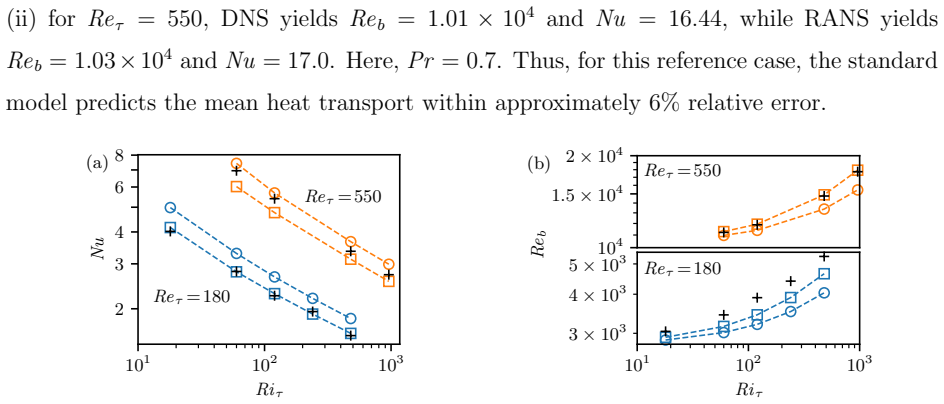
The representation of buoyancy-driven turbulence in Reynolds-averaged Navier--Stokes (RANS) models remains unresolved, with no widely accepted standard formulation. A key difficulty is the lack of analytical guidance for incorporating buoyant effects, particularly under unstable stratification. This study derives an analytical solution of the standard $k$--$\omega$ model for Rayleigh--B\'enard convection in an infinite layer, where turbulent kinetic energy is generated solely by buoyancy. The solution provides explicit scaling relations among the Rayleigh ($Ra$), Prandtl ($Pr$), and Nusselt ($Nu$) numbers that capture the simulation trends: $Nu \sim Ra^{1/3} Pr^{1/3}$ for $Pr \ll 1$ and $Nu \sim Ra^{1/3} Pr^{-0.415}$ for $Pr \gg 1$. This framework quantifies the discrepancies in the conventional buoyancy treatment and clarifies their origin. Informed by this analysis, the buoyancy-related modeling terms are reformulated to recover the measured trends: namely $Nu \sim Pr^{1/8}$ for $Pr \ll 1$ and $Nu \sim Pr^{0}$ for $Pr \gg 1$ at moderate $Ra$. Only two dimensionless algebraic functions are introduced, which vanish in the absence of buoyancy, ensuring full compatibility with the standard closure. The corrected model is validated across a range of buoyancy-driven flows, including two-dimensional Rayleigh--B\'enard convection, internally heated convection in two configurations, unstably stratified Couette flow, and vertically heated natural convection with varying aspect ratios. Across all cases, the corrected model provides significantly improved predictions of mean temperature fields and turbulent heat flux distributions.
Editorial analysis
A structured set of objections, weighed in public.
Referee Report
Summary. The manuscript derives an analytical solution for the standard k–ω model applied to Rayleigh–Bénard convection in an infinite horizontal layer with buoyancy-only turbulent kinetic energy production. This yields explicit scaling relations (Nu ∼ Ra^{1/3} Pr^{1/3} for Pr ≪ 1 and Nu ∼ Ra^{1/3} Pr^{-0.415} for Pr ≫ 1) that differ from measured trends. Informed by the discrepancies, the buoyancy-related terms are reformulated by introducing two dimensionless algebraic functions chosen to recover the observed scalings Nu ∼ Pr^{1/8} (Pr ≪ 1) and Nu ∼ Pr^0 (Pr ≫ 1) at moderate Ra; these functions are constructed to vanish without buoyancy. The modified closure is then validated on 2D Rayleigh–Bénard convection, two internally heated configurations, unstably stratified Couette flow, and vertically heated natural convection at varying aspect ratios, with reported improvements in mean temperature and turbulent heat flux predictions.
Significance. The analytical solution for the infinite layer constitutes a clear strength, supplying explicit, internally consistent scaling relations that can serve as a diagnostic benchmark for buoyancy closures. If the two algebraic functions prove transferable, the reformulation would offer a practical, backward-compatible improvement for RANS modeling of buoyancy-driven flows, an area that lacks a widely accepted standard. The multi-configuration validation adds weight, though the empirical calibration of the functions to target trends reduces the a priori character of the advance.
major comments (2)
- [§4 (reformulation)] §4 (reformulation): The two dimensionless algebraic functions are introduced explicitly to enforce the target Nu–Pr scalings (Pr^{1/8} at low Pr, Pr^0 at high Pr) identified from the infinite-layer analysis. While they vanish in the absence of buoyancy, their functional forms are selected to recover the measured trends by construction rather than from additional physical constraints or a parameter-free derivation; this makes the central modeling change partly empirical and requires clearer justification that the correction is not simply a data-guided adjustment.
- [§5 (validation)] §5 (validation): The same fixed algebraic functions, calibrated solely on the infinite horizontal layer with pure buoyancy production, are applied without retuning or sensitivity tests to configurations that include mean shear (unstably stratified Couette flow) and altered buoyancy–shear interactions (internally heated and vertical enclosures). No alternative functional forms or parameter variations are examined to assess whether the dependence remains accurate when the production mechanisms and boundary conditions differ from the calibration case.
minor comments (2)
- [Abstract] Abstract: The claim of 'significantly improved predictions' is stated without quantitative metrics (e.g., relative error reductions in Nu or temperature profiles); adding brief numerical indicators would make the improvement concrete.
- [Notation] Notation: The exact mathematical expressions for the two algebraic functions would benefit from being isolated in a single, numbered equation with all arguments and limiting behaviors shown explicitly.
Simulated Author's Rebuttal
We thank the referee for the constructive report and for highlighting the value of the analytical solution as a diagnostic benchmark. We respond to each major comment below, providing additional context from the derivation while noting where further clarification will be added to the manuscript.
read point-by-point responses
-
Referee: §4 (reformulation): The two dimensionless algebraic functions are introduced explicitly to enforce the target Nu–Pr scalings (Pr^{1/8} at low Pr, Pr^0 at high Pr) identified from the infinite-layer analysis. While they vanish in the absence of buoyancy, their functional forms are selected to recover the measured trends by construction rather than from additional physical constraints or a parameter-free derivation; this makes the central modeling change partly empirical and requires clearer justification that the correction is not simply a data-guided adjustment.
Authors: The functional forms were chosen as the minimal algebraic expressions that restore the experimentally observed Nu–Pr exponents once the discrepancies identified by the infinite-layer solution are quantified. Because the analysis supplies explicit relations for the standard model, the corrections are directly tied to those relations rather than to a broad empirical fit. The requirement that both functions vanish identically when buoyancy production is zero further constrains their structure and guarantees compatibility with the original closure. We agree that the motivation can be stated more explicitly and will revise §4 to include a step-by-step mapping from the derived scaling discrepancies to the arguments and exponents of the two functions. revision: partial
-
Referee: §5 (validation): The same fixed algebraic functions, calibrated solely on the infinite horizontal layer with pure buoyancy production, are applied without retuning or sensitivity tests to configurations that include mean shear (unstably stratified Couette flow) and altered buoyancy–shear interactions (internally heated and vertical enclosures). No alternative functional forms or parameter variations are examined to assess whether the dependence remains accurate when the production mechanisms and boundary conditions differ from the calibration case.
Authors: The decision to keep the functions fixed across all test cases was intentional: it constitutes a direct test of transferability to flows in which shear and buoyancy production coexist or in which the buoyancy–shear balance differs from the calibration configuration. The reported improvements in mean temperature and turbulent heat flux without any retuning already provide evidence that the corrections are not narrowly tuned to the infinite-layer case. We acknowledge that a systematic exploration of alternative functional forms or parameter variations would strengthen the claim of robustness; the present manuscript does not contain such a study. In the revised version we will add a short discussion of the observed robustness and the limitations of the current functional dependence. revision: partial
Circularity Check
Reformulation introduces two algebraic functions calibrated to enforce target Nu-Pr scalings
specific steps
-
fitted input called prediction
[Abstract (reformulation paragraph)]
"Informed by this analysis, the buoyancy-related modeling terms are reformulated to recover the measured trends: namely Nu ∼ Pr^{1/8} for Pr ≪ 1 and Nu ∼ Pr^0 for Pr ≫ 1 at moderate Ra. Only two dimensionless algebraic functions are introduced, which vanish in the absence of buoyancy, ensuring full compatibility with the standard closure."
The two algebraic functions are introduced specifically to enforce the target Nu-Pr scalings that match measured data. Consequently, the claim that the reformulated model 'recovers the measured trends' is achieved by the choice of the functions rather than emerging as an independent prediction from the equations.
full rationale
The paper first derives explicit Ra-Pr-Nu scalings from the unmodified k-ω equations under buoyancy-only production in an infinite layer. It then introduces two dimensionless algebraic functions whose explicit purpose is to alter the buoyancy terms so that the model reproduces the experimentally observed Nu ∼ Pr^{1/8} (low Pr) and Nu ∼ Pr^0 (high Pr) behaviors. Because these functions are constructed and tuned precisely to recover the measured trends (while vanishing in the non-buoyant limit), the central modeling improvement reduces in part to an empirical adjustment whose success on the calibration geometry is guaranteed by construction. Subsequent validation on other geometries therefore tests transferability rather than an independent first-principles derivation. This produces moderate circularity (score 6) without rendering the entire analysis tautological.
Axiom & Free-Parameter Ledger
free parameters (1)
- two dimensionless algebraic functions for buoyancy terms
axioms (1)
- domain assumption Standard k-ω model equations remain valid when buoyancy is the sole turbulence production mechanism
Lean theorems connected to this paper
-
IndisputableMonolith/Cost/FunctionalEquation.leanwashburn_uniqueness_aczel unclear?
unclearRelation between the paper passage and the cited Recognition theorem.
Only two dimensionless algebraic functions are introduced, which vanish in the absence of buoyancy... C'_ωb = c1 + c2 Pr^{-5/16} ... ψ = e0 Pr^{e1} (Pb/ε)^{e2} Re_T^{e3}
-
IndisputableMonolith/Foundation/DimensionForcing.leanalexander_duality_circle_linking unclear?
unclearRelation between the paper passage and the cited Recognition theorem.
Nu ∼ Pr^{1/8} for Pr ≪ 1 and Nu ∼ Pr^0 for Pr ≫ 1 at moderate Ra
What do these tags mean?
- matches
- The paper's claim is directly supported by a theorem in the formal canon.
- supports
- The theorem supports part of the paper's argument, but the paper may add assumptions or extra steps.
- extends
- The paper goes beyond the formal theorem; the theorem is a base layer rather than the whole result.
- uses
- The paper appears to rely on the theorem as machinery.
- contradicts
- The paper's claim conflicts with a theorem or certificate in the canon.
- unclear
- Pith found a possible connection, but the passage is too broad, indirect, or ambiguous to say the theorem truly supports the claim.
Reference graph
Works this paper leans on
-
[1]
Computational modeling of turbulent flows,
1J. L. Lumley, “Computational modeling of turbulent flows,” Adv. Appl. Mech.18, 123–176 (1979). 2W. Rodi,Turbulence Model and Their Application in Hydraulics: A state of the Art Review (Int. Ass. for Hydraulic Research, Delft, The Netherlands, 1980). 3W. Rodi, “Examples of calculation methods for flow and mixing in stratified fluids,” J. Geophys. Res. Oce...
work page 1979
-
[2]
On the accuracy of RANS simulations of 2D boundary layers with OpenFOAM,
35S. Gomez, B. Graves, and S. Poroseva, “On the accuracy of RANS simulations of 2D boundary layers with OpenFOAM,” in44th AIAA Fluid Dynamics Conference(2014) p
work page 2014
-
[3]
Prandtl number effects in convective turbulence,
36R. Verzicco and R. Camussi, “Prandtl number effects in convective turbulence,” J. Fluid Mech.383, 55–73 (1999). 37A. Pandey, D. Krasnov, K. R. Sreenivasan, and J. Schumacher, “Convective mesoscale turbulence at very low Prandtl numbers,” J. Fluid Mech.948, A23 (2022). 38X.-M. Li, J.-D. He, Y. Tian, P. Hao, and S.-D. Huang, “Effects of Prandtl number in ...
discussion (0)
Sign in with ORCID, Apple, or X to comment. Anyone can read and Pith papers without signing in.