REVIEW 2 major objections 5 minor 1 cited by
Dominance regions for affine cluster algebras
T0 review · 2 major / 5 minor · reviewed 2026-08-03 · deepseek-v4-flash
Pith's one-line read For affine cluster algebras, every dominance region is either a single point or a line segment, and the line segments are described explicitly.
desk verdict A strong, honest paper that resolves the affine dominance-region problem in the cases that matter, with one load-bearing dependency on an unpublished companion preprint. read the letter →
The pith
A machine-rendered reading of the paper's core claim, the machinery that carries it, and where it could break.
The reading
What carries the argument
The proof rests on the structure of the mutation fan of an affine exchange matrix, whose complement of the g-vector fan is a codimension-one cone called the imaginary wall d^B_∞, containing a unique imaginary ray spanned by -½ B δ_B. The new tool is a description of neighboring seeds—seeds with n−2 g-vectors on the imaginary wall—showing that, from such a seed, the imaginary wall is a half-hyperplane and the mutation fan restricts (metrically) to a product of an imaginary ray with finite-type C mutation fans. This reduces the affine problem to the finite-type singleton theorem, which is proved separately via the marked-surfaces model, folding, and a type-by-type check.
What would settle it
Compute P^B_λ for an affine-type exchange matrix B with λ inside d^B_∞ and check whether the intersection of the ray {λ + a B δ_B : a ≥ 0} with the relative boundary of d^B_∞ coincides with the dominance region; any point of P^B_λ outside that segment would falsify Theorem 4.1.
Extended reading notes
Core claim
The central claim is Theorem 4.1: if B is an exchange matrix of affine type and λ lies in the relative interior of the imaginary wall d^B_∞, then the dominance region P^B_λ is the line segment {λ + a B δ_B : a ≥ 0} ∩ d^B_∞, where the direction B δ_B is parallel to the unique imaginary ray of the mutation fan and the second endpoint lies on the relative boundary of the wall. For extended matrices the same line-segment answer holds whenever the projection of the parameter lands in the imaginary wall (Theorem 4.56), while parameters lying in a g-vector cone give singleton dominance regions (Theorem 4.26); the integral version is Theorem 4.58. A necessary preliminary, proved here, is that in fin
Load-bearing premise
The argument inherits, without proof in this paper, the identification that in affine type the mutation fan for B^T equals the cluster scattering fan and that the complement of the g-vector fan is exactly the codimension-one imaginary wall.
Editorial extensions
If this is right
- For any affine-type cluster algebra, every dominance region is completely understood: singletons on g-vector cones and explicitly described line segments elsewhere.
- Together with Qin's pointed-basis theorem, the result yields a concrete description of all pointed bases of affine cluster algebras when the extended exchange matrix has linearly independent columns.
- The integral dominance regions, described in Theorem 4.58, give the integer points that appear in theta functions for affine cluster scattering diagrams.
- The finite-type singleton theorem strengthens existing results: no coefficients or linear-independence assumptions are needed for finite-type dominance regions to be points.
- The neighboring-seed structure (finite type C products) gives a new, explicit model for the mutation fan near the imaginary wall in affine type.
Reading between the lines
- The same line-segment description is likely to extend to the missing case in the paper—arbitrary extended matrices with a parameter projecting to a g-vector cone—where the authors state the singleton result as 'Probable Theorem 4.29' but do not prove it.
- The metric (not just combinatorial) product structure of the imaginary wall suggests that the affine dominance region can be seen as the orbit of a single point under a one-parameter family of mutations, which might give a dynamical interpretation of the line segments.
- One could test the neighboring-seed model in higher-rank affine types beyond A, C, G by checking whether the type-C companion construction remains valid for all mutation sequences that stay near the imaginary wall.
- The finite-type proof via marked surfaces suggests that other tame classes (e.g., orbifold surfaces) may admit analogous singleton theorems by the same folding argument.
Editorial analysis
A structured set of objections, weighed in public.
Referee Report
Summary. The paper determines dominance regions for cluster algebras of affine type. The main theorem (Theorem 4.1) states that for an affine-type exchange matrix B and a point λ in the relative interior of the imaginary wall d_B^∞, the dominance region P^B_λ is the line segment {λ + a B δ_B : a ≥ 0} ∩ d_B^∞, parallel to the imaginary ray, with one endpoint at λ and the other on the relative boundary of the wall. This is extended to extended exchange matrices with linearly independent columns (Theorem 4.26, point regions in g-vector cones) and to arbitrary extensions with λ projecting into the imaginary wall (Theorem 4.56), plus an integral analogue (Theorem 4.58). The proof develops a detailed description of neighboring seeds of affine type, shows their companion matrices are of finite type C, and reduces the core computation to the finite-type singleton theorem (Theorem 3.2), which is proved by a combination of surface models, folding, and computational checks.
Significance. If correct, the result is significant: it gives the first complete description of dominance regions beyond rank 2 for affine cluster algebras, a key step toward pointed bases and theta functions in affine type. The paper introduces a genuinely new tool, the neighboring-seed structure, with an explicit finite-type-C companion that is used to linearize the dominance-region computation. The proofs are mostly detailed and well-structured, building on established results in a careful way. However, the central affine dichotomy rests on a structural identification imported from an unpublished preprint by two of the present authors, and the finite-type exceptional case is asserted to be computational with no code or certificates. These two points are load-bearing and prevent an unconditional acceptance at this stage.
major comments (2)
- [§1, §4.1 (after Eq. (4.1))] The entire affine machinery — the imaginary wall d_B^∞, the imaginary ray, Lemma 4.15, Proposition 4.16, Proposition 4.24, and the line-segment dichotomy in Theorem 4.1 — depends on the statement that for acyclic affine B^T the mutation fan equals the cluster scattering fan and that the complement of the g-vector fan is a codimension-1 cone. This is imported from [35, Theorem 2.10] and [32, Corollaries 1.3, 4.9]. [35] is an arXiv preprint by two of the present authors and is not reproved here. If [35, Theorem 2.10] failed for a single affine mutation class, the main theorem would lose its foundation. This is a correctness risk, not a claim of circularity. The authors should either give a self-contained proof of the needed identification or update the reference to a peer-reviewed publication and explain exactly which statements are used.
- [§3.1, exceptional types paragraph] Theorem 3.2 (finite-type singleton dominance region) is load-bearing: Theorem 3.1 uses it, and the proof of Theorem 4.1 uses Theorem 3.1 through the type-C companion reduction (Proposition 4.55 and the final paragraph of §4.5). The exceptional finite-type cases are dispatched as 'checked computationally' with no code, certificates, or a precise description of the computation: the reduction to one λ in the interior of each maximal cone is described, but no details are given of how the polyhedral intersections are computed, how many cones there are, or how the finite computation is certified. As written, this verification is not reproducible. Please provide the code or a rigorous finite-state certificate.
minor comments (5)
- [§3.1, Type D paragraph] The type-D proof says the three remarkable properties are verified 'straightforwardly' and omits details. Given the pivotal role of these properties in the type-A argument, a short explanation or figure for the tagged/quasi-lamination case would improve verifiability.
- [Remark 4.2] The remark states that Theorem 4.1 includes the 2×2 affine case but that the proof silently omits this case. It would be clearer to state explicitly that the 2×2 case is proved in [36, Theorem 1.2] and that the proof in this paper covers n ≥ 3.
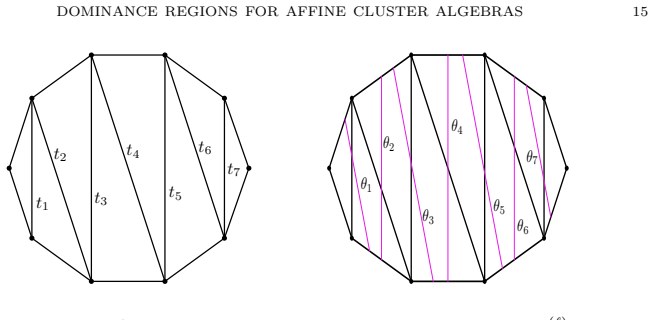
- [§4.4, proof of Proposition 4.42] Typo: 'he dashed lines in the left picture' should be 'The dashed lines in the left picture'.
- [§4.5, Proposition 4.53] The symbol k is used both for the special index and for the sequence k = k(n−1)knk (and later η^{BT}_k). This is confusing; consider using a bold or underscored symbol for the sequence.
- [§4.2, 'Probable Theorem 4.29'] The label 'Probable Theorem' is unusual; it is an open problem rather than a theorem. Consider renaming it 'Conjecture' or 'Open problem' to avoid confusion with proved results.
Circularity Check
No circularity: affine dominance regions are derived from prior fan-structure theorems and an internal finite-type proof; the self-cited [35]/[32] dependencies are not inputs to the conclusion.
full rationale
The derivation of Theorems 4.1, 4.26, 4.56 and 4.58 proceeds from the definition of dominance regions (Section 2.1) and the mutation-fan framework. The only potentially load-bearing self-citations are [35, Thm. 2.10] (mutation fan = scattering fan in affine type) and [32, Cors. 1.3, 4.9] (complement of the g-vector fan is a codimension-1 cone), quoted in §1 to define the imaginary wall d_B^∞. These are prior structural theorems about fans, not restatements of the dominance-region result; they do not contain the conclusion P_B^λ = segment, and the present paper's proof of that equality is a separate argument reducing to the finite-type singleton theorem (Thm. 3.2). Thm. 3.2 is proved internally via surfaces, folding, and computations; the exceptional-type computation is asserted without code, which is a verification gap, not a circular reduction. 'Probable Theorem 4.29' is explicitly labeled unproved, further showing the paper distinguishes proved results from open ones. No fitted parameters, data, or definitional equivalences make the output equal to an input. Thus no step exhibits Eq. X = Eq. Y by construction, and the mild self-citation concern is a correctness/verification risk, not circularity.
Assumptions & free parameters
assumptions (6)
- standard math Sign coherence of C-vectors and g-vectors, and inversion of the g-matrix by the transpose-inverse of the C-matrix.
- domain assumption In affine type, the mutation fan for B^T coincides with the cluster scattering fan, and the complement of the g-vector fan is a codimension-1 imaginary wall.
- domain assumption Almost-positive Schur roots and the doubled Cambrian fan model the affine g-vector fan and imaginary cones.
- domain assumption Mutation-finiteness and linear-growth classification of affine-type exchange matrices, including the b_ij b_ji ≥ -4 condition for n ≥ 3.
- standard math Marked-surface model facts for finite types A and D: shear coordinates, flips, and quasi-laminations.
- ad hoc to paper The exceptional finite-type singleton check is correct.
Cite this review
Pith. "Pith review of Dominance regions for affine cluster algebras." pith.science (2026). https://pith.science/paper/GW4CV7CF
@misc{pith2026251202218,
  author       = {Pith},
  title        = {Pith review of: Dominance regions for affine cluster algebras},
  year         = {2026},
  howpublished = {\url{https://pith.science/paper/GW4CV7CF}},
  note         = {Machine review of arXiv:2512.02218}
}
read the original abstract
We determine dominance regions associated to cluster algebras of affine type. In the most interesting cases, the dominance region is a line segment, which we describe explicitly. Motivations for this work include a project to determine all pointed bases for cluster algebras of affine type and a separate application that determines all theta functions in the affine case. The proofs draw on known results from the doubled Cambrian fan and almost-positive roots models, as well as a new tool that we develop: a detailed description of neighboring seeds of affine type (seeds that are, in some sense, as close as possible to the boundary of the g-vector fan).
Figures


Figures from the paper (1 more)

Forward citations
Cited by 1 Pith paper
-
Neighboring seeds in affine type: Universal coefficients and finite mutation-type
Affine-type cluster algebras have a uniform universal geometric basis — the g-vectors plus one imaginary-wall vector — and an affine exchange matrix stays mutation-finite under adding coefficients exactly when its coe...
Reference graph
Works this paper leans on
-
[35]
Cluster scattering diagrams of acyclic affine type
Nathan Reading and Salvatore Stella. Cluster scattering diagrams of acyclic affine type. arXiv:2205.05125, 2022
arXiv 2022
-
[1]
Berenstein, S
A. Berenstein, S. Fomin, and A. Zelevinsky. Cluster algebras. III. Upper bounds and double Bruhat cells.Duke Math. J., 126(1):1–52, 2005
2005
-
[2]
Brestensky and Nathan Reading
Laura G. Brestensky and Nathan Reading. Noncrossing partitions of an annulus.Comb. Theory, 5(1):Paper No. 12, 49, 2025
2025
-
[3]
Categorification of sign-skew-symmetric cluster alge- bras and some conjectures ong-vectors.Algebr
Peigen Cao, Min Huang, and Fang Li. Categorification of sign-skew-symmetric cluster alge- bras and some conjectures ong-vectors.Algebr. Represent. Theory, 25(6):1685–1698, 2022
2022
-
[4]
Linear independence of cluster monomials for skew-symmetric cluster algebras.Compos
Giovanni Cerulli Irelli, Bernhard Keller, Daniel Labardini-Fragoso, and Pierre-Guy Plamon- don. Linear independence of cluster monomials for skew-symmetric cluster algebras.Compos. Math., 149(10):1753–1764, 2013
2013
-
[5]
PhD thesis, 2008
Laurent Demonet.Cat´ egorification d’alg` ebres amass´ ees antisym´ etrisables. PhD thesis, 2008. Th` ese de doctorat dirig´ ee par Bernard Leclerc, Caen 2008
2008
-
[6]
Indecomposable representations of graphs and algebras.Mem
Vlastimil Dlab and Claus Michael Ringel. Indecomposable representations of graphs and algebras.Mem. Amer. Math. Soc., 6(173):v+57, 1976
1976
-
[7]
G. Dupont. An approach to non-simply laced cluster algebras.J. Algebra, 320(4):1626–1661, 2008
2008
Show all 40 references
-
[8]
G. Dupont. Generic variables in acyclic cluster algebras.J. Pure Appl. Algebra, 215(4):628– 641, 2011
2011
-
[9]
Growth rate of cluster algebras.Proc
Anna Felikson, Michael Shapiro, Hugh Thomas, and Pavel Tumarkin. Growth rate of cluster algebras.Proc. Lond. Math. Soc. (3), 109(3):653–675, 2014
2014
-
[10]
Cluster algebras of finite mutation type via unfoldings.Int
Anna Felikson, Michael Shapiro, and Pavel Tumarkin. Cluster algebras of finite mutation type via unfoldings.Int. Math. Res. Not. IMRN, (8):1768–1804, 2012
2012
-
[11]
Fomin and A
S. Fomin and A. Zelevinsky. Cluster algebras. I. Foundations.J. Amer. Math. Soc., 15(2):497– 529, 2002
2002
-
[12]
Fomin and A
S. Fomin and A. Zelevinsky. Cluster algebras. IV. Coefficients.Compos. Math., 143(1):112– 164, 2007
2007
-
[13]
Cluster algebras and triangulated sur- faces
Sergey Fomin, Michael Shapiro, and Dylan Thurston. Cluster algebras and triangulated sur- faces. I. Cluster complexes.Acta Math., 201(1):83–146, 2008
2008
-
[14]
Cluster algebras and triangulated surfaces Part II: Lambda lengths.Mem
Sergey Fomin and Dylan Thurston. Cluster algebras and triangulated surfaces Part II: Lambda lengths.Mem. Amer. Math. Soc., 255(1223):v+97, 2018
2018
-
[15]
Cluster algebras
Sergey Fomin and Andrei Zelevinsky. Cluster algebras. II. Finite type classification.Invent. Math., 154(1):63–121, 2003
2003
-
[16]
Sergey Fomin and Andrei Zelevinsky.Y-systems and generalized associahedra.Ann. of Math. (2), 158(3):977–1018, 2003. DOMINANCE REGIONS FOR AFFINE CLUSTER ALGEBRAS 53
2003
-
[17]
Cluster algebras and Poisson geometry
Michael Gekhtman, Michael Shapiro, and Alek Vainshtein. Cluster algebras and Poisson geometry. volume 3, pages 899–934, 1199. 2003.{Dedicated to Vladimir Igorevich Arnold on the occasion of his 65th birthday}
2003
-
[18]
Canonical bases for cluster algebras.J
Mark Gross, Paul Hacking, Sean Keel, and Maxim Kontsevich. Canonical bases for cluster algebras.J. Amer. Math. Soc., 31(2):497–608, 2018
2018
-
[19]
Robert B. Howlett. Coxeter groups andM-matrices.Bull. London Math. Soc., 14(2):137–141, 1982
1982
-
[20]
Kac.Infinite-dimensional Lie algebras
V. Kac.Infinite-dimensional Lie algebras. Cambridge University Press, Cambridge, third edition, 1990
1990
-
[21]
Cluster modular groups of affine and doubly extended cluster algebras.Math
Dani Kaufman and Zachary Greenberg. Cluster modular groups of affine and doubly extended cluster algebras.Math. Z., 310(2):Paper No. 31, 50, 2025
2025
-
[22]
Artin groups of Euclidean type.Invent
Jon McCammond and Robert Sulway. Artin groups of Euclidean type.Invent. Math., 210(1):231–282, 2017
2017
-
[23]
Nakanishi and S
T. Nakanishi and S. Stella. Diagrammatic description ofc-vectors andd-vectors of cluster algebras of finite type.Electron. J. Combin., 21(1):Paper 1.3, 107, 2014
2014
-
[24]
Nakanishi and A
T. Nakanishi and A. Zelevinsky. On tropical dualities in cluster algebras. InAlgebraic groups and quantum groups, volume 565 ofContemp. Math., pages 217–226. Amer. Math. Soc., Providence, RI, 2012
2012
-
[25]
Triangular bases in quantum cluster algebras and monoidal categorification conjec- tures.Duke Math
Fan Qin. Triangular bases in quantum cluster algebras and monoidal categorification conjec- tures.Duke Math. J., 166(12):2337–2442, 2017
2017
-
[26]
Bases for upper cluster algebras and tropical points.J
Fan Qin. Bases for upper cluster algebras and tropical points.J. Eur. Math. Soc. (JEMS), 26(4):1255–1312, 2024
2024
-
[27]
Reading and D
N. Reading and D. E. Speyer. Sortable elements in infinite Coxeter groups.Trans. Amer. Math. Soc., 363(2):699–761, 2011
2011
-
[28]
Universal geometric cluster algebras.Math
Nathan Reading. Universal geometric cluster algebras.Math. Z., 277(1-2):499–547, 2014
2014
-
[29]
Universal geometric cluster algebras from surfaces.Trans
Nathan Reading. Universal geometric cluster algebras from surfaces.Trans. Amer. Math. Soc., 366(12):6647–6685, 2014
2014
-
[30]
Scattering fans.Int
Nathan Reading. Scattering fans.Int. Math. Res. Not. IMRN, (23):9640–9673, 2020
2020
-
[31]
Nathan Reading and David E. Speyer. Combinatorial frameworks for cluster algebras.Int. Math. Res. Not. IMRN, (1):109–173, 2016
2016
-
[32]
Nathan Reading and David E. Speyer. Cambrian frameworks for cluster algebras of affine type.Trans. Amer. Math. Soc., 370(2):1429–1468, 2018
2018
-
[33]
The action of a Coxeter element on an affine root system.Proc
Nathan Reading and Salvatore Stella. The action of a Coxeter element on an affine root system.Proc. Amer. Math. Soc., 148(7):2783–2798, 2020
2020
-
[34]
An affine almost positive roots model.J
Nathan Reading and Salvatore Stella. An affine almost positive roots model.J. Comb. Alge- bra, 4(1):1–59, 2020
2020
-
[36]
Dominance regions for rank two cluster algebras.Ann
Dylan Rupel and Salvatore Stella. Dominance regions for rank two cluster algebras.Ann. Comb., 27(4):873–894, 2023
2023
-
[37]
Affine cluster monomials are generalized minors.Compos
Dylan Rupel, Salvatore Stella, and Harold Williams. Affine cluster monomials are generalized minors.Compos. Math., 155(7):1301–1326, 2019
2019
-
[38]
Ahmet I. Seven. Cluster algebras and semipositive symmetrizable matrices.Trans. Amer. Math. Soc., 363(5):2733–2762, 2011
2011
-
[39]
Stembridge
J. Stembridge. Folding by automorphisms (unpublished manuscript, 2008). https://dept.math.lsa.umich.edu/˜jrs/papers/folding.pdf
2008
-
[40]
ProQuest LLC, Ann Arbor, MI, 2018
Shira Coleman Polster Viel.Cluster Algebras and Mutation-Linear Algebra: Folding, Domi- nance, and the Orbifolds Model. ProQuest LLC, Ann Arbor, MI, 2018. Thesis (Ph.D.)–North Carolina State University. (N. Reading)Department of Mathematics, North Carolina State University, Ra...
2018
Reviewed August 3, 2026 · model on record in the stance chip above.
Discussion (0). Continue with ORCID to comment.