Shell formation and two-dimensional nanofriction in three-dimensional ion Coulomb crystals
Pith reviewed 2026-05-21 18:13 UTC · model grok-4.3
The pith
Small changes in ion number can alter the outer-shell rotational barrier in three-dimensional Coulomb crystals by up to a factor of 60.
A machine-rendered reading of the paper's core claim, the machinery that carries it, and where it could break.
Core claim
In self-organized three-dimensional ion Coulomb crystals the outer shell rotates against a static inner core under a Peierls-Nabarro-type potential whose barrier is governed by the system-dependent interplay between inter-shell interaction, outer-shell response and trap confinement. Changing N by one can alter the effective rotational barrier by up to a factor of approximately seven, while changes by only a few ions produce variations up to a factor of approximately sixty. Dynamical simulations with applied torques show pinned, stick-slip and smooth-sliding regimes whose depinning thresholds depend on ion number, inner-shell geometry and trap aspect ratio; some configurations exhibit torque-
What carries the argument
The rotation angle of the outer shell relative to the inner core, used as the collective coordinate to compute the Peierls-Nabarro-type potential.
Load-bearing premise
The inner core remains perfectly static while the outer shell rotates as a rigid body, allowing the rotation angle to serve as a clean collective coordinate for the Peierls-Nabarro-type potential.
What would settle it
Directly measuring the torque needed to rotate the outer shell for two crystals whose ion numbers differ by one and checking whether the observed barrier heights differ by the predicted factor of up to seven.
Figures


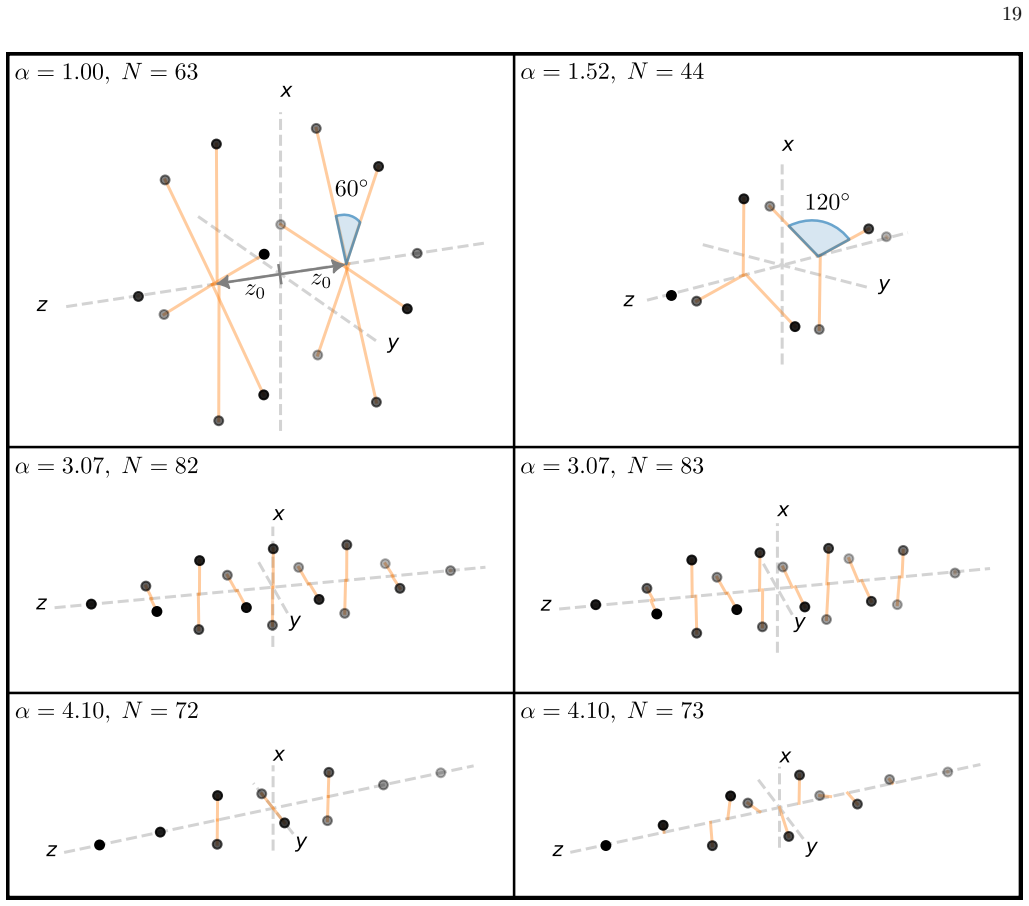

read the original abstract
Self-organized three-dimensional (3D) ion Coulomb crystals in linear Paul traps naturally form concentric shells that provide a curved, atomically resolved interface for studying two-dimensional (2D) nanofriction. Building on earlier studies of one-dimensional nanofriction and orientational melting in 2D ion crystals, we extend friction studies from linear chains and planar rings to 3D shell structures. Using molecular-dynamics simulations, we map shell formation as a function of ion number N and trap aspect ratio and obtain a simple scaling relation that can aid ion-number estimation in experiments. We compute a Peierls-Nabarro-type potential for rotating the outer shell against a static inner core, using the rotation angle as a collective coordinate. Changing N by one can alter the effective rotational barrier by up to a factor of ~7, while changes by only a few ions can lead to variations up to a factor of ~60. Combining geometric commensurability analysis with energy decomposition, we show that the barrier is governed by a system-dependent interplay between inter-shell interaction, outer-shell response and trap confinement. Dynamical simulations with applied torques reveal pinned, stick-slip and smooth-sliding regimes with depinning thresholds that depend on ion number, inner-shell geometry and trap aspect ratio. Some configurations show hysteresis due to torque-induced metastable states. We further find that spatially varying coupling to the inner-core corrugation can create coexisting fast and slow domains within the rotating outer shell, realizing multidimensional friction in which intra-shell shear and inter-shell nanofriction act simultaneously. Our results establish self-organized ion Coulomb crystals as model systems for 2D nanofriction and suggest routes toward ion-based nanorotors, torque sensors and ultra-low-friction nanomechanical systems.
Editorial analysis
A structured set of objections, weighed in public.
Referee Report
Summary. The manuscript uses molecular-dynamics simulations to map shell formation in three-dimensional ion Coulomb crystals confined in linear Paul traps as a function of ion number N and trap aspect ratio, deriving a scaling relation for experimental ion-number estimation. It computes a Peierls-Nabarro-type potential for rotating the outer shell against a static inner core using the rotation angle as collective coordinate, reporting that single-ion changes in N can alter the effective rotational barrier by factors up to ~7 and changes by a few ions by up to ~60. Dynamical torque simulations reveal pinned, stick-slip, and smooth-sliding regimes whose depinning thresholds depend on N, inner-shell geometry, and aspect ratio, together with hysteresis from metastable states and coexisting fast/slow domains arising from spatially varying inter-shell coupling.
Significance. If the numerical results are robust, the work provides a concrete platform for studying two-dimensional nanofriction on curved, atomically resolved interfaces and extends prior studies of one-dimensional chains and planar rings. The MD-derived scaling relation and regime diagrams constitute a useful contribution, and the reported extreme sensitivity of barriers to small changes in N offers a route to tunable nanofriction with possible applications to nanorotors and torque sensors. The authors receive credit for obtaining these relations directly from trajectories and energy decompositions without re-use of prior fitted parameters.
major comments (2)
- [Abstract and Methods] Abstract and Methods section: no information is supplied on the precise form of the inter-ion potential (Coulomb plus trap), integration timestep, equilibration protocol, or statistical uncertainties on the reported barrier variations (factors of ~7 and ~60). These omissions are load-bearing because the central claims of N-sensitivity and the existence of distinct dynamical regimes rest entirely on the simulation outputs.
- [Energy decomposition and dynamical torque simulations] Energy-decomposition and torque-simulation paragraphs: the Peierls-Nabarro potential is constructed by treating the rotation angle as the sole collective coordinate while holding the inner core perfectly static and the outer shell rigid. If torque-driven or thermal displacements occur in the inner shell, or if the outer shell experiences intra-shell shear or radial breathing, the extracted barrier heights and the claimed interplay between inter-shell interaction, outer-shell response, and trap confinement would incorporate additional degrees of freedom not accounted for in the reported values.
minor comments (3)
- [Abstract] The explicit functional form of the 'simple scaling relation' for shell formation is not stated in the abstract or early text; providing the relation (or at least its leading dependence on N and aspect ratio) would improve immediate accessibility.
- [Figures] Figure captions for the regime diagrams should list the specific values of N, aspect ratio, and temperature used, together with any averaging procedure over trajectories.
- [Dynamical simulations] A few sentences describing the hysteresis mechanism could be clarified by indicating whether the metastable states are identified from energy minima or from long-time trajectory statistics.
Simulated Author's Rebuttal
We thank the referee for the careful reading of our manuscript and for the constructive comments, which help improve the clarity and robustness of our presentation. We address each major comment below and will revise the manuscript accordingly.
read point-by-point responses
-
Referee: [Abstract and Methods] Abstract and Methods section: no information is supplied on the precise form of the inter-ion potential (Coulomb plus trap), integration timestep, equilibration protocol, or statistical uncertainties on the reported barrier variations (factors of ~7 and ~60). These omissions are load-bearing because the central claims of N-sensitivity and the existence of distinct dynamical regimes rest entirely on the simulation outputs.
Authors: We agree that these details are necessary for full reproducibility and to underpin the central claims. In the revised manuscript we will expand the Methods section to specify the inter-ion potential (Coulomb repulsion plus the linear Paul trap harmonic confinement), the integration timestep, the equilibration protocol (including annealing schedule and relaxation criteria), and quantitative estimates of statistical uncertainties on the barrier heights obtained from multiple independent trajectories and energy decompositions. revision: yes
-
Referee: [Energy decomposition and dynamical torque simulations] Energy-decomposition and torque-simulation paragraphs: the Peierls-Nabarro potential is constructed by treating the rotation angle as the sole collective coordinate while holding the inner core perfectly static and the outer shell rigid. If torque-driven or thermal displacements occur in the inner shell, or if the outer shell experiences intra-shell shear or radial breathing, the extracted barrier heights and the claimed interplay between inter-shell interaction, outer-shell response, and trap confinement would incorporate additional degrees of freedom not accounted for in the reported values.
Authors: The rigid-inner-core and rigid-outer-shell approximation is adopted deliberately to isolate the rotational Peierls-Nabarro barrier as a function of the collective rotation angle. The manuscript already reports an energy decomposition that explicitly includes outer-shell response and trap-confinement contributions, and the subsequent dynamical torque simulations allow all degrees of freedom to evolve freely, reproducing the pinned, stick-slip and smooth-sliding regimes. We will add a dedicated paragraph in the revised text that quantifies the energetic cost of inner-shell displacements and intra-shell shear, thereby clarifying the regime of validity of the reported barriers while preserving the central physical conclusions. revision: partial
Circularity Check
No significant circularity; results from direct MD and energy decomposition
full rationale
The paper derives shell formation, scaling relations, and rotational barriers directly from molecular-dynamics trajectories and explicit energy decompositions that vary the rotation angle as a collective coordinate under the stated static-inner-core assumption. No load-bearing step reduces a claimed prediction or uniqueness result to a parameter fitted from the same data and re-used, nor to a self-citation chain whose content is itself unverified. The reported factor-of-7 and factor-of-60 barrier variations are simulation outputs, not quantities defined by construction from prior fits or ansatzes imported via the authors' own earlier work. The derivation chain therefore remains self-contained against external simulation benchmarks.
Axiom & Free-Parameter Ledger
free parameters (1)
- trap aspect ratio
axioms (2)
- domain assumption Ions interact via pure Coulomb repulsion in a static harmonic trap potential
- domain assumption Classical molecular dynamics sufficiently captures the relevant dynamics at the simulated temperatures
Lean theorems connected to this paper
-
IndisputableMonolith/Foundation/AlexanderDuality.leanalexander_duality_circle_linking unclear?
unclearRelation between the paper passage and the cited Recognition theorem.
We compute a Peierls-Nabarro-type potential for rotating the outer shell against a static inner core, using the rotation angle as a collective coordinate.
-
IndisputableMonolith/Cost/FunctionalEquation.leanwashburn_uniqueness_aczel unclear?
unclearRelation between the paper passage and the cited Recognition theorem.
Changing N by one can alter the effective rotational barrier by up to a factor of ~7
What do these tags mean?
- matches
- The paper's claim is directly supported by a theorem in the formal canon.
- supports
- The theorem supports part of the paper's argument, but the paper may add assumptions or extra steps.
- extends
- The paper goes beyond the formal theorem; the theorem is a base layer rather than the whole result.
- uses
- The paper appears to rely on the theorem as machinery.
- contradicts
- The paper's claim conflicts with a theorem or certificate in the canon.
- unclear
- Pith found a possible connection, but the passage is too broad, indirect, or ambiguous to say the theorem truly supports the claim.
Reference graph
Works this paper leans on
-
[1]
The complete algorithm is explained in more detail in Appendix A
Multiple SA runs are executed until the same con- figuration has been found repeatedly, indicating that the structural ground state has been found. The complete algorithm is explained in more detail in Appendix A. While SA is a powerful algorithm to explore the energy landscape and reliably converges on low-energy config- urations, it cannot guarantee tha...
work page 2020
-
[2]
K. Holmberg and A. Erdemir, Influence of tribology on global energy consumption, costs and emissions, Friction 5, 263 (2017)
work page 2017
- [3]
- [4]
-
[5]
C. M. Mate, G. M. McClelland, R. Erlandsson, and S. Chiang, Atomic-scale friction of a tungsten tip on a graphite surface, Phys. Rev. Lett.59, 1942 (1987)
work page 1942
-
[6]
M. Dienwiebel, G. S. Verhoeven, N. Pradeep, J. W. M. Frenken, J. A. Heimberg, and H. W. Zandbergen, Super- lubricity of Graphite, Phys. Rev. Lett.92, 126101 (2004)
work page 2004
- [7]
-
[8]
D. Andersson and A. S. De Wijn, Understanding the fric- tion of atomically thin layered materials, Nat. Commun. 11, 420 (2020)
work page 2020
-
[9]
A. Vanossi, N. Manini, and E. Tosatti, Static and dy- namic friction in sliding colloidal monolayers, Proc. Natl. 15 Acad. Sci. U.S.A.109, 16429 (2012)
work page 2012
-
[10]
D. Mandelli, A. Vanossi, and E. Tosatti, Stick-slip nanofriction in trapped cold ion chains, Phys. Rev. B 87, 195418 (2013)
work page 2013
-
[11]
A. Bylinskii, D. Gangloff, and V. Vuleti´ c, Tuning friction atom-by-atom in an ion-crystal simulator, Science348, 1115 (2015)
work page 2015
- [12]
- [13]
-
[14]
J. I. Cirac and P. Zoller, Quantum Computations with Cold Trapped Ions, Phys. Rev. Lett.74, 4091 (1995)
work page 1995
-
[15]
R. Blatt and D. Wineland, Entangled states of trapped atomic ions, Nature453, 1008 (2008)
work page 2008
-
[16]
C. Monroe and J. Kim, Scaling the Ion Trap Quantum Processor, Science339, 1164 (2013)
work page 2013
- [17]
- [18]
-
[19]
J. Keller, H. N. Hausser, I. M. Richter, T. Nord- mann, N. M. Bhatt, J. Kiethe, H. Liu, E. Benkler, B. Lipphardt, S. D¨ orscher, K. Stahl, J. Klose, C. Lis- dat, M. Filzinger, N. Huntemann, E. Peik, and T. E. Mehlst¨ aubler, High-accuracy multi-ion spectroscopy with mixed-species Coulomb crystals, J. Phys. Conf. Ser. 2889, 012050 (2024)
work page 2024
-
[20]
P. O. Schmidt, T. Rosenband, C. Langer, W. M. Itano, J. C. Bergquist, and D. J. Wineland, Spectroscopy Using Quantum Logic, Science309, 749 (2005)
work page 2005
-
[21]
C. Champenois, M. Marciante, J. Pedregosa-Gutierrez, M. Houssin, M. Knoop, and M. Kajita, Ion ring in a lin- ear multipole trap for optical frequency metrology, Phys. Rev. A81, 043410 (2010)
work page 2010
- [22]
-
[23]
J. W. Britton, B. C. Sawyer, A. C. Keith, C.-C. J. Wang, J. K. Freericks, H. Uys, M. J. Biercuk, and J. J. Bollinger, Engineered two-dimensional Ising interactions in a trapped-ion quantum simulator with hundreds of spins, Nature484, 489 (2012)
work page 2012
-
[24]
J. G. Bohnet, B. C. Sawyer, J. W. Britton, M. L. Wall, A. M. Rey, M. Foss-Feig, and J. J. Bollinger, Quantum spin dynamics and entanglement generation with hun- dreds of trapped ions, Science352, 1297 (2016)
work page 2016
-
[25]
L.-A. R¨ uffert, E. A. Dijck, L. Timm, J. R. C. L´ opez- Urrutia, and T. E. Mehlst¨ aubler, Domain formation and structural stabilities in mixed-species Coulomb crystals induced by sympathetically cooled highly charged ions, Phys. Rev. A110, 063110 (2024)
work page 2024
-
[26]
D. H. E. Dubin and T. M. O’Neil, Trapped nonneutral plasmas, liquids, and crystals (the thermal equilibrium states), Rev. Mod. Phys.71, 87 (1999)
work page 1999
-
[27]
A. Poindron, J. Pedregosa-Gutierrez, and C. Champ- enois, Thermal bistability in laser-cooled trapped ions, Phys. Rev. A104, 043116 (2021)
work page 2021
-
[28]
M. Baldovin, G. Vallet, G. Hagel, E. Trizac, and C. Champenois, Self-diffusion in a strongly coupled non- neutral plasma, Phys. Rev. A109, 043116 (2024)
work page 2024
- [29]
-
[30]
S. L. Gilbert, J. J. Bollinger, and D. J. Wineland, Shell- Structure Phase of Magnetically Confined Strongly Cou- pled Plasmas, Phys. Rev. Lett.60, 2022 (1988)
work page 2022
-
[31]
R. W. Hasse and J. P. Schiffer, The structure of the cylin- drically confined Coulomb lattice, Ann. Phys.203, 419 (1990)
work page 1990
-
[32]
R. W. Hasse and V. V. Avilov, Structure and Madelung energy of spherical Coulomb crystals, Phys. Rev. A44, 4506 (1991)
work page 1991
-
[33]
M. Drewsen, C. Brodersen, L. Hornekær, J. S. Hangst, and J. P. Schiffer, Large Ion Crystals in a Linear Paul Trap, Phys. Rev. Lett.81, 2878 (1998)
work page 1998
-
[34]
A. Radzvilaviˇ cius and E. Anisimovas, Topological defect motifs in two-dimensional Coulomb clusters, J. Phys.: Condens. Matter23, 385301 (2011)
work page 2011
-
[35]
Drewsen, Ion Coulomb crystals, Physica B460, 105 (2015)
M. Drewsen, Ion Coulomb crystals, Physica B460, 105 (2015)
work page 2015
-
[36]
L. Duca, N. Mizukami, E. Perego, M. Inguscio, and C. Sias, Orientational Melting in a Mesoscopic System of Charged Particles, Phys. Rev. Lett.131, 083602 (2023)
work page 2023
- [37]
-
[38]
V. Golubnychiy, P. Ludwig, A. Filinov, and M. Bonitz, Controlling intershell rotations in mesoscopic electron clusters, Superlattices Microstruct.34, 219 (2003)
work page 2003
-
[39]
D. Kiesenhofer, H. Hainzer, A. Zhdanov, P. C. Holz, M. Bock, T. Ollikainen, and C. F. Roos, Controlling two-dimensional Coulomb crystals of more than 100 ions in a monolithic radio-frequency trap, PRX Quantum4, 020317 (2023)
work page 2023
-
[40]
J. Ahn, Z. Xu, J. Bang, P. Ju, X. Gao, and T. Li, Ul- trasensitive torque detection with an optically levitated nanorotor, Nat. Nanotechnol.15, 89 (2020)
work page 2020
- [41]
-
[42]
J. Shao, W. Zhu, X. Zhang, and Y. Zheng, Molecu- lar rotors with designed polar rotating groups possess mechanics-controllable wide-range rotational speed, npj Comput. Mater.6, 185 (2020)
work page 2020
-
[43]
A. Singhania, S. Kalita, P. Chettri, and S. Ghosh, Ac- counts of applied molecular rotors and rotary motors: Recent advances, Nanoscale Adv.5, 3177 (2023)
work page 2023
-
[44]
Paul, Electromagnetic traps for charged and neutral particles, Rev
W. Paul, Electromagnetic traps for charged and neutral particles, Rev. Mod. Phys.62, 531 (1990)
work page 1990
- [45]
-
[46]
A. Rahman and J. P. Schiffer, Structure of a One- Component Plasma in an External Field: A Molecular- Dynamics Study of Particle Arrangement in a Heavy-Ion Storage Ring, Phys. Rev. Lett.57, 1133 (1986)
work page 1986
-
[47]
H. Totsuji, Static and Dynamic Properties of Strongly- 16 Coupled Classical One-Component Plasmas: Numerical Experiments on Supercooled Liquid State and Simulation of Ion Plasma in the Penning Trap, inStrongly Coupled Plasma Physics, edited by F. J. Rogers and H. E. Dewitt (Springer US, Boston, MA, 1987) pp. 19–33
work page 1987
-
[48]
D. Dubin and T. O’Neil, Computer simulation of ion clouds in a Penning trap, Phys. Rev. Lett.60, 511 (1988)
work page 1988
- [49]
-
[50]
Prandtl, Ein Gedankenmodell zur kinetischen Theorie der festen K¨ orper, Z
L. Prandtl, Ein Gedankenmodell zur kinetischen Theorie der festen K¨ orper, Z. Angew. Math. Mech.8, 85 (1928)
work page 1928
-
[51]
G. A. Tomlinson, A molecular theory of friction, Philos. Mag. Ser. 77, 905 (1929)
work page 1929
-
[52]
Y. Frenkel and T. Kontorova, On the theory of plastic deformation and twinning, Zh. Eksp. Teor. Fiz.8, 1340 (1938), in Russian
work page 1938
-
[53]
S. Aubry, The New Concept of Transitions by Break- ing of Analyticity in a Crystallographic Model, inSoli- tons and Condensed Matter Physics, Vol. 8, edited by M. Cardona, P. Fulde, H.-J. Queisser, A. R. Bishop, and T. Schneider (Springer Berlin Heidelberg, Berlin, Heidel- berg, 1978) pp. 264–277
work page 1978
-
[54]
M. Peyrard and S. Aubry, Critical behaviour at the tran- sition by breaking of analyticity in the discrete Frenkel- Kontorova model, J. Phys. C: Solid State Phys.16, 1593 (1983)
work page 1983
- [55]
-
[56]
D. A. Gangloff, A. Bylinskii, and V. Vuleti´ c, Kinks and nanofriction: Structural phases in few-atom chains, Phys. Rev. Res.2, 013380 (2020)
work page 2020
- [57]
-
[58]
D. Gourdon and J. N. Israelachvili, Transitions between smooth and complex stick-slip sliding of surfaces, Phys. Rev. E68, 021602 (2003)
work page 2003
-
[59]
C. Drummond and J. Israelachvili, Dynamic phase transi- tions in confined lubricant fluids under shear, Phys. Rev. E63, 041506 (2001)
work page 2001
-
[60]
A. Benassi, A. Vanossi, and E. Tosatti, Nanofriction in cold ion traps, Nat. Commun.2, 236 (2011)
work page 2011
-
[61]
Y. Braiman, J. Baumgarten, J. Jortner, and J. Klafter, Symmetry-breaking transition in finite Frenkel- Kontorova chains, Phys. Rev. Lett.65, 2398 (1990)
work page 1990
-
[62]
D. H. E. Dubin, Theory of structural phase transitions in a trapped Coulomb crystal, Phys. Rev. Lett.71, 2753 (1993)
work page 1993
-
[63]
J.-F. Han, B. Liu, and W.-S. Duan, The superlubricity of the special material with hexagonal symmetry in a two- dimensional Frenkel–Kontorova model, Indian J. Phys. 94, 521 (2020)
work page 2020
-
[64]
W. Cang-Long, D. Wen-Shan, Y. Yang, and C. Jian-Min, Application of Two-Dimensional Frenkel–Kontorova Model to Nanotribology, Commun. Theor. Phys.54, 112 (2010)
work page 2010
-
[65]
K. Pyka, J. Keller, H. L. Partner, R. Nigmatullin, T. Burgermeister, D. M. Meier, K. Kuhlmann, A. Ret- zker, M. B. Plenio, W. H. Zurek, A. Del Campo, and T. E. Mehlst¨ aubler, Topological defect formation and spontaneous symmetry breaking in ion Coulomb crystals, Nat. Commun.4, 2291 (2013)
work page 2013
-
[66]
S. Kirkpatrick, C. D. Gelatt, and M. P. Vecchi, Optimiza- tion by Simulated Annealing, Science220, 671 (1983)
work page 1983
-
[67]
S. Caracciolo, A. K. Hartmann, S. Kirkpatrick, and M. Weigel, Simulated annealing, optimization, searching for ground states (2023)
work page 2023
-
[68]
D. J. Berkeland, J. D. Miller, J. C. Bergquist, W. M. Itano, and D. J. Wineland, Minimization of ion micro- motion in a Paul trap, J. Appl. Phys.83, 5025 (1998)
work page 1998
-
[69]
D. Kalincev, L. S. Dreissen, A. P. Kulosa, C.-H. Yeh, H. A. F¨ urst, and T. E. Mehlst¨ aubler, Motional heating of spatially extended ion crystals, Quantum Sci. Technol. 6, 034003 (2021)
work page 2021
-
[70]
J. Frausto-Sol´ ıs, E. Li˜ n´ an-Garc´ ıa, and G. Santamar´ ıa- Bonfil, Tuned simulated annealing based on Boltzmann and Bose–Einstein distribution applied to MAXSAT problem, J. Asian Sci. Res.4, 14 (2014). Appendix A: Simulated Annealing To explore potential ground state configurations, we employ a simulated annealing (SA) algorithm [65, 66, 69] that ite...
work page 2014
discussion (0)
Sign in with ORCID, Apple, or X to comment. Anyone can read and Pith papers without signing in.