Intrinsic tensor products and a Ganea-type extension of the five-term exact sequence
Pith reviewed 2026-05-17 01:51 UTC · model grok-4.3
The pith
Semi-abelian categories possess an intrinsic symmetric bilinear product defined via the cosmash product in their two-nilpotent reflection.
A machine-rendered reading of the paper's core claim, the machinery that carries it, and where it could break.
Core claim
The central claim is that an intrinsic symmetric bi-right-exact bilinear product exists on semi-abelian categories and is given by the cosmash product taken in the two-nilpotent reflection of the category. For varieties this product is bi-cocontinuous. It coincides with classical tensors on abelian objects in many cases. Any symmetric bi-cocontinuous bifunctor on an abelian variety of algebras arises this way from a suitable 2-nilpotent symmetric operad. The construction yields a right-exactness theorem for cross-effects and a Ganea-type six-term exact sequence, plus characterisations of abelian extensions via internal action cores.
What carries the argument
The cosmash product formed inside the two-nilpotent reflection of the semi-abelian category, which defines the intrinsic bilinear product.
Load-bearing premise
The semi-abelian category admits a two-nilpotent reflection in which the cosmash product can be formed while preserving the required bi-right-exactness.
What would settle it
Computing the bilinear product on two abelian groups inside the category of groups and finding that it differs from their usual tensor product over the integers would refute the recovery of classical tensors.
Figures




read the original abstract
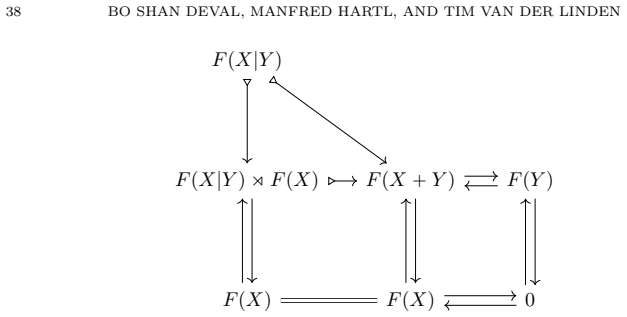
We define an intrinsic symmetric bi-right-exact (and for varieties, bi-cocontinuous) bilinear product on objects of a semi-abelian category, constructed as the cosmash product in the two-nilpotent reflection. When applied to abelian objects, this recovers classical tensor products in many cases. A recognition theorem states that any symmetric bi-cocontinuous bifunctor on an abelian variety of algebras is realised as the bilinear product in the variety of algebras over a suitable 2-nilpotent symmetric operad in the monoidal category of abelian groups. For abelian groups replaced with any commutative ring, the bilinear product of algebras over such an operad is associative as long as the only unary operations are given by multiplication with scalars, but not in general. This relies on a right-exactness theorem for cross-effects of bifunctors, and consequently for cosmash products. We develop basic properties, compare the bilinear product to the Brown-Loday non-abelian tensor product, and prove a categorical version of Ganea's six-term exact homology sequence. We further characterise abelian extensions via internal action cores, obtaining explicit descriptions of bilinear products in categories of representations; in particular, the bilinear product of the associated Beck modules generalises the classical tensor product of representations for groups and Lie algebras.
Editorial analysis
A structured set of objections, weighed in public.
Referee Report
Summary. The manuscript defines an intrinsic symmetric bi-right-exact bilinear product on objects of a semi-abelian category, realized as the cosmash product taken inside the two-nilpotent reflection of the category. When restricted to abelian objects this recovers classical tensor products in many cases. A recognition theorem identifies any symmetric bi-cocontinuous bifunctor on an abelian variety of algebras with the bilinear product arising from a suitable 2-nilpotent symmetric operad. The paper develops basic properties of the construction, compares it with the Brown-Loday non-abelian tensor product, proves a categorical Ganea-type six-term exact sequence extending the five-term homology sequence, and characterises abelian extensions via internal action cores, yielding explicit descriptions of bilinear products of Beck modules that generalise the classical tensor product of representations for groups and Lie algebras. The development relies on a supporting right-exactness theorem for cross-effects of bifunctors.
Significance. If the supporting exactness results hold, the work supplies a new intrinsic tensor product that is defined directly from the semi-abelian structure and extends classical notions to non-abelian settings. The recognition theorem, the Ganea-type sequence, and the explicit descriptions for representations and Beck modules constitute concrete advances that could be useful in homological algebra and categorical algebra. The paper credits the right-exactness theorem for cross-effects as the key technical ingredient enabling the bi-right-exactness claim.
major comments (1)
- [§4 and right-exactness theorem for cross-effects] §4 (construction of the intrinsic bilinear product) and the right-exactness theorem for cross-effects of bifunctors: the claim that the cosmash product inside the two-nilpotent reflection is bi-right-exact for arbitrary semi-abelian categories rests on this theorem. The manuscript must explicitly list the hypotheses under which the two-nilpotent reflection preserves the colimits needed for right-exactness of cross-effects; without such hypotheses the construction is not guaranteed to be defined on the full class of semi-abelian categories asserted in the abstract and introduction.
minor comments (2)
- [§2] Notation for the cosmash product and the two-nilpotent reflection should be introduced with a short reminder of the standard definitions from the cited literature to aid readers who are not specialists in semi-abelian categories.
- [§6] The comparison with the Brown-Loday tensor product would benefit from a short table summarising which exactness or universality properties each construction satisfies.
Simulated Author's Rebuttal
We thank the referee for the careful reading and the constructive major comment. We agree that greater explicitness regarding the hypotheses will improve the manuscript and will revise accordingly.
read point-by-point responses
-
Referee: [§4 and right-exactness theorem for cross-effects] §4 (construction of the intrinsic bilinear product) and the right-exactness theorem for cross-effects of bifunctors: the claim that the cosmash product inside the two-nilpotent reflection is bi-right-exact for arbitrary semi-abelian categories rests on this theorem. The manuscript must explicitly list the hypotheses under which the two-nilpotent reflection preserves the colimits needed for right-exactness of cross-effects; without such hypotheses the construction is not guaranteed to be defined on the full class of semi-abelian categories asserted in the abstract and introduction.
Authors: We accept the point. In the revised version we will add an explicit subsection (or a numbered remark in §2 or §4) that lists the precise hypotheses under which the two-nilpotent reflection preserves the colimits appearing in the definitions of cross-effects and cosmash products. These hypotheses are the standard ones already implicit in the theory of semi-abelian categories (pointedness, existence of finite limits and colimits, and the reflection commuting with the relevant pushouts and coequalizers). We will also state clearly that the bi-right-exactness claim holds precisely when these conditions are satisfied, thereby removing any ambiguity about the scope of the construction. revision: yes
Circularity Check
No significant circularity; new definitions and internal proofs support the claims
full rationale
The paper introduces the intrinsic bilinear product explicitly as the cosmash product taken inside the two-nilpotent reflection of a semi-abelian category, then proves a supporting right-exactness theorem for cross-effects of bifunctors to establish the bi-right-exactness property. This theorem is developed as part of the present work rather than imported via self-citation or assumed by definition. The recognition theorem, comparison with the Brown-Loday tensor product, and the categorical Ganea sequence are all derived from these constructions together with the standard axioms of semi-abelian categories. No equation or central claim reduces by construction to a fitted parameter, a renamed input, or a load-bearing self-citation chain; the derivation remains self-contained against external category-theoretic benchmarks.
Axiom & Free-Parameter Ledger
axioms (2)
- domain assumption The ambient category is semi-abelian.
- domain assumption The two-nilpotent reflection exists and admits a cosmash product with the required bilinearity and exactness.
invented entities (1)
-
Intrinsic symmetric bi-right-exact bilinear product
no independent evidence
Lean theorems connected to this paper
-
IndisputableMonolith/Foundation/RealityFromDistinction.leanreality_from_one_distinction unclear?
unclearRelation between the paper passage and the cited Recognition theorem.
We define an intrinsic symmetric bi-right-exact bilinear product ... constructed as the cosmash product in the two-nilpotent reflection.
-
IndisputableMonolith/Cost/FunctionalEquation.leanwashburn_uniqueness_aczel unclear?
unclearRelation between the paper passage and the cited Recognition theorem.
This relies on a right-exactness theorem for cross-effects of bifunctors, and consequently for cosmash products.
What do these tags mean?
- matches
- The paper's claim is directly supported by a theorem in the formal canon.
- supports
- The theorem supports part of the paper's argument, but the paper may add assumptions or extra steps.
- extends
- The paper goes beyond the formal theorem; the theorem is a base layer rather than the whole result.
- uses
- The paper appears to rely on the theorem as machinery.
- contradicts
- The paper's claim conflicts with a theorem or certificate in the canon.
- unclear
- Pith found a possible connection, but the passage is too broad, indirect, or ambiguous to say the theorem truly supports the claim.
Reference graph
Works this paper leans on
-
[1]
[AL06] D. Arias and M. Ladra,Ganea term for homology of precrossed modules, Comm. Algebra34(2006), no. 10, 3817–3834. [AR94] J. Adámek and J. Rosický,Locally Presentable and Accessible Categories, London Math. Soc. Lecture Note Ser., vol. 189, Cambridge Univ. Press,
work page 2006
-
[2]
[BB69] M. Barr and J. Beck,Homology and standard constructions, Seminar on triples and categorical homologytheory (ETH, Zürich, 1966/67), Lecture Notes in Math., vol.80, Springer, 1969, pp. 245–335. [BB04] F. Borceux and D. Bourn,Mal’cev, Protomodular, Homological and Semi-Abelian Categories, Math. Appl., vol. 566, Kluwer Acad. Publ.,
work page 1966
-
[3]
50 BO SHAN DEV AL, MANFRED HARTL, AND TIM V AN DER LINDEN [BB17] C
9Just keep in mind that certain results such as Theorem 9.5 and its consequences might not hold at that level of generality. 50 BO SHAN DEV AL, MANFRED HARTL, AND TIM V AN DER LINDEN [BB17] C. Berger and D. Bourn,Central reflections and nilpotency in exact Mal’tsev cate- gories, J. Homotopy Relat. Struct.12(2017), 765–835. [Bec03] J. M. Beck,Triples, alge...
work page 2017
-
[4]
Berstein,On co-groups in the category of graded algebras, Trans
[Ber65] I. Berstein,On co-groups in the category of graded algebras, Trans. Amer. Math. Soc. 115(1965), 257–269. [BG02] D. Bourn and M. Gran,Central extensions in semi-abelian categories, J. Pure Appl. Algebra175(2002), 31–44. [BG12] D. Bourn and J. R. A. Gray,Aspects of algebraic exponentiation, Bull. Belg. Math. Soc. Simon Stevin19(2012), 823–846. [BHP9...
work page 1965
-
[5]
[Bou91] D. Bourn,Normalization equivalence, kernel equivalence and affine categories, Cat- egory Theory, Proceedings Como 1990 (A. Carboni, M. C. Pedicchio, and G. Rosolini, eds.), Lecture Notes in Math., vol. 1488, Springer, 1991, pp. 43–62. [Bou01] D. Bourn,3ˆ3Lemma and Protomodularity, J. Algebra236(2001), 778–795. [Bou03] D. Bourn,The denormalized3ˆ3l...
work page 1990
-
[6]
[dMVdL20] D. di Micco and T. Van der Linden,An intrinsic approach to the non-abelian tensor product via internal crossed squares, Theory Appl. Categ.34(2020), 1268–1311. [EG15] T. Everaert and M. Gran,Protoadditive functors, derived torsion theories and ho- mology, J. Pure Appl. Algebra219(2015), no. 8, 3629–3676. [EGVdL08] T. Everaert, M. Gran, and T. Va...
work page 2020
-
[7]
[Fil85] V.T.Filippov,n-Lie algebras, Sibirsk.Mat.Zh.26(1985), no.6, 126–140, inRussian. [Fre64] P. Freyd,Abelian categories, Harper and Row, New York, 1964, Republished in: Reprints in Theory and Applications of Categories, no. 3 (2003). [Gan68] T. Ganea,Homologie et extensions centrales de groupes, C. R. Math. Acad. Sci. Paris 266(1968), 556–558. [GKV16]...
work page 1985
-
[8]
[Gra12] J. R. A. Gray,Algebraic exponentiation in general categories, Appl. Categ. Structures 20(2012), 543–567. [GSV19] M. Gran, F. Sterck, and J. Vercruysse,A semi-abelian extension of a theorem by Takeuchi, J. Pure Appl. Algebra223(2019), no. 10, 4171–4190. [GVdL09] J. Goedecke and T. Van der Linden,On satellites in semi-abelian categories: Ho- mology ...
work page 2012
-
[9]
[Hig56] P. J. Higgins,Groups with multiple operators, Proc. Lond. Math. Soc. (3)6(1956), no. 3, 366–416. [HL13] M. Hartl and B. Loiseau,On actions and strict actions in homological categories, Theory Appl. Categ.27(2013), no. 15, 347–392. [HS97] P. J. Hilton and U. Stammbach,A course in homological algebra, second ed., Gradu- ate Texts in Mathematics, vol...
work page 1956
-
[10]
[Huq68] S. A. Huq,Commutator, nilpotency and solvability in categories, Q. J. Math.19 (1968), no. 2, 363–389. [HV11] M. Hartl and C. Vespa,Quadratic functors on pointed categories, Adv. Math.226 (2011), no. 5, 3927–4010. [HVdL11] M. Hartl and T. Van der Linden,The ternary commutator obstruction for internal crossed modules, preprintarXiv:1107.0954v1,
work page internal anchor Pith review Pith/arXiv arXiv 1968
-
[11]
[HVdL13] M. Hartl and T. Van der Linden,The ternary commutator obstruction for internal crossed modules, Adv. Math.232(2013), no. 1, 571–607. [Jan03] G. Janelidze,Internal Crossed Modules, Georgian Math. J.10(2003), no. 1, 99–114. [JK94] G. Janelidze and G. M. Kelly,Galois theory and a general notion of central extension, J. Pure Appl. Algebra97(1994), no...
work page 2013
-
[12]
[Lac12] S. Lack,Non-canonical isomorphisms, J. Pure Appl. Algebra216(2012), no. 3, 593–597. [Lod93] J.-L. Loday,Une version non commutative des algèbres de Lie: les algèbres de Leib- niz, Enseign. Math. (2)39(1993), no. 3–4, 269–293. 52 BO SHAN DEV AL, MANFRED HARTL, AND TIM V AN DER LINDEN [Lue76] A. S.-T. Lue,The Ganea map for nilpotent groups, J. Lond....
work page 2012
-
[13]
Orzech,Obstruction theory in algebraic categories I and II, J
[Orz72] G. Orzech,Obstruction theory in algebraic categories I and II, J. Pure Appl. Algebra 2(1972), 287–314 and 315–340. [Ped95] M. C. Pedicchio,A Categorical Approach to Commutator Theory, J. Algebra177 (1995), 647–657. [Pir00] T. Pirashvili,Ganea term for CCG-homology of crossed modules, Extracta Math.15 (2000), no. 1, 231–235. [PVdL16] G. Peschke and...
work page 1972
-
[14]
[SVdL20] C. S. Simeu and T. Van der Linden,On the “Three Subobjects Lemma” and its higher-order generalisations, J. Algebra546(2020), 315–340. [War76] R. B. Warfield, Jr.,Nilpotent groups, Lecture Notes in Mathematics, vol. 513, Springer-Verlag, Berlin-New York,
work page 2020
-
[15]
Yamaguti,On the theory of Malcev algebras, Kumamoto J
[Yam63] K. Yamaguti,On the theory of Malcev algebras, Kumamoto J. Sci. Ser. A6(1963), 9–45. Email address:bo.deval@uclouvain.be Email address:mhartl@gmx.fr Email address:tim.vanderlinden@uclouvain.be (Manfred Hartl)Northeast Normal University, Changchun, Jilin, China (Manfred Hartl)UPHF, CERAMATH and FR CNRS 2956, F-59313 Valenciennes, France (Bo Shan Dev...
work page 1963
discussion (0)
Sign in with ORCID, Apple, or X to comment. Anyone can read and Pith papers without signing in.