Doppler Shift Mitigation in a Chip-Scale Atomic Beam Clock
Pith reviewed 2026-05-17 00:57 UTC · model grok-4.3
The pith
Chip-scale rubidium beam clock cancels Doppler sensitivity to laser frequency via competition with resonant light shifts.
A machine-rendered reading of the paper's core claim, the machinery that carries it, and where it could break.
Core claim
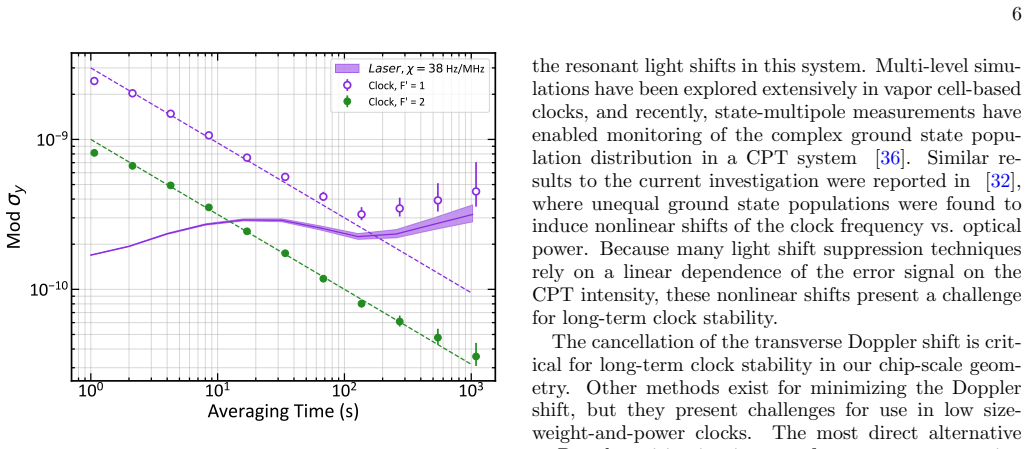
In a cm-scale 87Rb atom beam clock, a strong competition exists between Doppler shifts generated by the beam geometry and resonant light shifts caused by asymmetric decay in the clock Lambda-system; at specific experimental parameters this competition yields zero sensitivity to laser frequency variation and supports white-noise-limited frequency averaging for 1000 s of integration.
What carries the argument
Competition between beam-induced Doppler shifts and resonant light shifts from asymmetric decay in the Lambda-system, tuned to exact cancellation at convenient operating points.
If this is right
- Clock frequency becomes independent of small laser frequency drifts at the identified parameters.
- Frequency stability reaches the white-noise limit for integration times up to 1000 s.
- The approach suppresses collisional shifts and some light shifts that limit coherent-population-trapping clocks.
- Miniature beam clocks become viable for low-power, low-drift timing holdover applications.
Where Pith is reading between the lines
- The same cancellation principle could be tested in other atomic species or with different beam velocities to map the range of usable operating points.
- If the cancellation holds under vibration or temperature changes, it would reduce requirements for auxiliary laser stabilization in portable devices.
- Scaling the beam length or velocity distribution might shift the exact cancellation point, offering a design knob for different size and power constraints.
Load-bearing premise
The Doppler-light shift competition can be tuned to exact cancellation at convenient parameters without other unaccounted frequency shifts or instabilities dominating long-term performance.
What would settle it
Measure the clock frequency while deliberately stepping the laser frequency across a range around the chosen operating point and check whether the observed sensitivity remains zero or reappears after long averaging.
Figures
read the original abstract
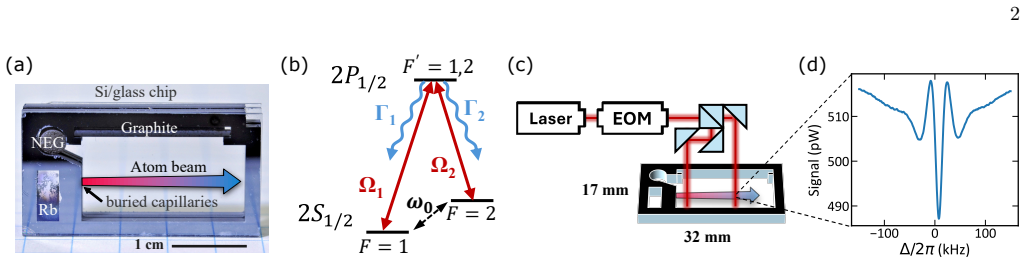
Chip-scale microwave atomic systems based on thermal atomic beams offer a promising approach to realize low-power and low-drift clocks for timing holdover applications. Miniature beam clocks are expected to suppress many of the shifts that commonly limit existing chip-scale atomic clocks based on coherent population trapping, including collisional shifts and some light shifts. However, the beam geometry can amplify some challenges such as Doppler shifts, which generate a strong sensitivity to laser frequency variation. Using a cm-scale 87Rb atom beam clock, we identify a surprisingly strong competition between Doppler shifts and resonant light shifts arising from asymmetric decay in the clock spectroscopy {\Lambda}-system. Leveraging this competition between Doppler and resonant light shifts, we demonstrate clock operation at specific, convenient experimental parameters consistent with zero sensitivity to laser frequency variation and white-noise-limited clock frequency averaging for 1000 s of integration.
Editorial analysis
A structured set of objections, weighed in public.
Referee Report
Summary. The manuscript reports an experimental demonstration in a cm-scale 87Rb atom beam clock. The authors identify a strong competition between Doppler shifts and resonant light shifts arising from asymmetric decay in the clock spectroscopy Λ-system. By operating at specific convenient experimental parameters, they achieve clock operation consistent with zero sensitivity to laser frequency variation and white-noise-limited clock frequency averaging for 1000 s of integration.
Significance. If the central experimental result holds, this work is significant for chip-scale atomic clocks. It provides a practical route to mitigate the Doppler sensitivity that is amplified in beam geometries by balancing it against resonant light shifts at accessible operating points. The demonstration of white-noise-limited performance to 1000 s directly addresses a key limitation for low-power, low-drift timing holdover applications.
major comments (1)
- The central claim of exact cancellation and long-term stability rests on direct measurements of clock frequency versus laser detuning. The manuscript should include quantitative modeling or additional data (e.g., sensitivity curves with error bars) around the chosen operating points to confirm that unaccounted shifts or instabilities do not dominate at those parameters.
minor comments (1)
- The abstract is concise but would benefit from a brief statement of the specific experimental parameters (e.g., beam velocity, laser intensity) at which zero sensitivity is observed.
Simulated Author's Rebuttal
We thank the referee for their positive evaluation of our work and for the constructive major comment. We address the point below and have revised the manuscript accordingly to strengthen the presentation of our results.
read point-by-point responses
-
Referee: The central claim of exact cancellation and long-term stability rests on direct measurements of clock frequency versus laser detuning. The manuscript should include quantitative modeling or additional data (e.g., sensitivity curves with error bars) around the chosen operating points to confirm that unaccounted shifts or instabilities do not dominate at those parameters.
Authors: We agree that additional quantitative support improves clarity. In the revised manuscript we have added a compact analytical model of the competing Doppler shift (from the beam velocity distribution) and the resonant light shift (arising from asymmetric spontaneous decay in the three-level Lambda system). We have also included sensitivity curves of clock frequency versus laser detuning, now plotted with error bars, focused on the region around the chosen operating points. These data and the model agree within experimental uncertainty, confirming that residual unaccounted shifts remain well below the level that would limit the observed white-noise-limited averaging to 1000 s. revision: yes
Circularity Check
No significant circularity
full rationale
This experimental demonstration paper reports direct measurements of clock frequency versus laser detuning to identify operating points where Doppler and resonant light shifts cancel. The central claims rest on empirical data from integration times up to 1000 s rather than any algebraic derivation, fitted parameter renamed as prediction, or self-citation chain. No load-bearing step reduces by construction to its inputs; the result is obtained from physical observation at chosen parameters and is self-contained against external benchmarks.
Axiom & Free-Parameter Ledger
axioms (1)
- domain assumption Asymmetric decay in the clock spectroscopy Lambda-system produces resonant light shifts that compete with Doppler shifts from the atomic beam velocity distribution.
Lean theorems connected to this paper
-
IndisputableMonolith/Cost/FunctionalEquation.leanwashburn_uniqueness_aczel unclear?
unclearRelation between the paper passage and the cited Recognition theorem.
Leveraging this competition between Doppler and resonant light shifts, we demonstrate clock operation at specific, convenient experimental parameters consistent with zero sensitivity to laser frequency variation
-
IndisputableMonolith/Foundation/AlphaCoordinateFixation.leanJ_uniquely_calibrated_via_higher_derivative unclear?
unclearRelation between the paper passage and the cited Recognition theorem.
resonant light shifts arising from asymmetric decay in the clock spectroscopy Λ-system
What do these tags mean?
- matches
- The paper's claim is directly supported by a theorem in the formal canon.
- supports
- The theorem supports part of the paper's argument, but the paper may add assumptions or extra steps.
- extends
- The paper goes beyond the formal theorem; the theorem is a base layer rather than the whole result.
- uses
- The paper appears to rely on the theorem as machinery.
- contradicts
- The paper's claim conflicts with a theorem or certificate in the canon.
- unclear
- Pith found a possible connection, but the passage is too broad, indirect, or ambiguous to say the theorem truly supports the claim.
Reference graph
Works this paper leans on
-
[1]
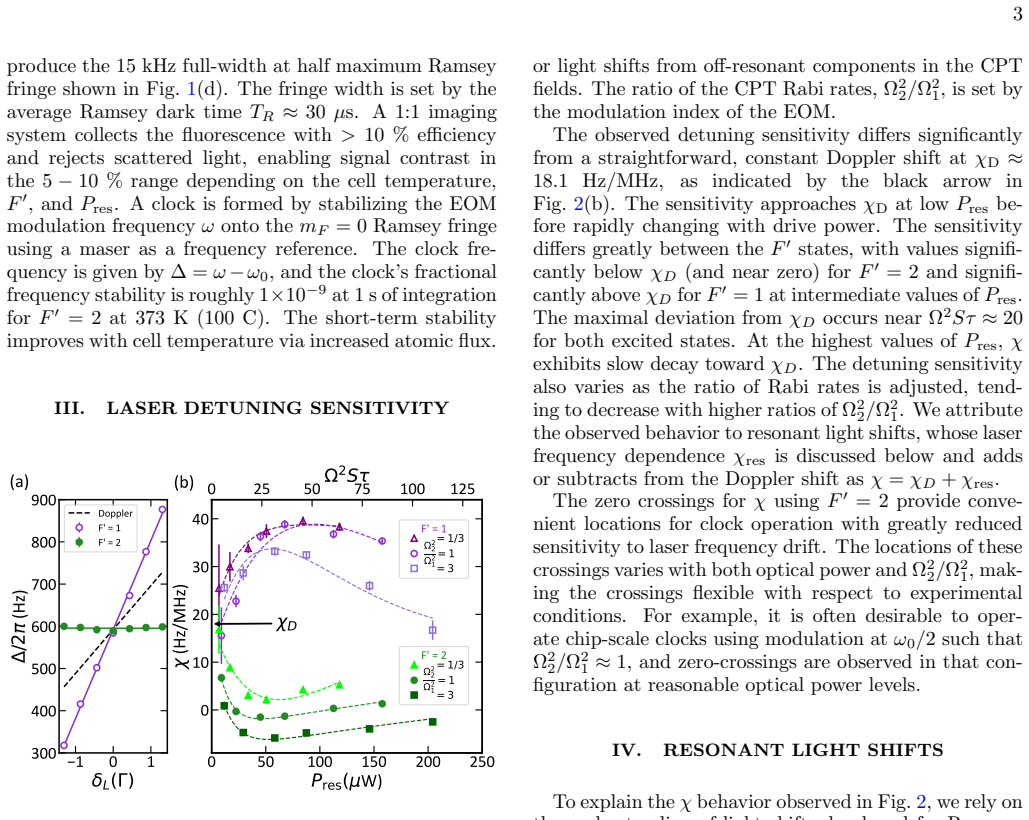
We attribute the observed behavior to resonant light shifts, whose laser frequency dependenceχ res is discussed below and adds or subtracts from the Doppler shift asχ=χ D +χ res. The zero crossings forχusingF ′ = 2 provide conve- nient locations for clock operation with greatly reduced sensitivity to laser frequency drift. The locations of these crossings...
-
[2]
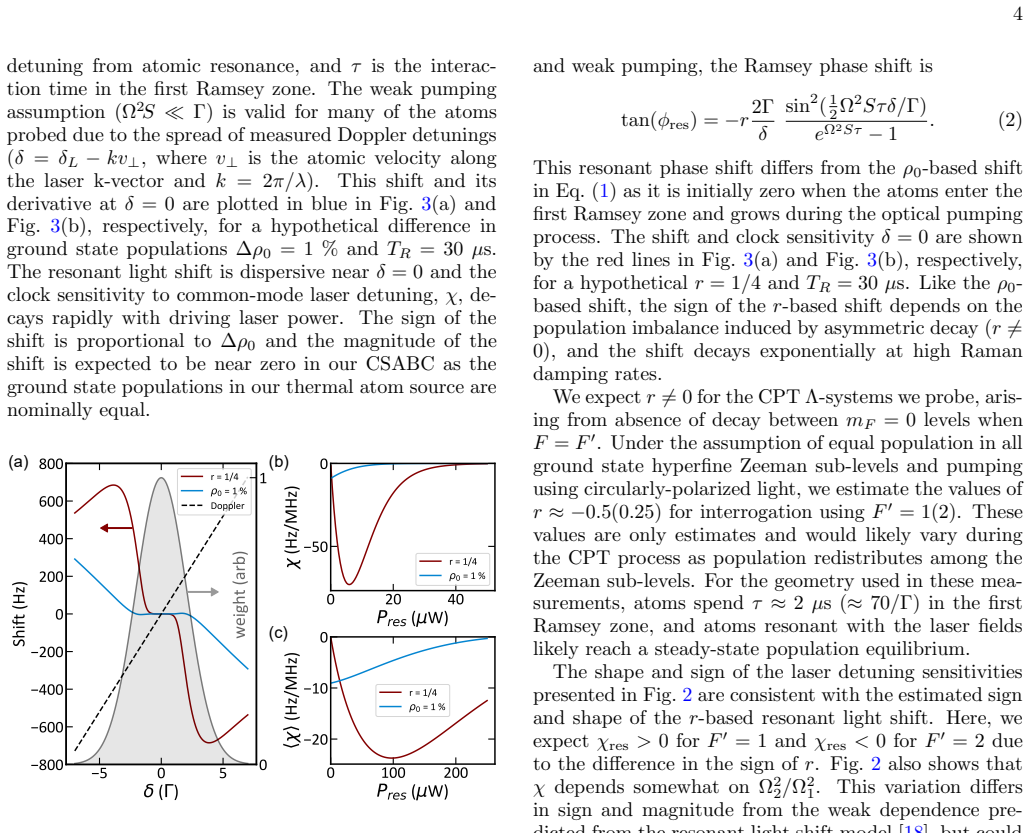
are the initialF= 1(2) occupations. This initial population imbalance generates a phase shiftϕ res which is initially maximal and expo- nentially decreases as the atoms are pumped into phase with the driving fields during the CPT process. An analytical approximation for the pumping- dependent resonant phase shift arising from an initial population imbalan...
-
[3]
Γ Γ2+4δ2 is the Raman damping rate in the first Ramsey zone,δis the common-mode 4 detuning from atomic resonance, andτis the interac- tion time in the first Ramsey zone. The weak pumping assumption (Ω 2S≪Γ) is valid for many of the atoms probed due to the spread of measured Doppler detunings (δ=δ L −kv ⊥, wherev ⊥ is the atomic velocity along the laser k-...
-
[4]
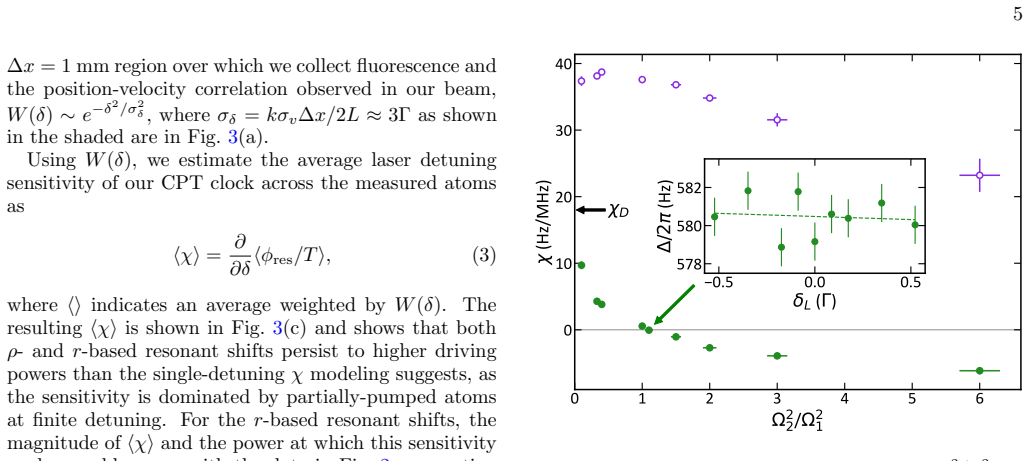
This variation differs in sign and magnitude from the weak dependence pre- dicted from the resonant light shift model [18], but could arise from modification torinduced by the unequal Rabi rates which we predict would shiftχin the observed di- rection. The population dynamics of the CPT Λ-system have been shown to not only depend on the spontaneous decay ...
-
[5]
J. Vanier, Atomic clocks based on coherent population trapping: a review, Applied Physics B81, 421 (2005)
work page 2005
-
[6]
Kitching, Chip-scale atomic devices, Applied Physics Reviews5, 031302 (2018)
J. Kitching, Chip-scale atomic devices, Applied Physics Reviews5, 031302 (2018)
work page 2018
-
[7]
B. L. S. Marlow and D. R. Scherer, A Review of Commer- cial and Emerging Atomic Frequency Standards, IEEE Transactions on Ultrasonics, Ferroelectrics, and Fre- quency Control68, 2007 (2021)
work page 2007
-
[8]
M. Abdel Hafiz, C. Carl´ e, N. Passilly, J. M. Danet, C. E. Calosso, and R. Boudot, Light-shift mitigation in a microcell-based atomic clock with symmetric auto- balanced Ramsey spectroscopy, Applied Physics Letters 120, 064101 (2022)
work page 2022
-
[9]
C. Carl´ e, S. Keshavarzi, A. Mursa, P. Karvinen, R. Chutani, S. Bargiel, S. Queste, R. Vicarini, P. Abb´ e, M. Abdel Hafiz, V. Maurice, R. Boudot, and N. Passilly, Reduction of helium permeation in microfabricated cells using aluminosilicate glass substrates and Al2O3 coat- ings, Journal of Applied Physics133, 214501 (2023)
work page 2023
-
[10]
C. Carl´ e, M. Abdel Hafiz, S. Keshavarzi, R. Vicarini, N. Passilly, and R. Boudot, Pulsed-CPT Cs-Ne microcell atomic clock with frequency stability below 2×10 -12 at 10 5 s, Optics Express31, 8160 (2023)
work page 2023
-
[11]
C. Li, X. Chai, B. Wei, J. Yang, A. Daruwalla, F. Ayazi, and C. Raman, Cascaded collimator for atomic beams traveling in planar silicon devices, Nature Communica- tions10, 1831 (2019)
work page 2019
-
[12]
C. Li, B. Wei, X. Chai, J. Yang, A. Daruwalla, F. Ayazi, and C. Raman, Robust characterization of microfabri- cated atomic beams on a six-month time scale, Physical Review Research2, 023239 (2020)
work page 2020
-
[13]
G. D. Martinez, C. Li, A. Staron, J. Kitching, C. Raman, and W. R. McGehee, A chip-scale atomic beam clock, Nature Communications14, 3501 (2023)
work page 2023
-
[14]
N. F. Ramsey, A Molecular Beam Resonance Method with Separated Oscillating Fields, Physical Review78, 695 (1950)
work page 1950
-
[15]
L. Essen and J. V. L. Parry, An Atomic Standard of Fre- quency and Time Interval: A Cæsium Resonator, Nature 176, 280 (1955)
work page 1955
-
[16]
J. Vanier and C. Audoin,The Quantum Physics of Atomic Frequency Standards(CRC Press, New York, 1988)
work page 1988
-
[17]
J. H. Shirley, W. D. Lee, and R. E. Drullinger, Accuracy evaluation of the primary frequency standard NIST-7, Metrologia38, 427 (2001)
work page 2001
-
[18]
C. Li, X. Chai, L. Zhuo, B. Wei, A. Lotfi, F. Ayazi, and C. Raman, Stimulated Laser Cooling in a Compact Ge- ometry Using Microfabricated Atomic Beam Collimators, Physical Review Applied20, 034042 (2023)
work page 2023
- [19]
-
[20]
J. E. Thomas, P. R. Hemmer, S. Ezekiel, C. C. Leiby, R. H. Picard, and C. R. Willis, Observation of Ramsey Fringes Using a Stimulated, Resonance Raman Transi- tion in a Sodium Atomic Beam, Physical Review Letters 48, 867 (1982)
work page 1982
-
[21]
P. R. Hemmer, G. P. Ontai, and S. Ezekiel, Precision studies of stimulated-resonance Raman interactions in an atomic beam, Journal of the Optical Society of America B3, 219 (1986)
work page 1986
-
[22]
P. R. Hemmer, M. S. Shahriar, V. D. Natoli, and S. Ezekiel, Ac Stark shifts in a two-zone Raman inter- action, Journal of the Optical Society of America B6, 1519 (1989)
work page 1989
-
[23]
P. R. Hemmer, M. S. Shahriar, H. Lamela–Rivera, S. P. Smith, B. E. Bernacki, and S. Ezekiel, Semiconductor laser excitation of Ramsey fringes by using a Raman transition in a cesium atomic beam, JOSA B10, 1326 (1993)
work page 1993
-
[24]
M. S. Shahriar, P. R. Hemmer, D. P. Katz, A. Lee, and M. G. Prentiss, Dark-state-based three-element vector model for the stimulated raman interaction, Phys. Rev. A55, 2272 (1997)
work page 1997
-
[25]
E. Blanshan, S. M. Rochester, E. A. Donley, and J. Kitching, Light shifts in a pulsed cold-atom coherent- population-trapping clock, Physical Review A91, 041401 (2015)
work page 2015
- [26]
-
[27]
F. Levi, A. Godone, and J. Vanier, The light shift ef- fect in the coherent population trapping cesium maser, IEEE Transactions on Ultrasonics, Ferroelectrics, and Frequency Control47, 466 (2000)
work page 2000
-
[28]
J. W. Pollock, V. I. Yudin, M. Shuker, M. Y. Basalaev, A. V. Taichenachev, X. Liu, J. Kitching, and E. A. Don- ley, ac Stark shifts of dark resonances probed with Ram- sey spectroscopy, Physical Review A98, 053424 (2018)
work page 2018
-
[29]
S. R. Jefferts, J. Shirley, T. E. Parker, T. P. Heavner, D. M. Meekhof, C. Nelson, F. Levi, G. Costanzo, A. D. Marchi, R. Drullinger, L. Hollberg, W. D. Lee, and F. L. Walls, Accuracy evaluation of NIST-F1, Metrologia39, 321 (2002)
work page 2002
-
[30]
D. K. Serkland, K. M. Geib, G. M. Peake, R. Lutwak, A. Rashed, M. Varghese, G. Tepolt, and M. Prouty, VCSELs for atomic sensors, inVertical-Cavity Surface- Emitting Lasers XI, Vol. 6484, edited by K. D. Choquette and J. K. Guenter, International Society for Optics and Photonics (SPIE, 2007) p. 648406
work page 2007
-
[31]
Y.-Y. Jau, E. Miron, A. B. Post, N. N. Kuzma, and W. Happer, Push-Pull Optical Pumping of Pure Su- perposition States, Physical Review Letters93, 160802 (2004)
work page 2004
-
[32]
H. C. W. Beijerinck and N. F. Verster, Velocity distri- bution and angular distribution of molecular beams from multichannel arrays, Journal of Applied Physics46, 2083 (1975)
work page 2083
-
[33]
A. V. Ta˘ ıchenachev, V. I. Yudin, R. Wynands, M. St¨ ahler, J. Kitching, and L. Hollberg, Theory of dark resonances for alkali-metal vapors in a buffer-gas cell, Physical Review A67, 033810 (2003)
work page 2003
-
[34]
T. Zanon-Willette, E. de Clercq, and E. Arimondo, Ultrahigh-resolution spectroscopy with atomic or molec- ular dark resonances: Exact steady-state line shapes and asymptotic profiles in the adiabatic pulsed regime, Phys- ical Review A84, 062502 (2011)
work page 2011
-
[35]
X. Liu, X. Zhao, J. Sun, Z. Xu, and Z. Hu, Light-shift induced by two unbalanced spontaneous decay rates in EIT (CPT) spectroscopies under Ramsey pulse excita- 8 tion, Chinese Physics B30, 083203 (2021)
work page 2021
-
[36]
E. A. Tsygankov, D. S. Chuchelov, M. I. Vaskovskaya, S. A. Zibrov, V. V. Vassiliev, and V. L. Velichansky, “Branching Asymmetry” of the Coherent Population Trapping Resonance, JETP Letters120, 33 (2024)
work page 2024
-
[37]
I. V. Jyotsna and G. S. Agarwal, Coherent population trapping at low light levels, Physical Review A52, 3147 (1995)
work page 1995
-
[38]
S. Micalizio and A. Godone, Raman-ramsey resonances in atomic vapor cells: Rabi pulling and optical-density effects, Phys. Rev. A99, 043425 (2019)
work page 2019
-
[39]
G. S. Pati, Z. Warren, N. Yu, and M. S. Shahriar, Com- putational studies of light shift in a Raman–Ramsey interference-based atomic clock, Journal of the Optical Society of America B32, 388 (2015)
work page 2015
-
[40]
A. Householder, N. Ristoff, and J. Camparo, Mea- suring state-multipole moments in coherent-population- trapping experiments, Physical Review A111, 023715 (2025)
work page 2025
-
[41]
E. A. Donley, F.-X. Esnault, E. Blanshan, and J. Kitch- ing, Cancellation of Doppler shifts in a cold-atom CPT clock, in2013 Joint European Frequency and Time Forum & International Frequency Control Symposium (EFTF/IFC)(IEEE, Prague, Czech Republic, 2013) pp. 445–447
work page 2013
-
[42]
F.-X. Esnault, E. Blanshan, E. N. Ivanov, R. E. Scholten, J. Kitching, and E. A. Donley, Cold-atom double-Λ co- herent population trapping clock, Physical Review A88, 042120 (2013)
work page 2013
-
[43]
J. D. Elgin, T. P. Heavner, J. Kitching, E. A. Donley, J. Denney, and E. A. Salim, A cold-atom beam clock based on coherent population trapping, Applied Physics Letters115, 033503 (2019)
work page 2019
-
[44]
R. Lutwak, A. Rashed, M. Varghese, G. Tepolt, J. LeBlanc, M. Mescher, C. S. D. Laboratory, D. K. Serkland, K. M. Geib, G. M. Peake, and S. Romisch, THE CHIP-SCALE ATOMIC CLOCK – PROTOTYPE EVALUATION, Proceedings of IEEE International Fre- quency Control Symposiums and European Frequency and Time Forum , pp. 1327 (2007)
work page 2007
- [45]
discussion (0)
Sign in with ORCID, Apple, or X to comment. Anyone can read and Pith papers without signing in.