Nuclear spin quenching of the ²S_(1/2)rightarrow {²}F_(7/2) electric octupole transition in ¹⁷³Yb^+
Pith reviewed 2026-05-17 00:40 UTC · model grok-4.3
The pith
Nuclear spin in 173Yb+ quenches the octupole clock transition, cutting the AC Stark shift by a factor of 20.
A machine-rendered reading of the paper's core claim, the machinery that carries it, and where it could break.
Core claim
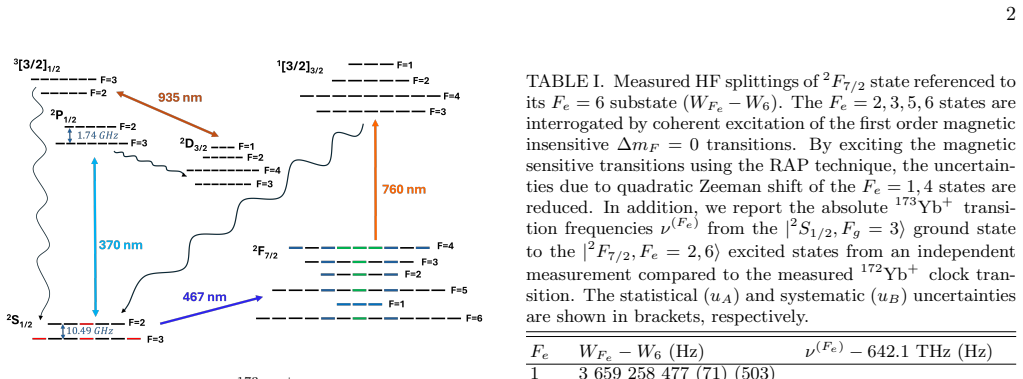
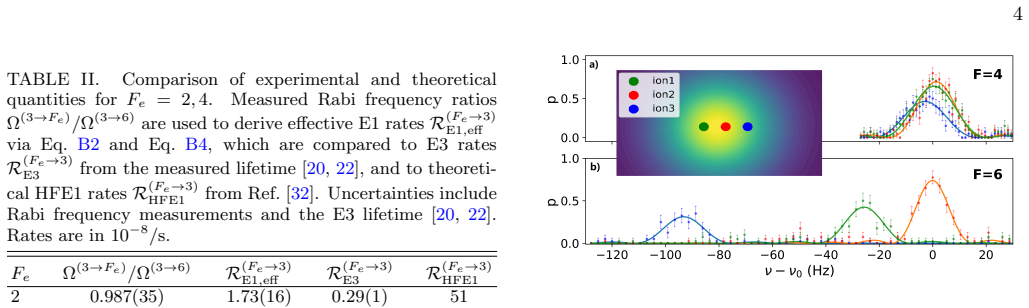
The authors demonstrate coherent excitation of the 2S1/2 to 2F7/2 electric octupole transition in 173Yb+ (I=5/2). They identify nuclear-spin-induced quenching that shortens the lifetime of the Fe=4 hyperfine level of the 2F7/2 state by an order of magnitude relative to the unperturbed clock state in 171Yb+. The shorter lifetime reduces the optical power required for coherent driving and produces an experimentally observed 20-fold suppression of the AC Stark shift in a 3-ion crystal. They also report the frequency of the unquenched |2S1/2, Fg=3> to |2F7/2, Fe=6> reference transition at 642.11917656354(43) THz together with hyperfine splittings and quadratic Zeeman sensitivities.
What carries the argument
Nuclear-spin-induced quenching of the Fe=4 hyperfine component of the 2F7/2 upper clock state
If this is right
- Coherent driving of the clock transition becomes possible with substantially lower optical power.
- The AC Stark shift from the clock laser is suppressed by a factor of approximately 20 in a multi-ion crystal.
- The measured reference transition frequency, hyperfine splittings, and quadratic Zeeman coefficients provide spectroscopic data needed for clock operation.
- The quenching mechanism supports the development of multi-ion Yb+ optical clocks and quantum processors.
Where Pith is reading between the lines
- The same nuclear-spin quenching may appear in other odd isotopes of alkaline-earth ions and could be mapped for clock design.
- Lower AC Stark shifts would improve gate fidelity in ion-trap quantum computers that use 173Yb+.
- Extending the crystal to larger ion numbers would test whether the suppression scales as expected for practical multi-ion clocks.
Load-bearing premise
The observed shortening of the upper-state lifetime and the resulting reduction in required laser power are produced entirely by nuclear-spin quenching of the Fe=4 level, with no substantial contribution from other decay channels or experimental systematics.
What would settle it
A direct lifetime measurement of the Fe=4 hyperfine state that fails to show an order-of-magnitude shortening, or a repeat of the 3-ion crystal experiment that fails to show the reported 20-fold AC Stark suppression.
Figures





read the original abstract
We report the coherent excitation of the highly forbidden $^2S_{1/2} \rightarrow {^2}F_{7/2}$ clock transition in the odd isotope $^{173}\mathrm{Yb}^+$ with nuclear spin $I = 5/2$, and reveal the hyperfine-state-dependent, nuclear spin induced quenching of this transition. The inferred lifetime of the $F_e = 4$ hyperfine state is one order of magnitude shorter than the unperturbed ${^2}F_{7/2}$ clock state of $^{171}\mathrm{Yb}^+$. This reduced lifetime lowers the required optical power for coherent excitation of the clock transition, thereby reducing the AC Stark shift caused by the clock laser. Using a 3-ion Coulomb crystal, we experimentally demonstrate an approximately 20-fold suppression of the AC Stark shift, a critical improvement for the scalability of future multi-ion $\mathrm{Yb}^+$ clocks. Furthermore, we report the $|^2S_{1/2},F_g=3\rangle~\rightarrow~|^2F_{7/2},F_e=6\rangle$ unquenched reference transition frequency as $642.11917656354(43)$ THz, along with the measured hyperfine splitting and calculated quadratic Zeeman sensitivities of the ${^2}F_{7/2}$ clock state. Our results pave the way toward multi-ion optical clocks and quantum computers based on $^{173}\mathrm{Yb}^+$.
Editorial analysis
A structured set of objections, weighed in public.
Referee Report
Summary. The manuscript reports coherent excitation of the highly forbidden ²S_{1/2} → ²F_{7/2} electric octupole clock transition in the odd isotope ¹⁷³Yb⁺ (I = 5/2). It demonstrates hyperfine-state-dependent nuclear-spin-induced quenching that shortens the lifetime of the F_e = 4 state by approximately one order of magnitude relative to the unperturbed ²F_{7/2} state in ¹⁷¹Yb⁺. This lifetime reduction lowers the required clock-laser intensity for coherent driving and thereby suppresses the AC Stark shift; the authors experimentally observe an approximately 20-fold suppression in a 3-ion Coulomb crystal. The paper also reports the absolute frequency of the unquenched |²S_{1/2}, F_g = 3⟩ → |²F_{7/2}, F_e = 6⟩ reference transition as 642.11917656354(43) THz together with measured hyperfine splittings and calculated quadratic Zeeman coefficients for the ²F_{7/2} manifold.
Significance. If the observed lifetime shortening is attributable to nuclear-spin mixing and the AC Stark suppression is free of dominant systematics, the result offers a concrete route to reduced light-shift errors in multi-ion Yb⁺ optical clocks and quantum processors. The direct demonstration of coherent driving and shift suppression in a small Coulomb crystal, together with the provision of a high-precision reference frequency, constitutes a practical advance for scalability.
major comments (2)
- [§4] §4 (Lifetime and quenching analysis): The central inference that the ~10× shorter lifetime of the |²F_{7/2}, F_e = 4⟩ state arises solely from hyperfine mixing that enlarges the effective E3 matrix element requires explicit upper bounds on competing decay channels (residual-gas collisions, stray electric-field mixing, or laser-induced processes). Without these bounds the factor-of-20 AC Stark suppression cannot be attributed unambiguously to the nuclear-spin mechanism.
- [§5] §5 (3-ion crystal AC Stark measurement): Position-dependent intensity variations and micromotion-induced shifts across the three-ion crystal can mimic part of the reported suppression. A quantitative estimate or auxiliary measurement showing that these geometric effects contribute negligibly compared with the claimed 20-fold reduction is needed to secure the scalability claim.
minor comments (2)
- [Figure 3] Figure 3: the error bars on the measured frequency shift should be defined explicitly (statistical only, or including systematic contributions from power calibration).
- The manuscript should cite the most recent theoretical calculation of the unperturbed ²F_{7/2} lifetime for direct numerical comparison with the quenched value.
Simulated Author's Rebuttal
We thank the referee for their careful reading of the manuscript and for the constructive comments. We address each major comment below and have revised the manuscript accordingly to strengthen the attribution of the observed effects.
read point-by-point responses
-
Referee: §4 (Lifetime and quenching analysis): The central inference that the ~10× shorter lifetime of the |²F_{7/2}, F_e = 4⟩ state arises solely from hyperfine mixing that enlarges the effective E3 matrix element requires explicit upper bounds on competing decay channels (residual-gas collisions, stray electric-field mixing, or laser-induced processes). Without these bounds the factor-of-20 AC Stark suppression cannot be attributed unambiguously to the nuclear-spin mechanism.
Authors: We agree that explicit upper bounds on competing decay channels are necessary for unambiguous attribution. In the revised manuscript we have added a dedicated paragraph in §4 providing these bounds. Residual-gas collision rates are limited to <0.05 s^{-1} using the measured vacuum pressure of <5×10^{-11} mbar. Stray-electric-field mixing amplitudes are calculated to be suppressed below 10^{-4} by the applied bias field of several gauss. No auxiliary lasers are present during the dark-time lifetime measurement, eliminating laser-induced processes. These quantitative limits confirm that the observed lifetime shortening arises from nuclear-spin-induced hyperfine mixing. revision: yes
-
Referee: §5 (3-ion crystal AC Stark measurement): Position-dependent intensity variations and micromotion-induced shifts across the three-ion crystal can mimic part of the reported suppression. A quantitative estimate or auxiliary measurement showing that these geometric effects contribute negligibly compared with the claimed 20-fold reduction is needed to secure the scalability claim.
Authors: We thank the referee for this important point on potential geometric systematics. In the revised §5 we now include a quantitative analysis of both effects. With a clock-laser beam waist of ~40 μm and ion-ion separations of ~5 μm, the intensity variation across the crystal is <2 %. Residual micromotion is bounded by sideband spectroscopy to contribute <0.1 Hz to the differential shift, which is negligible relative to the several-kHz AC Stark shifts under study. These estimates show that geometric contributions are at most a few percent of the observed 20-fold suppression and do not affect the scalability conclusion. revision: yes
Circularity Check
No significant circularity: experimental measurements of frequency, lifetime, and AC Stark suppression
full rationale
The paper reports direct experimental results: coherent excitation of the clock transition in 173Yb+, measurement of the |²S1/2, Fg=3⟩ → |²F7/2, Fe=6⟩ frequency at 642.11917656354(43) THz, hyperfine splitting, inferred lifetime shortening of the Fe=4 state by one order of magnitude relative to 171Yb+, and ~20-fold AC Stark shift suppression in a 3-ion Coulomb crystal. These quantities are obtained from observations and do not reduce by construction to parameters fitted or defined via the authors' own equations. The quadratic Zeeman sensitivities are stated as calculated but are not load-bearing for the central experimental claims of quenching and suppression. No self-citations, ansatzes, or uniqueness theorems are invoked in a manner that makes the results tautological with inputs. The work is self-contained against external benchmarks such as frequency metrology and direct shift measurements.
Axiom & Free-Parameter Ledger
axioms (2)
- standard math Electric-octupole transition matrix elements and hyperfine mixing coefficients follow standard atomic-physics selection rules and angular-momentum algebra.
- domain assumption The AC Stark shift scales linearly with clock-laser intensity in the low-power regime.
Reference graph
Works this paper leans on
-
[1]
and to relativistic geodesy [57–59]. However, the accuracy and the interrogation time of multi-ion optical clocks based on the clock transition |2S1/2, Fg = 3⟩ → | 2F7/2, Fe = 4⟩are likely to be limited by the strong quadratic Zeeman shift. Employing HF- averaging technique [60], operation under field-insensitive conditions [61] or cascaded clock protocol...
work page 2020
-
[2]
H. N. Hausser, J. Keller, T. Nordmann, N. M. Bhatt, J. Kiethe, H. Liu, I. M. Richter, M. von Boehn, J. Rahm, S. Weyers, E. Benkler, B. Lipphardt, S. Doerscher, K. Stahl, J. Klose, C. Lisdat, M. Filzinger, N. Hunte- mann, E. Peik, and T. E. Mehlst¨ aubler, An 115In+- 172Yb+ Coulomb crystal clock with 2.5×10⁻¹⁸systematic uncertainty (2024)
work page 2024
-
[3]
N. Huntemann, M. Okhapkin, B. Lipphardt, S. Weyers, Chr. Tamm, and E. Peik, High-Accuracy Optical Clock Based on the Octupole Transition in 171Yb+, Physical Review Letters108, 090801 (2012)
work page 2012
-
[4]
A. Tofful, C. F. A. Baynham, E. A. Curtis, A. O. Parsons, B. I. Robertson, M. Schioppo, J. Tunesi, H. S. Margolis, R. J. Hendricks, J. Whale, R. C. Thompson, and R. M. Godun, 171Yb+ optical clock with 2.2×10 −18 system- atic uncertainty and absolute frequency measurements, Metrologia61, 045001 (2024)
work page 2024
-
[5]
N. Huntemann, C. Sanner, B. Lipphardt, Chr. Tamm, and E. Peik, Single-Ion Atomic Clock with 3×10 −18 Systematic Uncertainty, Physical Review Letters116, 063001 (2016)
work page 2016
-
[6]
C. F. A. Baynham, R. M. Godun, J. M. Jones, S. A. King, P. B. R. Nisbet-Jones, F. Baynes, A. Rolland, P. E. G. Baird, K. Bongs, P. Gill, and H. S. Margolis, Absolute frequency measurement of the optical clock transition in with an uncertainty of using a frequency link to inter- national atomic time, Journal of Modern Optics65, 585 (2018)
work page 2018
-
[7]
R. M. Godun, P. B. R. Nisbet-Jones, J. M. Jones, S. A. King, L. A. M. Johnson, H. S. Margolis, K. Szymaniec, S. N. Lea, K. Bongs, and P. Gill, Frequency Ratio of Two Optical Clock Transitions in 171Yb+ and Constraints on the Time Variation of Fundamental Constants, Physical Review Letters113, 210801 (2014)
work page 2014
-
[8]
T. Rosenband, D. B. Hume, P. O. Schmidt, C. W. Chou, A. Brusch, L. Lorini, W. H. Oskay, R. E. Drullinger, T. M. Fortier, J. E. Stalnaker, S. A. Diddams, W. C. Swann, N. R. Newbury, W. M. Itano, D. J. Wineland, and J. C. Bergquist, Frequency Ratio of Al + and Hg + Single-Ion Optical Clocks; Metrology at the 17th Decimal Place, Science319, 1808 (2008)
work page 2008
-
[9]
S. A. King, L. J. Spieß, P. Micke, A. Wilzewski, T. Leopold, E. Benkler, R. Lange, N. Huntemann, A. Surzhykov, V. A. Yerokhin, J. R. Crespo L´ opez- Urrutia, and P. O. Schmidt, An optical atomic clock based on a highly charged ion, Nature611, 43 (2022)
work page 2022
-
[10]
Z. Zhiqiang, K. J. Arnold, R. Kaewuam, and M. D. Barrett, 176Lu+ clock comparison at the 10 −18 level via correlation spectroscopy, Science Advances9, eadg1971 (2023)
work page 2023
- [11]
-
[12]
M. Delehaye and C. Lacroˆ ute, Single-ion, transportable optical atomic clocks, Journal of Modern Optics65, 622 (2018). 6
work page 2018
-
[13]
G. P. Barwood, G. Huang, H. A. Klein, L. A. M. Johnson, S. A. King, H. S. Margolis, K. Szymaniec, and P. Gill, Agreement between two 88Sr+ optical clocks to 4 parts in 10−17, Physical Review A89, 050501 (2014)
work page 2014
-
[14]
S. M. Brewer, J.-S. Chen, A. M. Hankin, E. R. Clements, C. W. Chou, D. J. Wineland, D. B. Hume, and D. R. Leibrandt, 27Al+ Quantum-Logic Clock with a System- atic Uncertainty below 10 −18, Physical Review Letters 123, 033201 (2019)
work page 2019
-
[15]
S. D¨ orscher, N. Huntemann, R. Schwarz, R. Lange, E. Benkler, B. Lipphardt, U. Sterr, E. Peik, and C. Lis- dat, Optical frequency ratio of a 171Yb+ single-ion clock and a 87Sr lattice clock, Metrologia58, 015005 (2021)
work page 2021
- [16]
-
[17]
L. S. Dreissen, C.-H. Yeh, H. A. F¨ urst, K. C. Grense- mann, and T. E. Mehlst¨ aubler, Improved Bounds on Lorentz Violation from Composite Pulse Ramsey Spec- troscopy in a Trapped Ion, Nature Communications13, 7314 (2022)
work page 2022
-
[18]
J. Hur, D. P. L. Aude Craik, I. Counts, E. Knyazev, L. Caldwell, C. Leung, S. Pandey, J. C. Berengut, A. Geddes, W. Nazarewicz, P.-G. Reinhard, A. Kawasaki, H. Jeon, W. Jhe, and V. Vuleti´ c, Evidence of Two-Source King Plot Nonlinearity in Spectroscopic Search for New Boson, Physical Review Letters128, 163201 (2022)
work page 2022
-
[19]
M. Door, C.-H. Yeh, M. Heinz, F. Kirk, C. Lyu, T. Miyagi, J. C. Berengut, J. Biero´ n, K. Blaum, L. S. Dreissen, S. Eliseev, P. Filianin, M. Filzinger, E. Fuchs, H. A. F¨ urst, G. Gaigalas, Z. Harman, J. Herkenhoff, N. Huntemann, C. H. Keitel, K. Kromer, D. Lange, A. Rischka, C. Schweiger, A. Schwenk, N. Shimizu, and T. E. Mehlst¨ aubler, Probing New Boso...
work page 2025
-
[20]
K. Ono, Y. Saito, T. Ishiyama, T. Higomoto, T. Takano, Y. Takasu, Y. Yamamoto, M. Tanaka, and Y. Takahashi, Observation of Nonlinearity of Generalized King Plot in the Search for New Boson, Physical Review X12, 021033 (2022)
work page 2022
- [21]
-
[22]
M. Filzinger, S. D¨ orscher, R. Lange, J. Klose, M. Steinel, E. Benkler, E. Peik, C. Lisdat, and N. Huntemann, Im- proved Limits on the Coupling of Ultralight Bosonic Dark Matter to Photons from Optical Atomic Clock Compar- isons, Physical Review Letters130, 253001 (2023)
work page 2023
-
[23]
A. Surzhykov, A. Peshkov, N. Huntemann, and M. Steinel, Note, the lifetime of the 171Yb+ clock state 2F7/2 is currently re-evaluated and is likely to change. priv. comm. (2025)
work page 2025
-
[24]
V. A. Dzuba, V. V. Flambaum, and J. K. Webb, Space- Time Variation of Physical Constants and Relativistic Corrections in Atoms, Physical Review Letters82, 888 (1999)
work page 1999
-
[25]
V. A. Dzuba and V. V. Flambaum, Relativistic correc- tions to transition frequencies of Ag I , Dy I , Ho I , Yb II , Yb III , Au I , and Hg II and search for variation of the fine-structure constant, Physical Review A77, 012515 (2008)
work page 2008
-
[26]
V. A. Dzuba, V. V. Flambaum, M. S. Safronova, S. G. Porsev, T. Pruttivarasin, M. A. Hohensee, and H. H¨ affner, Strongly enhanced effects of Lorentz sym- metry violation in entangled Yb + ions, Nature Physics 12, 465 (2016)
work page 2016
- [27]
-
[28]
J. C. Berengut, D. Budker, C. Delaunay, V. V. Flam- baum, C. Frugiuele, E. Fuchs, C. Grojean, R. Harnik, R. Ozeri, G. Perez, and Y. Soreq, Probing New Long- Range Interactions by Isotope Shift Spectroscopy, Phys- ical Review Letters120, 091801 (2018)
work page 2018
-
[29]
V. A. Dzuba, V. V. Flambaum, and J. S. M. Ginges, Atomic electric dipole moments of He and Yb induced by nuclear Schiff moments, Physical Review A76, 034501 (2007)
work page 2007
-
[30]
J. S. M. Ginges and A. V. Volotka, Testing atomic wave functions in the nuclear vicinity: The hyperfine structure with empirically deduced nuclear and quantum electro- dynamic effects, Physical Review A98, 032504 (2018)
work page 2018
-
[31]
D. Xiao, J. Li, W. C. Campbell, T. Dellaert, P. McMillin, A. Ransford, C. Roman, and A. Derevianko, Hyper- fine Structure of 173Yb+: Toward Resolving the 173Yb Nuclear-Octupole-Moment Puzzle, Physical Review A 102, 022810 (2020)
work page 2020
-
[32]
J. Yu, K. C. Grensemann, C.-H. Yeh, I. A. Biswas, A. Singh, L. S. Dreissen, H. A. F¨ urst, and T. E. Mehlst¨ aubler, Precision Spectroscopy in Yb + ions, in 2024 European Frequency and Time Forum (EFTF) (IEEE, Neuchˆ atel, Switzerland, 2024) pp. 334–336
work page 2024
-
[33]
V. A. Dzuba and V. V. Flambaum, Hyperfine-Induced Electric Dipole Contributions to the Electric Octupole and Magnetic Quadrupole Atomic Clock Transitions, Physical Review A93, 052517 (2016)
work page 2016
- [34]
-
[35]
S. Suekane and Y. Yamaguchi, The Hexadecapole Mo- ments of Atomic Nuclei, Progress of Theoretical Physics 17, 449 (1957)
work page 1957
-
[36]
R. M. Sternheimer, Antishielding of Nuclear Electric Hexadecapole Moments, Physical Review Letters6, 190 (1961)
work page 1961
-
[37]
A. K. Singh, D. Angom, and V. Natarajan, Observation of the Nuclear Magnetic Octupole Moment of 173Yb from Precise Measurements of the Hyperfine Structure in the 3P2 State, Physical Review A87, 012512 (2013)
work page 2013
-
[38]
R. P. De Groote, S. Kujanp¨ a¨ a,´A. Koszor´ us, J. G. Li, and I. D. Moore, Magnetic octupole moment of 173Yb us- ing collinear laser spectroscopy, Physical Review A103, 032826 (2021)
work page 2021
-
[39]
D. T. C. Allcock, W. C. Campbell, J. Chiaverini, I. L. Chuang, E. R. Hudson, I. D. Moore, A. Ransford, C. Ro- man, J. M. Sage, and D. J. Wineland,omgBlueprint for Trapped Ion Quantum Computing with Metastable States, Applied Physics Letters119, 214002 (2021)
work page 2021
-
[40]
F. A. An, A. Ransford, A. Schaffer, L. R. Sletten, J. Gae- bler, J. Hostetter, and G. Vittorini, High Fidelity State 7 Preparation and Measurement of Ion Hyperfine Qubits with I>1/2, Physical Review Letters129, 130501 (2022)
work page 2022
- [41]
-
[42]
M. Kang, W. C. Campbell, and K. R. Brown, Quan- tum Error Correction with Metastable States of Trapped Ions Using Erasure Conversion, PRX Quantum4, 020358 (2023)
work page 2023
-
[43]
S. R. Vizvary, Z. J. Wall, M. J. Boguslawski, M. Bareian, A. Derevianko, W. C. Campbell, and E. R. Hudson, Eliminating Qubit-Type Cross-Talk in theomgProto- col, Physical Review Letters132, 263201 (2024)
work page 2024
- [44]
-
[45]
D. G. Matei, T. Legero, S. H¨ afner, C. Grebing, R. Weyrich, W. Zhang, L. Sonderhouse, J. M. Robinson, J. Ye, F. Riehle, and U. Sterr, 1.5µm Lasers with Sub- 10 mHz Linewidth, Physical Review Letters118, 263202 (2017)
work page 2017
-
[46]
W. H. King,Isotope Shifts in Atomic Spectra(Springer US, Boston, MA, 1984)
work page 1984
-
[47]
Peculiarities of the Isotope Shift in the Samarium Spectrum
W. H. King, Comments on the Article “Peculiarities of the Isotope Shift in the Samarium Spectrum”, Journal of the Optical Society of America53, 638 (1963)
work page 1963
-
[48]
Stone,Table of Recommended Nuclear Magnetic Dipole Moments: Part I - Long-lived States, Tech
N. Stone,Table of Recommended Nuclear Magnetic Dipole Moments: Part I - Long-lived States, Tech. Rep. (IAEA Nuclear Data Section, 2019)
work page 2019
-
[49]
H. A. F¨ urst, C.-H. Yeh, D. Kalincev, A. P. Kulosa, L. S. Dreissen, R. Lange, E. Benkler, N. Huntemann, E. Peik, and T. E. Mehlst¨ aubler, Coherent Excitation of the Highly Forbidden Electric Octupole Transition in 172Yb+, Physical Review Letters125, 163001 (2020)
work page 2020
- [50]
-
[51]
Huntemann,High-Accuracy Optical Clock Based on the Octupole Transition in 171Yb+, Ph.D
N. Huntemann,High-Accuracy Optical Clock Based on the Octupole Transition in 171Yb+, Ph.D. thesis, Han- nover : Gottfried Wilhelm Leibniz Universit¨ at Hannover (2014)
work page 2014
-
[52]
N. Herschbach, K. Pyka, J. Keller, and T. E. Mehlst¨ aubler, Linear Paul Trap Design for an Optical Clock with Coulomb Crystals, Applied Physics B107, 891 (2012)
work page 2012
-
[53]
G. W. Biedermann, K. Takase, X. Wu, L. Deslauriers, S. Roy, and M. A. Kasevich, Zero-Dead-Time Operation of Interleaved Atomic Clocks, Physical Review Letters 111, 170802 (2013)
work page 2013
-
[54]
M. Schioppo, R. C. Brown, W. F. McGrew, N. Hinkley, R. J. Fasano, K. Beloy, T. H. Yoon, G. Milani, D. Ni- colodi, J. A. Sherman, N. B. Phillips, C. W. Oates, and A. D. Ludlow, Ultrastable optical clock with two cold- atom ensembles, Nature Photonics11, 48 (2017)
work page 2017
-
[55]
J. Borregaard and A. S. Sørensen, Efficient Atomic Clocks Operated with Several Atomic Ensembles, Phys- ical Review Letters111, 090802 (2013)
work page 2013
-
[56]
D. B. Hume and D. R. Leibrandt, Probing beyond the laser coherence time in optical clock comparisons, Phys- ical Review A93, 032138 (2016)
work page 2016
-
[57]
N. Dimarcq, M. Gertsvolf, G. Mileti, S. Bize, C. W. Oates, E. Peik, D. Calonico, T. Ido, P. Tavella, F. Mey- nadier, G. Petit, G. Panfilo, J. Bartholomew, P. De- fraigne, E. A. Donley, P. O. Hedekvist, I. Sesia, M. Wouters, P. Dub´ e, F. Fang, F. Levi, J. Lodewyck, H. S. Margolis, D. Newell, S. Slyusarev, S. Weyers, J.- P. Uzan, M. Yasuda, D.-H. Yu, C. Ri...
work page 2024
-
[58]
J. Grotti, I. Nosske, S. Koller, S. Herbers, H. Denker, L. Timmen, G. Vishnyakova, G. Grosche, T. Waterholter, A. Kuhl, S. Koke, E. Benkler, M. Giunta, L. Maisen- bacher, A. Matveev, S. D¨ orscher, R. Schwarz, A. Al- Masoudi, T. H¨ ansch, Th. Udem, R. Holzwarth, and C. Lisdat, Long-distance chronometric leveling with a portable optical clock, Physical Rev...
work page 2024
-
[59]
M. Takamoto, I. Ushijima, N. Ohmae, T. Yahagi, K. Kokado, H. Shinkai, and H. Katori, Test of general relativity by a pair of transportable optical lattice clocks, Nature Photonics14, 411 (2020)
work page 2020
-
[60]
T. E. Mehlst¨ aubler, G. Grosche, C. Lisdat, P. O. Schmidt, and H. Denker, Atomic clocks for geodesy, Re- ports on Progress in Physics81, 064401 (2018)
work page 2018
-
[61]
M. D. Barrett, Developing a field independent frequency reference, New J. Phys.17, 053024 (2015)
work page 2015
-
[62]
K. J. Arnold and M. D. Barrett, Suppression of clock shifts at magnetic-field-insensitive transitions, Phys. Rev. Lett.117, 160802 (2016)
work page 2016
-
[63]
M. E. Kim, W. F. McGrew, N. V. Nardelli, E. R. Clements, Y. S. Hassan, X. Zhang, J. L. Valencia, H. Leopardi, D. B. Hume, T. M. Fortier, A. D. Lud- low, and D. R. Leibrandt, Improved interspecies optical clock comparisons through differential spectroscopy, Na- ture Physics19, 25 (2023)
work page 2023
-
[64]
W. R. Johnson,Atomic Structure Theory: Lectures on Atomic Physics, Lecture Notes in Physics, Vol. 789 (Springer, Berlin, Heidelberg, 2007)
work page 2007
-
[65]
B. E. King, Angular Momentum Coupling and Rabi Fre- quencies for Simple Atomic Transitions (2008)
work page 2008
-
[66]
T. Noel, M. R. Dietrich, N. Kurz, G. Shu, J. Wright, and B. B. Blinov, Adiabatic Passage in the Presence of Noise, Physical Review A85, 023401 (2012)
work page 2012
-
[67]
A. M¨ unch, M. Berkler, Ch. Gerz, D. Wilsdorf, and G. Werth, Precise ground-state hyperfine splitting in 173ii, Physical Review A35, 4147 (1987)
work page 1987
-
[68]
J. Yu, A. Prakash, I. A. Biswas, C. Zyskind, R. Kaewuam, P. Phoonthong, and T. Mehlst¨ aubler, Sup- plementary material to this article, Online (2024)
work page 2024
- [69]
-
[70]
W. F. Meggers, The Second Spectrum of Ytterbium (Yb II), Journal of Research of the National Bureau of Standards. Section A, Physics and Chemistry71A, 396 (1967)
work page 1967
-
[71]
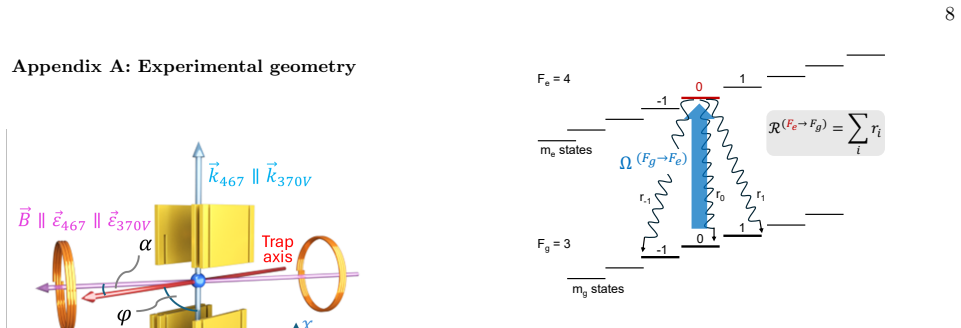
G. H. Gossel, V. A. Dzuba, and V. V. Flambaum, Calcu- lation of strongly forbidden M1 transitions and g -factor anomalies in atoms considered for parity-nonconservation measurements, Physical Review A88, 034501 (2013). 8 Appendix A: Experimental geometry FIG. 4. Experimental setup. A 173Yb+ ion (blue sphere) is trapped in a linear Paul trap. The red arrow...
work page 2013
-
[72]
Hyperfine-induced electric dipole (HFE1) We treat the hyperfine-induced electric dipole (HFE1) contribution as an effective E1 process. Since we useπ- polarized light, the Rabi frequency can be written as Ω(Fg→Fe) HFE1 = eE0 ℏ ⟨Fgmg,1,0|F eme⟩√2Fe + 1 ⟨Fe ∥ˆr∥Fg⟩,(B2) whereeis the elementary charge,E 0 is the electric field amplitude of the clock laser,⟨F...
-
[73]
The additional fac- tork 2 arises from second order spatial derivative of the laser’s electric field
Electric octupole (E3) For E3 transitions betweenm g = 0 andm e = 0 Zee- man substates, excited withπ-polarized light the Rabi 9 frequency is Ω(Fg→Fe) E3 = eE0 ℏ k2 30 ⟨Fg,0,3,0|F e,0⟩√2Fe + 1 ⟨Fe ∥ ˆO(r3)∥F g⟩, (B4) with ˆO(r3) the octupole operator. The additional fac- tork 2 arises from second order spatial derivative of the laser’s electric field. The...
-
[74]
1) We com- pared two sets of unquenched (pure E3) transitions using π-polarized light
and the experimentally determined effective tran- sition ratesR E1,eff, we performed three additional sets of measurements, summarized in Table III. 1) We com- pared two sets of unquenched (pure E3) transitions using π-polarized light. The measured Rabi frequency ratios agree with the calculated values, confirming the stabil- ity of the laser intensity an...
-
[75]
Measurement campaign at low¯n In our experiment, factors that could lead to ion tem- perature changes are 1) 370 nm laser power fluctuations and 2) the temperature-sensitive modulation depth of the EOM. To maintain a stable ion temperature dur- ing the measurement described in the main text, where decoherence times were determined, the experiment was cond...
-
[76]
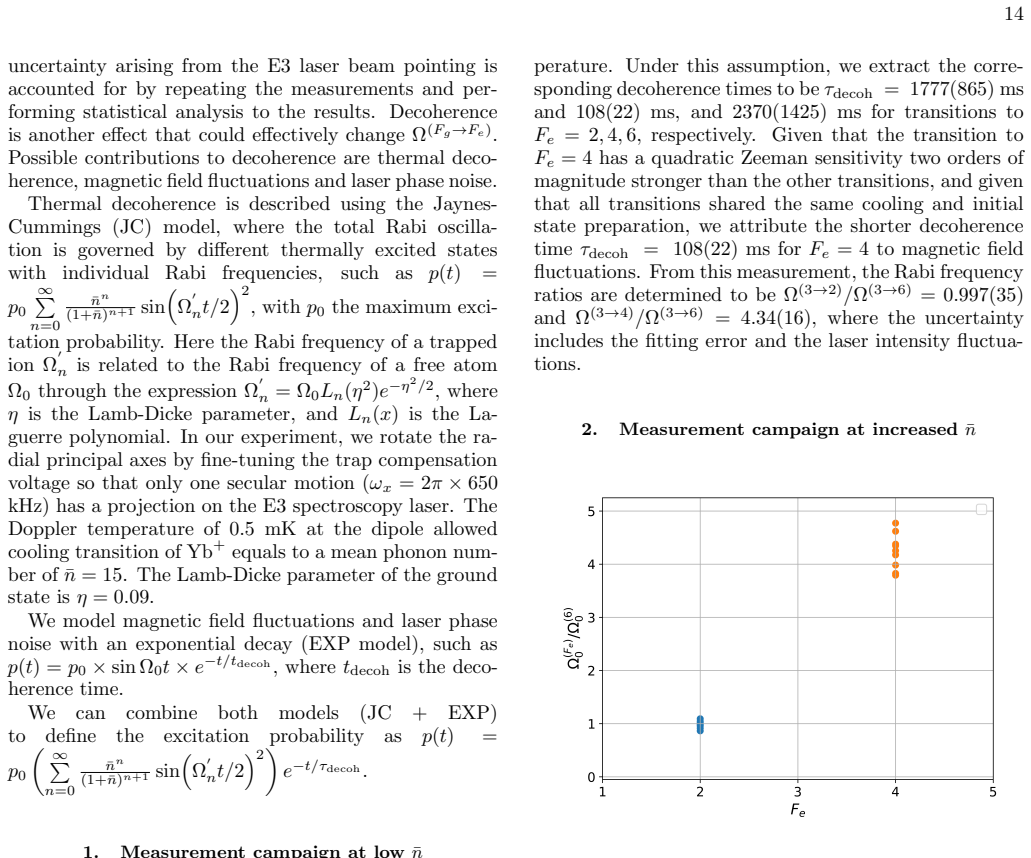
Measurement campaign at increased¯n FIG. 13. Rabi frequency ratio between the quenched tran- sition and the reference transition, determined from thermal dephasing model (JC). The error bars from the fit are not visible at this scale. To validate our model, we performed a second mea- surement campaign with increased ion temperature, achieved by a heating ...
discussion (0)
Sign in with ORCID, Apple, or X to comment. Anyone can read and Pith papers without signing in.