A Simple Construction of Lefschetz Fibrations on Compact Stein Surfaces
Pith reviewed 2026-05-17 01:42 UTC · model grok-4.3
The pith
Any compact Stein surface admits a positive allowable Lefschetz fibration over the disk with small-genus fiber via simple modifications of its 2-handlebody decomposition.
A machine-rendered reading of the paper's core claim, the machinery that carries it, and where it could break.
Core claim
We present a simple method for constructing a PALF from a 2-handlebody decomposition of any given compact Stein surface. Our method yields PALFs whose regular fibers have small genus, and it provides an alternative constructive proof that every compact Stein surface admits a PALF. We also define the minimal genus of a regular fiber of a PALF on the knot trace of a knot K with framing one less than its maximal Thurston-Bennequin number as an invariant of K. When the grid number of K is N, our construction produces a PALF whose regular fiber has genus at most (N-1)/2.
What carries the argument
Local modifications applied to the 2-handles that convert them into Lefschetz singularities while preserving positivity and allowability of the resulting fibration over the disk.
If this is right
- Every compact Stein surface admits a PALF over the disk.
- The genus of regular fibers in these PALFs is bounded above in terms of the grid number for knot traces.
- The minimal genus of the fiber serves as a well-defined invariant of the knot.
- The construction supplies an explicit method rather than a non-constructive existence argument alone.
Where Pith is reading between the lines
- The small-genus bound may allow explicit computation of the invariant for concrete knots and comparison with other knot invariants.
- The handle-modification technique could be tested on specific families of Stein surfaces to produce minimal examples.
- Similar local changes might be adapted to produce fibrations with additional constraints such as prescribed monodromy.
Load-bearing premise
Every compact Stein surface admits a 2-handlebody decomposition and the local modifications to create Lefschetz singularities preserve the Stein property along with the positivity and allowability conditions.
What would settle it
A compact Stein surface or knot trace for which no sequence of local handle modifications produces a valid positive allowable Lefschetz fibration would show the construction does not apply in general.
Figures




read the original abstract
Loi-Piergallini, Akbulut-Ozbagci, and Akbulut-Arikan showed that every compact Stein surface admits a positive allowable Lefschetz fibration over the disk $D^2$ with bounded fibers (PALF in short), and they provided constructions of PALF's corresponding to compact Stein surfaces. In this paper, we present a simple method for constructing a PALF from a 2-handlebody decomposition of any given compact Stein surface. Our method yields PALF's whose regular fibers have small genus, and it provides an alternative constructive proof of the above result. We also define the minimal genus of a regular fiber of a PALF on the knot trace of a knot $K$ with framing one less than its maximal Thurston-Bennequin number as an invariant of $K$. When the grid number of $K$ is $N$, our construction produces a PALF whose regular fiber has genus at most $(N - 1)/2$, showing that the defined invariant is bounded above by $(N - 1)/2$.
Editorial analysis
A structured set of objections, weighed in public.
Referee Report
Summary. The manuscript presents a simple explicit construction that converts a given 2-handlebody decomposition of any compact Stein surface into a positive allowable Lefschetz fibration (PALF) over the disk. The method proceeds by local replacements of 2-handles with positive Lefschetz singularities while preserving positivity of vanishing cycles, allowability, diffeomorphism type, and the Stein structure. It supplies an alternative proof of the existence of PALFs with bounded fibers and, for the knot trace of a knot K framed one less than its maximal Thurston-Bennequin number, defines the minimal regular-fiber genus of such a PALF as an invariant of K; when the grid number of K is N the construction yields a PALF whose fiber has genus at most (N-1)/2.
Significance. If the local replacement steps are verified, the paper supplies a concrete, handle-by-handle recipe that simplifies earlier constructions of Loi-Piergallini, Akbulut-Ozbagci and Akbulut-Arikan while producing PALFs with explicitly controlled fiber genus. The grid-number bound for the knot-trace invariant is a direct, falsifiable estimate that may be useful for comparing Stein-fillable knots with other 4-dimensional invariants. The step-by-step verification that each replacement preserves positivity, allowability and the Stein property is a technical strength.
minor comments (3)
- The statement of the genus bound in the abstract and introduction should explicitly reference the framing condition (one less than maximal Thurston-Bennequin number) to avoid ambiguity.
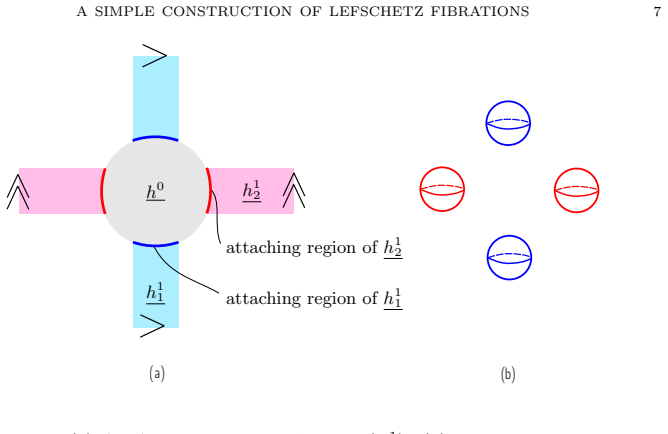
- Notation for the local replacement maps (e.g., how a 2-handle is turned into a positive Dehn twist) is introduced without a dedicated diagram or equation; adding a small illustrative figure in §3 would improve readability.
- The paper cites the classical existence results but does not compare the obtained fiber genera with those produced by the earlier constructions; a short remark or table would help situate the improvement.
Simulated Author's Rebuttal
We thank the referee for their positive assessment of the manuscript and for recommending minor revision. The report accurately summarizes our construction and its relation to prior work by Loi-Piergallini, Akbulut-Ozbagci, and Akbulut-Arikan, as well as the new invariant and grid-number bound. No specific major comments or criticisms appear in the report.
Circularity Check
No significant circularity
full rationale
The paper's core derivation starts from an independently supplied 2-handlebody decomposition of a compact Stein surface and applies explicit local replacements to produce a PALF, preserving positivity, allowability, and the Stein structure via the standard handle-to-Dehn-twist correspondence. The genus bound (N-1)/2 for grid diagrams of size N follows directly from counting the induced 2-handles in the construction, without any fitted parameters, self-definitional equations, or load-bearing self-citations. Prior existence theorems are cited from other authors solely for context and are not invoked to justify uniqueness or to close the argument. The new invariant is defined and then bounded from above by the construction; no step reduces the output to the input by construction or renames a known result as a derivation.
Axiom & Free-Parameter Ledger
axioms (2)
- domain assumption Every compact Stein surface admits a 2-handlebody decomposition.
- domain assumption Local handle modifications can be performed while preserving the Stein structure and the positivity/allowability of the resulting fibration.
Lean theorems connected to this paper
-
IndisputableMonolith/Foundation/AlexanderDuality.leanalexander_duality_circle_linking unclear?
unclearRelation between the paper passage and the cited Recognition theorem.
We present a simple method for constructing a PALF from a 2-handlebody decomposition... When the grid number of K is N, our construction produces a PALF whose regular fiber has genus at most (N-1)/2.
What do these tags mean?
- matches
- The paper's claim is directly supported by a theorem in the formal canon.
- supports
- The theorem supports part of the paper's argument, but the paper may add assumptions or extra steps.
- extends
- The paper goes beyond the formal theorem; the theorem is a base layer rather than the whole result.
- uses
- The paper appears to rely on the theorem as machinery.
- contradicts
- The paper's claim conflicts with a theorem or certificate in the canon.
- unclear
- Pith found a possible connection, but the passage is too broad, indirect, or ambiguous to say the theorem truly supports the claim.
Reference graph
Works this paper leans on
-
[1]
Firat Arikan,A note on Lefschetz fibrations on compact Stein 4-manifolds, Commun
[AA12] Selman Akbulut and M. Firat Arikan,A note on Lefschetz fibrations on compact Stein 4-manifolds, Commun. Contemp. Math.14(2012), no. 5, 1250035,
work page 2012
-
[2]
MR 2972525 [AO01] Selman Akbulut and Burak Ozbagci,Lefschetz fibrations on compact Stein surfaces, Geom. Topol.5(2001), 319–334. MR 1825664 [EF06] John B. Etnyre and Terry Fuller,Realizing 4-manifolds as achiral Lefschetz fibrations, Int. Math. Res. Not. (2006), Art. ID 70272,
work page 2001
-
[3]
MR 2219214 [Eli90] Yakov Eliashberg,Topological characterization of Stein manifolds of dimension>2, Internat. J. Math.1(1990), no. 1, 29–46. MR 1044658 [End21] Hisaaki Endo,Lefschetz fibrations [translation of 3675915], Sugaku Expositions34 (2021), no. 2, 175–204. MR 4327688 [Gom98] Robert E. Gompf,Handlebody construction of Stein surfaces, Ann. of Math. ...
work page 1990
-
[4]
MR 1707327 [Har79] John Lester Harer,PENCILS OF CURVES ON 4-MANIFOLDS, ProQuest LLC, Ann Arbor, MI, 1979, Thesis (Ph.D.)–University of California, Berkeley. MR 2628695 [LP01] Andrea Loi and Riccardo Piergallini,Compact Stein surfaces with boundary as branched covers ofB 4, Invent. Math.143(2001), no. 2, 325–348. MR 1835390 [NT09] Lenhard Ng and Dylan Thur...
work page 1979
-
[5]
MR 3381987 [Tan] Atsushi Tanaka,Lefschetz fibrations on knot traces of alternating knots and their ex- tensions, Preprint, to appear. [Uki] Takuya Ukida,Small genus positive allowable Lefschetz fibrations on compact Stein 4-manifolds, in preparation. [Uki16] ,A genus zero Lefschetz fibration on the Akbulut cork, Topology Appl.214 (2016), 127–136. MR 35710...
work page 2016
discussion (0)
Sign in with ORCID, Apple, or X to comment. Anyone can read and Pith papers without signing in.