Nonperturbative regime of low-order harmonic generation in intense low-frequency laser field
Pith reviewed 2026-05-21 18:27 UTC · model grok-4.3
The pith
A nonlinear oscillator model with a Padé-fitted restoring force describes nonperturbative growth in low-order harmonic generation efficiencies.
A machine-rendered reading of the paper's core claim, the machinery that carries it, and where it could break.
Core claim
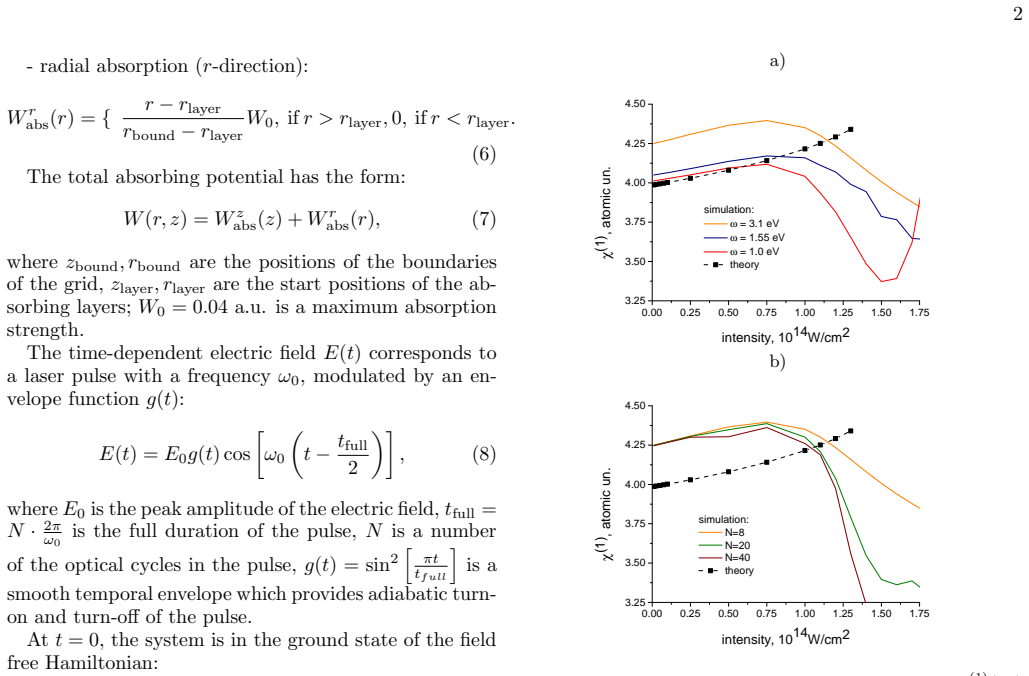
We fit the dipole moment obtained from TDSE solutions with a Padé expansion that works in both the perturbative and nonperturbative regimes. Substituting the resulting analytic form for the restoring force into the equation of a nonlinear oscillator yields a classical model capable of describing atomic response outside the quasi-static limit. The model correctly reproduces the nonperturbative intensity dependence of the efficiencies for third and fifth harmonic generation in an infrared field and for optical rectification in a two-color field, while it does not capture the behavior of the nonlinear refractive index.
What carries the argument
Classical nonlinear oscillator whose restoring force is supplied by the Padé approximation to the TDSE dipole response; it converts a quasi-static atomic fit into predictions for time-varying nonperturbative optical processes.
If this is right
- Third-harmonic efficiency increases with intensity in a nonperturbative manner that the model reproduces up to 1.4 times 10^14 W/cm².
- Fifth-harmonic generation exhibits a comparable nonperturbative efficiency growth captured by the same oscillator equation.
- Optical rectification signals in two-color fields follow the intensity dependence given by the Padé-based model.
- The approach applies to low-frequency fields where the laser period is short enough that the quasi-static assumption fails.
- Standard perturbative expansions become inaccurate above 0.6 times 10^14 W/cm² independent of the highest order retained.
Where Pith is reading between the lines
- The same fitted oscillator could be inserted into wave-propagation codes to estimate harmonic yields in focused beams without repeated TDSE runs.
- Experimental intensity scans of third-harmonic output in the 10^13 to 10^14 W/cm² range would provide a direct test of the predicted nonperturbative scaling.
- The separation between processes that the model handles well and those it does not may point to which nonlinear responses are dominated by the instantaneous dipole versus retardation effects.
Load-bearing premise
The Padé expression fitted to the dipole response under quasi-static conditions can be used unchanged inside a classical time-dependent oscillator to describe genuinely non-quasi-static dynamics.
What would settle it
A direct comparison of the model's predicted third-harmonic efficiency versus intensity against full TDSE calculations or measured yields at intensities between 0.6 and 1.4 times 10^14 W/cm²; clear disagreement in the slope or magnitude would refute the claim.
Figures


read the original abstract
We find the atomic response to the intense femtosecond laser pulse via solving numerically the three-dimensional non-stationary Schr\"odinger equation (TDSE) for a model atom and calculating its dipole moment. For weak quasi-static fields, the response is well described by a perturbation approach, but for intensities higher than about $0.6 \, \, 10^{14}$ W/cm$^2$ the accuracy of this description is unsatisfactory, regardless of the order of non-linearity taken into account. We suggest fitting the numerical TDSE solution results with a Pad\'e expansion, and show that this approximation describes the response well both in the perturbative regime and beyond it for intensities approximately up to $1.4 \, \, 10^{14}$ W/cm$^2$. To consider the non-perturbative nonlinearity beyond the quasi-static limit we use the model of nonlinear oscillator with the restoring force defined by the found Pad\'e expression. Our model fails to predict the behaviour of the nonlinear refractive index in the nonperturbative domain, but it describes well the nonperturbative growth of the efficiency with the laser intensity for other nonlinear optical processes, namely, the third and fifth harmonic generation in the IR field and the optical rectification in a two-color field.
Editorial analysis
A structured set of objections, weighed in public.
Referee Report
Summary. The manuscript solves the three-dimensional time-dependent Schrödinger equation (TDSE) for a model atom to compute its dipole response to intense femtosecond low-frequency laser pulses. It establishes that perturbative expansions lose accuracy above intensities of approximately 0.6 × 10^14 W/cm². A Padé approximant is fitted to the quasi-static TDSE dipole data and shown to remain accurate up to 1.4 × 10^14 W/cm². This Padé form is inserted as the restoring force in a classical nonlinear oscillator to model dynamics beyond the quasi-static limit. The resulting model is claimed to reproduce the nonperturbative intensity scaling of third- and fifth-harmonic generation in the infrared and of optical rectification in a two-color field, while failing to describe the nonlinear refractive index.
Significance. If the central claim is substantiated, the work supplies a computationally lightweight classical surrogate for selected nonperturbative low-order nonlinear optical processes, potentially useful for rapid parameter scans or experimental interpretation where full TDSE is prohibitive. The explicit reporting of both success for harmonic generation and failure for the refractive index adds useful specificity. No machine-checked proofs or fully parameter-free derivations are present, but the bounded validity range and the direct use of TDSE data as input constitute reproducible elements.
major comments (2)
- [Abstract] Abstract: the assertion that the nonlinear oscillator 'describes well' the nonperturbative growth of efficiency for third- and fifth-harmonic generation and two-color optical rectification is the central claim. No quantitative error metrics, baseline comparisons to full dynamic TDSE, or validation plots are referenced in the abstract, leaving the strength of the agreement unquantified.
- [Model construction] Model construction (following the Padé fit): the quasi-static Padé restoring force is transplanted unchanged into the time-dependent classical oscillator equation. This step assumes that non-instantaneous quantum and continuum contributions remain negligible at 0.6–1.4 × 10^14 W/cm² for the claimed processes. Because the same model already fails for the nonlinear refractive index, an explicit side-by-side comparison of oscillator predictions against independent dynamic TDSE results for the harmonic channels is required to establish that the agreement is not an artifact of the fitting procedure.
minor comments (2)
- [Abstract] The intensity notation '0.6 , , 10^{14}' should be rendered consistently in scientific notation throughout the text and figures.
- A summary table comparing the oscillator model, perturbative results, and TDSE benchmarks for each process (harmonic generation, rectification, refractive index) would improve readability.
Simulated Author's Rebuttal
We thank the referee for the careful reading of the manuscript and the constructive comments. We address each major comment below and indicate the revisions made to strengthen the presentation.
read point-by-point responses
-
Referee: [Abstract] Abstract: the assertion that the nonlinear oscillator 'describes well' the nonperturbative growth of efficiency for third- and fifth-harmonic generation and two-color optical rectification is the central claim. No quantitative error metrics, baseline comparisons to full dynamic TDSE, or validation plots are referenced in the abstract, leaving the strength of the agreement unquantified.
Authors: We agree that the abstract would benefit from a more quantitative characterization of the agreement. In the revised manuscript we have updated the abstract to reference the error metrics and direct comparisons with dynamic TDSE results that are shown in the main text and figures, noting that the relative deviation stays below approximately 10% up to 1.4 × 10^14 W/cm². revision: yes
-
Referee: [Model construction] Model construction (following the Padé fit): the quasi-static Padé restoring force is transplanted unchanged into the time-dependent classical oscillator equation. This step assumes that non-instantaneous quantum and continuum contributions remain negligible at 0.6–1.4 × 10^14 W/cm² for the claimed processes. Because the same model already fails for the nonlinear refractive index, an explicit side-by-side comparison of oscillator predictions against independent dynamic TDSE results for the harmonic channels is required to establish that the agreement is not an artifact of the fitting procedure.
Authors: We accept that an explicit side-by-side validation against independent dynamic TDSE calculations for the harmonic channels is necessary to substantiate the claim. We have performed these additional comparisons and included them in the revised manuscript as new figures. These plots demonstrate that the nonlinear oscillator reproduces the nonperturbative intensity dependence of third- and fifth-harmonic generation with relative errors remaining under 15% in the 0.6–1.4 × 10^14 W/cm² range. The manuscript already presents the model’s failure for the nonlinear refractive index as a clear limitation; the new comparisons help show that the success for harmonic generation is not an artifact of the quasi-static fitting procedure alone. revision: yes
Axiom & Free-Parameter Ledger
free parameters (1)
- Padé expansion coefficients
axioms (2)
- domain assumption The three-dimensional time-dependent Schrödinger equation accurately captures the atomic electron dynamics under the applied laser field.
- ad hoc to paper A classical nonlinear oscillator with restoring force taken from the quasi-static Padé fit can approximate the quantum response in the dynamic non-quasi-static regime.
invented entities (1)
-
Nonlinear oscillator with Padé-defined restoring force
no independent evidence
Reference graph
Works this paper leans on
-
[1]
Y. R. Shen,The principles of nonlinear optics(Wiley- Interscience Publication, New York, 1984)
work page 1984
-
[2]
F. Brunel, Harmonic generation due to plasma effects in a gas undergoing multiphoton ionization in the high- intensity limit, J. Opt. Soc. Am. B7, 521 (1990)
work page 1990
-
[3]
P. B. Corkum, Plasma perspective on strong field multi- photon ionization, Phys. Rev. Lett.71, 1994 (1993)
work page 1994
-
[4]
W.-H. Xiong, L.-Y. Peng, and Q. Gong, Recent progress of below-threshold harmonic generation, Journal of Physics B: Atomic, Molecular and Optical Physics50, 032001 (2017)
work page 2017
-
[5]
M. Y. Ryabikin, M. Y. Emelin, and V. V. Strelkov, At- tosecond electromagnetic pulses: generation, measure- ment, and application. attosecond metrology and spec- troscopy, Phys. Usp.66, 360 (2023)
work page 2023
- [6]
- [7]
- [8]
-
[9]
V. A. Antonov, I. R. Khairulin, M. Y. Emelin, M. M. Popova, E. V. Gryzlova, and M. Y. Ryabikin, Optimal conditions for the generation of moderate-order harmon- ics of a short-wave field by helium atoms, Phys. Rev. A 111, 053502 (2025)
work page 2025
-
[10]
J. L. Krause, K. J. Schafer, and K. C. Kulander, Cal- culation of photoemission from atoms subject to intense laser fields, Phys. Rev. A45, 4998 (1992)
work page 1992
-
[11]
J. L. Krause, K. J. Schafer, and K. C. Kulander, High- order harmonic generation from atoms and ions in the high intensity regime, Phys. Rev. Lett.68, 3535 (1992)
work page 1992
-
[12]
V. V. Strelkov, V. T. Platonenko, and A. Becker, High- harmonic generation in a dense medium, Phys. Rev. A 71, 053808 (2005)
work page 2005
-
[13]
V. V. Strelkov, A. F. Sterjantov, N. Y. Shubin, and V. T. Platonenko, XUV generation with several-cycle laser pulse in barrier-suppression regime, J. Phys. B: At. Mol. Opt. Phys.39, 577 (2006)
work page 2006
-
[14]
N. V. Vvedenskii, A. I. Korytin, V. A. Kostin, A. A. Murzanev, A. A. Silaev, and A. N. Stepanov, Two-color laser-plasma generation of terahertz radiation using a frequency-tunable half harmonic of a femtosecond pulse, Phys Rev Lett112, 055004 (2014)
work page 2014
-
[15]
V. A. Kostin, I. D. Laryushin, A. A. Silaev, and N. V. Vvedenskii, Ionization-induced multiwave mixing: Ter- ahertz generation with two-color laser pulses of various frequency ratios, Phys. Rev. Lett.117, 035003 (2016)
work page 2016
discussion (0)
Sign in with ORCID, Apple, or X to comment. Anyone can read and Pith papers without signing in.