REVIEW 2 major objections 2 minor 1 cited by
Core-halo scaling relations in self-interacting scalar field dark matter
T0 review · 2 major / 2 minor · reviewed 2026-05-17 · grok-4.3
Pith's one-line read Self-interactions make core-halo scaling relations in scalar field dark matter depend on interaction strength, sign, and halo evolutionary stage rather than being universal.
desk verdict Self-interactions in SFDM make core-halo scalings non-universal and dependent on interaction details and halo stage, though merger simulations raise questions about broader applicability. read the letter →
The pith
A machine-rendered reading of the paper's core claim, the machinery that carries it, and where it could break.
The reading
What carries the argument
Three-dimensional Gross-Pitaevskii-Poisson simulations of multiple soliton mergers that incorporate a constant scattering length to control the strength and sign of self-interaction and track core evolution inside forming halos.
What would settle it
A survey of galactic cores that finds mass-size-energy relations independent of any measurable proxy for interaction strength or halo age would falsify the claim that self-interactions control the scalings.
Extended reading notes
Core claim
Using three-dimensional Gross-Pitaevskii-Poisson simulations of multiple soliton mergers across repulsive and attractive regimes, the authors show that repulsive self-interactions yield more massive and extended cores with lower central densities than the free case, while attractive interactions increase central densities and drive collapse beyond a critical mass. The solitonic core mass-radius relation remains consistent with analytical predictions even when self-interactions are present, and the core-halo mass relation is extended accordingly. Scaling relations among core mass, size, and total energy are not universal but depend sensitively on self-interaction strength and sign as well as,
Load-bearing premise
That the outcomes of soliton-merger simulations with fixed scattering length in the Gross-Pitaevskii-Poisson system generalize to realistic cosmological halo assembly histories and that the analytical soliton solutions continue to hold when self-interactions are added.
Editorial extensions
If this is right
- Repulsive self-interactions produce more massive and extended cores with lower central densities than non-interacting fuzzy dark matter.
- Attractive self-interactions raise central densities and trigger core collapse once a critical mass threshold is crossed.
- The core mass-radius relation remains consistent with analytical soliton solutions across interaction regimes.
- The core-halo mass relation extends beyond the free fuzzy dark matter case when self-interactions are included.
- Self-interactions supply a natural regulator for core properties that affects supermassive black hole formation and galactic-core observables.
Reading between the lines
- Measurements of core densities and sizes in nearby galaxies could directly constrain the allowed range of self-interaction strengths.
- The reported dependence on evolutionary stage implies that recently assembled halos should exhibit systematically different core scalings than relaxed systems, offering a testable signature in large-scale simulations.
- Similar non-universal scalings may appear in other self-interacting dark matter models if soliton-like cores form, suggesting a broader class of regulated core structures.
Editorial analysis
A structured set of objections, weighed in public.
Referee Report
Summary. The paper uses three-dimensional Gross-Pitaevskii-Poisson simulations of multiple soliton mergers to study self-interacting scalar field dark matter halos across repulsive and attractive regimes. It reports that repulsive self-interactions produce more massive, extended cores with lower central densities while attractive interactions raise central densities and can trigger collapse above a critical mass; the mass-radius relation remains consistent with analytical soliton solutions; and core-halo scaling relations for mass, size, and total energy are non-universal, depending on interaction strength/sign and halo evolutionary stage.
Significance. If the central claims hold, the work demonstrates that self-interactions provide a tunable mechanism for regulating SFDM core properties, extending core-halo relations beyond the non-interacting fuzzy dark matter limit and offering implications for supermassive black hole seeding and galactic-core observables. The numerical confirmation of analytical mass-radius relations across interaction strengths is a concrete strength.
major comments (2)
- [Simulation setup and results sections] The central claim that scaling relations depend on evolutionary stage rests on discrete soliton-merger sequences. Because the simulations employ isolated initial conditions without continuous accretion or tidal fields, it is unclear whether the reported stage dependence generalizes to realistic cosmological assembly histories; this directly affects the load-bearing assertion that the relations are non-universal in a cosmologically relevant sense.
- [Results on mass-radius relation] The paper states that the mass-radius relation is 'well described by analytical predictions' even with self-interactions, yet no quantitative measure (e.g., fractional residuals, reduced chi-squared, or explicit comparison to the interaction-dependent soliton solution) is provided to substantiate the level of agreement across the scanned scattering lengths.
minor comments (2)
- [Throughout] Notation for the scattering length and its sign convention should be defined once in the methods and used consistently; occasional switches between 'positive' and 'repulsive' labels reduce clarity.
- [Figures showing scaling relations] Figure captions for the core-halo scaling plots should explicitly state the number of merger realizations per scattering length and whether error bars represent standard deviation across runs or fitting uncertainty.
Simulated Author's Rebuttal
We thank the referee for their constructive and detailed review of our manuscript. We have carefully considered each major comment and provide point-by-point responses below, along with the revisions we plan to implement.
read point-by-point responses
-
Referee: [Simulation setup and results sections] The central claim that scaling relations depend on evolutionary stage rests on discrete soliton-merger sequences. Because the simulations employ isolated initial conditions without continuous accretion or tidal fields, it is unclear whether the reported stage dependence generalizes to realistic cosmological assembly histories; this directly affects the load-bearing assertion that the relations are non-universal in a cosmologically relevant sense.
Authors: We agree that the simulations rely on isolated soliton-merger sequences with fixed initial conditions and lack continuous accretion or tidal fields. This controlled setup was chosen to isolate the effects of self-interactions on core-halo relations during successive mergers. We acknowledge that this does not fully capture the complexities of cosmological assembly histories. In the revised manuscript, we will add an expanded discussion of this limitation in the conclusions and methods sections, explicitly stating the scope of our claims regarding evolutionary-stage dependence and noting that future work with cosmological initial conditions would be valuable to test broader applicability. We maintain that the demonstrated non-universality within this regime remains a robust result. revision: yes
-
Referee: [Results on mass-radius relation] The paper states that the mass-radius relation is 'well described by analytical predictions' even with self-interactions, yet no quantitative measure (e.g., fractional residuals, reduced chi-squared, or explicit comparison to the interaction-dependent soliton solution) is provided to substantiate the level of agreement across the scanned scattering lengths.
Authors: We thank the referee for this observation. The manuscript includes visual comparisons between simulated core properties and analytical soliton solutions, but we did not include quantitative metrics such as residuals or goodness-of-fit measures. In the revised version, we will add explicit quantitative comparisons, including fractional residuals and root-mean-square deviations between the simulated mass-radius data and the interaction-dependent analytical predictions across the range of scattering lengths studied. These will be presented in a new figure or table in the results section to rigorously support the level of agreement. revision: yes
Circularity Check
No significant circularity; results from independent simulations
full rationale
The paper's central claims about non-universal core-halo scaling relations are obtained directly from three-dimensional Gross-Pitaevskii-Poisson simulations of soliton mergers across repulsive and attractive regimes. These numerical measurements of core mass, size, density, and energy as functions of scattering length and evolutionary stage constitute independent data rather than any fitted parameter, self-defined quantity, or reduction to prior inputs. The mention of confirming analytical mass-radius relations functions as a consistency check and does not serve as a load-bearing premise for the reported dependence on interaction strength, sign, or halo stage. No self-citation chain, ansatz smuggling, or renaming of known results is required to reach the primary conclusions, leaving the derivation self-contained.
Assumptions & free parameters
free parameters (1)
- scattering length
assumptions (1)
- standard math Dynamics of scalar field dark matter are governed by the Gross-Pitaevskii-Poisson equations with an additional self-interaction term proportional to scattering length
Cite this review
Pith. "Pith review of Core-halo scaling relations in self-interacting scalar field dark matter." pith.science (2026). https://pith.science/paper/2512.07020
@misc{pith2026251207020,
  author       = {Pith},
  title        = {Pith review of: Core-halo scaling relations in self-interacting scalar field dark matter},
  year         = {2026},
  howpublished = {\url{https://pith.science/paper/2512.07020}},
  note         = {Machine review of arXiv:2512.07020}
}
read the original abstract
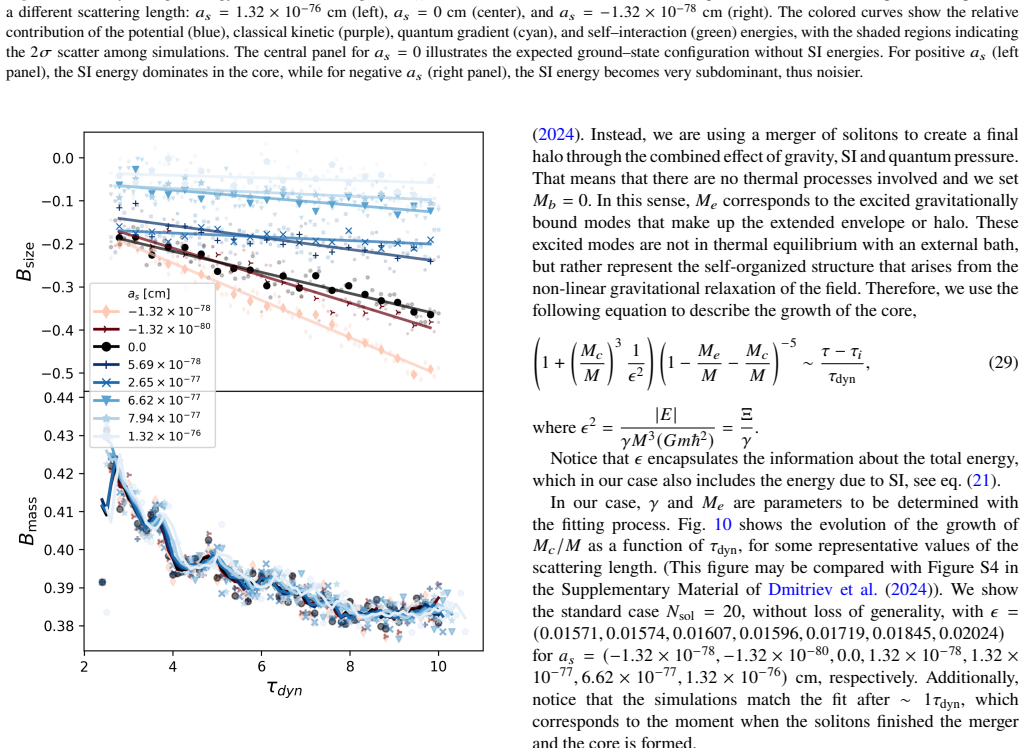
We study the impact of self-interactions on the structure and evolution of scalar field dark matter (SFDM) halos. Using three-dimensional Gross-Pitaevskii-Poisson simulations of multiple soliton mergers, we explore both repulsive and attractive regimes across a wide range of scattering lengths. Our results show that repulsive self-interactions lead to more massive and extended cores with lower central densities compared to the free (non-interacting) fuzzy dark matter case, while attractive interactions enhance central densities and can drive cores toward collapse, once a critical mass is exceeded. We confirm that the mass-radius relation of solitonic cores is well described by analytical predictions, even in the presence of self-interactions, and we extend the core-halo mass relation to scenarios beyond fuzzy dark matter. We find that the scaling relations between core mass, size, and total energy are not universal but depend sensitively on the strength and sign of the self-interaction, as well as on the evolutionary stage of the halo. These results demonstrate that self-interactions provide a natural mechanism to regulate core properties, with important implications for the formation of supermassive black holes and for potential astrophysical signatures in galactic cores.
Figures


Figures from the paper (7 more)



Forward citations
Cited by 1 Pith paper
-
Searching for signatures of fuzzy dark matter in cosmic filament profiles
Galaxy distributions around SDSS filaments are consistent with no periodicity and exclude A > 0.16 λ0 + 0.18 (0.2–2 Mpc) at 3σ in a simple cosine model of fuzzy-dark-matter interference.
Reference graph
Works this paper leans on
-
[1]
A., Van De Weygaert R., Jones B
Araya-Melo P. A., Van De Weygaert R., Jones B. J., 2009, Monthly Notices of the Royal Astronomical Society, 400, 1317 Avilez A. A., Bernal T., Padilla L. E., Matos T., 2018, MNRAS, 477, 3257 Banik N., Bovy J., Bertone G., Erkal D., De Boer T., 2021, Journal of Cos- mology and Astroparticle Physics, 2021, 043 BarN.,BlasD.,BlumK.,SibiryakovS.,2018,PhysicalR...
-
[2]
This paper has been typeset from a TEX/LATEX file prepared by the author. MNRAS000, 1–13 (2025)
work page 2025
Reviewed May 17, 2026 · model on record in the stance chip above.
Discussion (0). Continue with ORCID to comment.