REVIEW 3 major objections 6 minor 9 references
Enumeration of maps with the Dumitriu-Edelman model
T0 review · 3 major / 6 minor · reviewed 2026-08-03 · deepseek-v4-flash
Pith's one-line read The paper establishes a 1/N and β expansion of the β-ensemble cumulants whose coefficients are counts of vertex-labelled maps, with planar maps at leading order and maps on the projective plane at the next order.
desk verdict Strong new expansion of β-ensemble cumulants in labelled maps; the RP² bijection in Section 5 rests on a geometric lemma that is asserted, not proved. read the letter →
The pith
A machine-rendered reading of the paper's core claim, the machinery that carries it, and where it could break.
The reading
What carries the argument
The expansion's coefficients are carried by suitably labelled maps: maps whose vertices carry nonnegative labels with minimum 0 and |ℓ(v)−ℓ(w)|≤1 across every edge. Each non-local-minimum vertex contributes its distance from the local minima to an elementary symmetric polynomial; the sum over maps of this polynomial is the coefficient. The derivation uses the tridiagonal matrix model for the β-ensemble, whose moments become counts of Motzkin bridges with compatible permutations; cumulants impose transitivity of ⟨θ,σ⟩, selecting connected labelled hypermaps. A bijection from well-labelled hypermaps to suitably labelled maps turns the permutation data into vertex distances. For the subleading
What would settle it
Exhaustively enumerate all suitably labelled planar maps of small size (e.g. one face of length 4) and check whether every leftmost geodesic between the two minima satisfies Lemma 5.30 without interior label dips; a single counterexample would invalidate Theorem 5.43. Equivalently, compare #S2(θ) counted directly with (1+n/2−l) 2^{l−1} #M_{1/2}(θ) from the theorem for small θ and n.
Extended reading notes
Core claim
The paper's central claim is Theorem 1.2: for any partition n=(n_1,...,n_l) of n and any face profile θ, the joint cumulant κ_l(n) of the β-ensemble obeys (2/β)^{1-l} κ_l(n)/N^{n/2-l+2} = Σ_{v=0}^{n/2-l+1} N^{-v} Σ_{u+q+r=v} (2/β)^u (-1)^q B_r/(n/2-l+2-v) binom(r+n/2-l+1-v, r) ⟨e_q⟩_{θ,u+l-1}, where ⟨e_q⟩_{θ,p} is a sum over suitably labelled maps of the q-th elementary symmetric polynomial of the distances from the map's local minima. The proof passes through the tridiagonal model: moments of the matrix entries are read as Motzkin bridges decorated by permutations, cumulants select the connected pieces, and a known bijection between labelled hypermaps and suitably labelled maps converts the
Load-bearing premise
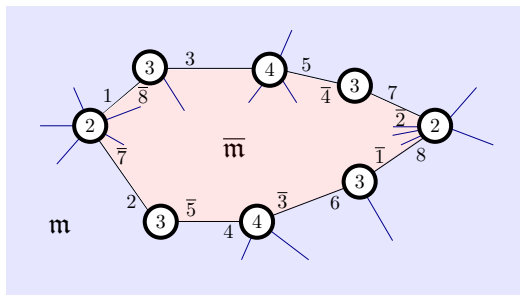
The entire projective-plane interpretation rests on Lemma 5.30: along the chosen segment of the leftmost geodesic between the two minima, the labels must form the exact symmetric tent min(ℓ(v°)+i, ℓ(v°)+#g̃−i), with no interior dip; the paper's proof is a single sentence and a dip would make the equilibrium loop fail to be good and break the 2^{c(θ)−1}-to-1 count.
Editorial extensions
If this is right
- For every β>0, the leading 1/N order of κ_l(n) is exactly the number of planar maps with face profile θ, recovering that planar map counts are universal in β.
- The first subleading order is the number of maps on the projective plane weighted by (2/β−1), so the GOE/GUE/GSE distinction (β=1,2,4) emerges from the β-dependence of the orientable-versus-non-orientable weight.
- At every order the coefficients are labelled-map distance statistics; an analytic handle on the cumulant expansion would give distance statistics of random planar maps with prescribed face profile.
- The 2^{c(θ)−1}-to-1 mapping of Theorem 5.43 gives a bijective bridge between orientable labelled maps with two minima and pointed maps on RP², so counts of the latter can be computed from the former.
- In the β→∞ limit, the expansion matches the known asymptotics of power sums of Hermite roots, recovering Catalan counts of planar trees and the Brownian-excursion area constant.
Reading between the lines
- Left implicit: the same slit-open/mirror-glue construction may apply at every order of the expansion, with higher-order coefficients counting maps on connected sums of projective planes; the paper only confirms the first two orders, so this is a conjecture.
- If the expansion can be computed analytically from known asymptotic analyses of tridiagonal matrices, the distance-statistics interpretation would yield new results on the distribution of distances in random planar maps with fixed face degrees — a direction the paper mentions but does not develop.
- The weight (2/β−1) in the subleading term suggests a natural interpolation: replacing β by a continuous parameter turns the expansion into a generating polynomial in non-orientability, analogous to b-deformations of map series studied elsewhere; this could give a new proof route for positivity of that polynomial.
Editorial analysis
A structured set of objections, weighed in public.
Referee Report
Summary. The paper derives an all-orders expansion in 1/N and β for the joint cumulants of power sums of the β-ensemble, using the Dumitriu–Edelman tridiagonal model. The coefficients are expressed as sums of elementary symmetric polynomials in distance labels of suitably labelled maps, via the Bouttier–Fusy–Guitter bijection. The first two orders of the expansion are identified with counts of planar maps and of maps on the projective plane, through a new many-to-one construction relating suitably labelled maps with two minima to maps on RP². The main expansion is obtained in Sections 2–4 from a Motzkin-path computation, a conjugation argument, and Faulhaber summation; the RP² interpretation is developed in Section 5.
Significance. If correct, the paper gives a new, parameter-free bridge between β-ensemble cumulants and labelled-map statistics, and a novel interpretation of the first subleading order in terms of maps on RP². The derivation is largely self-contained, uses no fitted quantities, and the leading-order recovery of planar map counts for all β>0 is a convincing check. The core expansion of Theorem 1.2 / Proposition 2.12 does not depend on the RP² section, so the main result is robust modulo the statement errors noted below. The RP² bijection is more fragile and needs a rigorous proof of its key lemmas.
major comments (3)
- [Theorem 1.2, Eq. (2)] The denominator in (2) is printed as N^{n/2+l-2}. Comparing with Proposition 2.12, where κ_l(n) = Σ ... N^{s+1} ..., and with eq. (15) and the leading-order computation in §4.2 (κ_l(n) ~ N^{n/2-l+2}), the denominator must be N^{n/2-l+2}. With the printed exponent, the left side is of order N^{2-2l} relative to the right side, so the statement is false as written. Please correct the exponent and check all displays for the same sign error.
- [Corollary 1.3] The subleading term inside the parenthesis is printed as (1/2^{1-l}) N (2/β - 1) #M_{1/2}(θ). This is of order N, while the leading term is O(1), so as written it would dominate the expansion. The proof at the end of §5.6 and the preceding computation give (1/(2^{l-1}N))(2/β - 1)#M_{1/2}(θ) = 2^{1-l}/N (2/β - 1)#M_{1/2}(θ). Please correct the statement: the factor N belongs in the denominator, not the numerator.
- [Lemma 5.30] The proof that the label sequence of g̃ equals min(ℓ(v°)+i, ℓ(v°)+#g̃-i) is a single sentence, 'as g̃ is a geodesic'. This is not a consequence of geodesy alone: a shortest path between two equal-label vertices can have label valleys or plateaus. Ruling these out requires using that every non-minimal vertex has a lower neighbour, that the map has exactly two local minima, and that v• is the unique other vertex of label ℓ(v°) on h̃; even then a length-comparison argument is needed. The same gap appears in Lemma 5.34, where the assertion that the maximum is attained only once or at two consecutive vertices is stated without proof. These lemmas feed into the slit-opening construction (§5.4) and the uniqueness of the equilibrium loop (§5.5.3), and hence into the 2^{c(θ)-1}-to-1 count of Theorem 5.43 and the RP² interpretation of Corollary 1.3. This is a load-bearing gap; please give a comple
minor comments (6)
- [Theorem 1.2 / Section 2] The paper uses n/2 in summation limits and map edge counts but never states that n must be even. Please state this explicitly in Theorem 1.2 and Proposition 2.12.
- [Lemma 5.17] The last sentence says 'As g is a good loop', but g is a good path, not a loop. Please correct.
- [Proof of Lemma 5.37] The displayed identity 'Note that #g_{u'}^{-} + #g_{u'}^{-} = #g_1 = #g_2' should read #g_{u'}^{-} + #g_{u'}^{+} = #g_1 = #g_2.
- [Abstract] Typo: 'in is study' should be 'in his study'.
- [Construction 5.16] The symbol \tildeφ is used both for the new face cycle and as a factor in φ'; define it explicitly as the single cycle (g_{2l-1} ... g_{2l}) and avoid the ambiguous notation.
- [Appendix A, Eq. (24)] The recurrence 'det(z - T^1_∞)' appears to have a typo in the index; please make the notation for T^N_∞ consistent.
Circularity Check
No circularity: the main expansion is derived from the independent Dumitriu–Edelman tridiagonal model and the Bouttier–Fusy–Guitter bijection, with no fitted parameter and no load-bearing self-citation.
full rationale
The derivation of Theorem 1.2 is self-contained and independent of the theorem it proves. The cumulant expansion is obtained by exact algebraic manipulation from Proposition 2.9, which is itself a direct computation of moments of the Dumitriu–Edelman tridiagonal model (Theorem 2.2), combined with the chi-distribution moment identity of Lemma 2.6 and Faulhaber's formula in (11). The coefficients are then re-expressed as sums over suitably labelled maps using the external Bouttier–Fusy–Guitter bijection (Theorem 3.17, cited to [BFG14]), not by defining the map statistics to match the cumulants. No quantity is fitted from the target expansion, and no 'prediction' is forced by construction. The first two orders are interpreted via Proposition 4.2 and Theorem 5.43, which are bijective combinatorial statements, not restatements of the cumulant formula. The many-to-one map to RP^2 maps is proved by explicit cutting-and-gluing constructions and does not rely on a self-citation; the cited uniqueness theorems (Lee 15.41/15.42, Edmonds, Tutte) are standard external results. There are no self-citations at all by the present author, so no self-citation chain props up the main claim. The one passage that deserves scrutiny, Lemma 5.30, asserts that the subpath g̃ of the leftmost geodesic has label sequence min(ℓ(v°)+i, ℓ(v°)+#g̃−i), with the single-sentence proof 'as g̃ is a geodesic.' This is a possible omitted-proof or correctness gap: a geodesic can in principle have label valleys without creating a new local minimum, and this tent property is load-bearing for Corollary 1.3's RP^2 interpretation. However, this is not circularity: it is an unproved geometric assertion, not an equivalence to the paper's inputs. The all-orders expansion (Theorem 1.2) does not depend on Section 5. The paper also explicitly notes in Section 4.2 that the mapping φ1, φ2 would need to be defined differently beyond the first sub-leading order, a scope limitation rather than a circular step. Overall, the claimed derivation does not reduce to its own definitions or to a fitted parameter.
Assumptions & free parameters
assumptions (6)
- domain assumption Dumitriu-Edelman tridiagonal model: the β-ensemble eigenvalues are the eigenvalues of T_N^β (Theorem 2.2)
- domain assumption Bouttier-Fusy-Guitter bijection between suitably labelled maps and well-labelled hypermaps (Theorem 3.17)
- domain assumption Labels in the BFG bijection equal corrected distances d_v = min_{v*} (d(v*,v)+ℓ(v*)) ([BFG14, Remark 1])
- standard math Standard facts about orientation double covers, Jordan-Schönflies, and cellular embeddings on non-orientable surfaces (Section 5.1-5.2)
- ad hoc to paper Transitivity preservation under conjugation by φ that preserves the cycles of θ
- standard math Faulhaber's formula and the Bernoulli number identity (3)
Cite this review
Pith. "Pith review of Enumeration of maps with the Dumitriu-Edelman model." pith.science (2026). https://pith.science/paper/DVNC6D3Z
@misc{pith2026251207753,
  author       = {Pith},
  title        = {Pith review of: Enumeration of maps with the Dumitriu-Edelman model},
  year         = {2026},
  howpublished = {\url{https://pith.science/paper/DVNC6D3Z}},
  note         = {Machine review of arXiv:2512.07753}
}
abstract
We give an expansion in $1/N$ and $\beta$ of the cumulants of power sums of the particles of the $\beta$-ensemble. This new expansion is obtained using the tridiagonal model of Dumitriu and Edelman. The coefficients of the expansion are expressed in terms of suitably labelled maps introduced by Bouttier, Fusy, and Guitter. Our expansion is of a different nature than the one obtained by LaCroix in is study of the $b$-conjecture of Goulden and Jackson, and involves only orientable maps. We are able to relate bijectively the first two orders of our expansion to the one of LaCroix using a novel many-to-one mapping that relates suitably labelled planar maps with two minima and maps on the projective plane.
Figures


Figures from the paper (11 more)




Reference graph
Works this paper leans on
-
[7]
Duality of Orthogonal and Symplectic Matrix Integrals and Quater- nionic Feynman Graphs
[MW03] M. Mulase and A. Waldron. “Duality of Orthogonal and Symplectic Matrix Integrals and Quater- nionic Feynman Graphs”. In:Communications in Mathematical Physics240.3 (2003), pp. 553–
2003
-
[26]
Matrix Models for Beta Ensembles
[DE02] I. Dumitriu and A. Edelman. “Matrix Models for Beta Ensembles”. In:Journal of Mathematical Physics43.11 (2002), pp. 5830–5847. [DGZ95] P. Di Francesco, P. Ginsparg, and J. Zinn-Justin. “2D Gravity and Random Matrices”. In:Physics Reports254.1–2 (1995), pp. 1–133. [Edm60] J. R. Edmonds. “A Combinatorial Representation for Polyhedral Surfaces”. In:No...
2002
-
[271]
On the Enumeration of Planar Maps
[Tut68] W. T. Tutte. “On the Enumeration of Planar Maps”. In:Bulletin of the American Mathematical Society74.1 (1968), pp. 64–75. [Tut84] W. T. Tutte.Graph Theory. Encyclopedia of Mathematics and Its Applications
1968
-
[586]
General Tridiagonal Random Matrix Models, Limiting Distributions and Fluctu- ations
[Pop09] Ionel Popescu. “General Tridiagonal Random Matrix Models, Limiting Distributions and Fluctu- ations”. In:Probability Theory and Related Fields144.1 (2009), pp. 179–220. [Tut63] W. T. Tutte. “A Census of Planar Maps”. In:Canadian Journal of Mathematics15 (1963), pp. 249–
2009
-
[646]
A Geometric Parametrization for the Virtual Euler Characteristics of the Moduli Spaces of Real and Complex Algebraic Curves
[GHJ01] I. P. Goulden, J. L. Harer, and D. M. Jackson. “A Geometric Parametrization for the Virtual Euler Characteristics of the Moduli Spaces of Real and Complex Algebraic Curves”. In:Transactions of the American Mathematical Society353.11 (2001), pp. 4405–4427. [GJ96] I. P. Goulden and D. M. Jackson. “Connection Coefficients, Matchings, Maps and Combina...
2001
-
[2001]
The Euler Characteristic of the Moduli Space of Curves
[HZ86] J. Harer and D. Zagier. “The Euler Characteristic of the Moduli Space of Curves”. In:Inventiones Mathematicae85.3 (1986), pp. 457–485. [Jac70] H. Jack. “A Class of Symmetric Polynomials with a Parameter”. In:Proceedings of the Royal Society of Edinburgh Section A: Mathematics69.1 (1970), pp. 1–18. [Jan07] S. Janson. “Brownian Excursion Area, Wright...
1986
-
[2010]
Planar Maps as Labeled Mobiles
[BDG04] J. Bouttier, P. Di Francesco, and E. Guitter. “Planar Maps as Labeled Mobiles”. In:The Electronic Journal of Combinatorics(2004), R69–R69. [BFG14] J. Bouttier, É. Fusy, and E. Guitter. “On the Two-Point Function of General Planar Maps and Hy- permaps”. In:Annales de l’Institut Henri Poincaré D, Combinatorics, Physics and their Interactions 1.3 (20...
2004
- [2014]
Show all 9 references
-
[2025]
Planar Diagrams
arXiv: 2512.03628 [math]. [Bré+78] E. Brézin et al. “Planar Diagrams”. In:Communications in Mathematical Physics59.1 (1978), pp. 35–51. [CD22] G. Chapuy and M. Dołęga. “Non-orientable branched coverings, b-Hurwitz numbers, and posi- tivity for multiparametric Jack expansions”....
1978 arXiv
Reviewed August 3, 2026 · model on record in the stance chip above.
Discussion (0). Continue with ORCID to comment.