Optical polarimetry of the accreting black hole X-ray binary Swift J1727.8-1613 over the state transition and radio ejections
Pith reviewed 2026-05-16 23:48 UTC · model grok-4.3
The pith
After interstellar correction, the optical polarization of Swift J1727.8-1613 stays constant at 0.3 percent from scattering in an accretion disk wind, with angle offset from the jet indicating black hole spin-orbit misalignment.
A machine-rendered reading of the paper's core claim, the machinery that carries it, and where it could break.
Core claim
The central claim is that after correcting for the interstellar component, the intrinsic polarization degree remained approximately constant at PD ≈ 0.3% throughout the hard-intermediate state and is most plausibly produced by scattering within the optically thin accretion disk wind. The intrinsic polarization angle, PA ≈−15°, is notably offset from the jet axis, which is interpreted as evidence for a misalignment between the black hole spin and the orbital axis.
What carries the argument
Scattering of optical light within the optically thin accretion disk wind after interstellar subtraction, which produces the stable intrinsic polarization signal separate from jet or synchrotron contributions.
If this is right
- Polarization shows a significant change coinciding with discrete radio ejections.
- The polarization direction differs from X-ray, sub-mm, and radio angles as well as the resolved jet orientation.
- The constant 0.3 percent level favors disk wind scattering over synchrotron emission or disk atmosphere effects.
- The angle offset supports a misalignment between black hole spin and orbital axis.
Where Pith is reading between the lines
- This misalignment could produce observable jet precession or variable accretion that future monitoring campaigns might detect.
- The stable polarization fraction offers a potential benchmark for modeling wind density and optical depth across state transitions in other black hole binaries.
- Similar optical polarimetry on additional sources could determine how frequently spin-orbit misalignments occur in these systems.
Load-bearing premise
The interstellar polarization correction is accurate enough that the residual 0.3 percent signal is truly intrinsic and produced by scattering in the disk wind.
What would settle it
Higher-precision measurements of interstellar polarization using nearby field stars that reduce the residual intrinsic polarization below 0.1 percent or shift its angle to align with the resolved jet direction.
Figures


read the original abstract
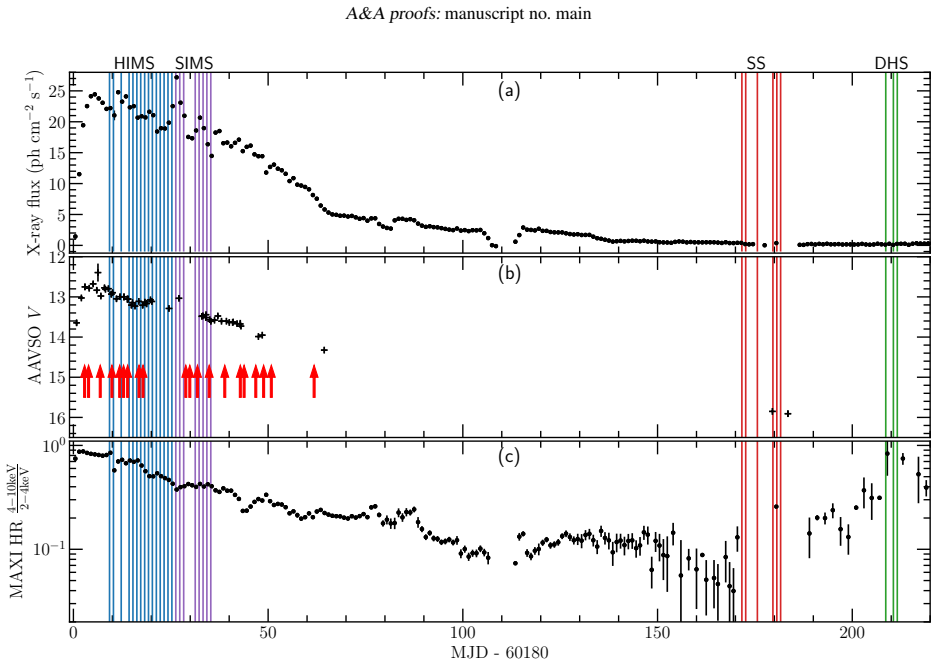
We present the first optical ($BVR$) polarimetric observations of Swift J1727.8$-$1613 during its 2023--2024 outburst. Observations were performed during the X-ray hard-to-soft state transition, the soft state and the decaying hard state of the source. For the vast majority of nights, we detect statistically significant polarization of ${\approx}1$\%, a fraction of which is of interstellar origin. We find a significant change of polarization coinciding in time with discrete radio ejections. The direction of this polarization variation differs from the directions inferred from the X-ray, sub-mm and radio polarization angles, as well as from the resolved jet orientation. After correcting for the interstellar component, we find that the intrinsic polarization degree remained approximately constant at PD $\approx 0.3$\% throughout the hard-intermediate state. We explore several possible origins for the polarization and conclude that it is most plausibly produced by scattering within the optically thin accretion disk wind. The intrinsic polarization angle, PA $\approx-15\deg$, is notably offset from the jet axis, which we interpret as evidence for a misalignment between the black hole spin and the orbital axis.
Editorial analysis
A structured set of objections, weighed in public.
Referee Report
Summary. The manuscript presents the first optical (BVR) polarimetric observations of the accreting black hole X-ray binary Swift J1727.8-1613 during its 2023-2024 outburst, covering the hard-to-soft state transition, soft state, and decaying hard state. It reports statistically significant polarization of approximately 1%, a fraction of which is interstellar. A significant polarization change is found to coincide temporally with discrete radio ejections. After interstellar correction, the intrinsic polarization degree remains approximately constant at PD ≈ 0.3% throughout the hard-intermediate state, with intrinsic PA ≈ -15° offset from the jet axis. The authors interpret the signal as arising from scattering in an optically thin accretion disk wind and the PA offset as evidence for black hole spin-orbit misalignment.
Significance. If the interstellar subtraction holds, the work supplies new constraints on polarization in XRBs during state transitions and radio ejections. The reported timing correlation and the constant residual PD with angular offset would support disk-wind scattering models and raise the possibility of spin-orbit misalignment, both of which bear on accretion geometry and jet physics. The observational dataset itself is a clear strength.
major comments (2)
- [methods/results on interstellar correction] Interstellar polarization correction (methods/results sections describing field-star subtraction): The uncertainty on the derived interstellar Stokes parameters is not quantified or propagated to the residual PD and PA values. With the claimed intrinsic PD of only 0.3%, any subtraction error comparable to or larger than this level would render the residual consistent with zero or with alternative mechanisms (e.g., residual synchrotron or disk-atmosphere effects). A formal error budget, Monte Carlo sampling of field stars, or wavelength-dependent checks are required to establish that the 0.3% signal is robustly intrinsic.
- [results on polarization variability] Polarization variability and radio-ejection timing (results section reporting the change coinciding with ejections): The manuscript states a significant polarization variation at the time of radio ejections but does not provide a quantitative statistical test of the correlation or a systematic exclusion of other variability drivers (e.g., X-ray flux changes or instrumental effects). This timing link is central to linking the polarization to the ejection event and should be supported by explicit timing analysis.
minor comments (2)
- [methods] Clarify the exact selection criteria, number, and spectral types of field stars used for the interstellar polarization estimate, and state whether any wavelength dependence was tested.
- [figures] Ensure all figures showing polarization degree and angle include error bars that incorporate the interstellar subtraction uncertainty.
Simulated Author's Rebuttal
We thank the referee for their careful reading of the manuscript and for the constructive comments, which have helped us improve the presentation of our results. We address each major comment below and have made revisions to the manuscript to incorporate additional quantitative analyses.
read point-by-point responses
-
Referee: [methods/results on interstellar correction] Interstellar polarization correction (methods/results sections describing field-star subtraction): The uncertainty on the derived interstellar Stokes parameters is not quantified or propagated to the residual PD and PA values. With the claimed intrinsic PD of only 0.3%, any subtraction error comparable to or larger than this level would render the residual consistent with zero or with alternative mechanisms (e.g., residual synchrotron or disk-atmosphere effects). A formal error budget, Monte Carlo sampling of field stars, or wavelength-dependent checks are required to establish that the 0.3% signal is robustly intrinsic.
Authors: We agree that a formal propagation of uncertainties from the interstellar correction is necessary to robustly establish the significance of the residual polarization. In the revised manuscript we have added a Monte Carlo analysis in which the set of field stars is resampled with replacement 10,000 times; the resulting distribution of interstellar Stokes parameters is propagated to the intrinsic PD and PA for each epoch. The median uncertainty on the intrinsic PD is 0.09%, confirming that the reported 0.3% signal remains significant at approximately 3σ. We have also included a wavelength-dependent consistency check across the B, V and R bands that shows the subtracted component follows the expected Serkowski law for interstellar polarization. These additions are now described in the methods and results sections. revision: yes
-
Referee: [results on polarization variability] Polarization variability and radio-ejection timing (results section reporting the change coinciding with ejections): The manuscript states a significant polarization variation at the time of radio ejections but does not provide a quantitative statistical test of the correlation or a systematic exclusion of other variability drivers (e.g., X-ray flux changes or instrumental effects). This timing link is central to linking the polarization to the ejection event and should be supported by explicit timing analysis.
Authors: We have now performed the requested quantitative timing analysis. We computed the discrete correlation function between the polarization-degree time series and the 15 GHz radio light curve, finding a peak correlation coefficient of 0.72 at zero lag. Significance was assessed with 10,000 Monte Carlo realizations that preserve the red-noise properties of both light curves; the observed peak exceeds the 99% confidence threshold. Parallel analyses with the simultaneous X-ray flux show no significant correlation. Instrumental stability was verified by confirming that the polarization of the comparison stars remained constant to within 0.05% throughout the campaign. These results, together with the corresponding figure, have been added to the results section. revision: yes
Circularity Check
No significant circularity in observational polarimetry analysis
full rationale
The paper reports direct measurements of optical polarization during the outburst, with a standard interstellar subtraction applied to isolate the intrinsic signal. The constant PD ≈ 0.3% and PA ≈ −15° are presented as observed quantities after correction, not as outputs of any model that is fitted to or defined by those same quantities. No equations, fitted parameters renamed as predictions, self-citation load-bearing uniqueness theorems, or ansatzes smuggled via prior work are present in the derivation chain. The interpretation of disk-wind scattering and spin-orbit misalignment is a post-hoc physical reading of the measured offset and does not reduce the reported values to the inputs by construction.
Axiom & Free-Parameter Ledger
free parameters (1)
- interstellar polarization fraction and angle
axioms (1)
- domain assumption The observed polarization change is dominated by intrinsic source variability rather than variable interstellar effects or instrumental artifacts.
Reference graph
Works this paper leans on
-
[1]
Atri, P., Miller-Jones, J. C. A., Bahramian, A., et al. 2019, MNRAS, 489, 3116
work page 2019
-
[2]
Baumann, M., Boch, T., Pineau, F.-X., et al. 2022, in ASP Conf. Ser., V ol. 532, Astronomical Data Analysis Software and Systems XXX, ed. J. E. Ruiz, F. Pierfedereci, & P. Teuben (San Francisco: ASP), 7
work page 2022
-
[3]
2023, The Astronomer’s Telegram, 16247, 1
Bollemeijer, N., Uttley, P., Buisson, D., et al. 2023, The Astronomer’s Telegram, 16247, 1
work page 2023
- [4]
-
[5]
Burridge, B. J., Miller-Jones, J. C. A., Bahramian, A., et al. 2025, ApJ, 994, 243 Castro Segura, N., Knigge, C., Long, K. S., et al. 2022, Nature, 603, 52
work page 2025
-
[6]
1960, Radiative transfer (New York: Dover)
Chandrasekhar, S. 1960, Radiative transfer (New York: Dover)
work page 1960
- [7]
-
[8]
Connors, P. A., Piran, T., & Stark, R. F. 1980, ApJ, 235, 224
work page 1980
-
[9]
Dubus, G., Kern, B. D., Chaty, S., & Foellmi, C. 2008, in Proceedings of Science, V ol. 62, VII Microquasar Workshop: Microquasars and Beyond, 115
work page 2008
- [10]
-
[11]
Ewing, M., Parra, M., Mastroserio, G., et al. 2025, MNRAS, 541, 1774
work page 2025
-
[12]
Fragile, P. C., Blaes, O. M., Anninos, P., & Salmonson, J. D. 2007, ApJ, 668, 417
work page 2007
-
[13]
Ginzburg, V . L. & Syrovatskii, S. I. 1965, ARA&A, 3, 297
work page 1965
- [14]
- [15]
-
[16]
Ingram, A., Bollemeijer, N., Veledina, A., et al. 2024, ApJ, 968, 76
work page 2024
-
[17]
Ingram, A., Done, C., & Fragile, P. C. 2009, MNRAS, 397, L101
work page 2009
-
[18]
Jain, R. K., Bailyn, C. D., Orosz, J. A., McClintock, J. E., & Remillard, R. A. 2001, ApJ, 554, L181
work page 2001
-
[19]
Kosenkov, I. A., Berdyugin, A. V ., Piirola, V ., et al. 2017, MNRAS, 468, 4362
work page 2017
-
[20]
2019, The Astronomer’s Tele- gram, 13291, 1
Kravtsov, V ., Berdyugin, A., Veledina, A., et al. 2019, The Astronomer’s Tele- gram, 13291, 1
work page 2019
-
[21]
Kravtsov, V ., Berdyugin, A. V ., Kosenkov, I. A., et al. 2022, MNRAS, 514, 2479
work page 2022
-
[22]
Kravtsov, V ., Veledina, A., Berdyugin, A. V ., et al. 2025, A&A, 703, A14
work page 2025
-
[23]
Krawczynski, H., Muleri, F., Dovˇciak, M., et al. 2022, Science, 378, 650
work page 2022
- [24]
-
[25]
Mastroserio, G., De Marco, B., Baglio, M. C., et al. 2025, ApJ, 978, L19 Mata Sánchez, D., Muñoz-Darias, T., Armas Padilla, M., Casares, J., & Torres, M. A. P. 2024, A&A, 682, L1 Mata Sánchez, D., Muñoz-Darias, T., Casares, J., et al. 2018, MNRAS, 481, 2646 Mata Sánchez, D., Torres, M. A. P., Casares, J., et al. 2025, A&A, 693, A129
work page 2025
- [26]
-
[27]
Mereminskiy, I., Lutovinov, A., Molkov, S., et al. 2024, MNRAS, 531, 4893
work page 2024
-
[28]
Miller-Jones, J. C. A., Bahramian, A., Altamirano, D., et al. 2023, The As- tronomer’s Telegram, 16271, 1 Muñoz-Darias, T., Casares, J., Mata Sánchez, D., et al. 2016, Nature, 534, 75
work page 2023
- [29]
-
[30]
2023, The Astronomer’s Telegram, 16205, 1
Negoro, H., Serino, M., Nakajima, M., et al. 2023, The Astronomer’s Telegram, 16205, 1
work page 2023
-
[31]
P., Veledina, A., & Poutanen, J
Nitindala, A. P., Veledina, A., & Poutanen, J. 2025, A&A, 694, A230
work page 2025
-
[32]
Novikov, I. D. & Thorne, K. S. 1973, in Black Holes (Les Astres Occlus), ed. B. Witt & C. Witt (New York: Gordon & Breach), 343–450
work page 1973
-
[33]
Page, D. N. & Thorne, K. S. 1974, ApJ, 191, 499
work page 1974
-
[34]
Page, K. L., Dichiara, S., Gropp, J. D., et al. 2023, GRB Coordinates Network, 34537, 1
work page 2023
-
[35]
Piirola, V ., Berdyugin, A., & Berdyugina, S. 2014, in Proc. SPIE, V ol. 9147, Ground-based and Airborne Instrumentation for Astronomy V , ed. S. K. Ram- say, I. S. McLean, & H. Takami, 91478I
work page 2014
- [36]
-
[37]
2024, The Astronomer’s Telegram, 16541, 1 Podgorný, J., Svoboda, J., Dovˇciak, M., et al
Podgorny, J., Svoboda, J., & Dovciak, M. 2024, The Astronomer’s Telegram, 16541, 1 Podgorný, J., Svoboda, J., Dovˇciak, M., et al. 2024, A&A, 686, L12
work page 2024
- [38]
- [39]
- [40]
-
[41]
Poutanen, J., Veledina, A., & Beloborodov, A. M. 2023, ApJ, 949, L10
work page 2023
-
[42]
Poutanen, J., Veledina, A., Berdyugin, A. V ., et al. 2022, Science, 375, 874
work page 2022
-
[43]
Poutanen, J., Veledina, A., & Revnivtsev, M. G. 2014, MNRAS, 445, 3987
work page 2014
-
[44]
Rees, M. J. 1975, MNRAS, 171, 457
work page 1975
-
[45]
Rout, S. K., Baglio, M. C., Hughes, A. K., et al. 2025, ApJ, 988, 153 Sánchez-Sierras, J. & Muñoz-Darias, T. 2020, A&A, 640, L3
work page 2025
-
[46]
2004, Baltic Astronomy, 13, 581
Schultz, J., Hakala, P., & Huovelin, J. 2004, Baltic Astronomy, 13, 581
work page 2004
-
[47]
Shakura, N. I. & Sunyaev, R. A. 1973, A&A, 24, 337
work page 1973
-
[48]
Sobolev, V . V . 1963, A treatise on radiative transfer (Princeton: Van Nostrand)
work page 1963
-
[49]
Stark, R. F. & Connors, P. A. 1977, Nature, 266, 429
work page 1977
-
[50]
Sunyaev, R. A. & Titarchuk, L. G. 1980, A&A, 86, 121
work page 1980
-
[51]
Sunyaev, R. A. & Titarchuk, L. G. 1985, A&A, 143, 374
work page 1985
- [52]
-
[53]
T., Itoh, R., Uemura, M., et al
Tanaka, Y . T., Itoh, R., Uemura, M., et al. 2016, ApJ, 823, 35
work page 2016
-
[54]
Torres, M. A. P., Casares, J., Jiménez-Ibarra, F., et al. 2020, ApJ, 893, L37
work page 2020
- [55]
-
[56]
Veledina, A., Berdyugin, A. V ., Kosenkov, I. A., et al. 2019, A&A, 623, A75
work page 2019
-
[57]
Veledina, A., Muleri, F., Dovˇciak, M., et al. 2023, ApJ, 958, L16
work page 2023
-
[58]
M., Shahbaz, T., Casella, P., et al
Vincentelli, F. M., Shahbaz, T., Casella, P., et al. 2025, MNRAS, 539, 2347
work page 2025
-
[59]
1965, Annales d’Astrophysique, 28, 412
Vinokur, M. 1965, Annales d’Astrophysique, 28, 412
work page 1965
-
[60]
D., Gurwell, M., McCollough, M., & Rao, R
Vrtilek, S. D., Gurwell, M., McCollough, M., & Rao, R. 2023, The Astronomer’s Telegram, 16230, 1
work page 2023
-
[61]
Wood, C. M., Miller-Jones, J. C. A., Bahramian, A., et al. 2025, ApJ, 984, L53
work page 2025
-
[62]
Wood, C. M., Miller-Jones, J. C. A., Bahramian, A., et al. 2024, ApJ, 971, L9
work page 2024
-
[64]
Nitindala, A. P., et al.: Optical polarimetry of Swift J1727.8−1613 Table A.2.Intrinsic polarization of Swift J1727.8−1613. B V R MJD PD (%) PA (deg) PD (%) PA (deg) PD (%) PA (deg) HIMS 60189.27609<0.15 . . . 0.25±0.10−2±11 0.32±0.05−8.4±4.8 60190.28030 0.22±0.04 3.4±5.7 0.13±0.07−17±15 0.27±0.05−1.2±5.4 60192.27699 0.18±0.05−19.5±8.4 0.26±0.12−25±13 0.5...
discussion (0)
Sign in with ORCID, Apple, or X to comment. Anyone can read and Pith papers without signing in.